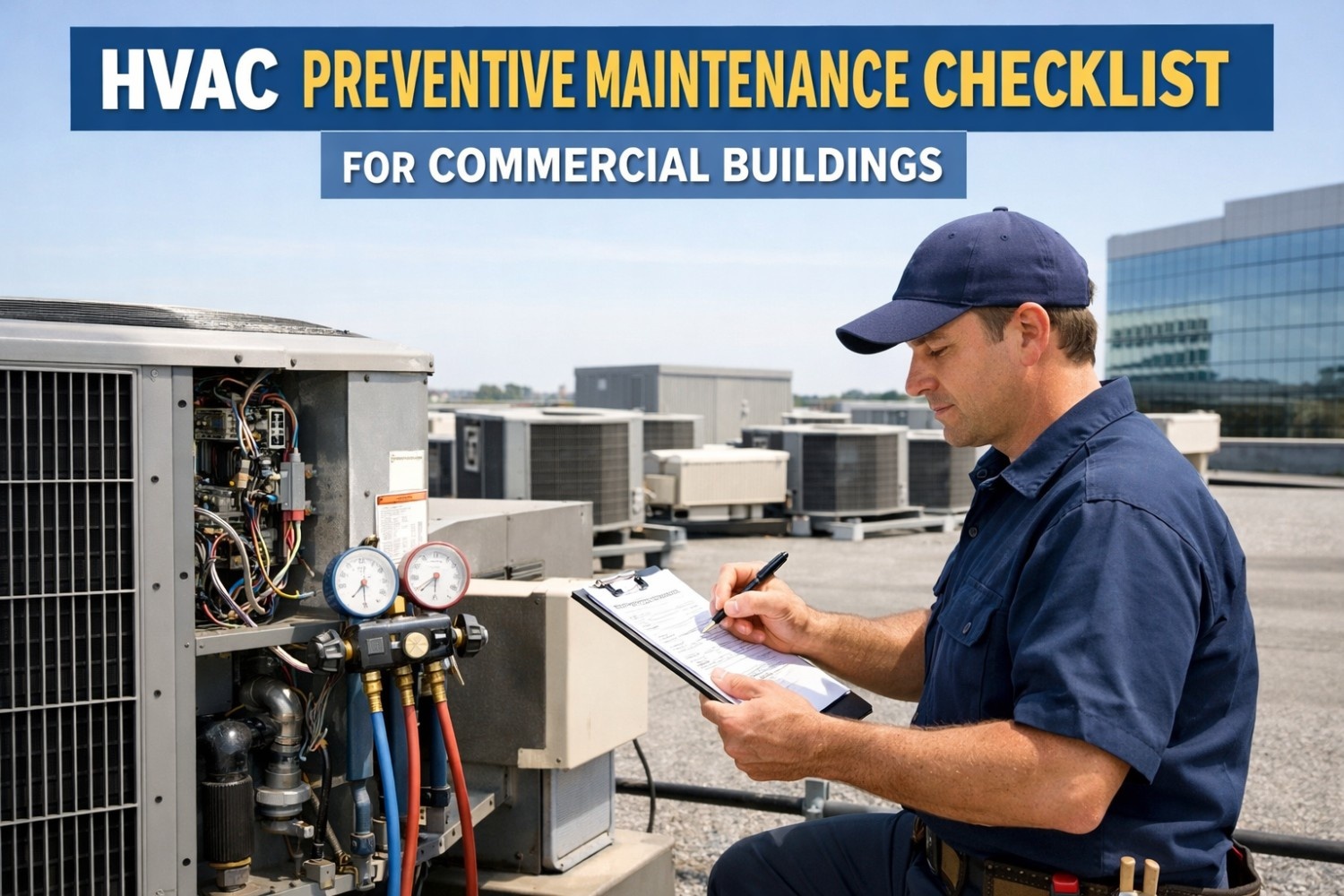
Commercial HVAC systems that skip preventive maintenance consume up to 20% more energy and fail years ahead of schedule — yet only 30% of facility managers schedule routine servicing. OxMaint's preventive maintenance platform converts this checklist into auto-scheduled digital work orders so nothing gets missed across air handlers, chillers, boilers, cooling towers, and controls — from monthly tasks to annual overhauls.
Equipment & Asset Management · PM Checklist
Complete HVAC Preventive Maintenance Checklist for Commercial Buildings
Monthly, quarterly, semi-annual, and annual PM tasks for every major commercial HVAC component — air handlers, chillers, boilers, cooling towers, ductwork, and controls — with assigned roles and documentation requirements.
20%
Energy wasted by poorly maintained HVAC systems
40%
Repair cost reduction from regular PM (US DOE)
5–10 yrs
Extra lifespan from structured maintenance programs
$4–6
Returned per $1 invested in preventive maintenance
PM Frequency Guide
What Gets Checked and When
Commercial HVAC preventive maintenance follows four frequency tiers. Monthly tasks protect consumables and catch early failure signals. Quarterly tasks address mechanical wear and refrigerant integrity. Semi-annual tasks prepare systems for seasonal peak loads. Annual tasks cover full overhauls, statutory certifications, and equipment-life assessments. Missing any tier forces reactive repairs — which cost 3 to 5 times more than scheduled PM and cause unplanned downtime.
Monthly
Filters, Belts & Visual Checks
Air filters, drain pans, thermostat operation, unusual noise or vibration — caught early, these prevent 60% of unplanned failures.
Quarterly
Coils, Refrigerant & Electrical
Coil cleaning, refrigerant pressure checks, electrical connection torque, and belt tension — the mechanical core of any PM programme.
Semi-Annual
Seasonal Readiness
Pre-cooling and pre-heating season preparations — full controls calibration, damper operation, and load testing before peak demand.
Annual
Full Overhaul & Certification
Boiler inspection certificates, cooling tower basin treatment, duct leakage assessment, and equipment life-cycle reporting.
Checklist
HVAC Preventive Maintenance Checklist by Component
Each item is structured with the PM frequency, responsible role, and documentation to capture. Digital execution in OxMaint attaches timestamped photos and technician sign-off to every task — the evidence needed for warranty compliance and regulatory audit.
A. Air Handling Units (AHUs)
Monthly · Quarterly · Annual
Inspect and replace air filters — check pressure differential across filter bank and replace when differential exceeds manufacturer specification; log filter MERV rating, condition on removal, and replacement date
Frequency: Monthly · Responsible: Maintenance Tech · Record: Filter change log with pressure readings
Inspect drive belts for cracking, glazing, and proper tension — measure belt deflection against manufacturer spec; replace any belt showing more than 50% wear or tension outside range
Frequency: Monthly · Responsible: Maintenance Tech · Record: Belt inspection form with tension measurements
Clean evaporator and cooling coils — inspect for fouling, scale, and biological growth; clean with approved coil cleaner and document condition before and after; fouled coils reduce efficiency by 5–15% per quarter
Frequency: Quarterly · Responsible: HVAC Technician · Record: Coil cleaning report with before/after photos
Inspect condensate drain pans and drain lines — flush drain lines with biocide treatment, check for standing water or algae growth, and verify float switch operation; blocked drains cause water damage and mold growth
Frequency: Quarterly · Responsible: Maintenance Tech · Record: Drain inspection log
Lubricate all motor and fan bearings using manufacturer-specified lubricant type and quantity — over-lubrication causes as many failures as under-lubrication; record grease type and quantity applied at each bearing point
Frequency: Semi-Annual · Responsible: HVAC Technician · Record: Lubrication log with bearing locations and grease quantity
Conduct full AHU performance test — measure supply and return air temperatures, static pressures, and airflow volumes; compare against design specifications and flag any unit operating more than 10% below design capacity
Frequency: Annual · Responsible: Commissioning Engineer · Record: AHU performance test report
B. Chillers
Monthly · Quarterly · Annual
Check refrigerant charge and operating pressures — record suction and discharge pressures, superheat, and subcooling at each inspection; abnormal readings indicate refrigerant loss, which triggers EPA Section 608 reporting obligations above threshold leak rates
Frequency: Monthly · Responsible: Certified Refrigeration Tech · Record: Refrigerant log with EPA tracking if applicable
Inspect oil level, oil pressure, and oil condition — draw oil sample for lab analysis quarterly; oil degradation precedes compressor bearing failure, which is the most expensive chiller repair at $15,000–$80,000 for large centrifugal units
Frequency: Quarterly · Responsible: HVAC Technician · Record: Oil analysis lab report
Inspect condenser tubes for fouling — measure approach temperature; a 1°F rise in approach temperature costs approximately 1–2% in chiller efficiency; tube cleaning frequency depends on water quality but should occur at minimum annually
Frequency: Semi-Annual · Responsible: HVAC Technician · Record: Condenser tube inspection and cleaning report
Conduct full chiller performance test — measure kW/ton efficiency against nameplate rating; chillers operating more than 15% below rated efficiency should be evaluated for refrigerant migration, tube fouling, or compressor wear
Frequency: Annual · Responsible: Commissioning Engineer · Record: Chiller efficiency report with trend data
C. Boilers
Monthly · Quarterly · Annual
Test low-water cutoff by manual float test or slow-drain method — low-water cutoff failure is the leading cause of boiler explosions; test must be performed monthly during heating season and documented with technician name and date
Frequency: Monthly · Responsible: Boiler Operator (licensed) · Record: Low-water cutoff test log
Test safety relief valve by lifting the test lever — verify valve reseats without leakage after test; a valve that weeps after testing must be replaced immediately; document test result and valve nameplate set pressure
Frequency: Monthly · Responsible: Boiler Operator (licensed) · Record: Safety valve test log
Analyse flue gas combustion efficiency — measure O2, CO2, CO, and stack temperature; adjust burner air-fuel ratio to achieve stack efficiency above 80%; a 1% improvement in combustion efficiency reduces fuel cost by approximately 1%
Frequency: Quarterly · Responsible: Licensed Burner Technician · Record: Combustion analysis report
Conduct annual boiler inspection by authorised inspector — required by ASME Boiler and Pressure Vessel Code and state regulations in most jurisdictions; inspection certificate must be posted on the boiler and a copy filed with the insurer
Frequency: Annual · Responsible: Authorised Inspector (third party) · Record: Boiler inspection certificate
D. Cooling Towers
Monthly · Quarterly · Annual
Test cooling tower water chemistry — measure pH (target 7.0–8.5), conductivity, hardness, and biological activity; inadequate water treatment allows Legionella growth, which triggers mandatory ASHRAE 188 water management programme requirements
Frequency: Monthly · Responsible: Water Treatment Specialist · Record: Water chemistry log with corrective chemical dosing
Inspect fill media, drift eliminators, and distribution nozzles — clean or replace blocked nozzles; degraded fill reduces thermal performance and creates areas of low-velocity water flow that accelerate biological growth
Frequency: Quarterly · Responsible: Maintenance Tech · Record: Tower inspection report with photo documentation
Perform full basin cleanout and disinfection — drain, degrease, and disinfect basin before seasonal startup; ASHRAE 188 and most local health codes require documented disinfection before first seasonal use each year
Frequency: Annual (seasonal startup) · Responsible: Water Treatment Specialist · Record: Disinfection log meeting ASHRAE 188
E. Ductwork and Air Distribution
Quarterly · Annual
Inspect accessible ductwork sections for duct leakage — tape, mastic, or sheet metal joint failures allow 20–30% of conditioned air to escape in typical commercial systems; visually inspect all accessible joints and seal any visible gaps
Frequency: Quarterly · Responsible: HVAC Technician · Record: Duct inspection report with repair log
Inspect and clean supply and return air grilles, diffusers, and registers — dust-blocked diffusers reduce air distribution uniformity; photograph before and after cleaning and note any grilles showing mold staining for IAQ follow-up
Frequency: Quarterly · Responsible: Maintenance Tech · Record: Grille cleaning log by zone
Verify damper operation — manually cycle all motorised outdoor air, mixing, and zone dampers through full travel range; a failed damper in the closed position can cause CO2 buildup; in the open position it wastes conditioning energy
Frequency: Semi-Annual · Responsible: Controls Technician · Record: Damper operation test log with positions verified
F. Controls and Thermostats
Monthly · Quarterly · Annual
Verify thermostat and room sensor calibration — compare sensor readings against a calibrated reference; a sensor reading 3°F high causes the system to undercool, directly increasing occupant complaints and energy use
Frequency: Monthly · Responsible: Controls Technician · Record: Sensor calibration log by zone
Review BAS (Building Automation System) alarm log — address all uncleared alarms; BAS systems in commercial buildings typically generate 30–50 alarms per week, many of which indicate equipment faults that are silently degrading efficiency
Frequency: Monthly · Responsible: Controls Technician · Record: BAS alarm review report with corrective action status
Test and verify all economiser controls — confirm outdoor air lockout setpoints are correctly programmed, economiser dampers respond to control signals, and free cooling mode activates at appropriate outdoor conditions
Frequency: Quarterly · Responsible: Controls Technician · Record: Economiser function test report
Conduct full controls commissioning review — verify all setpoints match current design intent, schedules reflect current occupancy patterns, and sequence of operations documentation is updated; outdated setpoints cause an average 10–15% energy waste in commercial buildings
Frequency: Annual · Responsible: Commissioning Engineer · Record: Controls commissioning report with setpoint register
Schedule every PM task on this checklist automatically. OxMaint assigns work orders, captures technician sign-off with photos, and tracks completion rates across every HVAC asset in your building.
PM Frequency Table
Task Frequency Quick Reference
| Component |
Monthly |
Quarterly |
Semi-Annual |
Annual |
| Air Handling Units |
Filters, Belts |
Coils, Drains |
Lubrication |
Performance Test |
| Chillers |
Refrigerant Check |
Oil Analysis |
Condenser Tubes |
Efficiency Report |
| Boilers |
Safety Valves, LWCO |
Combustion Analysis |
Burner Service |
Statutory Inspection |
| Cooling Towers |
Water Chemistry |
Fill Inspection |
— |
Basin Cleanout |
| Ductwork |
— |
Leakage, Grilles |
Damper Operation |
Full Survey |
| Controls & BAS |
Calibration, Alarms |
Economiser Test |
— |
Recommissioning |
Expert Review
What HVAC Professionals Say
The single biggest mistake I see in commercial buildings is treating HVAC PM as a cost rather than an investment. Every deferred filter change compounds — dirty filters force motors to work harder, which raises energy bills, increases bearing wear, and shortens the compressor's life. The ROI on a $30 filter change is measured in thousands.
Senior HVAC Commissioning Engineer
12 years, commercial and industrial facilities, US Southeast
Cooling tower water treatment is the most consistently under-managed task in commercial HVAC. Facilities skip the monthly water chemistry test because nothing seems wrong — until a Legionella concern or a failed chiller tube sends them into emergency mode. Documentation of regular testing is also your legal protection.
Water Treatment Specialist
ASHRAE 188 certified, 200+ commercial cooling tower programmes
BAS alarm fatigue is a real problem — buildings accumulate hundreds of uncleared alarms and technicians start ignoring them. A monthly alarm review that forces every open alarm to have an assigned corrective action is one of the highest-leverage maintenance activities a facility team can implement.
Building Controls Systems Manager
BMS/BAS integration specialist, 15+ years in large commercial portfolios
Cost vs Risk
Preventive vs Reactive: What the Numbers Show
The financial case for PM is unambiguous across every credible study. The table below compares PM vs reactive maintenance across the metrics that drive real facility budget decisions.
| Metric |
Preventive Maintenance |
Reactive Maintenance |
| Average equipment lifespan |
15–20 years |
10–12 years |
| Energy consumption |
Baseline (optimal) |
Up to 20% above baseline |
| Repair cost vs planned |
Scheduled, predictable |
3–5× higher per incident |
| After-hours emergency labour |
Rare |
$800–$1,500 per call |
| Annual cost reduction vs reactive |
8–12% lower total cost |
Baseline (highest cost) |
| System availability |
Near 100% (research: ~99.8%) |
Unpredictable downtime |
FAQs
Frequently Asked Questions
How often should commercial HVAC filters be replaced?
Replacement frequency depends on filter MERV rating, building occupancy, and air quality conditions. As a minimum, inspect filters monthly and replace when pressure differential across the filter bank exceeds the manufacturer's maximum. In high-occupancy commercial buildings, MERV 11–13 filters typically require replacement every 60–90 days. Never rely on a calendar schedule alone — pressure differential readings are the correct trigger.
OxMaint tracks filter replacement history and can trigger work orders based on logged pressure readings, not just elapsed time.
Is there a legal requirement to maintain cooling tower water treatment records?
Yes. ASHRAE Standard 188-2018 requires commercial cooling tower operators to maintain a documented Water Management Plan (WMP) with regular water chemistry test results, corrective action records, and disinfection logs. Many US states and cities have enacted local regulations that go beyond ASHRAE 188 — New York City's Local Law 77, for example, mandates quarterly inspections and annual certifications. Failure to maintain records is a compliance violation independent of whether Legionella is detected.
Book a demo to see how OxMaint manages recurring water treatment tasks and stores compliant records automatically.
What HVAC components require a licensed technician vs in-house maintenance staff?
Work involving refrigerant handling requires EPA Section 608 certification under the Clean Air Act — this applies to any technician adding, recovering, or checking refrigerant charge levels. Boiler work in most US states requires a licensed boiler operator or inspector. Combustion analysis, gas line work, and electrical panel work require licensed tradespeople. In-house staff can typically handle filter changes, belt inspections, visual checks, and minor cleaning tasks without specific licensure, but should be trained and documented as competent for those tasks.
OxMaint stores technician certifications and prevents assignment of regulated tasks to uncertified staff.
What is the annual boiler inspection requirement for commercial buildings?
In the United States, most states require annual inspection of commercial boilers by a licensed or authorised inspector under the ASME Boiler and Pressure Vessel Code. The inspection certificate must be posted on or near the boiler. Some states require more frequent inspections for high-pressure boilers. Failure to maintain a current inspection certificate is a statutory violation that can result in mandatory shutdown and fines. Annual inspections must be planned in advance since authorised inspectors are often booked months ahead.
See how OxMaint tracks statutory certificate expiry dates and sends automated renewal reminders.
Can OxMaint automate the scheduling of HVAC preventive maintenance work orders?
Yes. OxMaint allows facility teams to configure PM schedules at any frequency — daily, weekly, monthly, quarterly, seasonal, or annual — for each individual HVAC asset. Work orders auto-generate on schedule, are assigned to named technicians, and require photo evidence and sign-off for completion. All completed records are timestamped and searchable, giving you a full maintenance history per asset for warranty claims, insurance audits, and regulatory inspections.
Start free or
book a demo to configure your HVAC PM schedule.
Stop Managing HVAC PM on Spreadsheets
OxMaint auto-schedules every task in this checklist, assigns work orders to your team, and builds an audit-ready maintenance record across every HVAC asset — from a single rooftop unit to a full chiller plant.