Commercial buildings face an average of 4 to 7 regulatory inspections per year — and the majority of compliance failures are not caused by dangerous equipment. They are caused by missing documentation, inconsistent inspection schedules, and siloed records that inspectors reject on sight. Paper checklists get lost. Spreadsheets fall behind. And the same high-traffic areas get checked repeatedly while mechanical rooms, rooftops, and fire suppression systems go months without a visit. This guide gives facility managers a complete, equipment-specific inspection checklist framework for 2026 — covering generators, HVAC, fire systems, electrical panels, elevators, plumbing, and building envelope — with interval frequencies, acceptance criteria, and corrective action triggers for each system. If you want to run all of these checklists digitally with automated scheduling, mobile execution, and instant audit-ready reports, sign up for OxMaint free or book a live demo today.
Run Every Checklist Below Digitally — Mobile, Automated, and Audit-Ready from Day One.
OxMaint converts every inspection on this page into a digital, mobile-ready workflow with automated scheduling, photo documentation, deficiency-to-work-order conversion, and audit-ready reports generated in under 5 minutes.
Generator Inspection Checklist
Emergency generators must maintain reliability without daily use. A generator that fails during a power outage is worse than no generator — it creates a false sense of security. NFPA 110 mandates monthly load tests and annual full-load tests for Level 1 standby generators.
| Inspection Item | Acceptance Criteria | Frequency | Standard | Action if Failed |
|---|---|---|---|---|
| Load bank test — run at minimum 30% rated load | Stable output, no trips, voltage within ±5% of rated | Monthly | NFPA 110 | Schedule full-load test, notify facilities director |
| Fuel level and fuel quality check | Above 75% tank capacity, no microbial contamination | Monthly | NFPA 110 5.6 | Refuel immediately; fuel polishing if >12 months old |
| Coolant level, hoses, and belt condition | Full coolant, no cracks or weeping at hose connections | Monthly | OEM manual | Replace components; do not operate until resolved |
| Battery voltage and electrolyte level | Fully charged, electrolyte above plates, terminals clean | Monthly | NFPA 110 5.6.6 | Replace battery if voltage below 12.4V loaded |
| Automatic transfer switch (ATS) operation test | Transfer under 10 seconds for Level 1 — per NFPA 110 | Quarterly | NFPA 110 8.4 | ATS repair before next scheduled outage window |
| Full-load test at rated kW for minimum 2 hours | Stable output throughout, all parameters within spec | Annual | NFPA 110 8.4.2 | Engine overhaul assessment; report to owner |
| Oil and filter change per OEM service interval | Fresh oil at correct level, new filter installed and logged | Annual | OEM specification | Complete before next run test; document in CMMS |
| Exhaust system integrity and backpressure check | No leaks, backpressure within OEM limits, termination clear | Annual | NFPA 110 7.2 | Seal leaks immediately; CO risk if exhaust compromised |
HVAC System Inspection Checklist
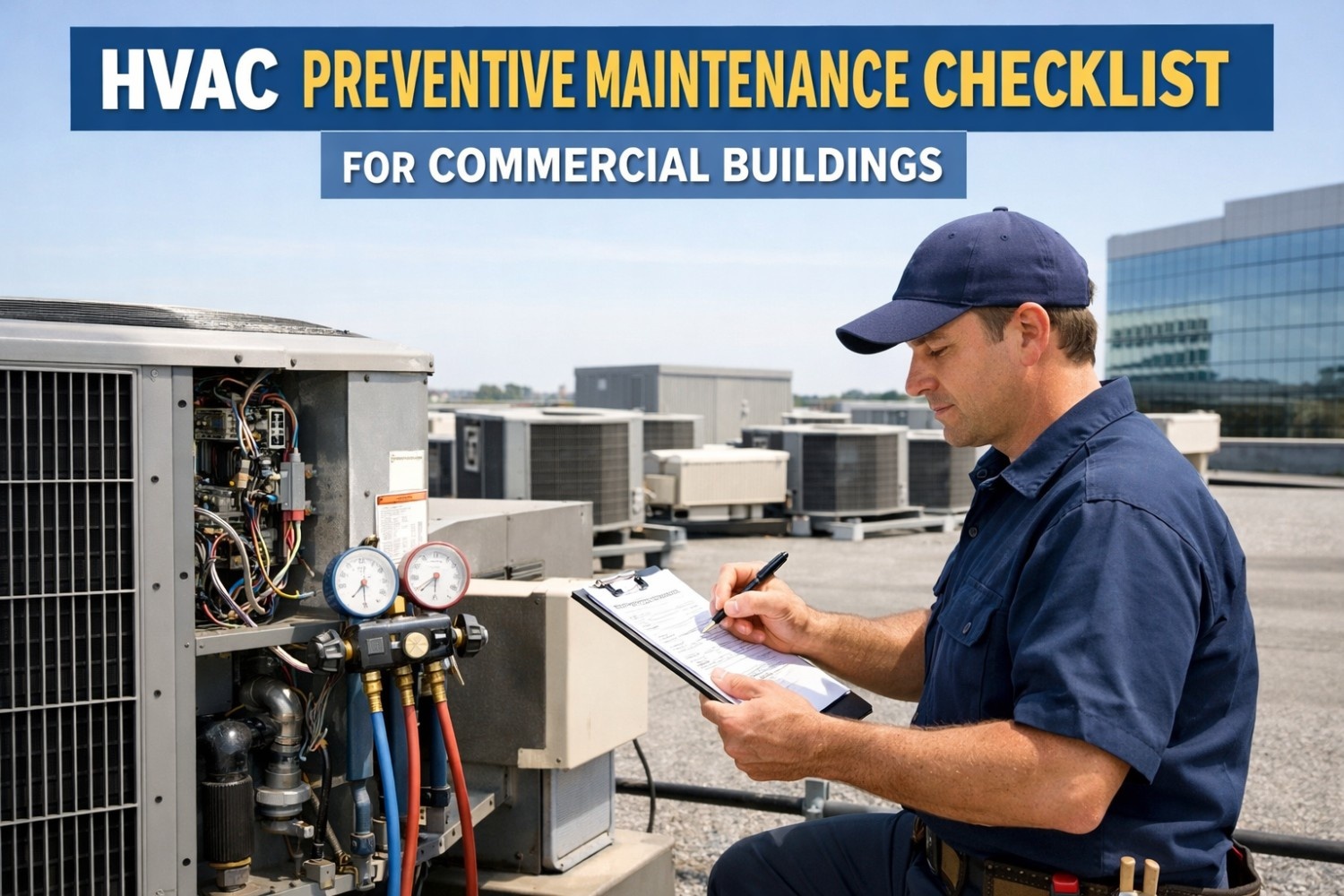
HVAC represents the largest energy cost in most commercial buildings — typically 40% of total energy spend. A 25-year-old chiller operating at 40% efficiency costs an extra $15,000 annually in electricity alone. ASHRAE 180 and local energy codes require documented inspection intervals for all commercial HVAC equipment.
| Inspection Item | Acceptance Criteria | Frequency | Standard | Action if Failed |
|---|---|---|---|---|
| Air filter condition and pressure differential | Pressure drop within manufacturer range; no bypass gaps | Monthly | ASHRAE 62.1 | Replace filter; check for housing bypass and seal |
| Condensate drain pan and drain line check | Pan dry or minimal condensate, drain flowing freely | Monthly | ASHRAE 180 | Clear blockage; bleach treatment to prevent mold growth |
| Thermostat calibration and zone control verification | Setpoints achieved within ±2°F in all served zones | Quarterly | ASHRAE 90.1 | Recalibrate sensor; check economizer damper control |
| Belt tension and bearing lubrication — air handlers | Belt deflection within spec; bearing temperature normal | Quarterly | OEM manual | Replace worn belts; re-lubricate or replace bearings |
| Refrigerant charge and leak detection | Charge within OEM tolerance; no detectable leak | Quarterly | EPA Section 608 | Locate and repair leak; recharge per EPA regulations only |
| Cooling tower water treatment and biological control | Biocide levels in range; no visible biofilm in basin | Monthly | ASHRAE 188 (Legionella) | Shock treatment; Legionella risk assessment if biofilm found |
| Chiller/boiler full performance test and efficiency rating | kW/ton or thermal efficiency within 10% of design rating | Annual | ASHRAE 180 | Tube cleaning; refrigerant optimization; CapEx flag if >15% off |
| Ductwork visual inspection for leakage and damage | No visible gaps, disconnects, or insulation deterioration | Annual | SMACNA | Seal leaks with mastic; re-insulate compromised sections |
Fire Safety System Inspection Checklist
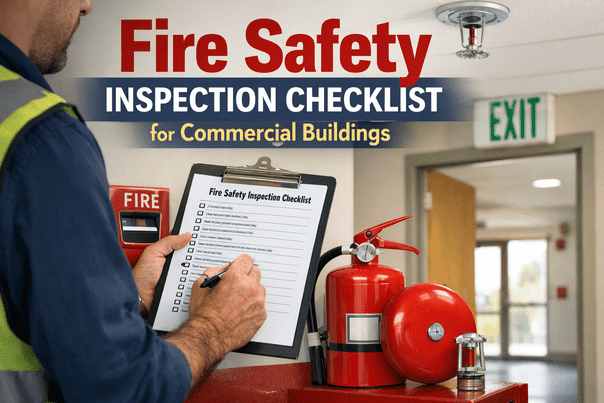
Fire system inspections are legally mandatory — not best practice. Fire code violations carry fines up to $10,000 per day and can force immediate building closure. NFPA 25, NFPA 72, and NFPA 10 govern inspection intervals for all fire suppression and detection equipment.
| Inspection Item | Acceptance Criteria | Frequency | Standard | Action if Failed |
|---|---|---|---|---|
| Sprinkler head visual inspection — no corrosion or damage | All heads undamaged, unobstructed, no paint or deposits | Quarterly | NFPA 25 5.2 | Replace damaged heads immediately; do not paint heads |
| Sprinkler system water flow test at inspector test valve | Flow triggers alarm within 90 seconds per NFPA 25 | Quarterly | NFPA 25 5.3.3 | Investigate alarm circuit; notify fire marshal if uncorrected |
| Fire alarm panel — test all initiating devices zone by zone | All devices respond within 20 seconds; no trouble indicators | Quarterly | NFPA 72 14.3 | Replace failed devices; document all trouble conditions |
| Portable fire extinguisher inspection — pressure and tag | Pressure needle in green zone; tag current within 12 months | Monthly | NFPA 10 6.2 | Service or replace immediately; no extinguisher to remain out of service |
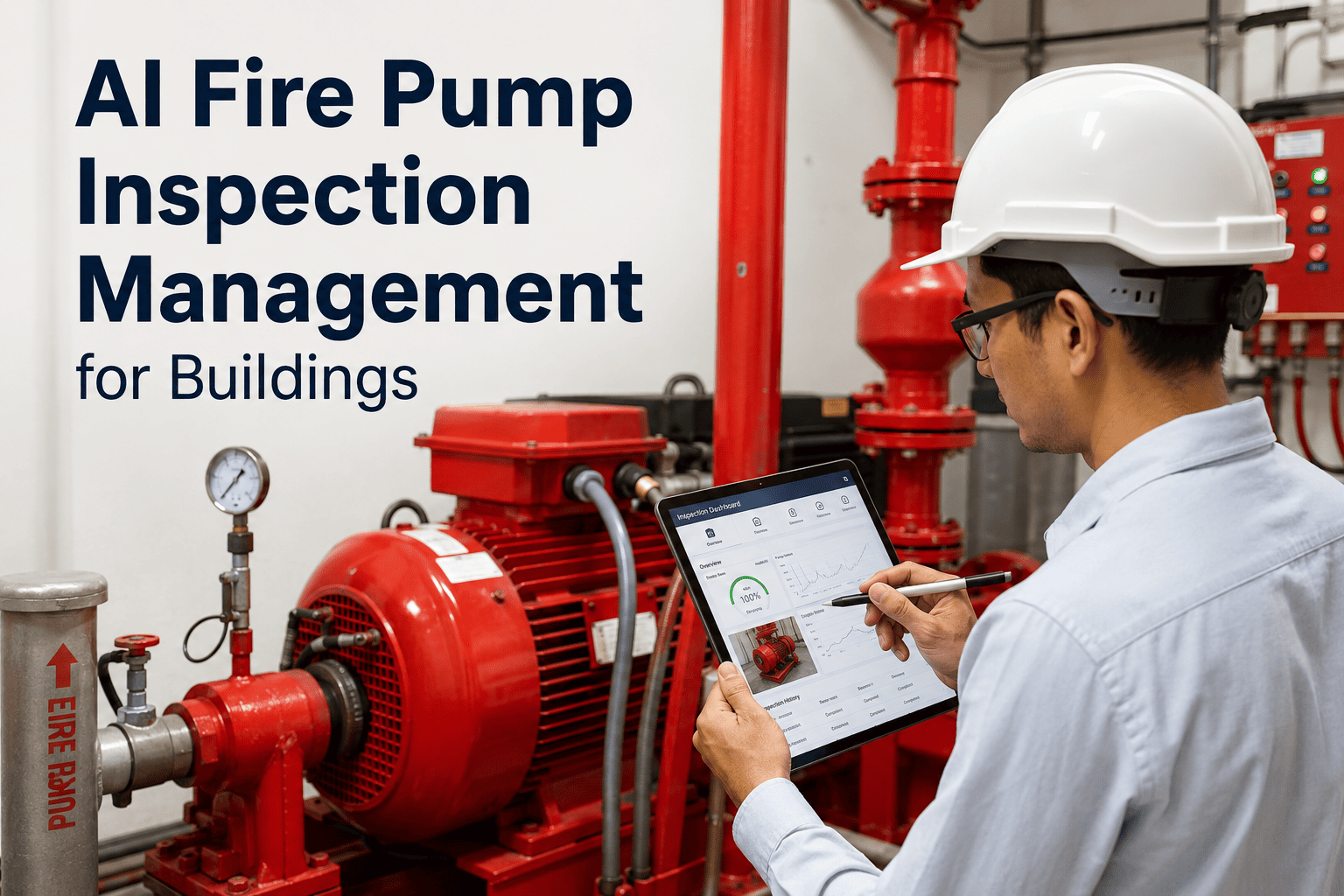
| Fire pump weekly churn test — no-flow start and run | Pump starts automatically; pressure at design flow; no alarms | Monthly | NFPA 25 8.3 | Investigate start failure immediately; notify AHJ within 24 hrs |
| Exit signs and emergency lighting — battery backup test | All signs illuminated; battery backup maintains 90 minutes | Monthly | NFPA 101 7.9 | Replace battery or lamp immediately; mark deficient unit |
| Fire door — swing, latch, and self-closing function test | Closes fully from open position; latch engages without manual assist | Annual | NFPA 80 | Adjust closer; repair or replace door; document findings |
| Full fire alarm and suppression system annual test with AHJ | All devices test satisfactory; certificate issued by licensed contractor | Annual | NFPA 72 / NFPA 25 | Correct all deficiencies before certificate is issued |
Electrical Panel and Distribution Inspection Checklist
Electrical system failures cause 13% of all commercial building fires. A warehouse in Atlanta discovered outdated Federal Pacific panels with a $30,000 immediate replacement requirement during a routine inspection. NFPA 70B and local NEC adoption require documented electrical inspection at mandated intervals.
| Inspection Item | Acceptance Criteria | Frequency | Standard | Action if Failed |
|---|---|---|---|---|
| Panel exterior — no heat discoloration, seals intact | No discoloration, warm spots, or unusual odor at panel | Monthly | NFPA 70B | Thermographic scan immediately; isolate circuit if hot |
| Circuit breaker trip test — manual operation check | All breakers trip and reset cleanly within spec | Quarterly | NFPA 70B 11.3 | Replace any breaker that fails to trip; document serial number |
| Thermographic scan of all panels and switchgear | No point above ambient + 10°C; no overloaded connections | Annual | NFPA 70B / NETA | Torque loose connections; replace overloaded components |
| GFCI and AFCI outlet test — all wet area and bedroom circuits | Test button trips; reset restores power; no nuisance tripping | Quarterly | NEC 210.8 / 210.12 | Replace GFCI/AFCI outlet; log location and date |
| Emergency and standby system transfer panel inspection | All connections torqued; no corrosion at terminals; ATS test pass | Quarterly | NFPA 110 / NEC 700 | Clean corroded terminals; retorque to spec; re-test ATS |
| Grounding and bonding continuity test | Resistance below 5 ohms at all verified points | Annual | NEC 250 | Install supplemental ground; consult licensed electrician |
| Switchgear insulation resistance testing (megger test) | Minimum 1 megohm per 1kV of operating voltage | Annual | NETA MTS | Schedule switchgear maintenance before next operating season |
| UPS system battery capacity and bypass test | Full runtime at design load; bypass transfer clean with no gap | Quarterly | IEEE 1188 | Replace battery strings below 80% capacity; test bypass path |
Elevator and Vertical Transportation Inspection Checklist
Elevator inspections are mandatory under ASME A17.1 and require annual certification from a licensed inspector in all US jurisdictions. Operating an elevator with an expired inspection certificate exposes ownership to immediate shutdown orders and liability.
| Inspection Item | Acceptance Criteria | Frequency | Standard | Action if Failed |
|---|---|---|---|---|
| Monthly safety device test — safeties, interlocks, buffers | All safety devices function as designed; no bypasses in place | Monthly | ASME A17.1 8.6 | Take elevator out of service immediately; notify AHJ |
| Door operation — opening force and reversal sensitivity | Maximum 30 lb opening force; reversal within 2 inches of contact | Monthly | ASME A17.1 2.1.3 | Adjust door operator; replace worn sensor strips |
| Machine room temperature and ventilation check | Temperature between 50°F and 90°F; no moisture or standing water | Monthly | ASME A17.1 2.7 | Restore HVAC to machine room; dehumidify if moisture present |
| Hydraulic fluid level and cylinder integrity | Fluid at operating level; no seepage at cylinder or fittings | Quarterly | ASME A17.1 3.19 | Top up fluid; inspect cylinder for pitting; notify AHJ if leaking |
| Full annual inspection — all code-required tests by licensed inspector | Certificate of inspection issued with no open violations | Annual | ASME A17.1 / State code | Correct all violations before certificate issuance; post in cab |
| Governor and safety gear test — full-speed overspeed trip | Governor trips at rated overspeed; car stops within spec distance | Annual | ASME A17.1 2.17 | Take out of service; recalibrate or replace governor |
Plumbing and Water Systems Inspection Checklist
Legionella risk management under ASHRAE 188 is a legal obligation for commercial buildings with cooling towers, hot water systems, or decorative water features. Water damage from undetected leaks remains one of the top five causes of commercial property insurance claims annually.
| Inspection Item | Acceptance Criteria | Frequency | Standard | Action if Failed |
|---|---|---|---|---|
| Hot water system temperature — Legionella control range | Storage above 140°F; distribution above 122°F at far fixtures | Monthly | ASHRAE 188 | Adjust water heater setpoint; flush stagnant dead legs |
| Backflow preventer test — all devices on potable system | All devices pass differential pressure test per local code | Annual | USC FCCC model codes | Repair or replace failed device; notify water authority |
| Building static water pressure check at multiple floors | 40–80 PSI at all floor levels; no sustained drops below 35 PSI | Quarterly | Local plumbing code | Inspect PRV; check booster pump if pressure inadequate |
| Visual pipe inspection — all accessible risers and chases | No corrosion, condensation accumulation, or joint weeping | Quarterly | IAPMO UPC | Treat exposed corrosion; isolate actively leaking sections |
| Floor drain flow test — all mechanical rooms and restrooms | Free-flowing drain; trap seal intact; no sewer gas odor | Quarterly | Local code | Clear blockage; prime trap; inspect trap primer operation |
| Water meter and sub-meter accuracy verification | Metered consumption within 2% of check measurement | Annual | AWWA standards | Recalibrate or replace meter; investigate billing discrepancy |
What Happens When Facilities Use Digital Inspection Management
The gap between paper-based and digital inspection programs is measurable at every point in the compliance cycle — from completion rates to audit outcomes to corrective action speed.
Frequently Asked Questions
How often are commercial facility equipment inspections legally required?
Inspection frequency requirements vary by system and jurisdiction, but general industry standards are well-established. HVAC and fire safety systems require monthly checks for critical items and quarterly for full system tests. Elevators require annual certification from a licensed inspector in all US jurisdictions. Electrical panels benefit from quarterly visual checks with annual thermographic scans under NFPA 70B. Plumbing hot water systems require monthly temperature verification for Legionella compliance under ASHRAE 188. Most commercial insurance policies require documented quarterly inspections as a policy condition, with annual certifications for fire and elevator systems. The safest approach is to treat every code-mandated interval as a minimum — best-practice facilities exceed these intervals for critical life safety systems. Sign up for OxMaint free to auto-schedule every inspection at the correct interval for your jurisdiction, or book a demo to see compliance scheduling in action.
What are the most common causes of commercial building inspection failures?
Research consistently shows that 66% of commercial building code violations originate from documentation gaps — not actual equipment failures or safety deficiencies. The most common failure patterns are: expired inspection certificates (elevators and fire systems most frequently), missing corrective action documentation for previously identified deficiencies, fire doors that passed swing tests but have adjacent wall penetrations from tenant improvements that were never re-inspected, backflow preventers without current test certificates, and GFCI outlets that were flagged but never replaced. The underlying cause is almost always the same: paper or spreadsheet tracking systems that cannot enforce completion, cannot link deficiencies to corrective actions, and cannot surface compliance gaps until an inspector finds them. Digital inspection management eliminates all of these failure patterns. Book a demo to see how OxMaint prevents each of these failure modes, or start free today.
How does a CMMS improve facility equipment inspection outcomes?
A CMMS transforms inspections from inconsistent manual events into standardized, trackable digital workflows across five dimensions. First, automated scheduling ensures every inspection runs at the correct interval — no interval is missed because a technician forgot or a calendar reminder was ignored. Second, mobile execution with mandatory field completion means inspectors cannot skip checklist items or submit incomplete records. Third, photo documentation at the point of inspection provides the visual evidence that insurance underwriters and regulatory auditors require. Fourth, automatic work order generation when deficiencies are flagged closes the gap between finding an issue and addressing it — the most common compliance failure mode. Fifth, portfolio-level dashboards give facility directors real-time visibility into compliance status across every property without waiting for weekly reports. The result is a 99.2% inspection completion rate versus under 70% on paper systems, and near-100% audit pass rates versus 34% for manual tracking. Sign up for OxMaint free — no credit card, operational in days.
Can OxMaint manage inspection compliance across multiple buildings or a property portfolio?
Yes. OxMaint is built as a multi-site platform from the ground up — a single deployment covers your entire facility portfolio from one dashboard, with building-specific inspection templates, intervals, and compliance requirements configured per property. Each building can have its own inspection schedules, regulatory documentation templates, and escalation rules, while portfolio leadership sees consolidated compliance status in real time across every property. For multi-jurisdictional portfolios, OxMaint supports different regulatory frameworks per property — NFPA and OSHA in the US, Building Safety Act requirements in the UK, and local code requirements in the UAE and Germany. When an inspection is overdue at any property, the platform escalates through a configurable notification chain — facility manager to property director to portfolio VP — until the item is resolved. A 42-building property management group migrated to OxMaint after failing two consecutive fire marshal inspections and achieved 100% compliance across all 14 buildings within one audit cycle. Book a demo to see multi-property inspection management live, or start free today.
Every Checklist on This Page Runs Digitally in OxMaint — Automated, Mobile, and Audit-Ready.
Stop tracking equipment inspections on paper and spreadsheets that fail audits and miss deficiencies. OxMaint automates every interval, enforces every checklist item, captures photo evidence in the field, converts every deficiency to a tracked work order, and generates audit-ready compliance reports in under 5 minutes.