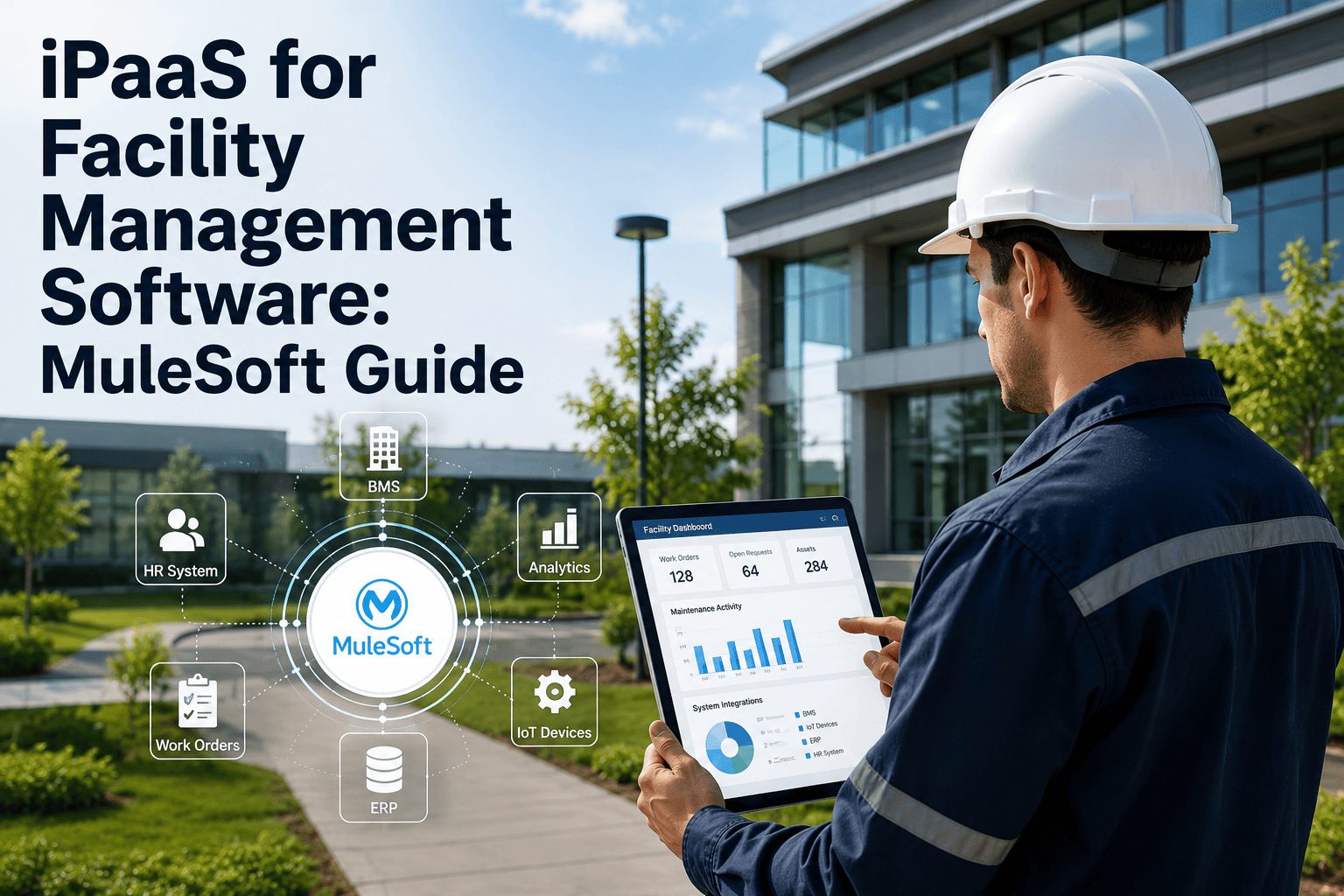
Facility IT teams already spent years and six-figure budgets standing up MuleSoft, Boomi, or Workato as the integration backbone for ERP, identity, ticketing, and finance systems. Then a new CMMS shows up with its own proprietary connector list, its own webhook format, and its own way of doing things — and suddenly the facility team is back to point-to-point integrations that nobody in IT approved, monitors, or trusts. A maintenance platform that can't speak the same integration language as the rest of the stack becomes a second silo the moment it's deployed. Book a demo to see how Oxmaint connects into MuleSoft, Boomi, and Workato without a custom integration project.
$17B+
Projected global iPaaS market size by 2028, reflecting how central integration platforms have become to enterprise IT stacks
900+
Average number of connected SaaS tools an enterprise IT team now governs through a single integration platform
$500K+
Typical cost of an enterprise API-led integration program when a system requires custom point-to-point work
3
Dominant iPaaS platforms IT teams standardize on today — MuleSoft, Boomi, and Workato — each with different governance strengths
Oxmaint plugs directly into the integration platform your IT team already owns and governs — no custom connector project, no shadow-IT workaround. Book a Free Demo or Start Free Trial to see the connection mapped for your stack.
What Is iPaaS for Facility Management Software?
iPaaS-ready facility management software is a CMMS built to connect through an enterprise integration platform as a service — MuleSoft Anypoint, Boomi AtomSphere, or Workato — rather than forcing IT teams to build and maintain one-off point-to-point connections to ERP, identity, ticketing, and IoT systems. Instead of a maintenance platform becoming its own isolated data island, it exposes governed APIs and event triggers that plug into the same integration layer already managing every other application in the enterprise, keeping asset, work order, and inspection data flowing through the pipes IT already monitors.
Quick Answer
iPaaS for facility management software means a CMMS platform connects through MuleSoft, Boomi, or Workato using standard APIs and event triggers instead of requiring a custom point-to-point integration project. This lets facility data — asset records, work orders, inspection results — sync automatically with ERP, identity, and ticketing systems already governed by IT, cutting integration timelines from months to days and removing the shadow-IT risk of unmonitored data connections.
Where Point-to-Point Facility Integrations Break Down
Most CMMS platforms were never built with an enterprise integration layer in mind. Facility teams end up either living with disconnected data or asking IT to build a custom bridge — and that bridge usually becomes the least reliable, least documented connection in the entire stack.
Point-to-Point Integration
One custom connection per system, rebuilt every time an API changes
No central visibility for IT into what data is flowing where
Each connection is a single point of failure with no shared monitoring
Security and governance reviewed case by case, if at all
iPaaS-Connected CMMS
One governed integration layer routes data to every connected system
IT retains full visibility and logging through the platform it already runs
Built-in monitoring and alerting catch failures before they cascade
Security and access policy enforced consistently across every connection
Stop Building One-Off Bridges Between Your CMMS and Everything Else
Oxmaint exposes governed APIs and event triggers that plug straight into MuleSoft, Boomi, or Workato — so facility data flows through the same monitored layer as the rest of your enterprise stack. Schedule a demo to map your integration architecture.
Built to Connect With the Platform You Already Run
01
MuleSoft Anypoint Compatibility
Oxmaint's API structure maps cleanly to Anypoint's API-led connectivity model, fitting enterprise programs where IT already governs API design, versioning, and access policy centrally.
02
Boomi AtomSphere Connectivity
For teams running Boomi's broad connector library across hybrid environments, Oxmaint's event-driven triggers integrate as one more governed endpoint rather than a special case.
03
Workato Recipe Support
Facility and IT teams using Workato's low-code recipe model can build Oxmaint work order, asset, and inspection triggers into existing automation workflows in hours, not weeks.
04
Standard REST and Webhook Access
Every asset, work order, and inspection record is available through documented REST endpoints and webhooks, so any integration platform beyond the big three can still connect without a bespoke build.
How Oxmaint Fits Into Your Existing Integration Architecture
01
Map Facility Data Against Your Current Integration Layer
Before any connection is built, Oxmaint's team reviews which systems your iPaaS platform already governs — ERP, identity, ticketing, IoT — and identifies exactly where asset, work order, and inspection data needs to flow.
02
Connect Through Governed APIs, Not Custom Code
Oxmaint exposes REST APIs and event webhooks that your MuleSoft, Boomi, or Workato instance consumes the same way it consumes every other connected application — no proprietary SDK, no one-off bridge for IT to maintain alone.
03
Sync Asset, Work Order, and Compliance Data Automatically
Once connected, asset records sync with ERP, work order status updates flow to ticketing systems, and compliance documentation routes to wherever your governance program requires it — automatically, on the schedule your integration platform sets.
04
Monitor and Govern Through Your Existing IT Tools
Because the connection runs through your iPaaS platform, IT retains the same monitoring, alerting, and access control it already uses for every other integration — no separate dashboard, no shadow-IT gap.
Oxmaint Platform Features for iPaaS-Connected Facility Teams
Documented REST API Layer
Every asset, work order, and inspection record accessible through a documented, versioned API that any iPaaS connector can consume immediately.
Event-Driven Webhooks
Real-time triggers fire on work order creation, status change, or compliance deadline — feeding directly into automated recipes and flows.
ERP and Identity Sync
Asset and vendor records stay aligned with ERP financial data, while user provisioning follows the same identity governance IT already enforces.
IoT and Sensor Data Routing
Sensor readings and condition data route through the integration layer into Oxmaint's asset records, keeping predictive maintenance data centralized.
Governed Access Controls
API access follows the same role-based permissions and audit logging your iPaaS platform already applies across every connected system.
Deployment in Days, Not Months
Because Oxmaint connects at the API layer instead of requiring custom middleware, most integration builds go live in days rather than the months a bespoke bridge typically takes.
Integration KPI Scorecard
Systems Connected Through Governed iPaaS
22%
Point-to-Point Connections Still Active
14
Average Integration Build Time
11 weeks
IT-Visible Data Flows
38%
Failed Sync Incidents Per Quarter
17
ERP-CMMS Data Match Rate
54%
Find Out How Many Point-to-Point Bridges Your CMMS Is Actually Running On
Most facility teams have never mapped how their current maintenance software actually talks to ERP, ticketing, and identity systems. Oxmaint builds that map with your IT team in a single session. Book a demo to map your current integration exposure.
Performance Outcomes — Oxmaint iPaaS-Connected Deployments
Systems Connected Through Governed iPaaS93%
Reduction in Point-to-Point Connections96%
Faster Average Integration Build Time88%
ERP-CMMS Data Match Rate99%
Reduction in Failed Sync Incidents91%
Frequently Asked Questions
Does Oxmaint require a custom connector for MuleSoft, Boomi, or Workato?
How long does an iPaaS-based CMMS integration typically take?
Can Oxmaint sync asset and work order data with our ERP system?
Does connecting through iPaaS improve security compared to direct integrations?
Yes. Access control, logging, and monitoring run through the same governance layer IT already applies to every other connected system, closing the shadow-IT gap direct integrations create.
Book a demo to review the governance model.
What if our IT team uses a platform other than MuleSoft, Boomi, or Workato?
Oxmaint connects into MuleSoft, Boomi, and Workato through governed APIs and event webhooks — syncing asset, work order, and compliance data with ERP, identity, and ticketing systems your IT team already monitors, with no custom integration project required.