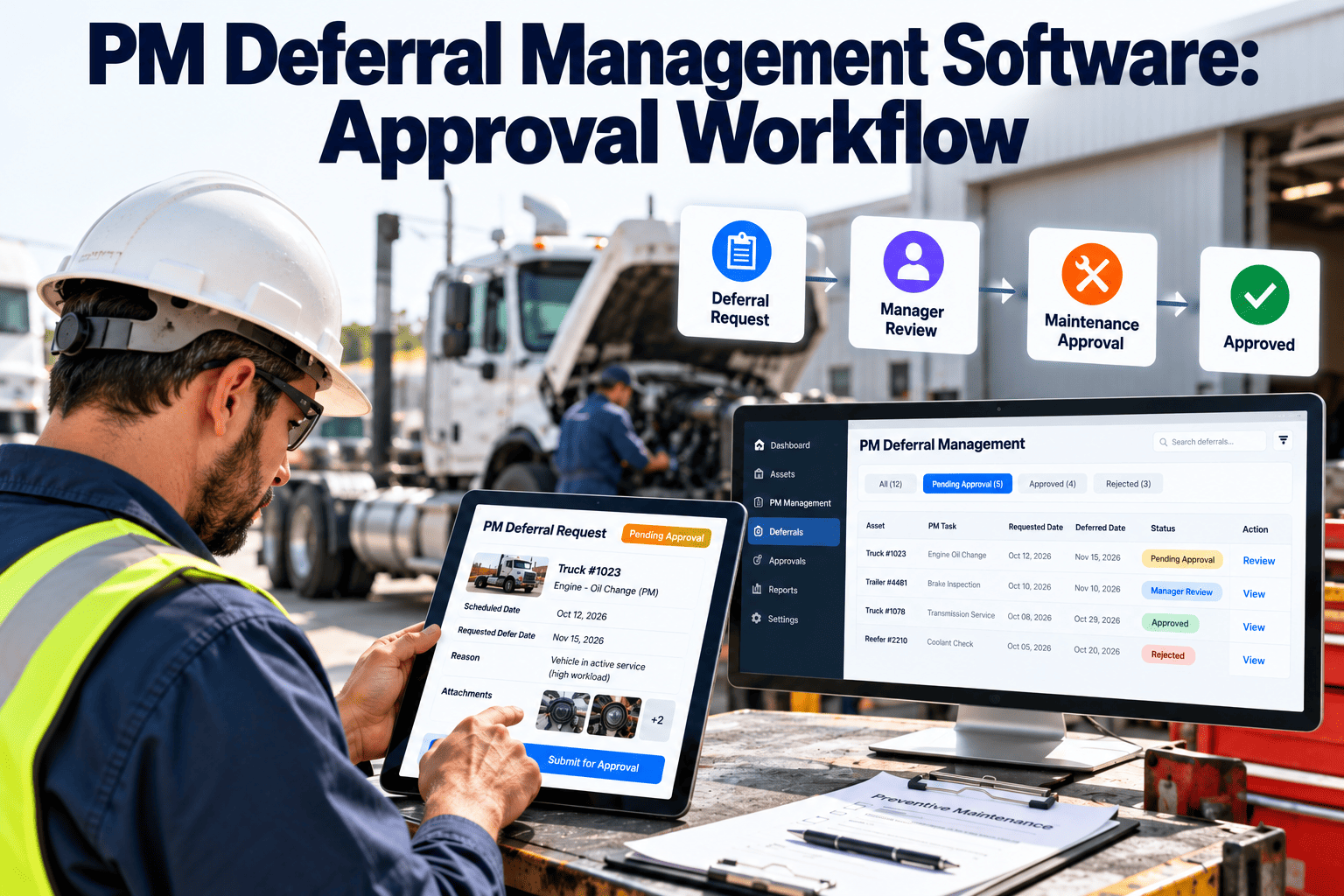
Every facility team defers preventive maintenance at some point. A shutdown window is cancelled, a contractor misses a date, or a production push makes a lockout impossible. The deferral itself is rarely the problem. The problem is the postponement nobody approved, nobody time-limited, and nobody can explain to an auditor months later. This guide walks through a practical PM deferral approval workflow, the reason codes and approval tiers that hold up in review, and how maintenance management software like Oxmaint keeps every postponement documented.
PM Deferral Management Software: An Approval Workflow That Survives an Audit
Replace quiet PM slippage with a controlled request, risk check, approval, expiry date, and reschedule trail for every deferred task across your facilities.
A Deferral Is a Decision With an Owner and an Expiry Date
Many teams treat "pushed to next month" as a scheduling detail. In a controlled program, a deferral is a recorded risk decision: who asked, why, what could go wrong, who accepted that risk, and when the task must be done.
The quiet slip
- The due date is edited and the original date disappears
- The reason lives in a text message or someone's memory
- No one with authority saw the request
- The same PM slides again the following month
- An auditor finds a gap and no explanation
The controlled deferral
- The original due date stays on the record
- A reason code and written justification are required
- The approver matches the asset's criticality
- A hard expiry date pulls the task back into the schedule
- Reports show every deferral, approver, and outcome
PM Tasks That Should Never Enter the Normal Deferral Queue
Not every PM belongs in the same approval path. Tasks tied to codes, insurers, or an authority having jurisdiction carry fixed intervals that an area supervisor cannot extend alone.
| Task Type | Typical Governing Source | Route Change Requests To |
|---|---|---|
| Fire sprinkler and alarm inspection, testing, maintenance | NFPA 25, NFPA 72, local fire code | Life safety owner and fire authority as required |
| Emergency generator testing | NFPA 110, facility accreditation rules | Electrical authority and compliance manager |
| Elevator and escalator inspection | Local jurisdiction, ASME A17.1 practice | Compliance manager and service contractor |
| Boiler and pressure vessel inspection | Jurisdictional inspection rules, insurer requirements | Compliance manager and insurer contact |
| Backflow preventer testing | Local water authority | Plumbing lead and compliance manager |
| Lockout/tagout procedure inspection | OSHA 29 CFR 1910.147 periodic inspection | Safety manager |
A good workflow detects these tasks through a compliance flag on the PM template. Any deferral request on a flagged task skips the normal tiers and goes straight to the compliance owner.
Reason Codes Turn Free-Text Excuses Into Reportable Data
Free-text reasons cannot be trended. A short, controlled list lets you see whether deferrals come from parts, access, labor, or planning failures. The codes below are example starting points to adapt to your policy.
| Code | Typical Situation | Evidence To Attach | Example Window |
|---|---|---|---|
| Production Constraint | Asset cannot be taken offline during a run | Production schedule or operations sign-off | Until next planned stop |
| Parts Unavailable | Filters, belts, or seals are on order | Purchase order and expected receipt date | Until parts receipt plus one week |
| Labor Shortage | Qualified technician is not available | Staffing note and backfill plan | Short, with weekly review |
| Access Restriction | Area closed, tenant event, or weather | Facility notice or access request | Until access reopens |
| Contractor Delay | Vendor missed the booked visit | Vendor confirmation of new date | Until confirmed visit |
| Asset Retirement | Equipment scheduled for replacement | Capital project or decommission record | Review at each interval |
Writing a Deferral Justification That Holds Up in Review
A reason code explains the category. The written justification explains the decision. Reviewers and auditors read it to judge whether the risk was understood, so it should make sense even if its author has left the company.
Weak justification
Strong justification
Six elements every justification should contain
- The exact asset and task. Name the equipment and the specific PM, not just the building.
- What prevented the work. State the real constraint in plain words.
- The new date. A named date, never "when possible".
- The risk if it slips again. Describe the likely failure and its consequence.
- The interim safeguard. List the lighter check that covers the gap.
- Supporting evidence. Attach the order confirmation, notice, or schedule that backs the reason.
Match the Approver to Asset Criticality and Deferral Length
A single approver for everything either creates a bottleneck or a rubber stamp. Tiering by asset criticality and by how long the task is postponed keeps routine requests fast and serious requests visible.
| Asset Criticality | Within Grace Window | Up To One Full Interval | Beyond One Interval |
|---|---|---|---|
| Critical or life safety | Maintenance manager | Facility director and risk owner | Not permitted without executive review |
| Important to operations | Supervisor | Maintenance manager | Facility director |
| Standard building systems | Supervisor | Supervisor with note | Maintenance manager |
| Low consequence | Planner | Supervisor | Maintenance manager |
The Five Stages of a Defensible PM Deferral
- 01
Raise the request from the work order
The planner or technician selects a reason code, enters the proposed new date, and writes the justification against the exact asset and task. - 02
Run the risk check
The system surfaces criticality, compliance flag, last completion date, and how many times this task was already deferred. - 03
Route to the correct approver
The tier table decides who sees it. Approvers can approve, reject, or approve with conditions such as compensating checks. - 04
Set the expiry and compensating actions
Approval always carries a hard expiry date. Any interim inspection or monitoring task becomes its own scheduled work order. - 05
Reschedule, complete, and close the loop
The deferred PM returns to the schedule, is completed, and the deferral record is closed with the actual completion date.
Four Deferral Situations and How the Workflow Responds
Policies look simple until a real request arrives. Walking through typical situations shows where tiering, the compliance lane, and compensating controls each earn their place.
| Situation | Classification | Approval Path | Conditions Attached |
|---|---|---|---|
| Air handler filter change delayed by a back-ordered part | Standard asset, parts reason | Supervisor approves a short deferral | Order confirmation attached, weekly pressure check, expiry one week after parts arrive |
| Fire pump test falls during a tenant event | Life safety, compliance flagged | Compliance owner decides, not the area supervisor | Reschedule to the earliest permitted window and notify the authority where required |
| Cooling tower inspection pushed three times in a row | Repeat deferral on an important asset | Escalates automatically to the maintenance manager | Review the root cause: staffing, access, or an unrealistic task definition |
| Roof drain cleaning deferred as storm season approaches | Seasonal task with rising consequence | Manager approval with a firm date before forecast weather | Post-rain inspection added and drain photos recorded |
Stop Explaining Missed PMs From Memory
Compensating Controls: What Happens While the PM Waits
Approving a deferral without adding a safeguard simply accepts more risk. Each deferred task should trigger a lighter interim check aimed at the failure the PM was meant to prevent.
Six Metrics That Show Whether Deferral Is Under Control
Who Does What in a Deferral Workflow
Deferral control fails when everyone assumes someone else is watching. Clear roles keep the request, the decision, and the follow-through with named people.
Technician
Planner
Approver
Compliance owner
Deferral Aging: Escalate Before the Backlog Becomes Normal
Aging buckets give supervisors a daily view of how far past the original due date each deferred task has drifted, and what should happen next.
What to Require From PM Deferral Management Software
When comparing CMMS platforms for deferral control, test the approval path with a real scenario rather than a feature list. These requirements separate record-keeping from true control.
- Original due date preserved. Edits never overwrite history.
- Mandatory reason code and justification. The request cannot be submitted blank.
- Criticality-based routing. Approvers change with asset class and deferral length.
- Compliance flag. Regulated tasks follow a separate path.
- Hard expiry with escalation. Expired approvals notify managers automatically.
- Mobile approval. Managers can approve from the floor, not only a desktop.
- Reporting by reason, site, and approver. Export-ready for audits and reviews.
Six Elements of a Written PM Deferral Policy
Software enforces a policy; it cannot invent one. Document these elements first, then configure the workflow to match.
Mistakes That Turn a Deferral Process Into Paperwork
- Approving everything at one level. A single approver becomes either a bottleneck or a rubber stamp.
- Allowing open-ended approvals. A deferral without an expiry is simply a cancelled PM.
- Ignoring repeat deferrals. The fifth request for the same task signals a planning problem, not a scheduling one.
- Skipping compensating checks. Approval without an interim safeguard just accepts more risk.
- Treating compliance tasks like routine ones. Regulated intervals need their own path and owner.
- Never reviewing the data. Reason codes only help if someone reads the trend every month.
What to Be Able to Produce on Audit Day
- A list of every deferral in the period. Filter by site, asset class, reason code, and approver.
- The full record for any single deferral. Original date, request, evidence, approval, expiry, and completion.
- Proof that regulated tasks were never extended internally. Show the compliance path and decision owner.
- Evidence that interim checks were done. Completed work orders matched to each approval.
- Trend data showing management attention. Monthly review notes and actions taken on repeat deferrals.
How Oxmaint Supports a Controlled Deferral Workflow
Oxmaint connects asset records, preventive maintenance scheduling, work orders, and reporting in one system, which is the foundation a deferral process depends on.