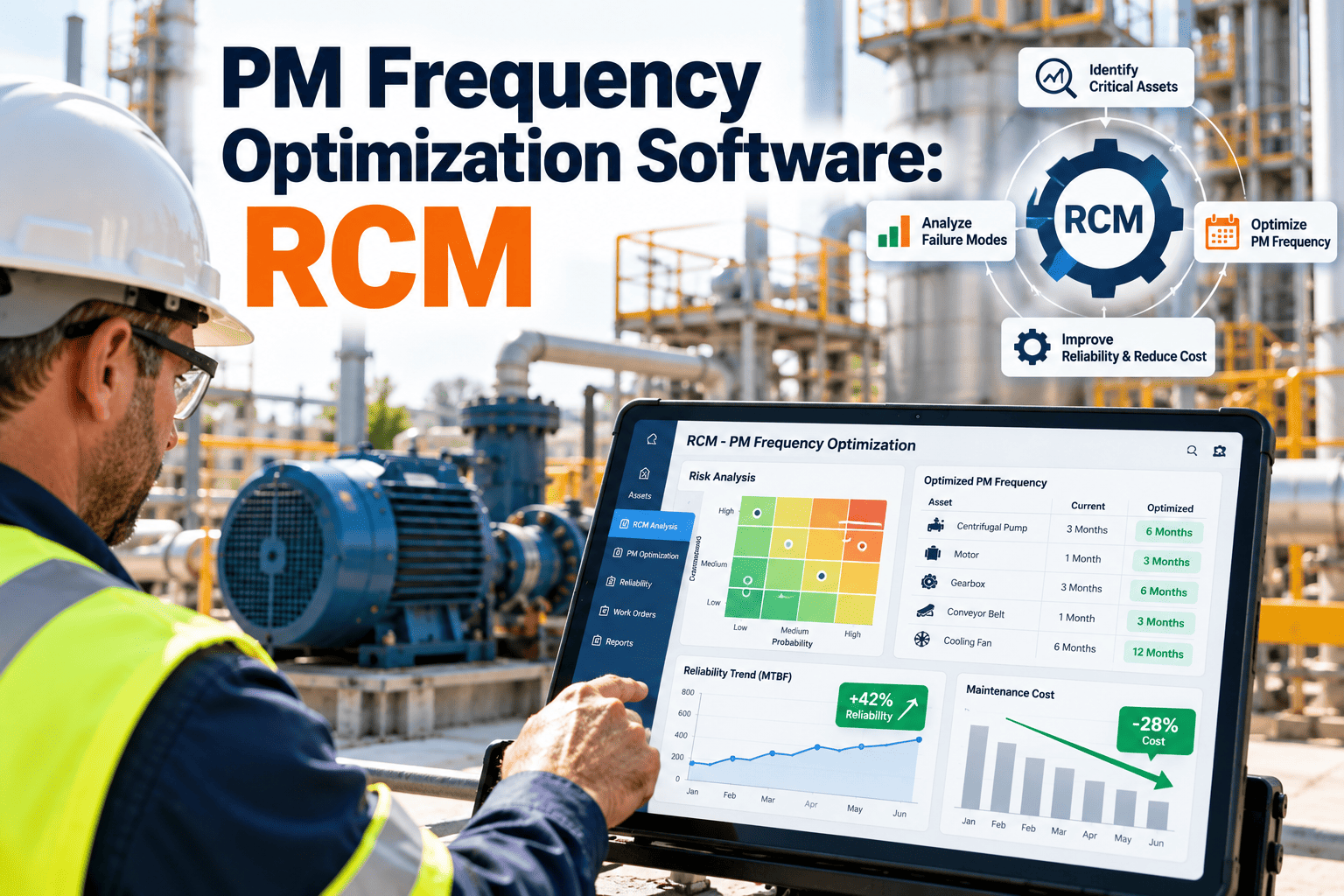
Most PM schedules were built years ago from manufacturer manuals, habit, or the interval the last supervisor preferred. Some tasks are repeated far more often than the failure mode demands, while others are checked too rarely to catch a fault before it develops. Reliability-centered maintenance, or RCM, gives teams a structured way to ask which tasks are worth doing and how often. This guide covers frequency review methods, interval formulas, and how a CMMS such as Oxmaint supplies the history needed to adjust PM intervals with evidence.
PM Frequency Optimization Software: Use RCM to Right-Size Every Interval
Review PM intervals using failure history, failure consequences, and condition data, so effort goes where it prevents real failures.
Two Symptoms Your PM Frequencies Need Review
Signs of too much PM
- Inspections that almost never find anything
- Failures that start soon after a PM visit
- Technicians skipping tasks they consider pointless
- Calendar-based tasks on equipment with low run hours
- Backlog caused by volume, not by difficulty
Signs of too little PM
- Repeat breakdowns between scheduled visits
- Faults found only when equipment stops
- Rising corrective work on critical assets
- Lubrication or filter tasks missed during heavy use
- Inspections that find advanced damage each time
Why Fixed Calendar Intervals Often Miss the Real Failure Pattern
Time-based PM assumes that the chance of failure rises with age. Reliability studies from commercial aviation, which shaped RCM, found that many failure modes show no clear age relationship at all.
- This is why the same interval for every motor, pump, or fan is rarely the best answer.
- Frequency should come from how each failure mode actually behaves.
The Seven RCM Questions Applied to PM Frequency
RCM, as described in standards such as SAE JA1011, rests on seven questions asked for each asset. Together they decide what to do, not only how often.
- 1What are the functions and performance standards of the asset?
- 2In what ways can it fail to fulfill those functions?
- 3What causes each functional failure?
- 4What happens when each failure occurs?
- 5How does each failure matter, in safety, environment, operations, and cost?
- 6What can be done to predict or prevent each failure?
- 7What if no suitable proactive task can be found?
Choosing the Task Type Before Choosing the Interval
| Task Type | Use When | How Frequency Is Set | Facility Example |
|---|---|---|---|
| Time-based restoration or replacement | Failure is age-related and consequence is high | From the age at which failure risk rises | Replacing wear items on a fixed cycle |
| Condition-based inspection | A detectable warning appears before failure | From the warning-to-failure time, the P-F interval | Thermal scan of electrical connections |
| Condition monitoring | Failure is costly and signs are measurable | Continuous or short route interval | Vibration trend on a critical pump |
| Failure-finding test | Protective or standby device fails silently | From required availability and failure rate | Testing a standby pump or alarm |
| Run to failure | Consequence is low and repair is cheap | No scheduled task | A non-critical lamp or small fixture |
| Redesign | No task gives acceptable risk | Not applicable | Replacing an inaccessible, repeat-failure component |
Review PM Frequency With Real Failure History
The P-F Interval: A Simple Way to Set Inspection Frequency
The P-F interval is the time between the first detectable sign of a developing fault, point P, and functional failure, point F. An inspection must happen more often than that window to catch the fault.
- A common rule of thumb sets the inspection interval at about half the P-F interval.
- If the P-F interval is eight weeks, inspect roughly every four weeks.
- The P-F interval must come from observed failure behavior and technician experience, not guesswork.
Worked Example: Reviewing the PM Plan for a Pump Group
The example below is illustrative. It shows how the same review questions produce different decisions for tasks on the same equipment.
| PM Task | Evidence Reviewed | Likely Decision | Follow-Up |
|---|---|---|---|
| Monthly visual check of a standby pump | Many cycles with no findings, low consequence due to redundancy | Extend interval | Monitor corrective work for the following quarters |
| Quarterly bearing lubrication on a duty pump | Repeat bearing failures between visits | Shorten interval or add condition check | Review lubricant type and quantity |
| Annual coupling alignment check | Failures follow repairs, not age | Keep, but trigger after any repair | Add alignment check to repair work orders |
| Weekly seal leak inspection | Leaks start slowly and are easy to see | Convert to operator walk-down | Record observations on the route checklist |
| Standby pump start test | Hidden failure risk, protects against outage | Keep as failure-finding task | Set interval from required availability |
Data You Need in the CMMS for a Frequency Review
- Failure history by asset
- Dates, failure codes, causes, and downtime from corrective work orders.
- PM findings
- What each PM actually found, and whether any task found nothing for several cycles.
- Run hours or usage
- Meter readings to compare usage-based and calendar-based intervals.
- Criticality ranking
- Safety, operational, and cost consequence of losing each asset.
- Condition readings
- Temperature, vibration, pressure, and inspection scores over time.
- Labor and parts cost
- Cost of each PM task compared with the cost of the failure it prevents.
Calendar-Based Versus Usage-Based Intervals
When calendar intervals fit
- Deterioration happens with time, such as corrosion or seal aging
- Equipment runs on a steady, predictable schedule
- Safety or code requirements use fixed dates
- No reliable usage meter is available
When usage intervals fit
- Wear follows run hours, starts, or cycles
- Equipment runs seasonally or in uneven bursts
- Standby units sit idle for long periods
- Meters or controllers already record usage
Formulas and Metrics That Support Interval Decisions
A Simple Cost Test for Any PM Task
Before keeping or changing a task, compare what it costs with what it protects. The test does not need precise numbers, only honest estimates.
A Frequency Review Cycle You Can Repeat Each Quarter
Rank assets by criticality and failure cost
Pull PM yield and repeat failures
Review with technicians and engineers
Change one thing at a time
Monitor results and repeat
Frequency Review Priorities by Asset Class
| Asset Class | Review Focus | Typical Over-Maintenance Sign | Typical Under-Maintenance Sign |
|---|---|---|---|
| HVAC air handlers | Filters, belts, coils, and drives | Filter changes done well before pressure rises | Coil fouling and belt failures between visits |
| Pumps and motors | Lubrication, alignment, and bearings | Greasing on a fixed date regardless of running time | Repeat bearing failures |
| Electrical distribution | Connections, protection devices, and thermal condition | Intrusive checks on stable equipment too often | Hot connections found only after trips |
| Plumbing and water systems | Valves, backflow devices, and treatment | Low-risk fixtures inspected as often as critical ones | Valve failures and leaks during service |
| Building envelope | Roof, drains, sealants, and glazing | Uniform checks regardless of exposure | Water entry after storms |
Getting Technician Buy-In for Frequency Changes
- 1Show the data. Share PM yield and failure history rather than announcing a decision.
- 2Ask for field knowledge about early warning signs and how fast faults develop.
- 3Pilot changes on a few assets before applying them across a site.
- 4Explain that fewer low-value tasks free time for higher-value work.
- 5Give technicians an easy way to report tasks that find nothing or miss problems.
- 6Report results back so the team sees the effect of each change.
Quick Wins You Can Start With Existing Data
Guardrails: Where Not to Stretch an Interval
Condition Triggers: Moving From a Date to a Reading
Condition-based PM replaces a fixed date with a trigger. Triggers should be set from your own baselines and the asset's history, not copied from a generic table.
| Asset Type | Condition Measure | Trigger Idea | Resulting Work |
|---|---|---|---|
| Rotating equipment | Vibration and bearing temperature | Rising trend above the asset's own baseline | Inspect and lubricate or schedule replacement |
| Air filters | Differential pressure | Reaching the manufacturer's change-out point | Filter change work order |
| Electrical connections | Thermal scan results | Hot spot compared with similar components | Tighten, repair, or plan outage work |
| Lubricated drives | Oil sample results or level checks | Contamination or wear indicators past limits | Oil change or component inspection |
| Building envelope | Inspection scores and moisture findings | Declining score on repeated inspections | Repair or sealant work order |
Events That Should Trigger an Immediate Frequency Review
- A major or repeat failure on a critical asset, regardless of the review calendar.
- A change in how the equipment is used, such as longer run hours, new loads, or a different operating schedule.
- A significant repair, rebuild, or replacement, since early-life risk changes after intervention.
- A new manufacturer bulletin, regulation, or insurer requirement affecting the task.
- A pattern of PM tasks being skipped or closed with no findings across several cycles.
Documenting Every Frequency Change
An interval change is a maintenance decision, and it needs the same traceability as any other. Without a record, no one can tell later whether a failure was a bad decision or bad luck.
- State the old interval, the new interval, and the date of the change.
- Record the evidence: failure history, PM yield, condition data, and consequence ranking.
- Name who reviewed and approved the change.
- Set a review date to check results, and note what outcome would reverse the change.
- Keep regulatory, warranty, and insurer requirements attached to the task so they are never overlooked.
How Oxmaint Supports PM Frequency Optimization
Oxmaint keeps the records a frequency review depends on in one place, and carries approved changes back into the schedule.