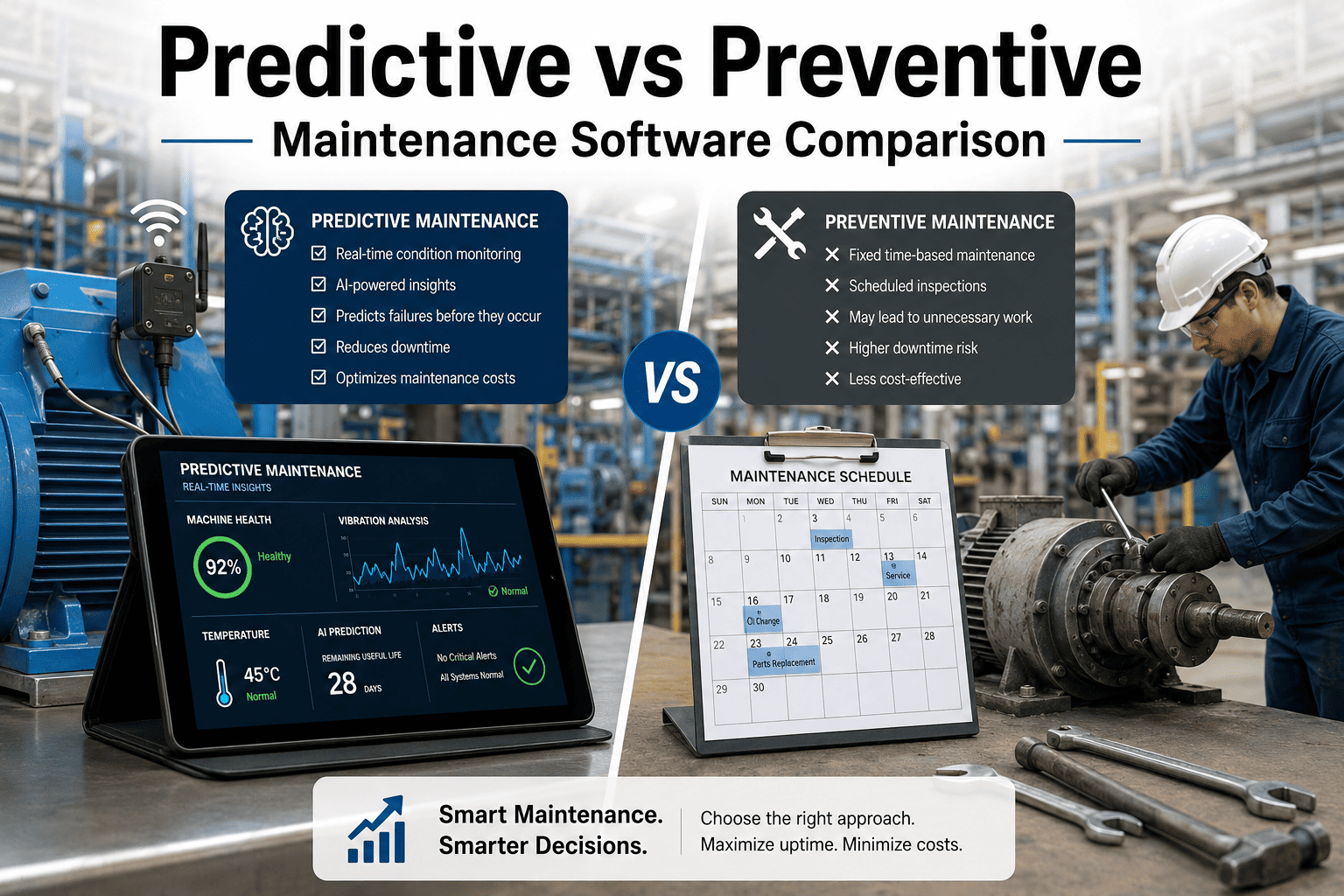
Predictive vs preventive maintenance software comparison is the defining decision for facility teams in 2026 — and the right CMMS makes both strategies work together instead of forcing a choice. Preventive maintenance follows fixed schedules and calendar intervals, while predictive maintenance uses real-time asset data and AI to trigger work only when condition thresholds demand it. The best predictive vs preventive CMMS platforms let you run both strategies side by side, assigning the right approach to each asset class based on criticality, failure patterns, and cost. OxMaint's cloud-based facility strategy CMMS gives maintenance and reliability teams the tools to schedule preventive tasks, ingest IoT sensor data for predictive alerts, track asset performance, and prove ROI — all from one platform. Whether you manage a single plant or a multi-site portfolio, this guide breaks down which strategy wins for each asset class and how top strategy comparison platforms like OxMaint make the decision data-driven. Start Free Trial and see the difference on your own assets.
Predictive vs Preventive Maintenance: Which Strategy Wins for Your Asset Class?
Stop guessing. The top strategy comparison platform shows exactly when to schedule PMs and when to let sensor data trigger work — so you cut downtime 30–50% and extend asset life without over-maintaining.
- Fixed intervals (weekly, monthly, quarterly)
- Best for low-criticality, predictable wear
- Risks over-maintenance on healthy assets
- Lower upfront cost, simpler to launch
- Triggered by real-time sensor thresholds
- Best for critical, high-value, failure-prone assets
- Eliminates unnecessary PMs and catches failures early
- Higher setup cost, faster long-term ROI
Predictive vs Preventive Software: What Each Strategy Actually Does
Facilities running pure preventive maintenance waste 30% of PM labor on assets that don't need service yet, while reactive teams face unplanned downtime costing up to $260K per hour in critical operations. The best strategy CMMS 2026 platforms solve this by matching the right approach to each asset.
Time-Based Maintenance
Work orders trigger on fixed schedules — every 500 operating hours, every 90 days, every season. You service equipment whether it needs it or not, which guarantees you catch wear before failure but also means you replace parts with remaining life and spend labor on healthy machines.
Condition-Based Maintenance
IoT sensors monitor vibration, temperature, pressure, oil quality, and acoustic signatures in real time. AI models detect anomalies and trigger work orders only when asset health degrades — so you intervene at the optimal moment, not too early and never too late.
How to Choose: A 4-Question Asset Criticality Test
A 180-asset manufacturing plant spending $42K annually on blanket PMs discovered that 60% of its calendar-based tasks were unnecessary — sensors proved the equipment was healthy. Use this test to assign the right strategy to every asset class in your facility.
What happens if this asset fails unexpectedly?
If failure stops production, triggers safety risks, or costs >$10K in emergency repairs, it's a predictive candidate. If failure is an inconvenience with a cheap fix, preventive or even run-to-failure works.
Does this asset have a predictable wear pattern?
Assets with consistent, time-based degradation (filters, belts, lubricants) fit preventive schedules. Assets with variable failure modes (bearings, motors, pumps) benefit from condition monitoring.
Can you install sensors cost-effectively?
Wireless vibration sensors now cost $50–$200 per asset with 3–5 year battery life. If sensor + platform cost is less than 10% of asset replacement value, predictive ROI is strong.
Do you have failure history data?
Predictive models need baseline data. If you've logged 12+ months of failures, repairs, and operating conditions in a CMMS, AI can identify patterns. Without history, start preventive and layer in sensors to build the dataset.
The Real Numbers: Preventive vs Predictive Maintenance Costs
Preventive maintenance costs $9–$13 per asset per month in labor and parts; predictive runs $14–$22 per asset per month including sensors and platform fees — but predictive cuts total maintenance spend 18–25% by eliminating unnecessary work and preventing catastrophic failures.
| Cost Factor | Preventive Maintenance | Predictive Maintenance |
|---|---|---|
| Upfront setup | Low — CMMS license + PM schedules | Medium — CMMS + IoT sensors + AI model training |
| Monthly cost per asset | $9–$13 (labor + parts on fixed schedule) | $14–$22 (sensors + platform + condition-triggered labor) |
| Unplanned downtime | 18–25% reduction vs reactive | 30–50% reduction vs reactive |
| Asset lifespan extension | 10–15% longer than reactive | 20–40% longer than reactive |
| Over-maintenance waste | 25–30% of PM tasks are unnecessary | <5% — work only happens when needed |
| Payback period | 6–12 months | 12–24 months (faster on critical assets) |
| Best-fit asset value | <$25K replacement cost | >$50K replacement cost or high downtime impact |
Example: A data center with 40 CRAC units spending $68K/yr on quarterly PMs installs vibration + temp sensors for $8K and pays $4.8K/yr for a predictive CMMS. Avoiding one compressor failure ($32K emergency repair + 18 hours downtime at $12K/hr = $248K total loss) pays for the entire program 19x over in year one.
Run Both Strategies in One Platform — No Forced Choice
OxMaint is the best predictive vs preventive CMMS because it doesn't make you pick. Assign calendar-based PMs to low-criticality assets and condition-based alerts to high-value equipment — then track both in the same dashboard, mobile app, and analytics engine.
Flexible PM Scheduling
Build calendar, meter-based, or seasonal preventive schedules in minutes. Auto-generate work orders, assign techs, and track completion — cutting PM admin time by 60% vs spreadsheets.
IoT Sensor Integration
Connect vibration, temperature, pressure, and oil-quality sensors via API or MQTT. Set custom thresholds and let OxMaint trigger predictive work orders when asset health degrades — catching failures 2–6 weeks early.
Asset Criticality Scoring
Tag every asset with criticality, replacement cost, failure history, and downtime impact. OxMaint recommends the optimal strategy per asset class and shows exactly where predictive ROI beats preventive.
Unified Analytics & Reporting
Compare preventive vs predictive performance side by side — downtime, cost per asset, MTBF, PM compliance. Export audit-ready reports proving which strategy wins for each equipment class.
See OxMaint Run Both Strategies on Your Assets
Book a 30-minute live demo and we'll map your asset classes to the right maintenance strategy — preventive, predictive, or hybrid — with real ROI projections.
Myth vs Reality: What Facility Teams Get Wrong
Bad assumptions about predictive and preventive maintenance cost facilities six figures annually in wasted labor, unnecessary downtime, and premature asset replacement. Here's what the data actually shows.
"Predictive maintenance is only for huge enterprises with million-dollar budgets."
Wireless IoT sensors now cost $50–$200 per asset with 3–5 year battery life, and cloud CMMS platforms start under $100/month. A 50-asset facility can launch predictive on its 10 most critical machines for under $5K total — and avoid one $30K failure to pay for the entire program.
"Preventive maintenance guarantees zero breakdowns."
Calendar-based PMs reduce downtime 18–25% but can't catch random failures, infant-mortality defects, or degradation that accelerates between intervals. Predictive monitoring catches 70–85% of failure modes that preventive misses — especially bearing wear, misalignment, and lubrication breakdown.
"You have to choose one strategy for the whole facility."
The best facility strategy CMMS 2026 platforms let you run hybrid programs — preventive on low-cost, predictable assets and predictive on critical, high-value equipment. OxMaint customers typically assign 60–70% of assets to preventive, 20–30% to predictive, and 5–10% to run-to-failure based on criticality scoring.
How to Launch a Hybrid Strategy in 90 Days
Most facilities overthink the predictive vs preventive decision and stall for months. This 90-day rollout gets both strategies live without disrupting operations — and starts delivering measurable ROI by month four.
Audit & Criticality Scoring
Log every asset in your CMMS with replacement cost, failure history, downtime impact, and current PM schedule. Score each asset 1–10 on criticality. Assets scoring 8+ are predictive candidates; 4–7 fit preventive; 1–3 can run-to-failure.
Build Preventive Schedules
Create calendar and meter-based PM templates in OxMaint for all preventive-tier assets. Set auto-work-order generation, assign techs, attach digital checklists, and configure mobile notifications. Test with one asset class before rolling out facility-wide.
Install Sensors & Connect IoT
Deploy vibration, temperature, or pressure sensors on predictive-tier assets. Connect to OxMaint via API or MQTT, set baseline thresholds, and configure alert rules. Let the system collect 2–4 weeks of baseline data before enabling auto-work-order triggers.
Train Team & Go Live
Train techs on mobile work orders, QR code scanning, and sensor alert response. Launch both strategies facility-wide, monitor dashboards daily, and adjust thresholds based on false positives. By day 90 you'll have real performance data proving which strategy wins per asset class.
What Facility Teams Achieve with the Right Strategy Mix
Facilities using OxMaint to run hybrid preventive + predictive programs see measurable improvements within 6 months — and the data proves which strategy delivers the best ROI per asset class.
Predictive vs Preventive Maintenance: Your Questions Answered
What is the main difference between predictive and preventive maintenance?
Preventive maintenance triggers work on fixed schedules (every 90 days, every 500 hours) regardless of asset condition. Predictive maintenance uses real-time sensor data and AI to trigger work only when condition thresholds indicate degradation — so you service equipment at the optimal moment, not too early or too late.
Which strategy costs more: predictive or preventive maintenance?
Predictive has higher upfront costs (sensors, platform, setup) but lower long-term costs because it eliminates 25–30% of unnecessary PM tasks and prevents catastrophic failures. Preventive costs $9–$13 per asset per month; predictive runs $14–$22 per asset per month — but predictive cuts total maintenance spend 18–25% by optimizing labor and extending asset life 20–40%.
Can I run both predictive and preventive maintenance in the same facility?
Yes — and you should. The best predictive vs preventive CMMS platforms like OxMaint let you assign calendar-based PMs to low-criticality assets (filters, extinguishers, elevators) and condition-based alerts to high-value equipment (compressors, chillers, production motors). Most facilities run 60–70% preventive, 20–30% predictive, and 5–10% run-to-failure. Book a Demo to see how hybrid strategies work in OxMaint.
How long does it take to see ROI from predictive maintenance software?
Median payback is 12–24 months, but it's much faster on critical assets. If one avoided failure saves $30K+ in emergency repairs and downtime, the program pays for itself immediately. Facilities typically see measurable downtime reduction within 6 months and full ROI within 19 months. Starting with your 10 most critical assets accelerates payback.
Do I need special sensors or equipment for predictive maintenance?
Yes — predictive maintenance requires IoT sensors (vibration, temperature, pressure, oil quality) installed on monitored assets. Wireless sensors now cost $50–$200 per asset with 3–5 year battery life and connect to CMMS platforms via WiFi, cellular, or LoRaWAN. OxMaint integrates with all major sensor brands via API and MQTT, so you're not locked into proprietary hardware. Start Free Trial and test sensor integrations on your equipment.
Stop Guessing. Start Measuring Which Strategy Wins.
OxMaint is the top strategy comparison platform for facility teams — run preventive and predictive side by side, track real ROI per asset class, and prove which approach cuts downtime and cost. See it live on your assets.