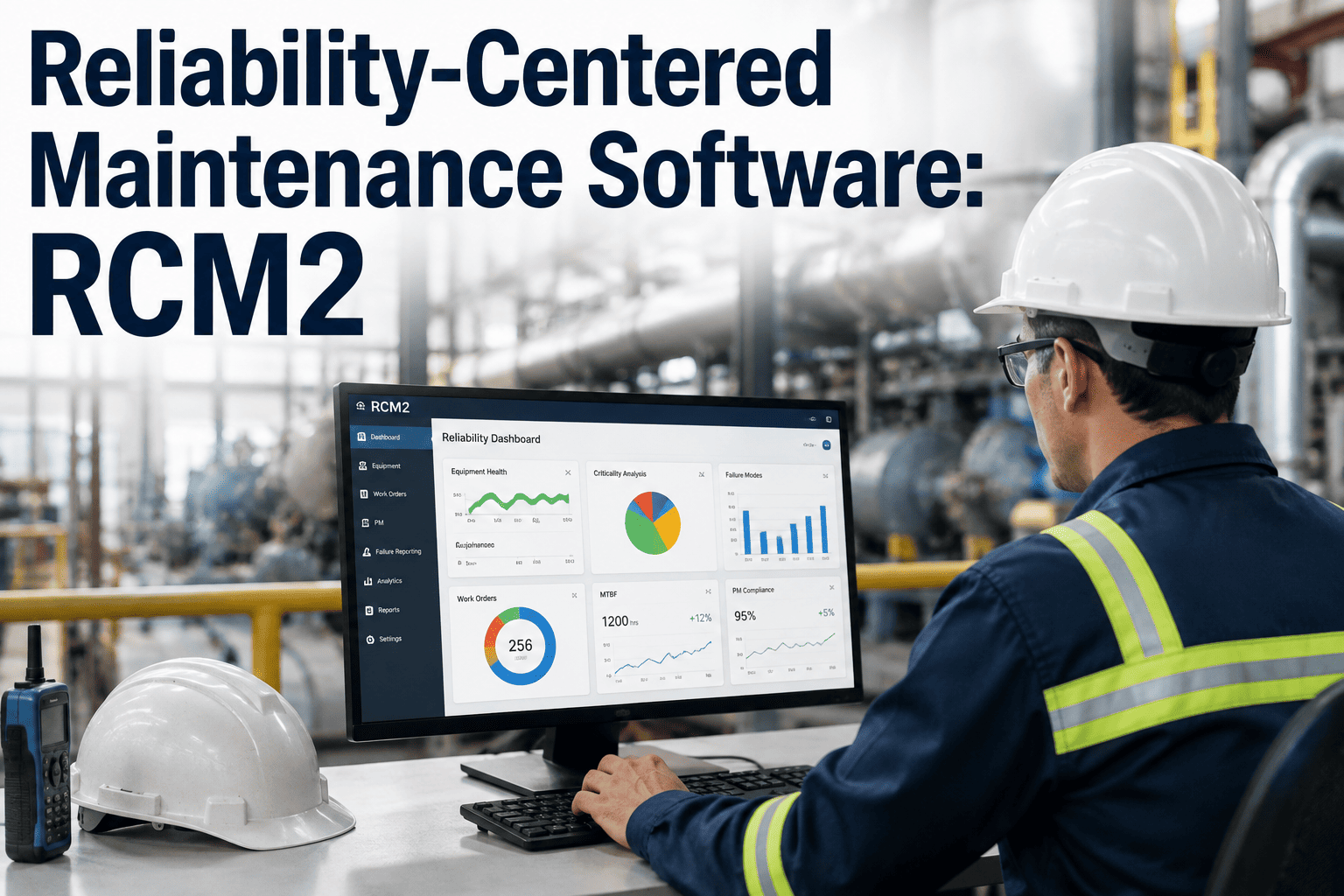
Most maintenance programs are built backward. A schedule gets copied from an OEM manual, tasks get assigned out of habit, and nobody asks whether the work actually stops the failure that matters. Reliability-centered maintenance flips that order. Developed from the 1978 Nowlan and Heap study for United Airlines and refined into RCM2 by John Moubray, it forces a team to define what an asset must do, how it can fail to do that, and only then decide whether a task is worth doing at all. Facilities that run a genuine RCM2 analysis often discover that most of their failure modes were never age-related to begin with, which means a large share of routine overhauls were adding cost without adding reliability. Oxmaint builds that same seven-question logic into a working CMMS so the analysis does not end on a workshop whiteboard, and you can see it running against live work orders after you sign up free.
11%
Of failure modes studied across major reliability research were genuinely age-related, per the original Nowlan and Heap findings
68%
Of components followed a pattern with no identifiable wear-out point, where fixed-interval overhaul added little to no benefit
7
Structured questions form the SAE JA1011 criteria that any process, including RCM2, must satisfy to be called RCM
32
Countries where RCM2 methodology has been formally applied across industrial sites since its development in 1990
Reliability Logic Belongs Inside Your CMMS, Not a Filing Cabinet
RCM2 analysis answers seven structured questions about every asset function and failure mode. Oxmaint turns those answers into scheduled tasks, condition triggers, and failure-finding checks that keep running long after the analysis workshop ends.
RCM2 Framework
The Seven Questions Every RCM2 Analysis Has to Answer
John Moubray built RCM2 directly on the SAE JA1011 questions. A task only earns a place on the maintenance plan after all seven have been worked through, in order, for every function of every significant asset.
01
Functions and Standards
What is the asset supposed to do, and to what standard of performance, within its current operating context and duty cycle?
02
Functional Failures
In how many distinct ways can the asset fail to deliver each of those functions, partially or completely?
03
Failure Modes
What events, conditions, or degradation mechanisms are reasonably likely to cause each functional failure to occur?
04
Failure Effects
What actually happens, physically and operationally, in the moments after each failure mode takes place?
05
Failure Consequences
Does the failure carry safety, environmental, operational, or cost consequences, and how severe are they in this context?
06
Proactive Task Selection
Is there a proactive task that is technically feasible and worth doing to manage that failure before it happens?
07
Default Actions
If no proactive task qualifies, should the team redesign the asset, run it to failure, or search for hidden failures another way?
Failure Behaviour
Six Failure Patterns Behind Every RCM2 Decision
Nowlan and Heap's original age-reliability study, later reproduced in industries far beyond aviation, mapped six conditional-probability patterns. Only two show a genuine wear-out region, which is why blanket time-based overhaul rarely holds up under scrutiny.
Pattern A · ~4%
Bathtub Curve
High infant failure rate, a long stable period, then a rising wear-out zone late in life. Scheduled restoration can genuinely help here.
Pattern B · ~2%
Wear-Out
Low, steady failure rate that climbs sharply once the component nears the end of its useful life. A classic case for scheduled discard.
Pattern C · ~5%
Fatigue
Failure probability rises gradually across the entire service life with no flat middle period. Trend monitoring beats a fixed interval.
Pattern D · ~7%
Break-In
Failures cluster shortly after installation or overhaul, then settle into a steady rate. Points to commissioning quality, not more PM.
Pattern E · ~14%
Random
Constant failure probability regardless of age. Condition monitoring or failure-finding tasks consistently outperform time-based replacement.
Pattern F · ~68%
No Age Relationship
The largest single category by far. No meaningful link between age and failure, where scheduled overhaul can do more harm than good.
Task Selection Logic
What RCM2 Actually Recommends Once a Task Is Needed
Question six and seven of the framework narrow every failure mode down to one of five outcomes. Oxmaint maps each outcome to a specific work order type instead of leaving the decision buried in a report.
Scheduled Restoration
Rework or refurbish the item at a defined interval, used only where a clear wear-out point can be demonstrated.
Scheduled Discard
Replace the component outright before it reaches the age where its failure probability starts to climb.
On-Condition Tasks
Monitor for a potential failure signal inside the P-F interval and act before the functional failure occurs.
Failure-Finding Tasks
Periodically test hidden or protective functions, such as standby pumps and alarms, that give no warning on their own.
Redesign or Run-to-Failure
Where no task qualifies, either redesign the function out of the risk or accept the failure and manage its consequence.
Turn Seven Questions Into a Living, Trackable Maintenance Plan
Oxmaint stores the function, failure mode, and consequence rating for every asset, then converts the question-six decision into a scheduled task, a condition trigger, or a failure-finding checklist that a technician actually sees on their phone.
Rollout Plan
Getting a Working RCM2 Program Live Inside Oxmaint
A full RCM2 analysis workshop can take weeks on its own. Getting the outputs of that workshop running as digital, trackable work is what usually stalls, and that is the part Oxmaint is built to shorten.
1
Days 1 to 7
Function and Criticality Mapping
Critical systems and their primary and secondary functions are registered as assets in Oxmaint, each tagged with a consequence category: safety, environmental, operational, or economic.
2
Days 8 to 14
Failure Mode Library Build
Functional failures and their likely failure modes are entered against each asset record, drawing on team knowledge, OEM data, and existing failure history logged in the platform.
3
Days 15 to 21
Task Assignment and Digital Activation
Every failure mode gets its question-six outcome assigned as a live task: a scheduled work order, a condition-monitoring trigger, or a failure-finding checklist pushed to mobile.
4
Day 22 onward
Living Program and Continuous Review
Completed task data feeds back into the failure history, so consequence ratings and task intervals can be revisited as real evidence accumulates instead of staying fixed forever.
Where RCM2 Is Used
Industries That Rely on Reliability-Centered Maintenance
RCM2 started in commercial aviation and moved outward as other industries recognized the same pattern: a small share of failure modes carry most of the risk.
Why Oxmaint
Six Ways Oxmaint Keeps an RCM2 Program Alive After the Workshop
Failure Mode Library Built Into Every Asset
Functions, functional failures, and failure modes live directly on the asset record instead of in a static spreadsheet nobody opens again.
Condition Triggers, Not Just Calendar Triggers
On-condition tasks can be tied to inspection readings or sensor thresholds so work fires when the P-F interval actually calls for it.
Failure-Finding Tasks That Do Not Get Forgotten
Hidden-function checks for standby equipment and protective devices are scheduled and tracked with the same rigor as visible work.
Criticality-Ranked Work Order Queues
Technicians see the tasks tied to the highest consequence failures first, instead of a flat list ordered only by due date.
Cross-Functional Review Built In
Operations, maintenance, and reliability teams can review and adjust failure consequence ratings together as real task history accumulates.
Analysis to Execution in One Platform
The seven-question output turns directly into a work order, so the analysis stops being a document and starts being a schedule.
What Structured Rollouts Typically Change
Outcomes Facilities Commonly Report After Moving RCM2 Onto a Digital Platform
Fewer
Unnecessary Overhauls
Tasks tied to failure modes with no real age relationship get removed instead of repeated on a fixed calendar out of habit.
Faster
Deficiency Response
On-condition alerts and failure-finding results generate a corrective work order automatically instead of waiting for the next report cycle.
Clearer
Priority on Critical Assets
Consequence ratings keep the highest-risk failure modes visible on the dashboard rather than buried under low-impact routine tasks.
Better
Institutional Memory
Failure history stays attached to the asset record permanently, so the next review does not start from a blank page.
Frequently Asked Questions
RCM2 Software: What Reliability Teams Ask First
What is the difference between RCM and RCM2?
RCM is the general concept from the 1978 Nowlan and Heap report. RCM2 is John Moubray's trademarked seven-question process built on that report and adapted for industries beyond aviation.
Sign up free to see the framework mapped to work orders.
How long does an RCM2 analysis take for a mid-size facility?
A focused analysis on critical systems typically runs a few weeks of workshop time, followed by a phased rollout into a live schedule.
Book a demo to see a realistic timeline for your asset count.
Does RCM2 replace preventive maintenance entirely?
No. RCM2 decides which tasks are worth doing and in what form, which often keeps some scheduled PM, replaces some with condition-based checks, and removes tasks that add no value.
Can Oxmaint run RCM2 analysis alongside an existing PM program?
Yes. Existing preventive tasks stay active while the failure mode library is built, so nothing is removed until its RCM2 outcome has actually been reviewed.
Sign up free to start the asset mapping phase.
Is RCM2 only useful for aviation and nuclear industries?
No. The same seven questions apply to any asset with a defined function, which is why manufacturing, facilities, and transit teams now run RCM2 reviews on their own critical systems.
Your Next Reliability Review Should Not Start From a Blank Spreadsheet
Oxmaint gives reliability and facility teams a single place to define asset functions, log failure modes, assign the right proactive task, and prove the whole program is actually running as scheduled.