Not every asset deserves a preventive maintenance plan, and pretending otherwise quietly drains maintenance budgets across facilities every year. A $40 sensor scheduled for quarterly inspections by a $150-an-hour technician is not disciplined maintenance — it is waste dressed up as diligence. Run-to-failure, done deliberately, is not neglect. It is a calculated decision to let specific low-risk assets operate until they fail, because the cost of preventing that failure is higher than the cost of simply fixing it. The hard part is knowing which assets actually qualify, because applying the same logic to the wrong equipment turns a smart strategy into a safety and production risk. Start a free trial with Oxmaint to see how a criticality-based CMMS separates true run-to-failure candidates from the assets that should never be left unmonitored.
Run-to-Failure Strategy Software: When Reactive Wins
Run-to-failure is not the strategy nobody teaches because it doesn't work — it is the strategy nobody teaches correctly. Here is how to know exactly which assets belong on it, and which ones never should.
What Run-to-Failure Actually Means (And What It Doesn't)
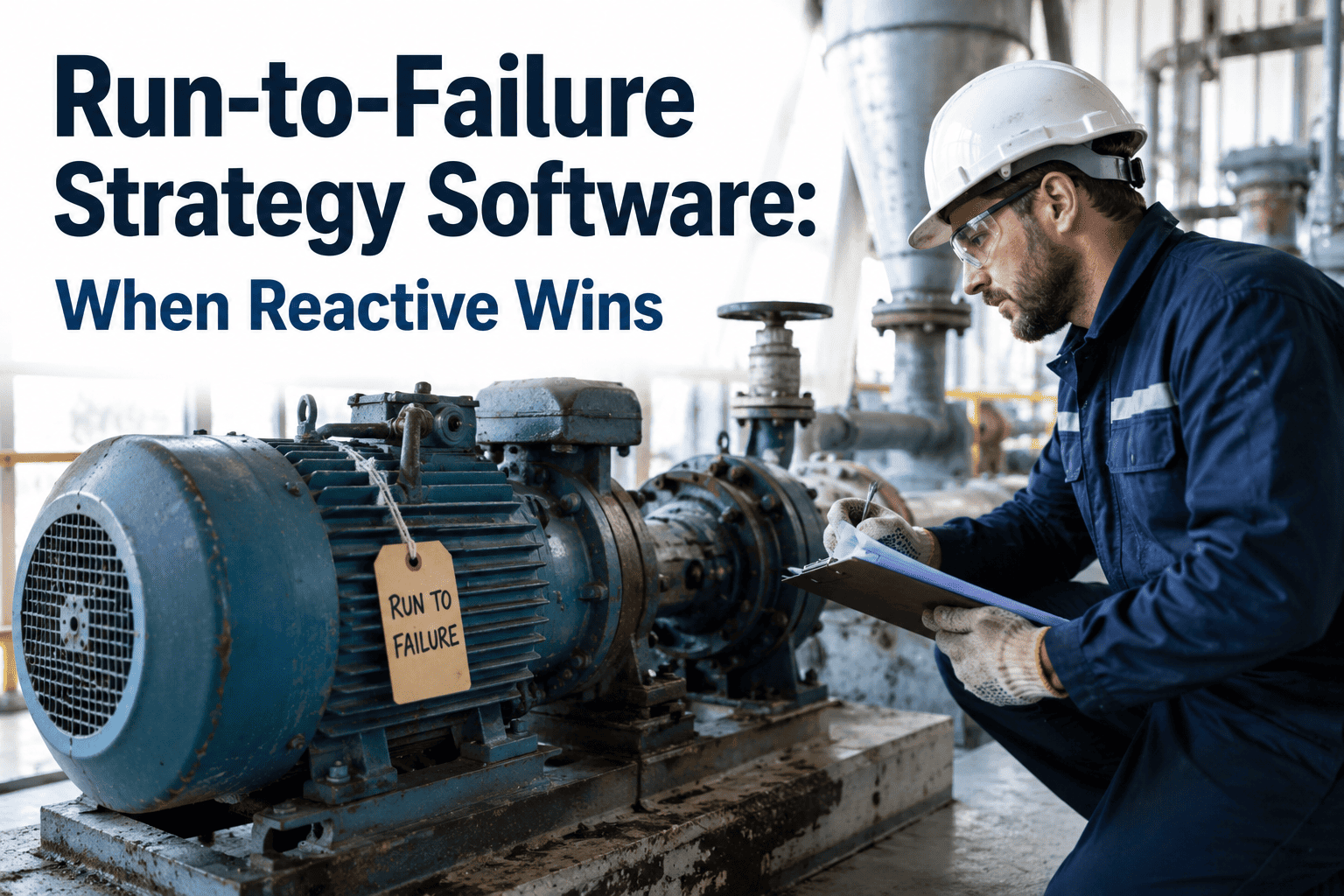
Run-to-failure means an asset receives no scheduled inspections, no condition monitoring, and no preventive intervention. It runs until it breaks, and the team repairs or replaces it at that point — nothing more, nothing less. It is deliberately different from neglect, where equipment fails simply because nobody was watching. A real run-to-failure decision is documented, reviewed, and backed by a criticality analysis, not the accidental result of an understaffed maintenance team defaulting to firefighting.
Reactive repairs, on average, cost three to five times more per event than the same work done on a planned schedule. That statistic gets used to argue against run-to-failure entirely, but it only tells half the story — that cost premium applies when reactive maintenance happens on the wrong assets. For a genuinely low-cost, low-risk component, skipping preventive work removes labor and parts spend with almost no downside at all.
The 5-Condition Checklist for a True RTF Candidate
Before tagging any asset as run-to-failure, it should clear every condition below. Missing even one moves it into preventive or condition-based territory instead.
The part or unit is inexpensive relative to the labor it would take to inspect or service it on a schedule.
Failure creates zero risk of injury to operators, technicians, or anyone nearby the asset.
When it fails, it fails in isolation — it will not take down adjacent equipment or the wider system with it.
A replacement is already in inventory or available fast enough that downtime stays short and predictable.
The rest of the operation keeps running normally while the failed asset is swapped or repaired.
Which Assets Belong on Run-to-Failure — and Which Never Should
Run-to-Failure vs. Preventive vs. Predictive
| Strategy | Trigger for Work | Best Fit | Cost Profile |
|---|---|---|---|
| Run-to-Failure | Asset actually breaks | Low-cost, non-critical, redundant assets | Zero upfront, higher per-event repair |
| Preventive | Fixed time or usage interval | Mid-criticality assets with wear patterns | Predictable, moderate ongoing spend |
| Predictive | Real-time condition data | High-value, production-critical assets | Higher setup, lowest total lifecycle cost |
The strongest maintenance programs never pick one strategy for the entire facility. They apply run-to-failure, preventive, and predictive maintenance side by side, matched deliberately to what each asset actually needs.
The Hidden Cost of Preventing Failure on the Wrong Assets
Scheduled inspections on disposable components consume skilled labor that critical assets need far more urgently.
Unnecessarily opening up a healthy machine for preventive work can introduce the very failure it was meant to prevent.
Over-maintaining low-value assets ties up warehouse space and working capital that should back the 20% that truly matter.
Stop Wasting PM Hours on Assets That Don't Need Them
See a live walkthrough of how Oxmaint reclassifies low-value assets into a run-to-failure track while keeping your critical equipment fully protected.
Built for Mixed-Strategy Maintenance, Not Just One Playbook
Classify every asset as run-to-failure, preventive, or predictive using cost, safety, and downtime impact — reviewed automatically as conditions change.
RTF assets stay covered with reorder triggers, so a failure never turns into extended downtime from a missing replacement part.
Every breakdown gets logged against the asset record, so a component failing far more often than expected gets flagged for reclassification.
Preventive schedules, condition monitoring, and reactive work orders live side by side, so mixed-strategy maintenance never means juggling separate systems.
What Deliberate Run-to-Failure Delivers
Common Questions About Run-to-Failure Maintenance
Is run-to-failure the same thing as neglecting maintenance?
No. Neglect is unplanned and unreviewed. Run-to-failure is a documented, deliberate classification applied only to assets that pass a criticality assessment. Start a free trial to see how the classification works.
What percentage of our assets should realistically be on RTF?
Roughly 20% in a typical facility. The remaining 80%, especially anything safety-critical or production-critical, should stay on preventive or predictive maintenance instead.
Does run-to-failure increase overall maintenance spend?
Only when applied to the wrong assets. Used correctly on low-cost, low-risk components, it removes unnecessary labor and parts spend without adding meaningful downtime risk.
How do we know an asset has been wrongly classified as RTF?
Watch failure frequency and repair cost over time. An RTF asset that starts failing far more often than expected, or causing downstream disruption, should be reassessed immediately.
Can a CMMS manage run-to-failure and preventive maintenance together?
Yes, and it should. Mixed-strategy maintenance works best in one system that tracks criticality, spares, and failure history side by side. Book a demo to see a live example.
Apply Run-to-Failure Where It Actually Wins
Oxmaint scores every asset in your fleet, separates the true run-to-failure candidates from the ones that need protection, and keeps spares ready so every reactive repair stays fast and predictable.