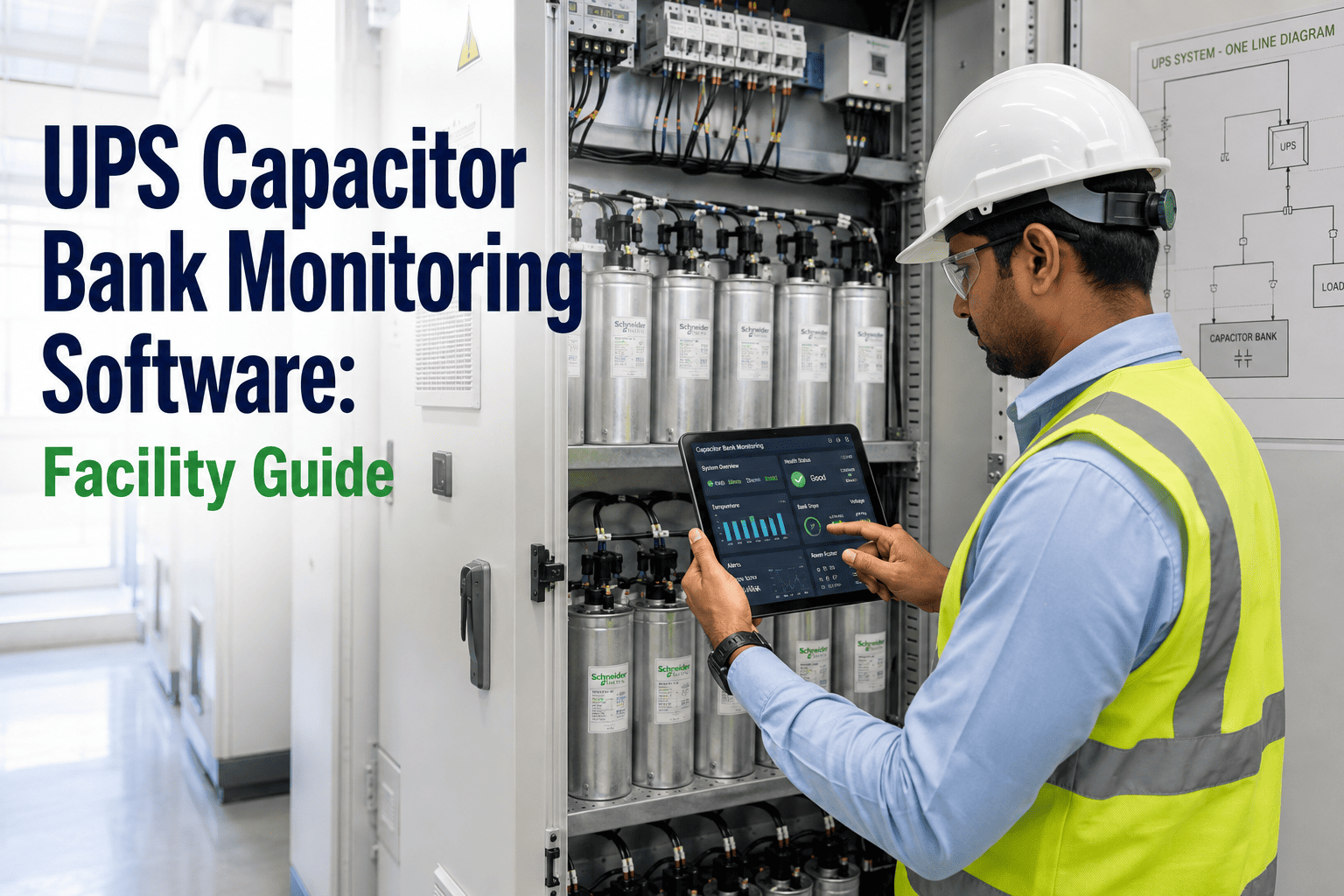
A UPS does not fail the day it fails — it fails months earlier, quietly, inside the capacitor bank nobody is watching. Electrolytic capacitors dry out, their equivalent series resistance climbs, and their capacitance drifts downward long before a technician ever gets an alarm. By the time the UPS trips during a real utility outage, the capacitor bank has usually been degrading for a year or more, invisible to a maintenance program built around annual PM visits instead of continuous, data-backed inspection. This guide breaks down what actually drives capacitor failure inside a UPS, the exact thresholds that separate a healthy bank from one weeks away from failure, and how a modern CMMS turns that data into a maintenance program instead of a guessing game — the same approach facility teams are building inside OxMaint today.
Facility Guide · Power Reliability · 2026
UPS Capacitor Bank Monitoring Software: Catching Failure Before the Outage Does
How capacitance drift and ESR trends actually predict UPS capacitor failure, and how facility teams are using CMMS software to track it before catastrophic module failure hits.
Why Capacitor Banks Are the Weakest Link in a UPS
Every UPS module depends on its DC bus and output filter capacitors to smooth ripple, hold energy during transfer events, and absorb transient loads. Electrolytic capacitors are, by a wide margin, the highest failure-rate component inside any switch-mode power system, and a UPS runs its capacitors under near-constant thermal and electrical stress for years without interruption. Heat is the primary driver: internal electrolyte evaporates gradually, capacitance falls, and equivalent series resistance rises. That rising ESR generates more internal heat under load, which accelerates the same degradation — a feedback loop that ends in either a soft failure (ripple instability, reduced runtime) or a hard failure (module shutdown mid-outage).
10%
Capacitance drop that signals thermal-stress end-of-life in most industry specifications
250%
ESR increase over rated value that defines failure threshold under thermal stress
300%
ESR increase considered end-of-life under sustained electrical load stress
20%
Capacitance loss under electrical stress conditions that confirms a bank is failing
5 Warning Signs Your Capacitor Monitoring Program Is Missing
Most facility teams do not lack a maintenance schedule — they lack visibility into the trend line. A capacitor can pass a single spot check and still be six months from failure if nobody is tracking how its readings are moving over time. These are the signs a monitoring program is reactive instead of predictive.
01
ESR readings are recorded but never trended
A single ESR value tells you almost nothing on its own. What matters is the rate of change between readings — a bank climbing 15% every quarter is a very different risk than one that has been flat for two years.
02
Runtime tests happen once a year, if at all
A battery and capacitor system that has not been load-tested since the last annual PM can be silently degrading for eleven months before anyone notices the runtime has dropped.
03
Temperature is not logged against capacitor age
Every 10°C above rated operating temperature roughly halves a capacitor's expected life. A unit running hot in a poorly ventilated UPS room is aging on a completely different curve than the same part in a cool room.
04
Findings live in a spreadsheet, not a work order
A capacitance reading that drops below threshold does nothing if it sits in a spreadsheet cell instead of triggering a scheduled replacement work order with a technician assigned to it.
05
Nobody can answer "which banks are closest to failure" in one screen
Without a fleet-wide view, capacitor risk is scattered across individual technician notes instead of ranked so the team knows exactly which unit to prioritize this month.
Stop Waiting for the Failure Alarm — Start Tracking the Trend
OxMaint logs every capacitance and ESR reading against the asset's history, flags drift automatically, and turns a failing threshold into a work order before it turns into an outage.
How CMMS-Based Capacitor Monitoring Actually Works
The shift from reactive to predictive capacitor maintenance is not about buying new test equipment — most facility teams already own an ESR meter and a capacitance tester. The shift is about where those readings go after they are taken, and what happens automatically once a value crosses a threshold.
1
Log every capacitor bank as a tracked asset
Each UPS module's capacitor bank gets its own asset record with install date, rated capacitance, rated ESR, and manufacturer specifications — the baseline every future reading is measured against.
2
Capture ESR and capacitance readings on a fixed PM cycle
Technicians record readings during scheduled preventive maintenance using a mobile checklist, so every reading is timestamped, attributed, and comparable to the last one.
3
Set drift thresholds instead of static pass/fail limits
Instead of a single pass/fail number, thresholds are set against the rate of change — a 10% capacitance drop or a 250% ESR rise from the recorded baseline automatically flags the asset.
4
Auto-generate a work order the moment a threshold is crossed
A flagged reading creates a work order in the same system, assigned to the right technician, with the asset's full reading history attached — no separate spreadsheet review needed.
5
Rank the entire UPS fleet by risk, in one view
A single dashboard ranks every capacitor bank across every UPS unit by how close it is to threshold, so replacement budgets and technician time go to the highest-risk units first.
Manual Testing vs CMMS-Driven Capacitor Monitoring
Both approaches use the same test equipment. The difference is entirely in what happens to the data afterward — and that difference is usually the gap between catching a failing bank in week three and finding out about it during a power event.
| Capability |
Manual / Spreadsheet Tracking |
OxMaint CMMS |
| Reading history per asset |
Scattered across files and technician notebooks |
Full timestamped history on the asset record |
| Drift detection |
Manual comparison, if done at all |
Automatic threshold and trend alerts |
| Work order creation |
Separate step, often delayed weeks |
Auto-generated the moment a threshold is crossed |
| Fleet-wide risk view |
Not available without manual compilation |
Single ranked dashboard across all UPS units |
| Mobile field data entry |
Paper form, entered later |
Logged on-site from a mobile device |
| Audit and compliance reporting |
Rebuilt manually before each audit |
Generated report, ready on demand |
| Typical time to detect a failing bank |
Next scheduled PM cycle, or the outage itself |
Within one reading cycle of threshold crossing |
Is Your Facility Carrying Hidden Capacitor Risk?
Use this quick read to check whether your current UPS maintenance program is actually catching capacitor degradation, or just checking a box on an annual PM form.
Lower Risk Signals
ESR and capacitance readings are logged and compared to the previous reading every cycle
Every UPS module has a documented baseline from install
A threshold breach automatically creates a work order
Room temperature around UPS units is monitored and logged
Higher Risk Signals
Readings exist but nobody compares them cycle to cycle
The last full load-bank test was over a year ago
Capacitor findings sit in a spreadsheet, not a work order queue
There is no single view ranking which UPS unit is highest risk
Time to Detection: Reactive Maintenance vs Trend-Based Monitoring
The real cost of skipping trend analysis is not the labor — it is the time between when a capacitor starts drifting and when someone actually finds out.
Average Time to Detect a Drifting Capacitor Bank
Annual PM only
Up to 12 months
Quarterly manual checks
1–3 months
CMMS trend monitoring
One reading cycle
See Your UPS Fleet's Capacitor Health in One Dashboard
Import your UPS assets, set your capacitance and ESR baselines, and let OxMaint flag risk before your next audit or your next outage — whichever comes first.
Frequently Asked Questions
How often should UPS capacitor banks be tested for ESR and capacitance?
Most facility teams test quarterly to catch drift early, though high-heat environments warrant monthly checks. The exact cadence matters less than consistent trend tracking —
OxMaint lets you set the PM interval that fits your facility's conditions.
What ESR increase actually means a capacitor needs replacement?
Industry guidance generally treats an ESR increase of 250% or more over the rated value, paired with a capacitance drop of 10% or more, as end-of-life under thermal stress. Electrical stress conditions push that threshold to 280–300% ESR increase.
Can a standard multimeter measure capacitor ESR?
No — ESR is an AC parameter typically measured at 100kHz, while a multimeter's resistance mode only reads DC resistance. A dedicated ESR meter is required for an accurate reading on any UPS capacitor bank.
Does room temperature really affect capacitor lifespan that much?
Yes — as a general rule, every 10°C above a capacitor's rated operating temperature roughly halves its expected service life. UPS rooms with poor ventilation are a common hidden driver of early capacitor failure.
How does OxMaint turn a capacitor reading into a maintenance action?
Every reading is logged against the asset's baseline and history. When a value crosses your set threshold, OxMaint automatically generates a work order assigned to a technician.
Book a demo to see the workflow live.
Your Next UPS Failure Is Preventable — If Someone Is Watching the Trend
Capacitor bank failure is one of the most predictable events in facility maintenance, yet one of the most commonly missed. OxMaint turns your ESR and capacitance readings into an early-warning system instead of a filing cabinet — live in days, not months.