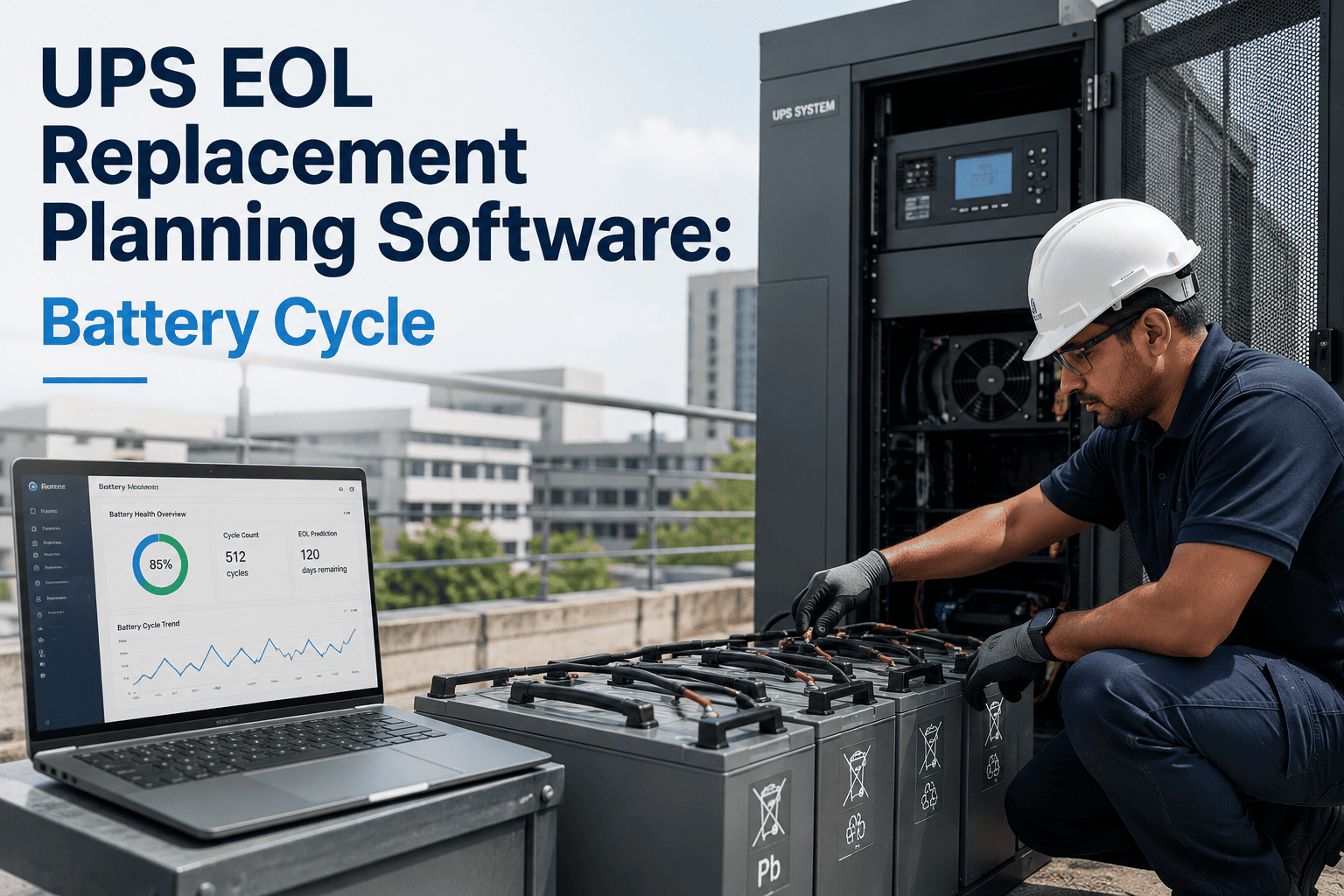
UPS batteries are the last line of defense between a power event and a critical load, yet most facilities still track replacement on a calendar rather than actual battery health. VRLA batteries typically reach end of life in 3 to 5 years, lithium-ion strings can run 8 to 10 years or more, and heat alone can cut that lifespan in half — every 10°C above 25°C roughly doubles the rate of degradation. One data center operator running 47 UPS units on calendar-based replacement discovered this the hard way: a $2.3 million unplanned outage traced back to batteries that had failed just 24 months after installation, with no monitoring in place to catch it. This guide breaks down how UPS EOL replacement planning software turns battery age into battery condition data, and what the top facility CMMS platforms in this category deliver in 2026. Start a free trial with OxMaint or book a demo to see a live battery health dashboard.
UPS Battery Lifecycle · EOL Planning · Facility CMMS 2026
UPS EOL Replacement Planning Software: Beat the Battery Cycle Before It Beats You
Track battery condition, not just battery age — and replace on schedule instead of during an outage.
$2.3M
Unplanned outage cost traced to calendar-based UPS battery replacement
34%
Battery lifecycle extension achieved with condition-based monitoring
$410K
Annual maintenance cost reduction across three critical facilities
60-90 Days
Advance warning possible from internal resistance trend data before failure
Battery Chemistry
VRLA vs Lithium — Two Very Different Replacement Cycles
The single biggest driver of your UPS EOL replacement schedule is battery chemistry. Getting this wrong at procurement doubles your replacement frequency for the next decade, so every EOL planning program has to start here.
Legacy Standard
VRLA (Sealed Lead-Acid)
The most common UPS battery chemistry, rated for 3 to 5 years under normal operating conditions and as little as 18 to 24 months in a hot server room. Lower upfront cost, shorter replacement cycle, and highly sensitive to float voltage and ambient temperature.
Conservative planning rule: replace 4-year VRLA strings at year 4, not year 5
Emerging Standard
Lithium-Ion
Commonly delivers 8 to 10 years of service life, with some controlled-environment deployments approaching 12 to 15 years. Higher upfront capex but far fewer replacement cycles, less floor space, and better thermal tolerance across a 10 to 20 year facility horizon.
Typically 15–25% higher upfront cost, but avoids one to two full replacement cycles
What Shortens Battery Life
The Four Factors That Push Batteries Toward Early End of Life
Ambient Temperature
Every 10°C above 25°C roughly cuts VRLA battery life in half. A battery room running at 35°C can push failure into an 18 to 24 month window instead of the rated 3 to 5 years.
Discharge Frequency and Depth
Frequent, deep discharge events accelerate chemical degradation well beyond what a calendar-based schedule accounts for, especially in facilities with unstable grid power.
Charge Management
Improper float voltage settings or overcharging is a leading cause of early failure and thermal events, and it rarely shows up until a battery is already compromised.
Maintenance Gaps
Skipped inspections, missing impedance tests, and poor record-keeping mean the early warning signs of degradation go unseen until the battery fails under load.
2026 Platform Rankings
Top UPS EOL and Battery Lifecycle Planning Platforms Compared
Ranked on the capabilities that actually prevent surprise battery failures: condition monitoring versus calendar tracking, replacement forecasting, procurement sync, and compliance reporting for standards like IEEE 1188 and IEEE 450.
OxMaint · UPS Battery Health · Predictive AI
Replace on Battery Condition, Not on a Guess
OxMaint tracks internal resistance, temperature, and discharge history for every battery string and flags degradation 60 to 90 days before failure — so replacement happens on your schedule, in a controlled maintenance window, not during an outage.
How It Works
How OxMaint Plans UPS Battery Replacement Before Failure
01
Assign Every Battery String a Digital Asset ID
Each battery string gets a unique OxMaint asset ID linked to its parent UPS unit, so replacement history and test data travel with the asset for its entire service life.
02
Set Chemistry-Specific Alert Thresholds
VRLA strings are flagged at a 20% rise in internal resistance from baseline, with a critical alert at 30%, while temperature sensors trigger a warning above 27°C in the battery room.
03
Log Every Discharge Event Automatically
Every UPS runtime event generates a work order documenting discharge depth and duration, building the condition history that a calendar-only program never captures.
04
Sync Replacement Windows With Procurement
Once a battery trends toward end of life, OxMaint checks parts availability and reserves replacement units, so the swap happens in a planned window instead of an emergency order.
The Replacement Roadmap
Where Your Battery Sits on the Replacement Timeline
Year 1-2: Baseline and Monitoring
Healthy range
Year 3-4: Watch Zone (VRLA)
Impedance rising
Year 4-5: Planned Replacement Window (VRLA)
Schedule the swap
Year 8-10: Planned Replacement Window (Lithium)
Long-range capex
Program Impact
What Condition-Based EOL Planning Delivers
47
UPS Units, One Dashboard
Every unit displayed with current impedance versus baseline, color-coded by health status, across every site in a single view.
34%
Longer Battery Lifecycle
Condition-based monitoring extends useful battery life well past a fixed calendar date by catching healthy strings that don't need early replacement.
$410K
Annual Cost Reduction
Across three critical facilities, eliminating emergency replacements and unnecessary early swaps cut annual maintenance spend measurably.
Zero
Surprise Outages
Replacement happens in a controlled maintenance window once a string trends toward end of life, not after it fails under load.
Facility Team Questions
UPS Battery EOL Planning — Common Questions
How often should UPS batteries actually be replaced?
+
VRLA batteries are typically replaced every 3 to 5 years, while lithium-ion strings can run 8 to 10 years or more. Conservative programs replace VRLA strings at year 4 rather than waiting for the full rated life.
Start a free trial to track your actual battery condition against these windows.
Why do calendar-based replacement schedules fail?
+
Calendar schedules assume every battery degrades at the same rate, but temperature, discharge depth, and charge management vary widely by site. Batteries can fail well before their rated age, or stay healthy well past it.
How much does temperature really affect UPS battery life?
+
Every 10°C above 25°C roughly cuts VRLA battery life in half, meaning a battery room running at 35°C can see failures in 18 to 24 months instead of the rated 3 to 5 years.
What early warning signs indicate a battery is approaching end of life?
+
Rising internal resistance is the clearest leading indicator, often trending 60 to 90 days before a failure would occur under load.
Book a demo to see how threshold alerts catch this early.
How does UPS EOL software help with budgeting, not just maintenance?
+
By forecasting replacement windows years in advance, facility teams can spread battery capex across budget cycles strategically instead of facing sudden, unplanned equipment spend.
OxMaint · UPS EOL Planning · Battery Cycle
Know Exactly When Every Battery String Needs Replacing — Before It Fails
OxMaint links every UPS battery to a digital asset record, tracks impedance and temperature against chemistry-specific thresholds, and syncs replacement windows with procurement — so end-of-life planning becomes a schedule, not a scramble.