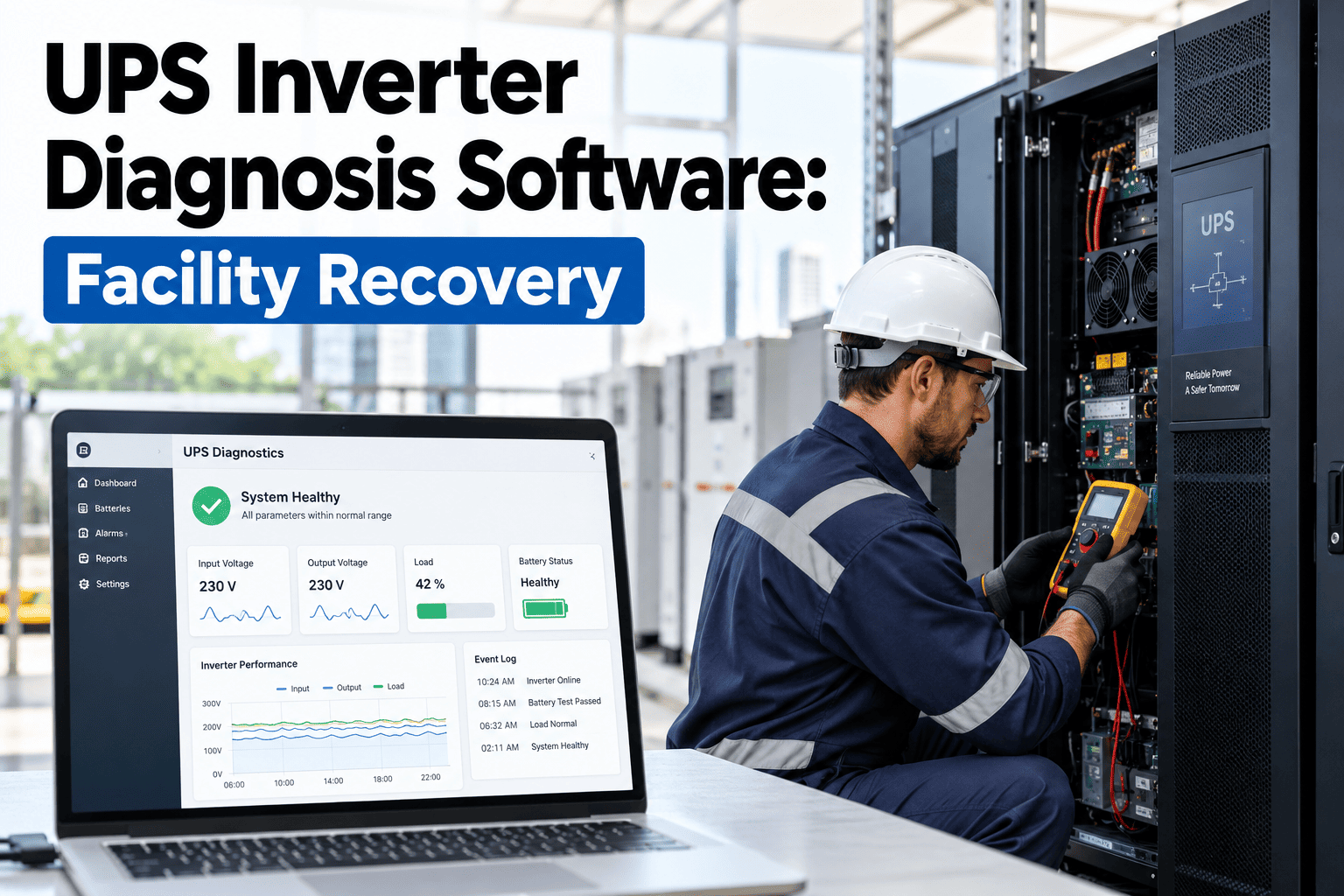
An uninterruptible power supply is only as reliable as the inverter stage that sits at its heart, and when that stage begins to fail, the warning signs are rarely obvious until load is already dropping. IGBT modules degrade under thermal cycling, capacitor banks dry out years before anyone checks their impedance, and firmware faults hide behind vague alarm codes that technicians have learned to dismiss. UPS inverter diagnosis software gives facility teams a structured way to catch these failures early, correlate them with real maintenance history, and turn a 3 AM outage into a scheduled repair instead, an approach platforms like OxMaint AI are built to support.
When the inverter stage fails, the whole facility loses protection
UPS inverters carry the entire load during a utility event. A single overlooked IGBT fault or a capacitor bank past its service life can turn a routine power blip into hours of unplanned downtime across data halls, production lines, or hospital floors.
The inverter stage hides its problems until they are expensive
An inverter fault rarely announces itself cleanly. Facility teams often see a nuisance alarm, clear it, and move on, not realizing the alarm was the first sign of a developing failure. Without a system that logs, correlates, and trends these events over time, every alarm is treated as an isolated incident instead of a pattern.
Alarm fatigue
Technicians who see the same transient alarm repeatedly begin acknowledging and clearing it without investigation, masking a slow component failure.
Fragmented records
Inverter test reports, thermal scans, and vendor service tickets often live in separate folders or filing cabinets instead of one asset record.
No baseline data
Without a documented baseline for output ripple, DC bus voltage, or capacitor ESR, technicians cannot tell drift from normal variation.
The inverter faults facility teams diagnose most often
Most inverter failures fall into a small number of recognizable categories. Structuring inspection and diagnosis workflows around these categories, rather than treating every alarm as unique, is what separates a reactive team from a predictive one.
Thermal cycling and gate driver stress cause progressive IGBT degradation, often showing up first as elevated switching temperatures or intermittent overcurrent trips before a hard failure.
DC link and output filter capacitors lose capacitance and gain equivalent series resistance as they age, producing output ripple and harmonic distortion long before an outright failure.
Clogged filters, failed cooling fans, or blocked airflow paths raise internal cabinet temperature, accelerating every other failure mode inside the inverter enclosure.
Control board faults, corrupted firmware, or communication dropouts between the inverter and static bypass can cause unnecessary transfers or false shutdown commands.
A repeatable path from alarm to verified repair
Facility teams that diagnose inverter faults consistently follow a defined sequence, rather than improvising each time. Building this sequence into a CMMS turns tribal knowledge into a process any technician can follow.
Capture the alarm with context
Log the exact alarm code, timestamp, load level, and ambient conditions rather than a generic note that the unit "tripped."
Correlate against asset history
Pull the last thermal scan, capacitor test, and preventive maintenance record for that specific inverter module to look for a developing pattern.
Isolate the failing stage
Use the correlated data to narrow the fault to a module, capacitor bank, or control card instead of swapping parts on a guess.
Generate a scoped work order
Route the corrective task to the right technician with the exact spare part, torque specs, and lockout procedure attached.
Verify and document
Record post-repair readings against the baseline so the next technician has an updated reference point, closing the loop.
What structured diagnosis actually saves
The gap between a paper-based troubleshooting process and a connected CMMS shows up most clearly in how long it takes to move from alarm to confirmed root cause.
| Fault Type | Typical First Symptom | Manual Diagnosis Time | CMMS-Assisted Diagnosis Time |
|---|---|---|---|
| IGBT degradation | Intermittent overcurrent trip | 4-8 hours across shifts | Under 1 hour with logged thermal trend |
| Capacitor bank aging | Rising output ripple | 1-2 days waiting on vendor test | Same-day with ESR history on file |
| Cooling/thermal fault | High cabinet temperature alarm | Several hours of manual inspection | Minutes with filter and fan PM records |
| Control/firmware fault | Unexplained bypass transfer | Escalation to OEM support | Faster triage using logged event sequence |
What actually drives inverter degradation over the years
Inverter components rarely fail on a fixed schedule. They fail based on how hard the unit has worked, how hot the room has run, and how consistently preventive tasks have actually been completed rather than just scheduled.
Load profile matters more than most teams assume
An inverter running near its continuous rating for years, especially in a data center or hospital with limited redundancy, cycles its IGBT junctions harder than one operating comfortably below capacity. That thermal cycling is cumulative, and it is invisible unless someone is tracking switching temperature trends over time rather than looking at a single snapshot reading during an annual inspection.
Ambient conditions compound the problem
Electrical rooms that run a few degrees warmer than design intent, or that see seasonal spikes when building HVAC struggles, accelerate capacitor electrolyte breakdown well ahead of the manufacturer's stated design life. A facility that logs room temperature alongside inverter performance data can often explain a capacitor bank's early failure instead of being surprised by it.
Deferred preventive maintenance is the quiet multiplier
A missed annual capacitor test, a skipped fan inspection, or a thermal scan that was scheduled but never completed removes the one data point that would have caught the problem early. None of these gaps look serious in isolation, but across several years they are what turns a predictable component replacement into an unplanned outage.
The KPIs worth watching on every critical inverter
Facility and reliability teams that manage inverters well track a small set of recurring metrics rather than reacting only to alarms. These numbers turn subjective impressions into objective, comparable data over time.
Mean time between failures
Tracked per module or unit, MTBF trends reveal whether a specific inverter is degrading faster than its peers in the same fleet.
Mean time to repair
Falling MTTR over successive repairs is a sign the diagnostic process, spares availability, and documentation are actually working together.
Preventive completion rate
The percentage of scheduled capacitor tests, thermal scans, and filter changes actually completed on time, not just logged as scheduled.
None of these KPIs matter as a single number in isolation. Their value comes from trending them month over month and unit over unit, so a facility director can see which inverters are quietly becoming a risk long before an alarm forces the conversation.
See how OxMaint tracks every inverter alarm back to its root cause
Walk through a live inverter asset record, from logged alarm to closed work order, in a 30-minute session with our team.
Turning inverter alarms into a maintenance program
OxMaint does not replace the inverter's own protection logic. It gives facility and reliability teams the asset-level system of record needed to spot degradation early and act on it with confidence.
Centralized Alarm and Event Log
Every alarm, transfer event, and technician note attaches to the specific inverter module asset record, building a searchable history instead of a scattered paper trail.
Preventive Test Scheduling
Recurring capacitor ESR checks, thermal scans, and torque inspections are scheduled automatically and tracked against manufacturer-recommended intervals.
Mobile Diagnostic Checklists
Technicians follow structured, module-specific checklists on a phone or tablet, capturing readings directly against the asset's documented baseline.
Spare Parts and Vendor Tracking
IGBT modules, gate driver boards, and capacitor kits are tracked by location and lead time, so a diagnosed fault does not stall waiting on parts.
Mistakes that turn a fixable fault into a full outage
Most catastrophic inverter failures were survivable earlier in their development. A handful of recurring mistakes explain why teams miss the window to intervene before the failure becomes total.
Replacing a module or board on a guess, without confirming the actual failed component, often leaves the underlying cause in place to fail again within months.
Redundancy buys time, not immunity. A degrading module left unaddressed because the system is still protected removes the safety margin the redundancy was meant to provide.
Closing a work order without recording new baseline readings means the next technician has nothing current to compare against when the unit is inspected again.
Without a defined temperature or ripple threshold that triggers a mandatory inspection, minor drift is left to a technician's individual judgment call.
Why inverter records matter beyond the repair itself
Critical facilities in healthcare, data center, and manufacturing environments increasingly face audit requirements that extend to power protection equipment, not just life-safety systems.
Insurance and risk reviews ask for maintenance history
Property insurers underwriting critical facilities frequently request evidence of a documented preventive maintenance program for UPS systems, particularly after a claim. A facility with organized inverter test records and repair history is in a materially stronger position than one relying on a technician's memory of what was done.
Internal reliability programs need consistent data
Facility directors reporting uptime and reliability metrics to leadership need inverter performance data that is consistent across units and time periods. A CMMS that enforces the same checklist and the same fields for every inspection makes that reporting possible without a manual data-cleaning exercise every quarter.
One inverter fault, two very different outcomes
- A UPS module logs three brief overcurrent alarms across two weeks, each cleared without investigation
- No trend is visible because the alarms are recorded in three different shift logs
- The IGBT module fails completely during a utility outage, forcing a transfer to bypass
- Emergency vendor dispatch and expedited part shipping add days to the repair
- The same three alarms are logged against one asset record and flagged as a repeating pattern
- A diagnostic work order is generated automatically, prompting a thermal scan
- Elevated switching temperature confirms early IGBT degradation before a hard failure
- The module is scheduled for replacement during a planned maintenance window
UPS inverter diagnosis questions facility teams ask
What causes most UPS inverter failures?
The majority trace back to IGBT thermal degradation, aging DC link capacitors, or cooling system faults that raise internal cabinet temperature. Firmware and control board issues account for a smaller but still significant share.
How often should UPS inverter capacitors be tested?
Most manufacturers recommend annual capacitance and ESR testing, with more frequent checks as units approach eight to ten years of service. A CMMS can schedule and track this automatically, see how at Calendly.
Can software actually diagnose an inverter fault?
Software does not replace electrical testing, but it correlates alarm history, test data, and maintenance records so technicians can isolate a probable cause faster and confirm it with targeted testing rather than guesswork.
What is the biggest gap in manual inverter troubleshooting?
The lack of a documented baseline. Without recorded readings from when the unit was healthy, technicians cannot reliably tell whether a reading indicates drift or normal variation.
How quickly can a facility get inverter diagnostics running in OxMaint?
Most facilities load their UPS and inverter asset registers and begin logging alarms within one to two weeks. Start a free trial at OxMaint to configure your first inverter asset records.
Building an inverter diagnostic program without a long rollout
Facility teams do not need every inverter fully instrumented before this approach pays off. A staged rollout that starts with the most critical units captures value fast while the broader asset register is built out.
Start with the units that carry the most risk
Inverters protecting the largest load, the oldest units approaching end of design life, or any unit with a recent history of nuisance alarms are the natural starting point. Loading their nameplate data, service history, and current alarm log into a CMMS asset record takes a fraction of the time of a full facility-wide rollout.
Let the alarm history build the baseline
Even without historical test data on hand, logging every new alarm and reading from this point forward begins building the trend line that makes future diagnosis faster. Six months of consistent logging is often enough to reveal patterns that years of undocumented service history never surfaced.
Bring the electrical contractor's data into the same record
Facilities that outsource inverter testing to an electrical contractor or the UPS manufacturer's service team should route that contractor's findings into the same asset record used for internal work orders. Splitting vendor test reports from internal repair history across two systems recreates the exact fragmentation this approach is meant to solve.
Stop treating inverter alarms as one-off events
Every logged alarm, test result, and repair is a data point that makes the next diagnosis faster. Build that record with OxMaint before the next fault becomes an outage.
Free 14-day trial · No credit card