If you manage facilities, real estate, or workplace operations at any scale, you have almost certainly encountered the acronym IWMS — usually in a vendor pitch, a consultant's report, or a procurement comparison document. An Integrated Workplace Management System is a software platform that consolidates multiple facility and real estate management functions into a single database: maintenance, space management, real estate portfolio, capital projects, and sustainability reporting. The question most facility directors actually need answered is not "what is an IWMS" but "does my organisation need one, or is a purpose-built CMMS like OxMaint the right fit for where we are today?" This guide answers that question with the specifics that vendor marketing pages deliberately avoid.
Blog · Facility Management · IWMS vs CMMS
What Is an IWMS — and Do You Actually Need One?
IWMS definition, core modules, the real differences from a CMMS, implementation costs, and the honest decision framework for choosing the right platform for your organisation's size and complexity.
What This Guide Covers
01 · IWMS Definition
02 · 5 Core Modules
03 · IWMS vs CMMS
04 · Real Costs
05 · Who Needs What
06 · ROI Comparison
07 · Expert Review
08 · FAQs
01 — What an IWMS Actually Is
The term IWMS was coined by Gartner in 2004 to describe a class of software that integrates five distinct workplace and real estate management disciplines into a single platform with a unified data model. The defining characteristic is integration — not just data sharing between modules, but a single asset and location record that all modules reference. A building in an IWMS is not entered separately in the maintenance system, the lease management system, and the space management system — it exists once and is accessed by all.
Gartner IWMS Definition
"An integrated workplace management system (IWMS) is a software platform that helps organisations optimise the use of workplace resources, including the management of a company's real estate portfolio, infrastructure, and facilities assets."
Key word: integrated — five modules, one data model, one vendor. That integration is both the value proposition and the implementation complexity.
02 — The 5 Core IWMS Modules
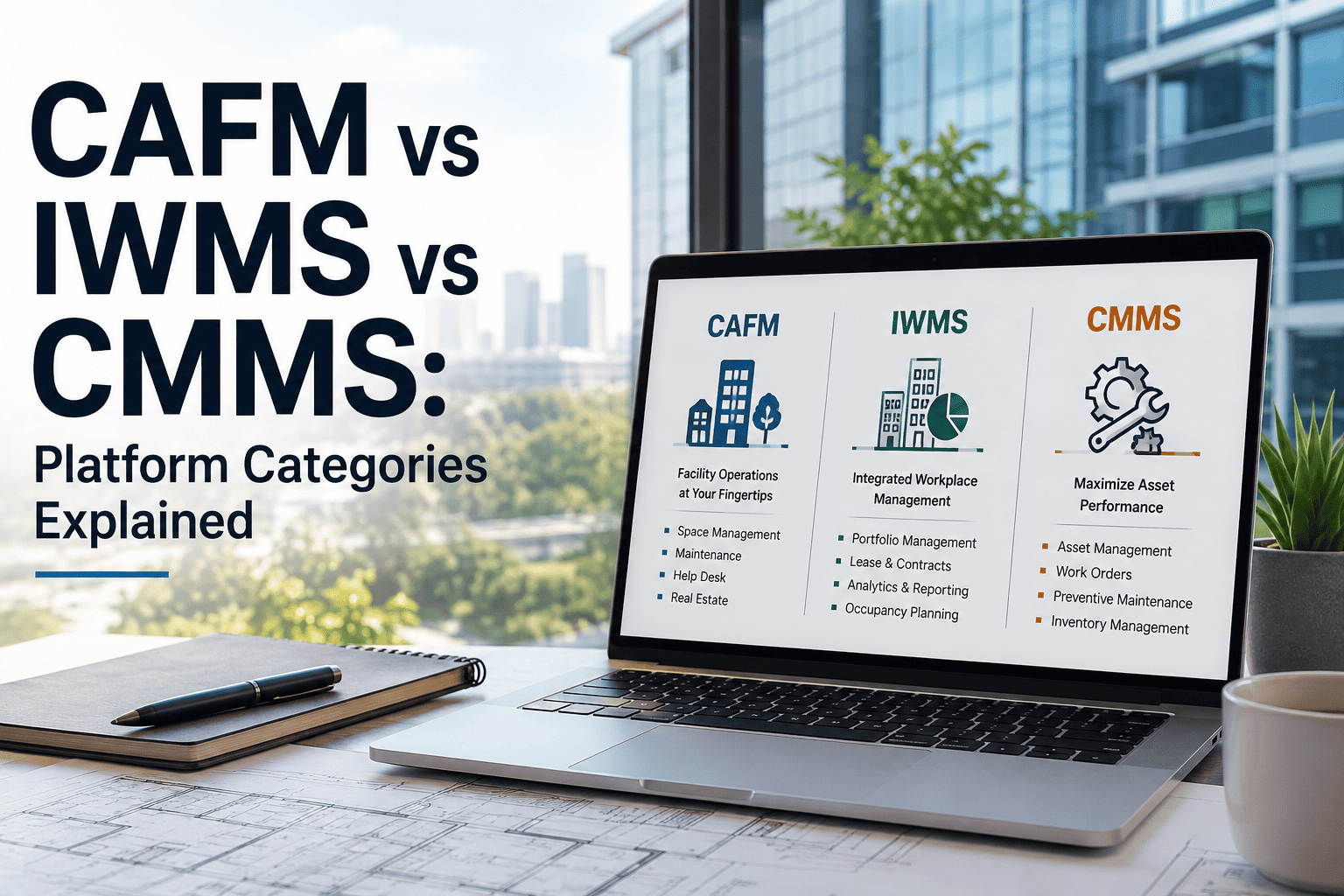
Every platform marketed as an IWMS should include all five of these functional modules. Platforms that cover only two or three are CAFM (Computer-Aided Facility Management) or CMMS solutions — legitimate products, but not IWMS by the Gartner definition. Understanding which modules you actually need is the starting point for a correct platform decision.
01
Operations and Maintenance
Work order management, PM scheduling, asset lifecycle tracking, and compliance documentation. This is the module where CMMS platforms like OxMaint operate — and where the deepest day-to-day operational value is generated.
Primary users: Facility managers, maintenance technicians, compliance teams
02
Real Estate and Lease Management
Lease abstraction, critical date tracking, rent payment automation, and portfolio financial reporting. Covers commercial real estate transactions, lease accounting (ASC 842 / IFRS 16 compliance), and landlord/tenant management.
Primary users: Real estate directors, CFOs, legal and finance teams
03
Space and Move Management
Floor plan management, seat allocation, occupancy utilisation tracking, and move/add/change coordination. Became significantly more valuable post-2020 as hybrid work models created the need to manage dynamic space utilisation across portfolios.
Primary users: Workplace experience teams, HR, space planners
04
Capital Project Management
Capital improvement planning, construction project management, contractor management, and budget tracking for renovation and fit-out projects. Links to the maintenance module through asset commissioning on project completion.
Primary users: Project managers, capital planning teams, finance
05
Sustainability and Energy Management
Energy consumption tracking, carbon footprint reporting, ESG data aggregation, and utility bill management. Increasingly tied to maintenance data — linking energy anomalies to maintenance work orders that address the root cause of efficiency losses.
Primary users: Sustainability managers, CFOs, ESG reporting teams
OxMaint covers Module 1 (Operations and Maintenance) and Module 5 (Energy and ESG Reporting) with purpose-built depth — at a fraction of the cost and implementation time of a full IWMS. Start free or book a demo to see how it maps to your facility's needs.
03 — IWMS vs CMMS: The Honest Comparison
The IWMS vs CMMS comparison is frequently oversimplified as "IWMS does more." The accurate framing is: IWMS does more things at shallower depth, and CMMS does fewer things at greater operational depth. For a maintenance team whose primary need is asset reliability, PM compliance, and work order efficiency, a deep CMMS almost always outperforms an IWMS's maintenance module in day-to-day usability.
| Capability |
Full IWMS |
OxMaint CMMS |
Who Wins |
| Maintenance work orders |
Present — often basic compared to dedicated CMMS |
Full feature — mobile, escalation, PM auto-scheduling |
CMMS |
| Asset lifecycle tracking |
Present — linked to capital planning module |
Full feature — condition history, FCI, replacement planning |
CMMS |
| PM compliance and audit trail |
Present — varies by vendor |
Purpose-built — immutable records, mobile sign-off, reports |
CMMS |
| Predictive maintenance AI |
Available in some platforms — add-on cost |
Native — BMS integration, anomaly detection, auto work orders |
CMMS |
| Lease and real estate management |
Full feature — ASC 842, IFRS 16, portfolio reporting |
Not included |
IWMS |
| Space and occupancy management |
Full feature — floor plans, utilisation, move management |
Not included |
IWMS |
| Capital project management |
Full feature — budgets, contractors, commissioning |
Partial — through work order and asset records |
IWMS |
| Energy and ESG reporting |
Present — utility bill aggregation, basic carbon |
Maintenance-linked — energy anomaly to work order pipeline |
Tie — different approach |
| Implementation time |
12–24 months for full deployment (enterprise) |
5–14 days to first work orders in production |
CMMS |
| Total cost of ownership (3 yr) |
$180K–$1.2M (enterprise) · $40K–$180K (mid-market) |
$6K–$60K depending on portfolio size |
CMMS |
| Mobile field technician UX |
Often limited — designed for desktop power users |
Mobile-first — built for plant floor, gloved-hand use |
CMMS |
04 — IWMS Real Costs: What Vendors Don't Publish
IWMS vendors almost universally decline to publish pricing — which is itself an indicator of implementation complexity and negotiation-based pricing. The ranges below are drawn from publicly reported procurement data, analyst reports (Gartner, Forrester), and buyer community benchmarks for the major IWMS platforms (IBM Tririga, Archibus/Eptura, Planon, iOFFICE, Accruent).
Enterprise IWMS
10M+ sq ft · Multi-country portfolio
Licensing (annual)$150K–$600K
Implementation$300K–$1.5M
Internal IT resources2–4 FTE for 18 months
Training$40K–$120K
3-Year TCO$900K–$3.5M
Mid-Market IWMS
500K–10M sq ft · Single country
Licensing (annual)$30K–$150K
Implementation$60K–$300K
Internal IT resources1–2 FTE for 12 months
Training$15K–$50K
3-Year TCO$180K–$800K
OxMaint CMMS
Any size · Live in days, not months
Licensing (annual)Free → Paid tiers
ImplementationDays — self-serve or guided
Internal IT resourcesNone required
TrainingIncluded
3-Year TCO$6K–$60K
05 — Decision Framework: Who Needs What
The right platform depends on which business problems you are actually solving today — not which platform looks most comprehensive in a demo. Use the framework below to identify your fit honestly.
Start with a CMMS (OxMaint)
Your primary pain is maintenance reliability, PM compliance, or work order efficiency
You manage 1–50 buildings with a maintenance team
You need to be live and producing value within weeks, not months
Budget is under $50K/year for platform investment
You do not have a complex real estate portfolio requiring lease accounting
You need mobile-first tools for field technicians, not desktop-first for administrators
Consider IWMS When
You manage 50+ buildings with complex lease portfolios requiring ASC 842 / IFRS 16 compliance
Space utilisation and move management at portfolio scale is a primary business problem
You have active capital construction programmes requiring project management integration
Corporate real estate, facilities, and sustainability report to the same executive and need unified data
You have IT resources and 12–24 months available for a structured implementation
Annual platform investment of $150K+ is justifiable by cross-functional efficiency gains
06 — ROI Comparison: IWMS vs CMMS at Different Scales
ROI on facility management software is driven by two factors: the size of the problem being solved and the time to value. A CMMS deployed in one week that prevents a $40,000 chiller failure in month two has already paid for years of platform cost. An IWMS that takes 18 months to implement cannot deliver any ROI until after go-live.
Time to First Measurable ROI (months from contract signing)
Mid-Market IWMS
12–18 months
Enterprise IWMS
18–30 months
3-Year Total Cost of Ownership (USD)
Mid-Market IWMS
$180K–$800K
Enterprise IWMS
$900K–$3.5M
Most Facility Teams Need Maintenance Excellence First — OxMaint Delivers It in Days, Not Months
Before investing 18 months and $300K+ in an IWMS implementation, consider whether your primary operational gap is in maintenance reliability, PM compliance, and asset visibility — problems that OxMaint solves completely, at a fraction of the cost and timeline, with a free starting tier and no IT project required.
Expert Review
DM
David Marchetti, CFM, LEED AP
Director of Facilities Management, 24 years · Cornell University, Facilities Engineering · IFMA Fellow · Specialist in facility technology strategy and IWMS/CMMS platform selection for corporate and institutional portfolios
The most expensive mistake I see in facility management technology decisions is organisations buying an IWMS when they need a CMMS. The reasoning is understandable — the IWMS looks more comprehensive in the demo, the vendor positions it as the "enterprise" choice, and nobody wants to be seen making the less sophisticated decision. What those organisations discover 18 months later, $400,000 into implementation, is that their maintenance team still cannot run a reliable PM schedule because the IWMS's maintenance module was an afterthought to the lease management and space planning functionality. The platforms built around real estate and space first treat maintenance as a supporting feature. Platforms like OxMaint that were built around maintenance operations first are fundamentally better tools for the people who actually run the building day to day. My recommendation: start with a CMMS that solves the operational maintenance problem completely. Add IWMS real estate and space modules when — and only when — those business problems become the limiting constraint on your organisation's performance.
Frequently Asked Questions
Can a CMMS replace an IWMS, or do the two platforms serve different purposes?
For organisations whose primary operational challenge is maintenance reliability, PM compliance, asset lifecycle management, and work order visibility, a purpose-built CMMS like
OxMaint outperforms an IWMS's maintenance module in day-to-day usability and depth. An IWMS is the right choice when you need lease accounting, space utilisation management, and capital project management integrated with maintenance data in a single platform — which is a legitimate need for complex corporate real estate portfolios but is not the operational reality for most facility management teams. The platforms serve different primary users: CMMS serves the maintenance team; IWMS serves the corporate real estate, HR, and finance functions alongside facilities.
What are the leading IWMS platforms and how do they compare?
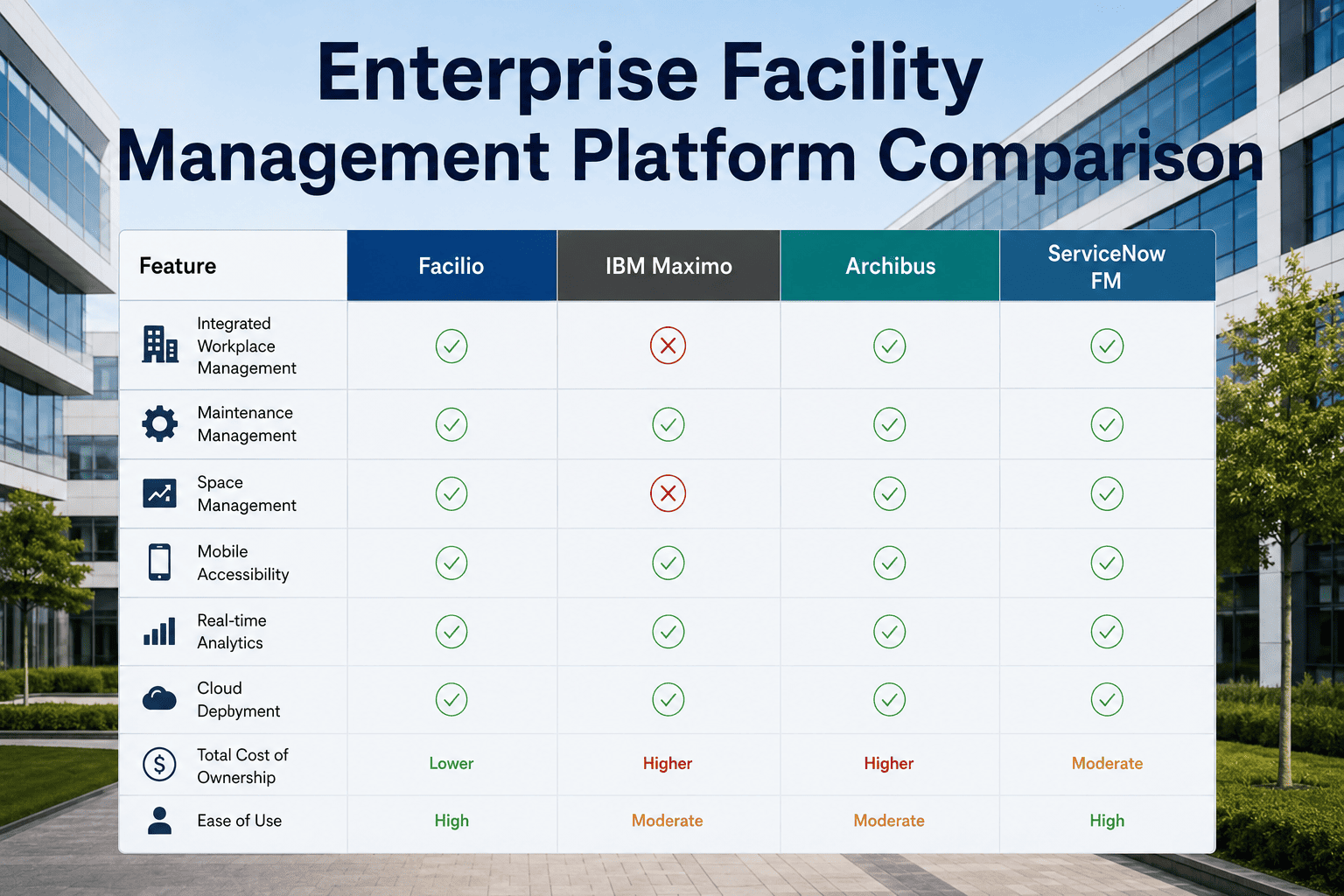
The major enterprise IWMS platforms are IBM Tririga, Planon, Eptura (formerly Archibus and iOFFICE), Accruent, and Nuvolo. Each has historical strengths in different modules: Tririga is strong in real estate; Planon is strong in maintenance and sustainability; Archibus has historically been the most widely deployed; Eptura covers space management for hybrid work particularly well. All of them require significant implementation investment ($60K–$1.5M depending on scale) and 12–24 months to full deployment. For organisations that need only the maintenance and ESG reporting modules,
OxMaint delivers both at a fraction of the cost and timeline.
How does IWMS handle ASC 842 and IFRS 16 lease accounting compliance?
IWMS platforms with real estate management modules include lease accounting functionality that calculates right-of-use assets and lease liabilities per ASC 842 (US GAAP) and IFRS 16 (international) standards. They automate the amortisation schedules, journal entry generation, and disclosure reporting required for compliance — replacing the spreadsheet-based lease accounting that most organisations used before these standards took effect in 2019. This is a legitimate and valuable function for organisations managing 20+ leases — but it has no overlap with maintenance operations and does not require the same platform as your work order management system.
OxMaint focuses on operations and maintenance, not lease accounting.
What is the realistic implementation timeline for an IWMS versus a CMMS?
Enterprise IWMS implementations typically run 18–30 months for full deployment across all five modules. Mid-market IWMS deployments run 9–18 months. These timelines reflect data migration, configuration, integration with HR, finance, and BMS systems, and user training across multiple departments with different workflows. By contrast, OxMaint's CMMS implementation for a facility of any size runs 5–14 days from account creation to first work orders in production — with asset import from Excel, PM schedule configuration, and mobile technician onboarding all completed within the first week.
Book a 30-minute demo to see the onboarding process live.
Your Facility Operations Problem Is Probably a CMMS Problem — Not an IWMS Problem
If your maintenance team is missing PMs, losing asset history, managing work orders on paper, or struggling to produce audit documentation — OxMaint solves all of it in days, not months, at a cost that does not require a capital committee approval. Start with a free account and see your first automated PM work orders in production this week.