Every maintenance team knows the frustration: a critical pump fails at 2 AM, the operator calls the supervisor, who calls the maintenance manager, who creates a work order manually, who then assigns it to a technician — all while the production line bleeds money at $260,000 per hour of unplanned downtime. By the time a wrench touches the machine, the damage has compounded exponentially. Now imagine a different scenario — an IoT vibration sensor detects an anomaly at 11 PM, your CMMS platform automatically generates a prioritized work order, assigns it to the right technician based on skill and availability, and attaches the asset history before anyone even picks up a phone. That is work order automation with IoT triggers — and it is transforming maintenance from a reactive firefight into a precision operation. Schedule a demo to see how Oxmaint makes this real for your facility.
Anomaly identified
Work order created
Auto-assigned
Before breakdown
How IoT-Triggered Work Orders Actually Work
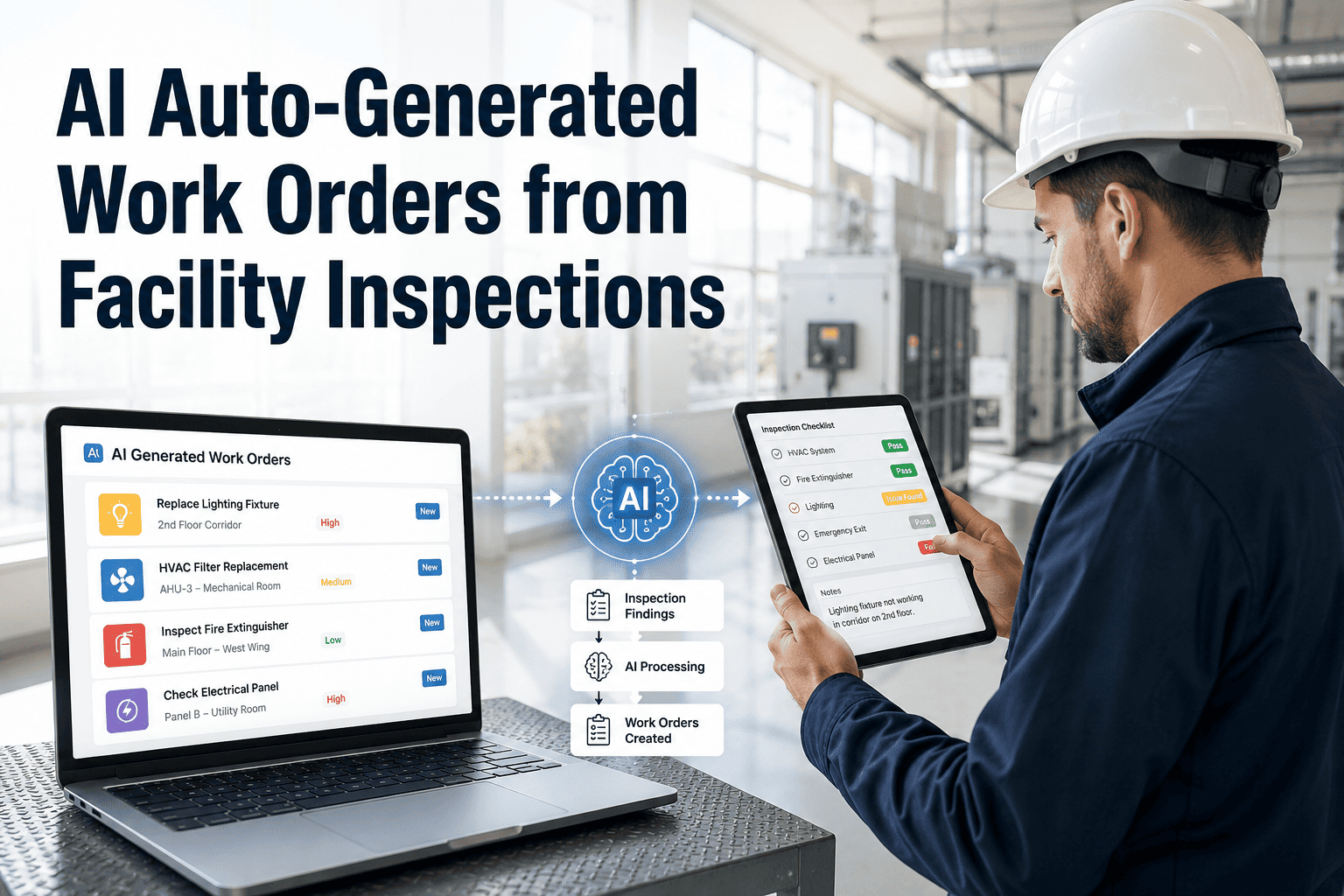
The traditional maintenance workflow has too many human handoffs — each one adding delay, error potential, and cost. IoT-triggered work order automation eliminates these gaps by creating a closed loop between your equipment and your maintenance team. Sensors continuously monitor critical parameters like vibration amplitude, bearing temperature, motor current draw, pressure differentials, and fluid levels. When any reading crosses a predefined threshold, the Oxmaint work order system instantly generates a prioritized task — complete with asset details, failure mode context, recommended parts, and technician assignment. No phone calls. No clipboard handoffs. No lost time.
Automate Work Orders from Sensor Data
Oxmaint connects with vibration, temperature, pressure, and current sensors to generate work orders the moment thresholds are crossed — no manual intervention required.
Sensor Types That Drive Automated Work Orders
Not all sensors serve the same purpose, and your IoT strategy should match sensor types to the failure modes most critical in your facility. Here are the key sensor categories that integrate with Oxmaint's predictive maintenance engine to trigger intelligent work orders:
Vibration Sensors
Tri-axial accelerometers sampling at up to 25 kHz detect bearing-wear signatures at specific shaft-frequency multiples — patterns invisible to human senses. When RMS velocity exceeds ISO 10816 thresholds, a work order is triggered automatically.
Temperature Sensors
Thermocouples and IR sensors detect hotspots exceeding OEM limits by as little as 2 degrees Celsius — an early flag for lubrication breakdown or electrical faults. Critical for motors, bearings, switchgear, and HVAC compressors.
Pressure Sensors
Differential pressure transmitters track hydraulic systems, pneumatic lines, and filtration systems. A gradual pressure drop across a filter triggers a replacement work order before flow restriction impacts production.
Current / Power Sensors
Current transformers and power meters detect motor degradation through current signature analysis. Increasing amp draw under constant load indicates winding insulation breakdown or mechanical binding — triggering inspection work orders weeks before failure.
Ultrasonic Sensors
Detect high-frequency sounds generated by compressed air leaks, faulty steam traps, and partial discharge in electrical systems. A single compressed air leak can cost $3,000-$8,000 annually — ultrasonic detection catches them early.
Runtime / Cycle Counters
Track operating hours, cycle counts, and production volumes. When a CNC spindle hits 2,000 hours or a press reaches 50,000 cycles, the CMMS automatically generates a preventive maintenance work order with the full task checklist attached.
The Automation Engine: From Threshold to Technician
Understanding the data flow from sensor to completed repair is critical. Here is exactly how Oxmaint processes an IoT trigger into an actionable, tracked work order:
Sensor Reading Captured
IoT sensor transmits data via MQTT, LoRaWAN, or cellular to the Oxmaint gateway. Data is time-stamped, tagged with asset ID, and stored in the cloud data lake.
Threshold Evaluation
Rule engine compares live reading against predefined thresholds. Supports multi-condition logic: temperature > 85C AND vibration > 7mm/s AND runtime > 500 hours.
Work Order Generated
CMMS creates a prioritized work order with: asset details, sensor data snapshot, failure mode context, recommended spare parts, and estimated completion time.
Technician Assigned
Auto-assignment based on skill certification, current workload, shift schedule, and physical proximity. Technician receives a mobile push notification with full context.
Parts Verified
Inventory system cross-references required parts against available stock. If parts are in stock, the storeroom is notified. If not, a purchase requisition is auto-created.
Closed Loop Tracking
Technician updates status via mobile app. Completion data feeds back into the analytics engine — improving future threshold accuracy and failure predictions.
Real-World Impact: Industries Benefiting from IoT Work Orders
IoT-triggered work order automation is not a future concept — it is delivering measurable results across industries today. Here is how different sectors are using this capability with Oxmaint's industry-specific solutions:
Manufacturing
Vibration sensors on CNC machines, injection molders, and conveyor drives detect bearing wear and imbalance 2-6 weeks before failure. Automated work orders cut unplanned downtime by 35% and emergency maintenance spend by 30%.
Facility Management
Temperature and humidity sensors in HVAC systems, data centers, and cold storage trigger work orders when environmental conditions drift outside safe ranges — protecting sensitive equipment and inventory before damage occurs.
Oil and Gas
Pressure and gas sensors on pipelines, compressors, and wellheads detect leaks, corrosion, and equipment degradation. Automated escalation protocols ensure safety compliance while preventing catastrophic failures at remote sites.
Food and Beverage
Temperature sensors in refrigeration, pasteurization lines, and storage units trigger immediate work orders when readings exceed compliance thresholds — ensuring HACCP and FDA compliance while preventing product spoilage and costly recalls.
Your Industry, Your Rules, Your Triggers
Configure custom threshold rules, multi-condition logic, and escalation protocols tailored to your equipment and compliance requirements. Sign up free and start automating today.
ROI of IoT Work Order Automation
The business case for IoT-triggered work orders is built on hard numbers. Here is a breakdown of the financial impact facilities can expect after implementation:
Getting Started: 5 Steps to IoT Work Order Automation
Implementing IoT-triggered work orders does not require ripping out your existing infrastructure. Here is a practical roadmap to get from manual processes to automated, sensor-driven maintenance:
Identify Critical Assets
Start with the 20% of equipment that causes 80% of your downtime. Use your CMMS failure history to rank assets by downtime cost, repair frequency, and production impact. These are your first IoT candidates.
Select the Right Sensors
Match sensor types to dominant failure modes: vibration sensors for rotating equipment, temperature sensors for electrical systems, pressure sensors for hydraulics and pneumatics. Choose industrial-rated sensors with IP67+ protection.
Connect to Oxmaint CMMS
Oxmaint supports MQTT, REST API, LoRaWAN, and cellular gateways. Sensors feed data directly into your asset records. Sign up for Oxmaint and configure your first sensor connection in minutes.
Define Threshold Rules
Set condition-based triggers with multi-parameter logic. Example: IF vibration > 7mm/s AND temperature > 80C AND runtime > 1,000 hours THEN create Priority-1 work order for bearing inspection.
Train, Monitor, and Optimize
Train your team on mobile work order management. Monitor trigger accuracy for the first 90 days. Use Oxmaint's analytics and reporting to refine thresholds based on actual failure data — continuously improving prediction accuracy.
Stop Reacting to Breakdowns — Start Preventing Them
Oxmaint connects your IoT sensors to intelligent work order automation — generating, assigning, and tracking maintenance tasks the moment conditions change. Reduce downtime, cut costs, and keep your operations running at peak performance.
Frequently Asked Questions
What IoT protocols does Oxmaint support for sensor integration?
Oxmaint supports all major industrial IoT protocols including MQTT, REST API, OPC-UA, Modbus TCP, LoRaWAN, and cellular (4G/5G). Sensors transmit data through gateways that aggregate and forward readings to the Oxmaint cloud platform. The system also integrates with existing SCADA and BAS (Building Automation Systems), so you can leverage sensors already installed in your facility without additional hardware investment. Data mapping is configurable per sensor, allowing you to define exactly which parameters feed into work order trigger rules.
How quickly does an IoT trigger generate a work order?
From the moment a sensor reading crosses a threshold to a fully populated work order appearing on a technician's mobile device, the typical latency is under 30 seconds. This includes threshold evaluation, work order creation with asset context, technician auto-assignment based on skill and availability, parts inventory verification, and push notification delivery. Compare this to manual processes that average 4-8 hours from failure detection to work order assignment — the difference is the gap between a minor repair and a catastrophic breakdown.
Can I set multi-condition triggers (AND/OR logic)?
Yes. Oxmaint's rule engine supports complex multi-condition logic combining multiple sensor inputs. For example, you can set a rule that triggers only when vibration exceeds 7mm/s AND bearing temperature exceeds 80 degrees C AND the asset has logged more than 1,000 runtime hours. You can also configure OR conditions, time-based restrictions (only trigger during production hours), and escalation chains (if not acknowledged within 30 minutes, escalate to supervisor). This prevents false-positive work orders while ensuring genuine anomalies are never missed.
What is the typical ROI timeline for IoT work order automation?
Most facilities see measurable value within 6-10 weeks of deployment, with full payback achieved in 6-18 months. The ROI comes from multiple sources: reduced emergency repair costs (25-40% reduction), decreased unplanned downtime (35-50% reduction), extended equipment lifespan (20-40% improvement), and lower administrative overhead (40% reduction in manual work order processing). Facilities that achieve seamless integration between sensors, analytics, and their CMMS typically realize 3-4x higher ROI than those using isolated monitoring solutions.
Do I need to replace my existing sensors to use Oxmaint?
No. Oxmaint is sensor-agnostic and integrates with most existing industrial sensor networks. If your facility already has vibration monitors, temperature probes, pressure transmitters, or PLC-connected sensors, Oxmaint can ingest that data through standard protocols like MQTT, OPC-UA, or REST APIs. You only need to add new sensors for assets that currently lack monitoring. Many customers start by connecting existing SCADA or BAS data to Oxmaint, then gradually add dedicated IoT sensors to their most critical unmonitored assets.