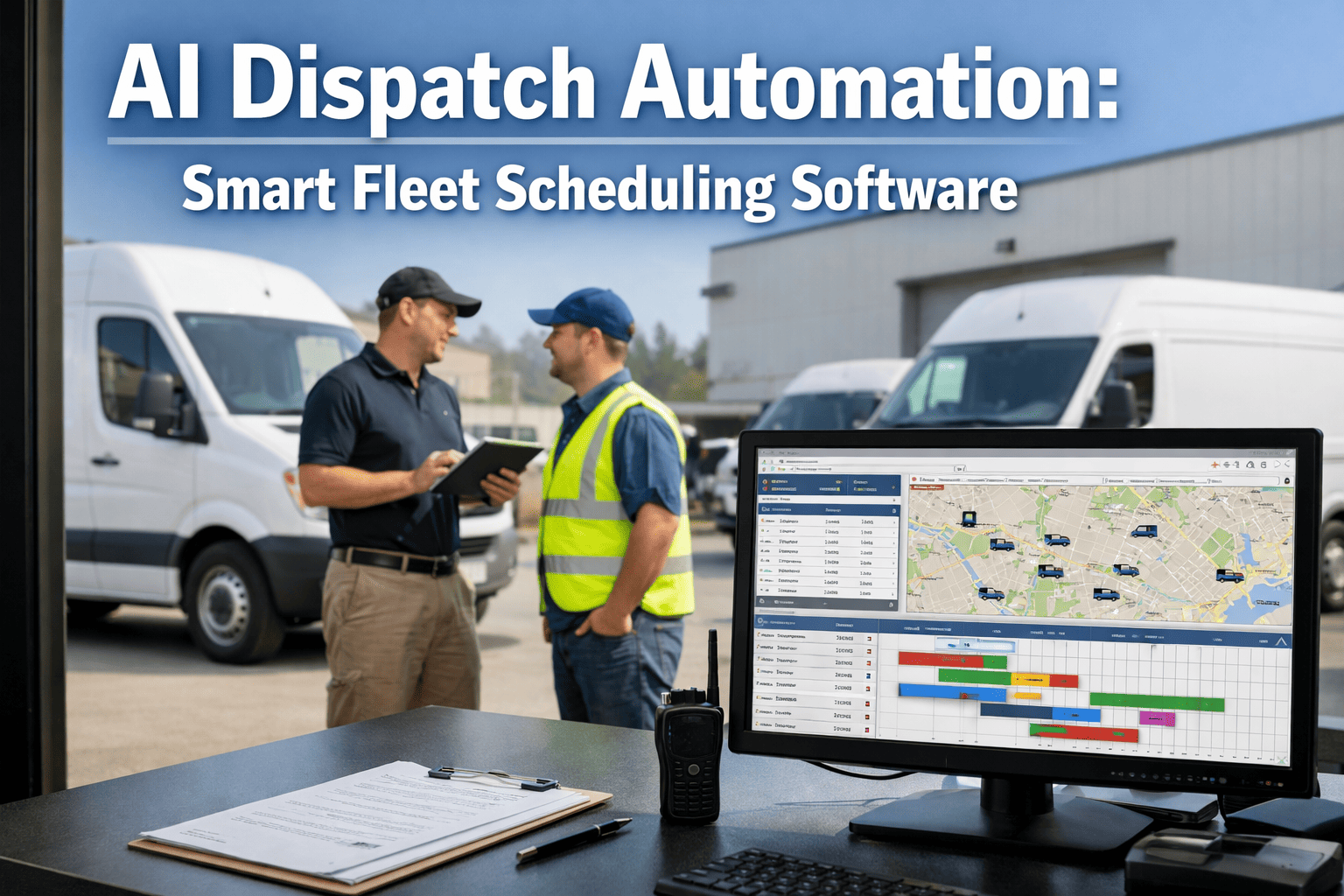
AI Dispatch Automation: Smart Fleet Scheduling Software
By Jack Miller on April 10, 2026
A regional HVAC service company in Phoenix was running 48 technicians across 280 daily service jobs. Their dispatch coordinator spent the first two hours of every morning manually assigning jobs — matching technician skill to job type, checking availability, estimating drive times, and updating the board whenever a job ran long or a technician called in sick. By 9 AM the schedule was already 40 minutes behind and the coordinator was fielding three simultaneous phone calls. The company's on-time arrival rate was 61%. Customer complaints about missed windows were their top negative review driver. OxMaint's AI dispatch engine replaced the entire morning scheduling process with automated job assignment that matches technician skill, availability, location, and current route in real time — then re-optimises continuously as the day changes. On-time arrival reached 89% within 90 days. Book a demo to see your fleet scheduled automatically.
AI Dispatch — Right Technician. Right Job. Right Time. Automatically.
Automated job assignment, dynamic re-scheduling, and real-time optimisation — OxMaint AI Dispatch
On-time arrival rate — up from 61% within 90 days of AI dispatch deployment
2 hrs
Dispatcher time saved every morning — manual scheduling replaced by AI job assignment
23%
More jobs completed per day — same fleet, same technicians, smarter scheduling
The Six Problems AI Dispatch Solves That Manual Scheduling Cannot
Manual dispatch is not a people problem — it is a data problem. No coordinator can hold 48 technician locations, 280 job priorities, real-time traffic, and skill requirements simultaneously in their head. OxMaint's AI dispatch engine processes every variable simultaneously, every 90 seconds, without fatigue.
Wrong Technician, Wrong Job
Manual dispatch relies on dispatcher memory for skill matching. AI cross-references every technician's certified skills, equipment type authorisations, and job history to assign the correct person every time.
Schedule Collapses When One Job Runs Late
A single 45-minute overrun cascades across the day in manual scheduling. AI re-optimises all downstream assignments automatically the moment a job extends — customers are notified before windows are missed.
Drive Time Waste Between Jobs
Manual dispatch rarely optimises geographic clustering. AI sequences jobs by real-time location — reducing total drive time 18–28% and recovering 40–90 minutes of productive time per technician per day.
Unequal Workload Distribution
Manual scheduling consistently overloads the same technicians while others have spare capacity. AI balances workload across the team while respecting skill requirements — reducing overtime and burnout simultaneously.
No Real-Time Visibility for Customers
Customers call to chase ETAs because they have no real-time visibility. AI dispatch generates accurate ETAs at assignment and updates them continuously — automated SMS and app notifications reduce inbound calls by 60%.
Emergency Jobs Break the Entire Schedule
When a priority breakdown arrives mid-day, manual re-scheduling takes 20–40 minutes and rarely optimises correctly. AI inserts emergency jobs in under 60 seconds — calculating the lowest disruption insertion point automatically.
AI Dispatch — OxMaint
Your Morning Scheduling Done in 60 Seconds.
OxMaint AI assigns every job to the right technician, in the right sequence, before your dispatcher finishes their first coffee.
How OxMaint AI Dispatch Works — From Job Request to Technician Assignment
AI dispatch is not a black box — it is a five-input optimisation that runs every 90 seconds across your entire job queue. OxMaint's dispatch engine considers every variable simultaneously to produce assignments that no manual process can match for accuracy or speed.
OxMaint AI Dispatch — Five Inputs, One Optimised Assignment
Input 1
Job Requirements
Priority, skill needed, equipment type, time window, estimated duration
Input 2
Technician State
Location, current job status, skills, availability, remaining capacity
Input 3
Real-Time Traffic
Live drive time, road incidents, predicted congestion windows
Output
Optimal Assignment
Best technician · Lowest total drive · Customer window met · Workload balanced
Dispatch Performance — Before and After AI Automation
The metrics below compare typical service fleet performance before and after deploying OxMaint AI dispatch — based on aggregated data from OxMaint service fleet customers across the US and Canada.
Performance Metric
Manual Dispatch
OxMaint AI Dispatch
Improvement
On-time arrival rate
58–67%
84–92%
+27% avg
Jobs completed per technician/day
6.2 avg
7.6 avg
+23%
Daily dispatcher scheduling time
2.5–3.5 hrs
Under 20 min
−90%
Total daily drive time per fleet
Baseline
−18–28%
$38–$74K/yr fuel
Emergency job insertion time
20–40 min manual
Under 60 seconds
−97%
Customer inbound ETA calls
High volume
−60% via auto-notifications
Dispatcher time freed
Technology Stack Powering AI Dispatch
OxMaint's AI dispatch draws on four real-time data sources that manual dispatch cannot process simultaneously — OBD telematics for exact technician location, traffic APIs for live route time, job history AI for duration prediction, and PLC-connected fault triggers for emergency priority insertion.
OBD / Telematics — Real-Time Location Layer
Every technician's exact GPS location updates every 30 seconds in OxMaint. AI dispatch uses live position — not last-known location — to calculate accurate drive time from current position to every unassigned job. A technician finishing a job 8 miles east of the next assignment gets it instantly; the technician 22 miles away does not.
AI Job Duration Prediction
OxMaint AI analyses historical job duration data by job type, asset age, technician, and time of day. Duration estimates are per-job rather than per-category — a preventive HVAC service at a 15-year-old commercial unit gets a different time estimate than the same service at a 2-year-old residential system. Scheduling accuracy improves continuously.
PLC / CMMS Integration — Auto-Priority Dispatch
Equipment fault codes from PLC systems auto-generate emergency work orders in OxMaint, which immediately trigger AI dispatch — inserting the emergency job into the optimal position in the day's schedule with no dispatcher involvement. The nearest qualified technician is assigned and notified in under 60 seconds of the fault firing.
AI Digital Twin — Skill-to-Asset Matching
OxMaint's digital twin holds the skill requirements, service history, and complexity profile of every asset. When an asset-specific job is dispatched, the AI automatically filters the technician pool to those qualified for that specific asset type and service — preventing the wrong technician arriving at a job they cannot complete.
AI Camera Vision — Arrival and Departure Confirmation
Camera vision at customer sites confirms technician arrival time and vehicle identification automatically — creating a timestamped arrival record that feeds the dispatch accuracy analytics and proves on-time performance to service level agreement reporting.
SAP / ERP Integration — Parts Availability Check
Before confirming a technician assignment, OxMaint checks SAP inventory to confirm the parts required for the job are either on the assigned technician's vehicle or available for same-day pickup. Jobs that would fail for parts are flagged before dispatch — not discovered on-site.
89%
On-time arrival rate
23%
More jobs per day
18%
Drive time reduction
60%
Fewer ETA calls to dispatch
My dispatcher was spending her entire morning on scheduling and still finishing behind by 9 AM. OxMaint AI has the day scheduled before she arrives. She now focuses on exception management and customer escalations. We went from 61% to 89% on-time in 90 days and completed 23% more jobs per week with the same technicians.
— Operations Director, 48-Technician HVAC Service Fleet, Phoenix AZ · OxMaint customer since 2023
Frequently Asked Questions
Each job type in OxMaint carries a required skill tag. The AI filters the technician pool to only those holding the required skill and certification — and verifies the assigned technician's certification has not expired before confirming the assignment.
OxMaint re-optimises all downstream assignments within 90 seconds of detecting a job overrun via telematics. Affected customers receive automated ETA update notifications before their original window expires.
Yes — dispatchers retain full override capability. OxMaint AI provides recommendations; the dispatcher approves or manually overrides any assignment. Manual overrides are flagged so supervisors can review whether the AI or human decision produced better outcomes over time.
Yes — OxMaint supports service fleets (skill-based assignment), delivery fleets (stop-sequence optimisation), and mixed operations where vehicles carry both technicians and deliveries. Each job type has configurable dispatch logic independently.
Most fleets complete full AI dispatch configuration — technician profiles, job types, skill tags, and telematics integration — within 14 days. AI accuracy improves over the first 30–60 days as it learns your fleet's actual job duration patterns.