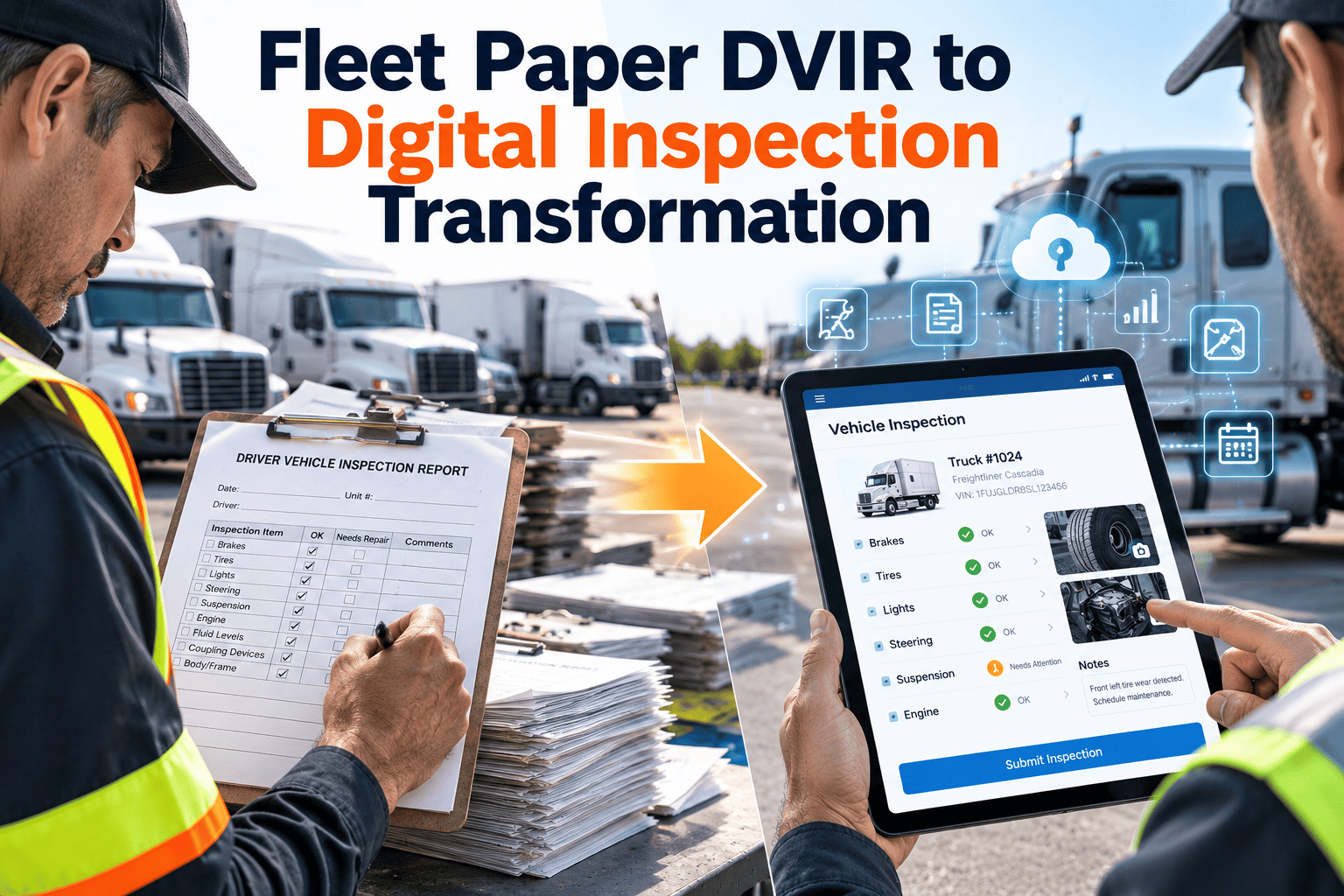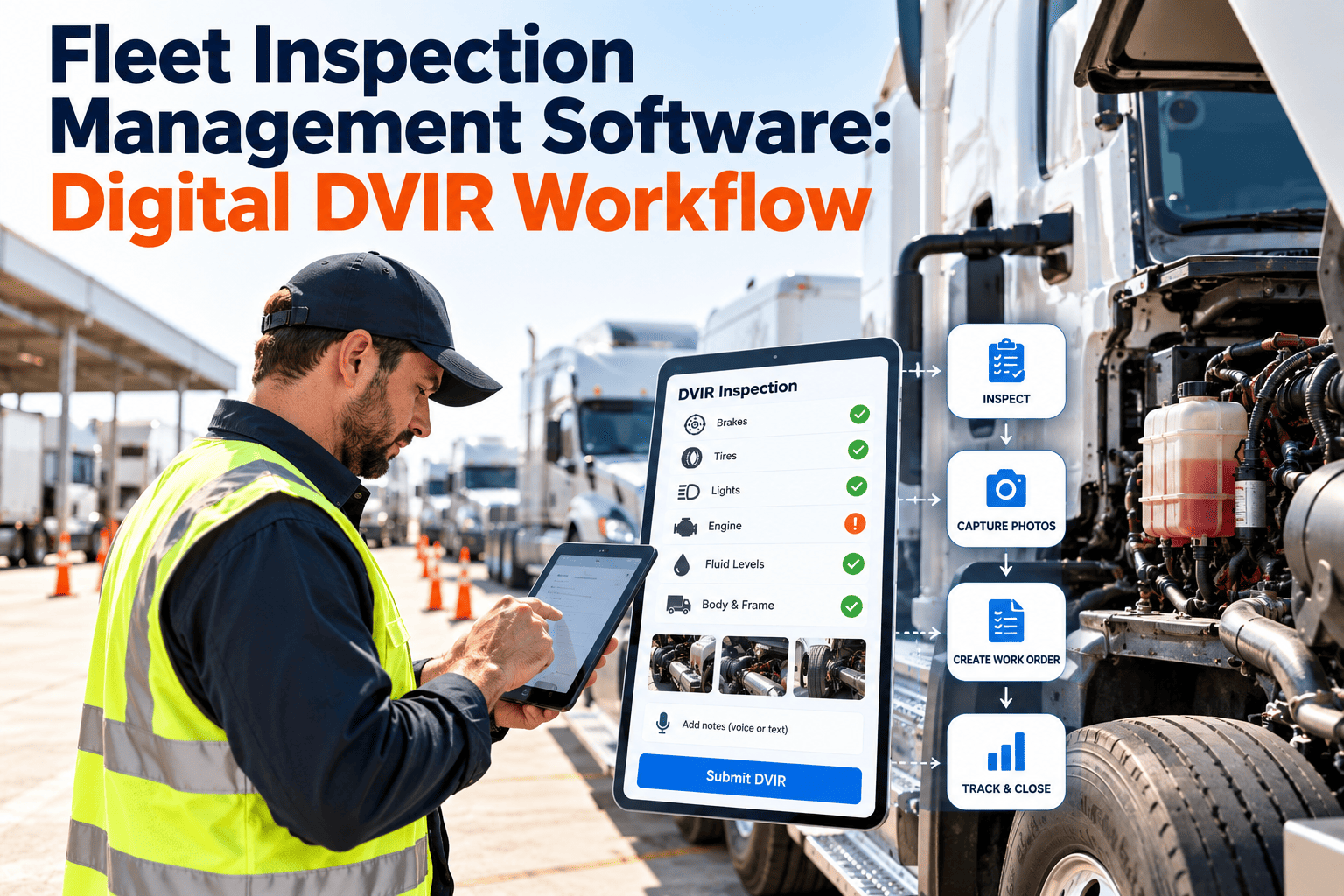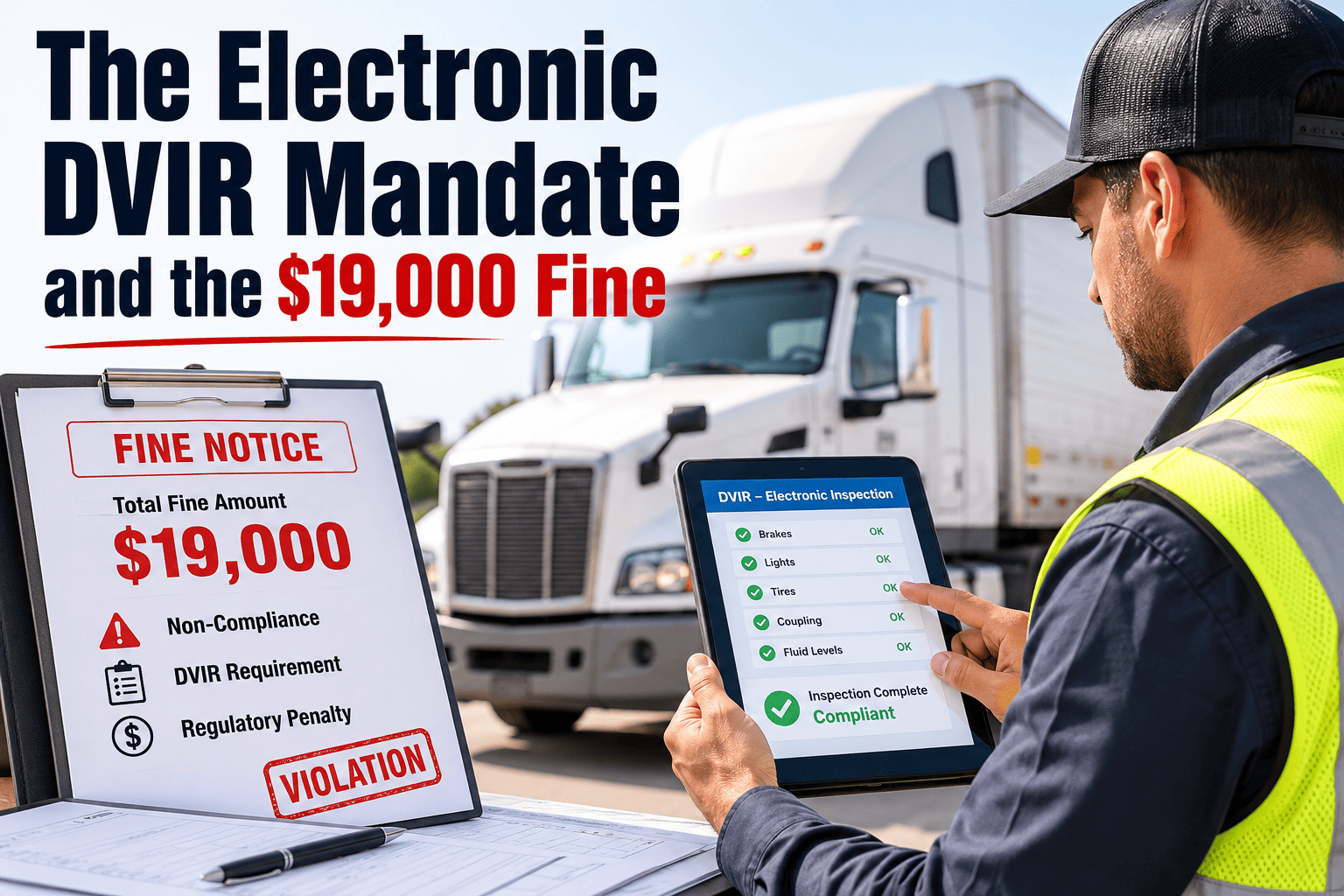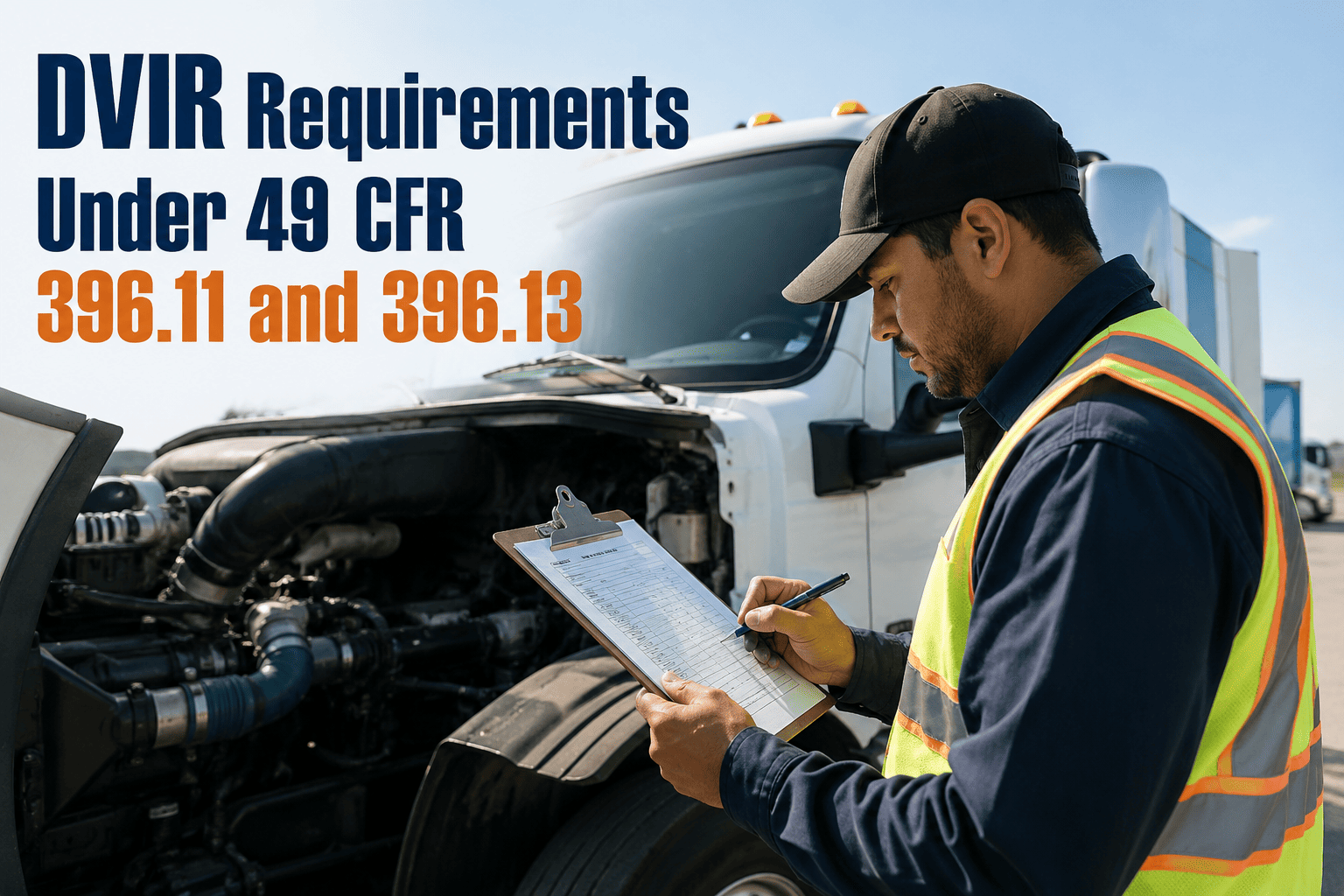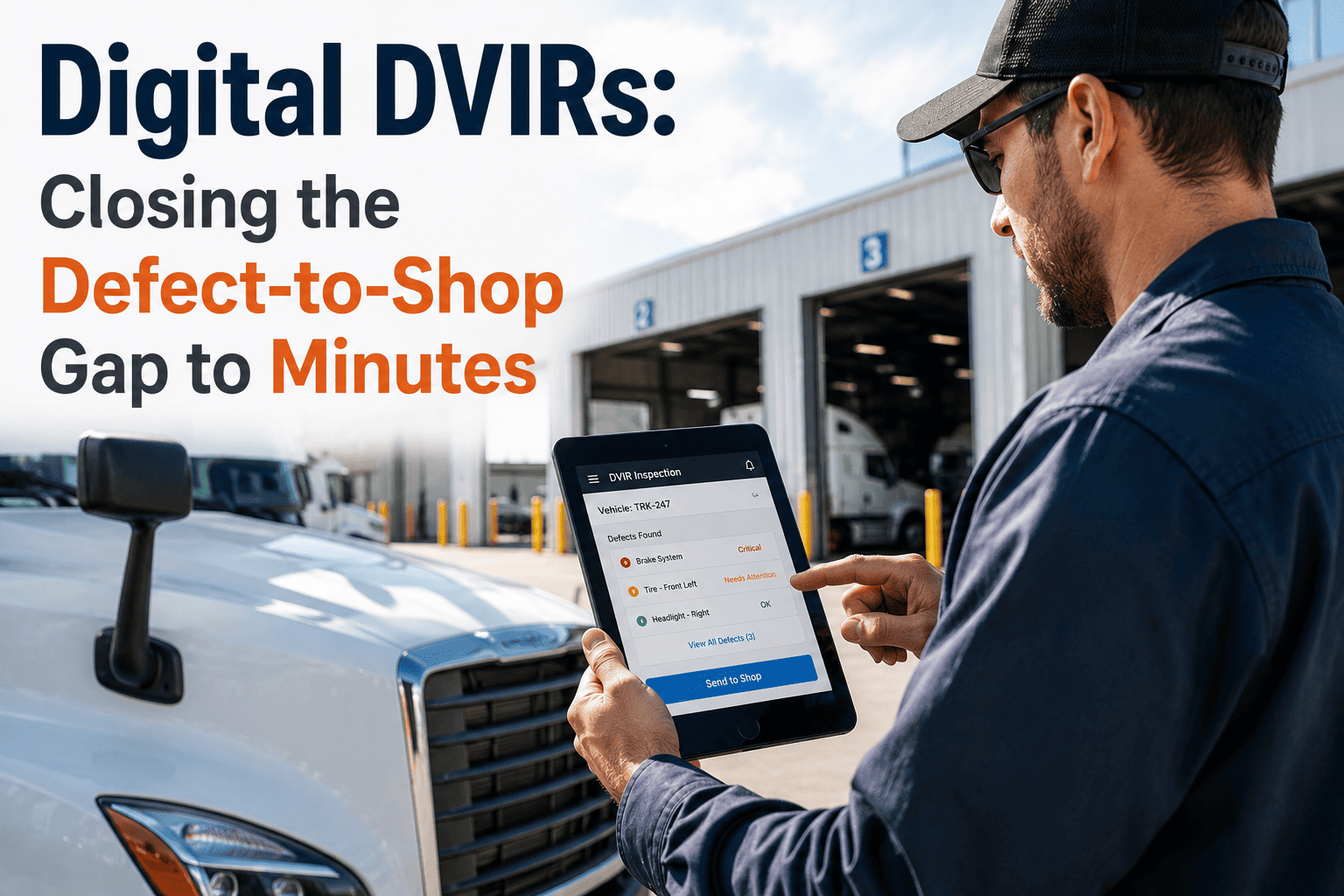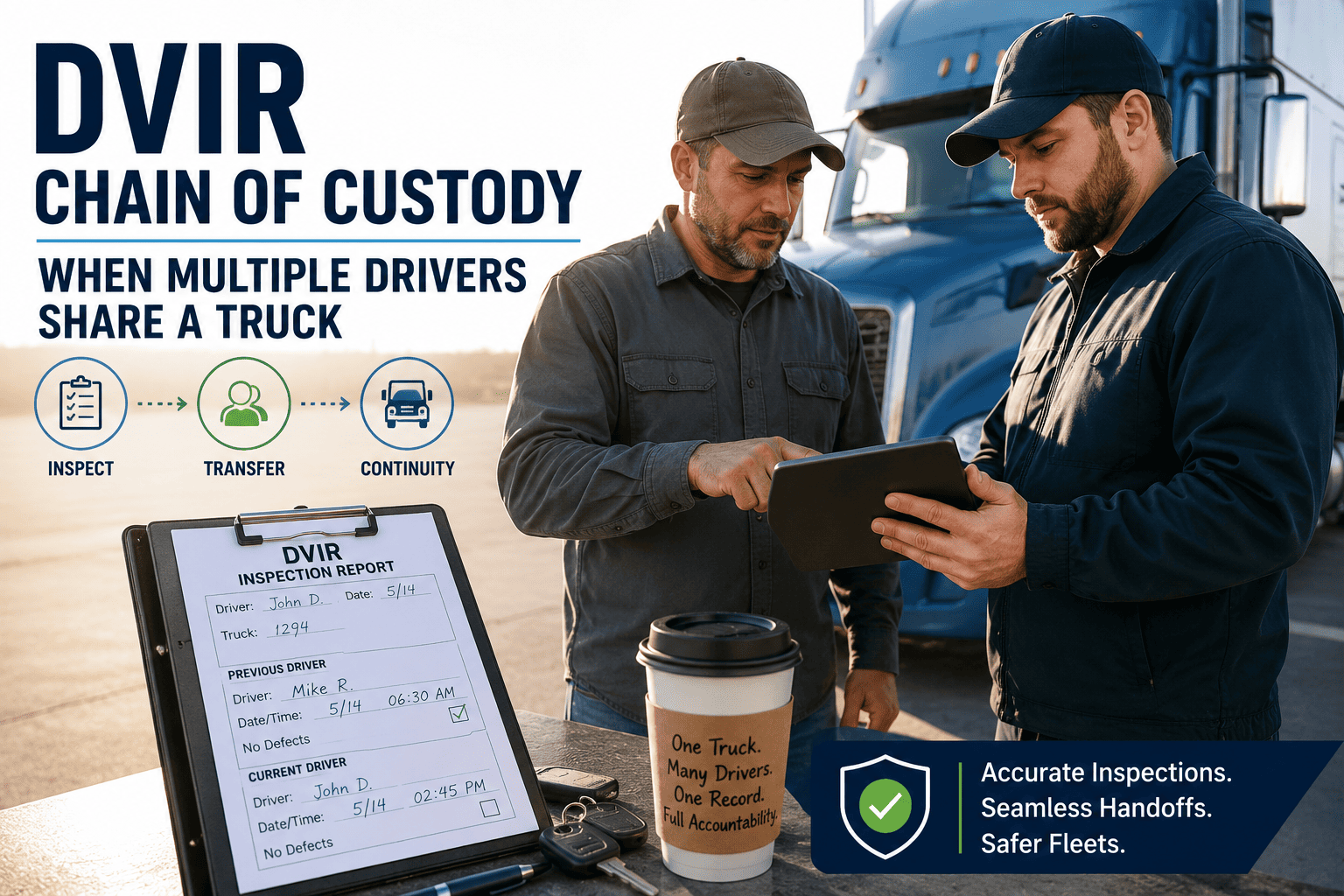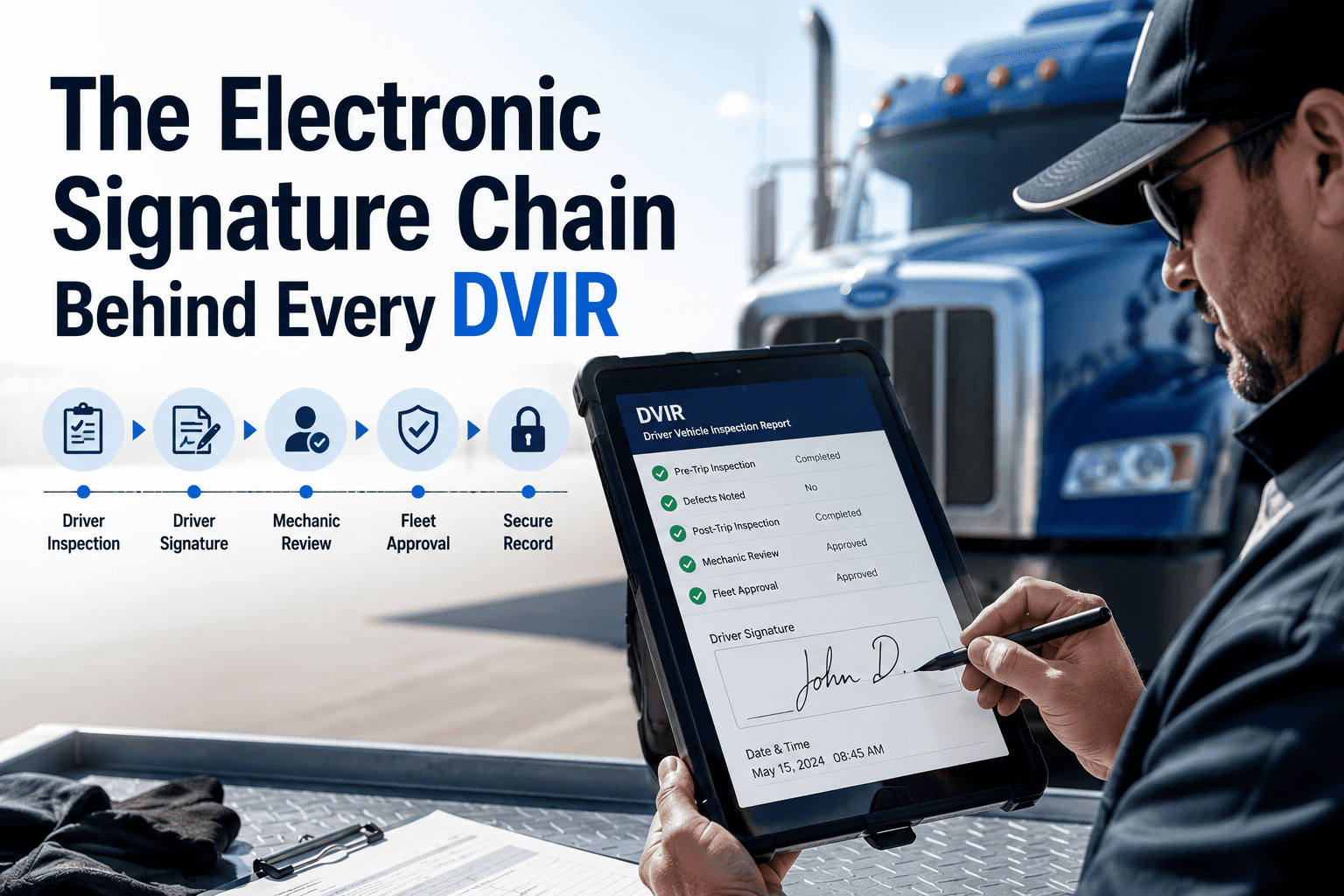
The federal DVIR framework has always been a chain — three distinct signatures, three distinct moments of accountability, and zero room for a missing link. Under the FMCSA's 2026 final rule, every one of those signatures can now be electronic, provided the system capturing them meets the four-part evidentiary test laid out by the E-SIGN Act of 2000. The practical difference is enormous: a paper DVIR proves that somebody signed something, while a properly constructed electronic signature proves who, where, when, and that the document has not been altered since. fleets that operationalize this evidence bundle see fewer roadside violations, faster dispatch, and a far stronger posture in litigation. Ready to modernize your own chain? You can Start Free Trial and capture all three signatures the right way from day one.
Is your DVIR chain
actually defensible at scale?
Every defect-containing DVIR requires three legally distinct signatures — the reporting driver, the certifying mechanic, and the next driver who acknowledges the repair. Break that chain, and your vehicle has no business leaving the yard.
Three signatures, three federal citations, one unbroken chain
The DVIR is not a form — it is a sequential certification process rooted in two distinct sections of the Federal Motor Carrier Safety Regulations. Each signature represents a separate legal act, performed by a different party, at a different point in time.
Driver reports the defect
The operator who completes the post-trip inspection identifies any defect on the vehicle and records it. This first signature attests that the inspection was actually performed and that the listed condition is real — not that it has been resolved.
Mechanic certifies the repair
A motor carrier representative or qualified mechanic reviews the reported defect and certifies — in writing — that it was repaired or that no repair was necessary. This is the most frequently missed signature in paper-based operations.
Next driver acknowledges
Before operating the vehicle, the next driver reviews the prior DVIR and the mechanic's certification, then signs to acknowledge both. Without this third signature the chain is incomplete and the vehicle should not be dispatched.
The chain breaks in the middle, not at the ends.
DOT roadside data consistently shows that signature two — the mechanic's certification — is the most commonly missing or undated entry on paper DVIRs. When that link fails, the entire chain fails, even when both drivers signed correctly.
What makes an electronic signature legally equivalent to ink
Since 2000, the federal E-SIGN Act has granted electronic signatures the same legal weight as handwritten ones — but only when four specific criteria are met. A checkbox on a screen is not a signature unless all four are present.
Intent
The signer took a clear, affirmative action — pressing a dedicated "Sign" button, entering a PIN, or drawing a signature. A passive page-load or auto-filled field does not demonstrate intent.
Consent
The signer agreed in advance to sign electronically. Most systems record this consent as an accepted checkbox on first login, timestamped and stored with the user profile.
Association
The signature is uniquely linked to both the signer and the specific document. A generic login stamp shared across many forms does not satisfy this criterion.
Retention
The signed document is preserved in a form that is accurate, accessible, and reproducible for the retention window — 12 months for driver DVIRs, 6 months for mechanic records under § 396.11(d).
Why a digital signature is more defensible than ink
A wet signature on a paper DVIR proves exactly one thing: that someone signed something. A compliant electronic signature captures a full forensic bundle that paper fundamentally cannot carry.
| Evidence captured at signing | Paper DVIR | Electronic DVIR (E-SIGN compliant) |
|---|---|---|
| Identity of the signer | Name on a line — not verified | Authenticated user account with credential |
| Timestamp of the signature | Handwritten date — can be backdated | Server-clock UTC timestamp — cannot be backdated |
| Location at moment of signing | Not captured | GPS coordinates proving on-site inspection |
| Device used | Not captured | Device identifier and session token |
| Document integrity | Carbon can be altered, lost, or smudged | Cryptographic hash proving tamper-evidence |
| Reproducibility for audit | Physical retrieval from a filing cabinet | Instant export, filterable by driver and date |
Consider a 220-truck regional fleet running an average of 1.8 defect-containing DVIRs per truck per month — roughly 4,000 DVIRs annually that require the full three-signature chain. On paper, auditors estimate 12–18% of those chains are incomplete or undated, exposing the carrier to roughly 480–720 violations per audit cycle. At an average CSA penalty of $3,500 per Hours-of-Service / Vehicle Maintenance violation, that is $1.7M–$2.5M of preventable exposure. An electronic chain that blocks dispatch until all three signatures are captured eliminates the gap by design, not by discipline.
The chain that cannot be broken by human shortcut
In a paper workflow, the integrity of the three-signature chain depends entirely on the discipline of dispatchers, drivers, and mechanics. Oxmaint removes that dependency: the system itself refuses to release a vehicle to dispatch when the chain is incomplete.
All three signatures captured
Driver reported → mechanic certified → next driver acknowledged. The cryptographic hash is sealed. Dispatch is authorized.
Mechanic signature missing
The system blocks dispatch, surfaces the missing link to the shop, and notifies the next driver that acknowledgment cannot proceed until certification is recorded.
Make the chain enforce itself
Oxmaint captures every DVIR signature with the full E-SIGN evidence bundle — timestamp, GPS, device ID, and cryptographic hash — and blocks dispatch the moment a link is missing.
DVIR electronic signature chain, answered
Does the 2026 FMCSA final rule actually permit all three DVIR signatures to be electronic?
Yes. The 2026 final rule explicitly authorizes each of the three signatures in the DVIR chain — the reporting driver under § 396.11, the certifying mechanic, and the next driver under § 396.13 — to be captured electronically, provided the system meets the E-SIGN Act criteria of intent, consent, association, and retention.
What happens if a vehicle is dispatched with an incomplete signature chain?
In a manual workflow, nothing stops it — the gap is discovered at roadside or during a compliance review, when the violation already exists. In Oxmaint, dispatch is system-blocked until all three signatures are present, so the chain cannot be broken by human shortcut. You can see how this works by booking a demo at calendly.com/oxmaintapp/30min.
Is a checkbox tap enough to count as an electronic signature?
Not on its own. A valid electronic signature requires a clear affirmative action demonstrating intent, the signer's prior consent to sign electronically, a unique association between the signature and the document, and a retained, reproducible record. A passive checkbox with no identity binding does not pass the four-part E-SIGN test.
How long must electronic DVIR records be retained?
Under § 396.11(d), driver DVIR records must be retained for 12 months, and mechanic certification records for 6 months. A compliant electronic system retains them in a tamper-evident, exportable format that can be reproduced instantly during an audit or litigation. You can stand up a compliant archive today at app.oxmaint.ai.
What evidence does an electronic DVIR signature carry that paper cannot?
Beyond the signature itself, a compliant system captures a server-clock timestamp that cannot be backdated, GPS coordinates proving the signer was on-site, the device identifier used, and a cryptographic hash of the document at the moment of signing that proves the record has not been altered since. Paper carries none of this.
Three signatures. One unbreakable chain.
Deploy Oxmaint and turn the DVIR signature chain into a system-enforced, audit-ready, tamper-evident record — not a binder full of hope.
Free 14-day trial · No credit card