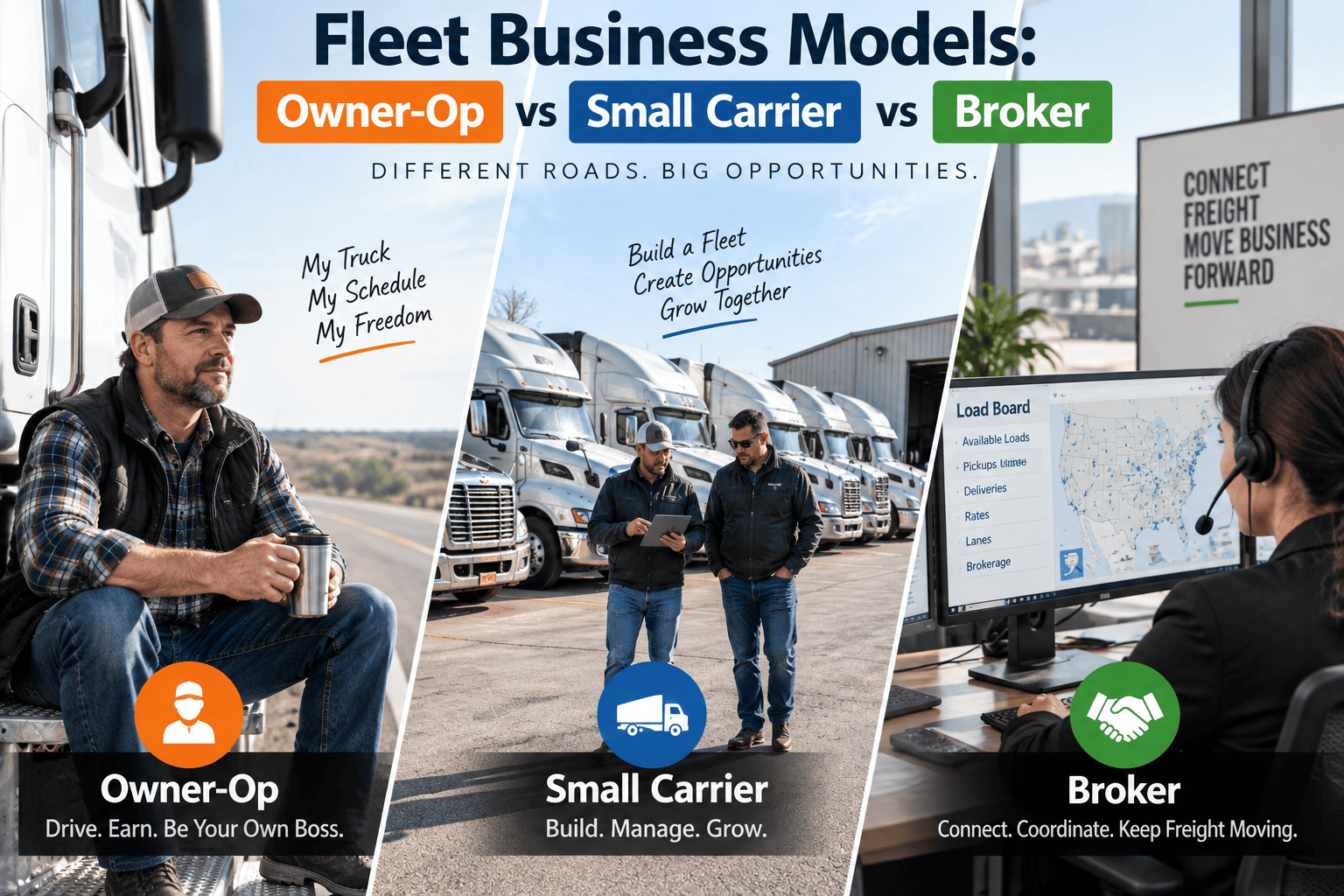
Every trucking business begins with one structural choice: run a single truck, grow a small fleet, or arrange freight without owning any trucks. Each path earns money differently, carries different legal duties, and exposes you to very different maintenance risk. This guide compares owner-operators, small carriers, and freight brokers side by side, using current cost data and federal requirements. Asset-owning models can also see where Oxmaint fits.
Fleet Business Models: Owner-Operator vs Small Carrier vs Broker
Compare who owns the trucks, who holds the authority, and who absorbs the repair bill, then match the structure to your capital and your tolerance for risk.
Owner-Operator
Small Carrier
Freight Broker
The Three Models in One View
The table summarizes structural differences. Financial responsibility figures come from federal filing rules, while the fit notes describe typical patterns rather than guarantees.
| Dimension | Owner-Operator | Small Carrier | Freight Broker |
|---|---|---|---|
| What you sell | Truck and driver capacity, usually your own labor | Fleet capacity delivered by employed or contracted drivers | Coordination that matches shippers with carriers |
| Authority | Leased under a carrier, or your own authority | Motor carrier authority in your name | Broker of property authority, no trucks required |
| Financial responsibility | $750,000 liability under your own authority for general freight | The same $750,000 general freight minimum, filed for the fleet | $75,000 BMC-84 bond or BMC-85 trust |
| Main revenue lever | Rate per mile, loaded miles, and low deadhead | Utilization across trucks and driver retention | Spread between shipper rate and carrier pay |
| Maintenance exposure | Direct and personal; one breakdown stops all revenue | Direct and multiplied; downtime disrupts dispatch and service | Indirect; depends on the carriers you book |
| Cash pressure | Repairs, fuel, and slow-paying customers | Payroll, equipment payments, insurance, and repairs | Paying carriers before shippers pay you |
| Typical best fit | Drivers who want independence and can hold a repair reserve | Operators with a customer base who can manage people | Relationship-driven sellers with limited equipment capital |
Owner-Operator: One Truck, Every Cost Lands on You
An owner-operator owns the truck and usually drives it. That makes the business simple to start and unforgiving to run, because the truck is both the asset and the only source of revenue. When it sits in a shop, income stops while payments, insurance, and permits continue.
Leased on to a carrier
- The carrier supplies operating authority, freight, and often dispatch.
- You supply the truck, maintain it, and pay its operating costs.
- Settlement statements can hide deductions, so track every charge.
- Paperwork is lighter, but you control fewer rates and lanes.
Running under your own authority
- You hold motor carrier authority, a BOC-3 filing, and insurance filings.
- You find freight through brokers, load boards, or direct customers.
- Federal minimum liability for general freight is $750,000, and many customers ask for $1,000,000.
- Margin potential rises, and so do administration and collections work.
The maintenance reality for a single truck
ATRI's latest operational cost report put average repair and maintenance at 21.5 cents per mile in 2025, up 8.6% from 2024. Published summaries of the report show truckload fleets with fewer than five trucks averaging 27.5 cents per mile. Over 100,000 miles, that rate equals $27,500 in repair spend.
What to check on a lease-on settlement
- Who pays for fuel, tolls, and permits, and at what markup.
- Any escrow or maintenance holdback, and when it is returned.
- Chargebacks for inspections, equipment, or insurance programs.
- Whether the carrier can dispatch you without your approval of the load.
Habits that protect uptime
- Move a per-mile repair reserve into a separate account every week.
- Schedule preventive maintenance by odometer or engine hours, not by feel.
- Keep receipts, inspections, and repair history in one record for financing and resale.
- Log defects at the pre-trip inspection instead of trusting memory.
Where the Money Goes: A Cost-Per-Mile Lens
ATRI's 2025 averages show why one total never tells the whole story. Driver pay, fuel, and equipment payments dominate, yet repair and maintenance is one of the few lines a fleet can shape through planning.
What the trend means for asset owners
- Every major cost line except permits and licenses rose in 2025.
- Repair and maintenance climbed after a small decline in 2024, alongside longer equipment trade cycles.
- Reported distance between breakdowns or unscheduled repairs slipped from 38,249 miles to 36,891 miles.
Market Pressure in 2026: How Each Model Feels It
ATRI reported that carriers parked trucks, cut staff, delayed equipment purchases, and stretched maintenance cycles during a prolonged freight downturn. Those choices ripple differently through each business model.
Soft freight rates
Rising repair costs
Aging equipment
Slow payment
Practical responses that work in any model
- Know your true cost per mile before accepting a rate, and refresh it every quarter.
- Replace reactive repairs with scheduled preventive maintenance so failures happen in the shop, not on the shoulder.
- Track receivables weekly, and price slow-paying customers accordingly.
Small Carrier: Where Systems Replace Memory
A small carrier adds trucks, drivers, and dispatch on top of the owner-operator model. The work shifts from driving to scheduling, and maintenance decisions multiply with every unit added. Habits that worked for one truck begin to break.
Stage one: the second and third truck
Stage two: hired drivers
Stage three: a vendor and parts network
Policies to write down early
- Who approves a repair above a set dollar amount, and how fast.
- Which defects take a truck out of service until fixed.
- Where repair history, inspection reports, and invoices are stored.
- How preventive maintenance intervals are set and reviewed for each truck type.
Why small fleets pay more per mile
ATRI found that truckload repair costs tended to fall as fleet size grew. Fleets with fewer than five trucks spent the most, partly because they bought newer equipment less often, and older trucks usually need more maintenance.
Growing Past One Truck? Give Every Repair a Home
Oxmaint keeps preventive maintenance schedules, work orders, inspections, and repair history for every unit in one place, so growth does not mean more guesswork.
Freight Broker: Margin Without Metal
A broker arranges freight between shippers and carriers and earns the spread. No trucks means no repair bills, but it brings payment risk, carrier vetting duties, and a federal financial security requirement.
Shipper
Broker
Carrier
The financial security rule
FMCSA requires brokers and freight forwarders to maintain $75,000 through a BMC-84 bond or BMC-85 trust. A recent rule lets the agency suspend authority when available security drops below that amount and is not replenished within seven calendar days of notice.
A carrier vetting checklist
- Confirm active operating authority and insurance on file before every first load.
- Review the carrier's safety record and roadside inspection outcomes.
- Match equipment type and condition to the freight being moved.
- Check references and on-time history on comparable lanes.
- Agree on payment terms and breakdown communication in writing.
Where maintenance still touches a broker
- Carrier selection: equipment condition and breakdown history shape on-time performance.
- Hybrid operations: many brokerages add a few trucks, which brings asset maintenance back.
- Liability roles: the Carmack Amendment applies to carriers rather than brokers who only arrange transportation, though a broker acting like a carrier may be treated as one. Confirm your position with counsel.
Compliance and Paperwork by Model
| Requirement | Leased-On Owner-Operator | Own Authority or Small Carrier | Broker |
|---|---|---|---|
| Operating authority | The carrier's authority covers the freight | Motor carrier authority in your name | Broker of property authority |
| Liability minimum | Set by the lease, plus your own policies | $750,000 for general freight over 10,001 lbs GVWR | Bond replaces an auto liability policy |
| Financial security | None on your own filing | Insurance filing with FMCSA | $75,000 BMC-84 bond or BMC-85 trust |
| Process agent (BOC-3) | Held by the carrier | Required | Required |
| Maintenance records | Your duty, often audited by the carrier | Required inspection, repair, and maintenance records | Not applicable to the brokerage itself |
| Cargo claims | Carrier is the primary contact | Carmack liability generally applies | Depends on the role you play |
Choosing a Model: Four Questions
1. Can you fund a truck and a repair reserve?
2. Do you want to manage people?
3. Can you carry a gap between paying carriers and collecting from shippers?
4. Do you want control over rates and customers?
Common mistakes when choosing a model
- Judging a model by gross revenue instead of margin per mile after repairs.
- Skipping the repair reserve because the truck is new or recently rebuilt.
- Underestimating the administration that comes with your own authority.
- Starting a brokerage without working capital for payment gaps.
- Adding trucks before the maintenance process can handle them.
Maintenance Workflow: Before and After a System
For owner-operators and small carriers, the difference between reactive and planned maintenance often comes down to whether records live in one place. Brokers benefit less directly, since they hold no vehicle assets.
Before: paper and memory
- Service dates tracked in notebooks or spreadsheets.
- Defects reported by text, then forgotten.
- Repair invoices scattered across glove boxes and inboxes.
- Cost per truck unknown until tax time.
After: one maintenance record
- Preventive maintenance schedules generate work orders on time.
- Mobile inspections capture defects and open corrective work.
- Asset history, parts, and vendor costs sit on each unit.
- Dashboards show overdue tasks and repair spend by truck.
Metrics Worth Tracking in Each Model
Owner-Operator
- Cost per mile after all expenses
- Repair and maintenance per mile
- Deadhead miles as a share of total
- Miles between unscheduled repairs
- Repair reserve balance
Small Carrier
- Cost per mile by truck
- Preventive maintenance completion rate
- Unscheduled repairs versus planned work
- Downtime hours per unit
- Driver-reported defects closed on time
Freight Broker
- Gross margin per load
- Days to collect versus days to pay
- Claims rate per hundred loads
- Carrier on-time performance
- Service failures tied to equipment
Frequently Asked Questions
Is an owner-operator better off leased on or under their own authority?
Do freight brokers need to worry about truck maintenance?
What does a broker bond cost each year?
What insurance minimum applies to a small carrier hauling general freight?
When should a small carrier move from spreadsheets to maintenance software?
Run the Model You Choose With Maintenance Under Control
Whether you drive one truck or dispatch a growing fleet, Oxmaint helps you plan preventive maintenance, close defects faster, and see repair cost by asset.