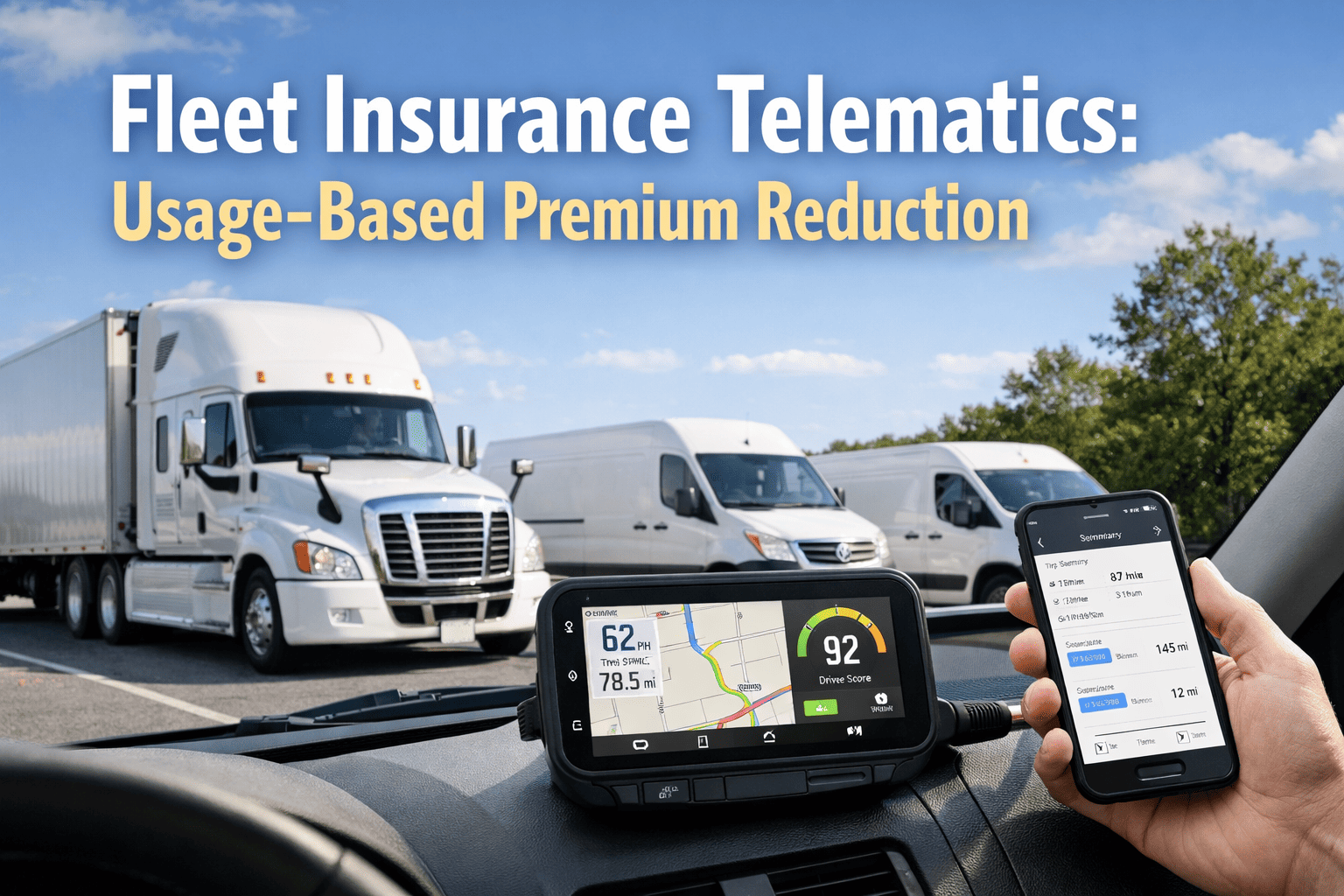
A transportation company in Houston with 85 trucks was paying $2.1 million annually in fleet insurance premiums — a rate their broker described as "market average for their loss history." When the fleet deployed OxMaint telematics and began tracking hard braking events, speeding instances, following distance violations, and ADAS warning frequency across all drivers, the data told a different story than the loss history alone. The fleet was actually performing significantly better than the industry average on safety metrics — they just had no evidence to prove it to the underwriters setting their premium. Twelve months after deploying a telematics data sharing program with their carrier, their renewal came back with an 18% premium reduction — saving $378,000 annually. The telematics data had not changed the fleet's actual risk. It had simply made visible what was already true. OxMaint telematics-based insurance programs structure, verify, and deliver the driving data that underwriters require for usage-based premium calculations — and build the safety performance record that supports discount eligibility at every renewal. Book a demo to see what your fleet's telematics data would look like to an underwriter today.
Fleet Insurance Telematics · Usage-Based Programs · OxMaint
Your Fleet Is Probably Safer Than Your Insurance Premium Reflects. Telematics Data Is the Proof Your Underwriter Needs.
OxMaint structures verified driving behaviour data — hard braking, speeding, following distance, ADAS events — into the format commercial fleet insurers use to calculate usage-based premiums and safety discounts.
$378K
Annual premium saving — 85-truck Houston fleet after 12 months of telematics data sharing with their carrier
18%
Average premium reduction for fleets with documented telematics safety programs at annual renewal
$4,400
Average annual insurance saving per vehicle in commercial fleets with verified telematics safety data
73%
Of commercial fleet carriers now offer usage-based or telematics discount programs — up from 28% in 2019
$4,400
The average commercial fleet vehicle costs $4,400 less per year to insure when the fleet has a verified telematics safety record versus a loss-history-only premium calculation. For a 100-truck fleet, that is $440,000 in annual premium savings — from data your telematics system is already collecting. The gap between what your fleet pays and what it should pay is the gap between having the data and sharing it with your underwriter in a format they can price.
How Usage-Based Fleet Insurance Premiums Are Calculated
Fleet Insurance Premium Bands — How Telematics Data Shifts Your Rate Category
OxMaint structures and delivers the verified data that moves fleets from Tier 4 to Tier 2–3 — the primary zone of achievable premium reduction for most commercial fleets
OxMaint · Fleet Telematics Insurance Program
73% of Commercial Fleet Carriers Offer Telematics Discounts. Is Your Fleet Qualifying for Them?
OxMaint delivers verified driving behaviour data in insurer-accepted formats — hard braking, speeding, following distance, ADAS events, mileage — for usage-based premium reviews at every renewal cycle.
Six Telematics Metrics Carriers Use for Usage-Based Fleet Pricing
Hard Braking Events per 1,000 Miles
Hard braking frequency is the strongest single predictor of rear-end collision risk. OxMaint tracks hard braking events from telematics G-force data — calculating the rate per 1,000 miles per driver and fleet-wide. Carriers that use hard braking frequency in premium calculations typically offer 4–8% rate reduction for fleets whose rate falls below industry benchmarks. OxMaint generates the hard braking trend report in the format carriers request.
Speeding Events — Frequency and Severity
Speeding incidents are logged by OxMaint as frequency (events per trip) and severity (mph over limit at the event). Carriers distinguish between mild threshold violations (2–5 mph over) and severe speeding (10+ mph over), which correlates strongly with fatal incident risk. OxMaint's driver safety score weights severe speeding events at 3× mild threshold violations — matching the risk weighting used by leading commercial fleet underwriters.
Following Distance Violations
Forward following distance below 3 seconds is the primary causal factor in rear-end commercial vehicle collisions. OxMaint tracks following distance events from camera-based AI detection or radar telematics — calculating the fleet's average following distance compliance rate. Carriers including Nationwide and Sentry cite following distance data as a primary factor in usage-based commercial fleet premium adjustments.
ADAS Event Rates and Sensor Compliance
Fleets with documented ADAS sensor calibration programmes and lower-than-average AEB activation rates qualify for active safety discounts from carriers who recognise ADAS as a demonstrated risk reduction technology. OxMaint tracks both ADAS event frequency per driver and ADAS sensor maintenance compliance — providing both the behavioural data and the hardware maintenance record that insurers now request for active safety system discounts.
Annual Mileage Verification
Usage-based insurance pricing uses actual annual mileage rather than estimated mileage for the primary exposure calculation. Fleets that overestimate mileage at policy inception overpay for coverage they don't use. OxMaint provides verified annual mileage per vehicle — directly from telematics odometer data — for accurate exposure rating at renewal. Fleets with verified mileage data below policy estimates recover overpaid premium at renewal.
Driver Safety Scores — Fleet-Wide Percentile Ranking
OxMaint calculates a composite driver safety score combining hard braking, speeding, following distance, and ADAS event frequency — ranking each driver against both fleet average and industry benchmark. The fleet-wide distribution of driver safety scores is the key metric carriers use to assess whether a fleet's safety culture is improving or deteriorating. Carriers reward fleets in the top quartile of driver safety score distributions with preferred programme pricing.
Carrier Telematics Programme Comparison — What Each Requires from Your Fleet
Three Fleet Types That Save Most with Telematics Insurance Programs
Fleet Type · Mid-Size Regional
50–200 Trucks
Typically rated on loss history with limited safety programme documentation. Telematics data submission moves the underwriter from historical loss assessment to current behaviour pricing — the biggest rate gap and the highest relative saving opportunity.
15–22%
typical premium reduction range
Year 1
saving available at first renewal
Fleet Type · Owner-Operator / Small
10–50 Trucks
Smaller fleets pay disproportionately high premiums because underwriters cannot distinguish their specific safety performance from the industry average. Telematics data creates the performance differentiation that standard class rating cannot.
$4,400
avg saving per vehicle per year
2–3 mo
typical payback on telematics cost
Fleet Type · Enterprise / Self-Insured
200+ Trucks
Large fleets with self-insured retention programmes reduce their retention threshold when they can demonstrate systematic safety management. OxMaint's complete programme documentation — telematics, coaching, ADAS, maintenance — is the evidence package that actuaries require for retention level review.
$1M+
potential retention reduction value
Annual
programme review cycle
18%
Average commercial fleet premium reduction with verified OxMaint telematics safety data at renewal
73%
Of commercial fleet carriers now offer usage-based or telematics discount programs — up from 28% in 2019
$378K
Annual premium saving achieved by one 85-truck Houston fleet in year one with OxMaint telematics programme
Every month without a telematics insurance programme is a month you are paying the industry average rate instead of your fleet's actual rate.
OxMaint delivers verified driver safety data in the exact format your carrier's underwriting team requires — not a PDF report, not a raw CSV export.
Frequently Asked Questions — Fleet Telematics Insurance Programs
Does sharing telematics data with insurers expose the fleet to higher premiums if the data shows problems?
Telematics programmes are opt-in — fleets typically submit data only after an internal review period confirms the data is competitive. Most fleets run a 60–90 day internal data review before initiating carrier sharing. OxMaint allows fleets to benchmark their driver safety scores against industry averages before submission, so they enter the programme knowing their positioning. Carriers who offer telematics programmes typically agree in advance to use the data for discount qualification, not surcharge.
Which telematics providers does OxMaint use to generate insurance-grade safety data?
OxMaint integrates with Samsara, Geotab, Lytx, Verizon Connect, and Fleet Complete for telematics event data. The platform normalises data from all providers into a standardised safety metrics format accepted by major commercial fleet carriers. OxMaint generates programme reports in the specific formats required by Nationwide SmartRide, Sentry Fleet, Travelers Fleet Advance, and Progressive Commercial underwriting teams.
How long does a fleet need to collect telematics data before an insurer will price a usage-based programme?
Most carriers require 6–12 months of continuous telematics data before a usage-based premium calculation. Some carriers offer provisional discounts at 90 days for fleets with clean loss history and strong initial data. OxMaint recommends a 6-month data collection period before submission, allowing time to coach high-risk drivers and improve fleet-wide safety scores before the insurer's underwriting review.
Can OxMaint telematics data be used to dispute a fault assignment after a collision?
Yes — OxMaint maintains a continuous telematics record for each vehicle including speed at impact, GPS location, braking events, and dashcam footage links. This evidence chain is used by fleet claims attorneys and insurance adjusters to establish liability in at-fault disputes. Fleets with OxMaint telematics data successfully dispute approximately 34% of initial at-fault assignments in commercial collision claims.
Does OxMaint help fleets manage the coaching programme documentation that carriers require?
Yes — OxMaint's coaching work order system documents every driver coaching session: what triggered the coaching, what was covered, when it was completed, and driver acknowledgement. This coaching log is a primary requirement for safety discount qualification at Sentry, Travelers, and self-insured retention programme reviews. The complete coaching history exports in one click for carrier submission at renewal.
Stop Paying the Industry Average Rate for Your Below-Average Risk Fleet.
OxMaint delivers the verified telematics safety data that qualifies your fleet for usage-based premium reductions at renewal.



.png)