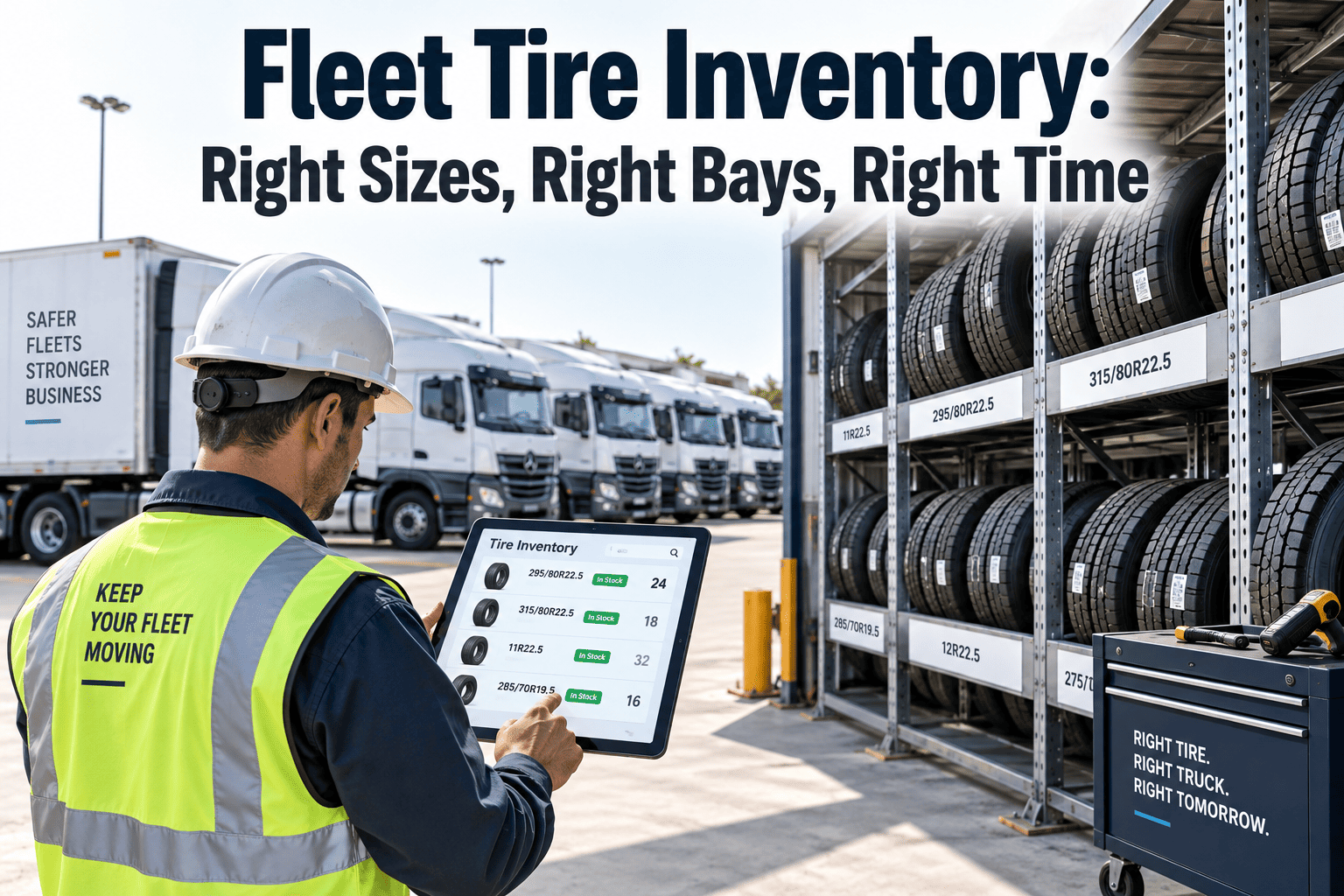
Every fleet shop with a tire wall runs the same two-sided risk day after day: too few of the right size sitting in the bay when a truck is due for service, or too much capital frozen in slow-moving casings that have not shifted in months. Tires typically rank as the third or fourth largest line item on a fleet's operating budget, so getting the stocking math wrong is expensive in either direction. A stockout means a grounded vehicle waiting on a supplier run instead of rolling out on schedule, while overstock means working capital sitting idle on a shelf instead of funding the next repair cycle. Fixing this is not about hiring someone to keep a better mental tally on a busy Monday morning. Oxmaint's inventory tools give fleet shops calculated par levels, SKU-level visibility, and automated purchase order triggers so the right tire is in the right bay at the right time, and you can start managing tire stock with Oxmaint free right here.
Fleet Tire Inventory: Right Sizes, Right Bays, Right Time
Stop losing uptime to a tire wall that is either empty or overloaded. Oxmaint gives fleet maintenance teams SKU-level visibility, data-driven par levels, and automated purchase orders so the correct tire is always on the shelf the moment a truck rolls in for service.
The Two-Sided Tire Inventory Problem Every Shop Faces
Tire inventory management fails in two directions at once, and most fleet shops only notice the one that is currently hurting them. A shop that just lived through a grounded truck starts overordering out of fear, which quietly builds an overstock problem that shows up on the books six months later. A shop that just got audited for excess tire capital starts underordering, which sets up the next roadside call. The two failure modes below are opposite in appearance but share the same root cause: reorder points that were never calculated from real consumption data in the first place.
Stockout Risk
A vehicle due for a tire swap sits in the bay while someone calls three suppliers looking for the right size. Roadside tire incidents alone average $500 to $1,000 or more per event once you count the service call, driver downtime, and the missed delivery window. Emergency purchases made under pressure also cost more per tire than the same size bought on a scheduled reorder, because there is no time to compare vendor pricing.
Overstock Drain
Extra casings piled on a rack look like safety, but they are really working capital that cannot be spent on anything else. Tires also age in storage even when they are never mounted, and stock sitting past its recommended shelf window loses tread life before a wheel ever touches it. Overstock also crowds bay space and makes FIFO rotation harder to enforce, so the newest tires get grabbed first and the oldest stock keeps aging in the corner.
The Par Level Formula That Actually Works
Most fleets set minimum stock levels once, when the storeroom was first organized, and never touch them again. A reorder point that was correct for a 40-truck operation is wrong once the fleet grows to 120 trucks, but nobody goes back and recalculates it. The formula itself is simple. The discipline is in feeding it real numbers instead of a guess.
Minimum Stock = (Average Weekly Consumption × Lead Time in Weeks) + Safety Buffer
Worked Example
A terminal consuming 12 tires per week with a 2-week supplier lead time needs 24 tires to cover the lead-time gap alone. Add a 25 percent safety buffer of 6 tires for demand variability, and the minimum par level comes out to 30 tires on hand before a reorder should trigger.
Where Oxmaint Fits
Oxmaint pulls average consumption directly from mount and dismount work order history instead of relying on a manager's memory, and it recalculates the reorder point automatically as fleet size and tire mix change, so par levels stay accurate without a quarterly spreadsheet review.
Fewer SKUs, Full Coverage: Standardizing What You Stock
Every unique tire size, brand, and specification you carry requires its own separate safety stock, which multiplies the total capital sitting on the shelf. Most fleets can cover more than 80 percent of their replacement needs with three to five core SKUs spread across steer, drive, and trailer positions. Reducing variety is not about cutting corners on tire quality, it is about not paying for a dozen small safety buffers when three well-chosen ones would do the same job.
Highest safety criticality and the fastest wear cycle on front-heavy loads. Standardize on one or two rib-pattern SKUs rated for the duty cycle and keep this par level tightest, since a steer tire failure grounds the vehicle immediately.
Highest volume consumption across most fleets, which makes it the best candidate for retread programs. Standardizing drive SKUs also makes rotation scheduling and casing tracking dramatically simpler for the shop floor.
Lower cost per unit but often the highest count per vehicle, so this is where SKU sprawl adds up fastest if left unmanaged. A single trailer SKU across the fleet simplifies both purchasing and yard storage.
See your fleet's real par levels calculated automatically
Oxmaint reads consumption straight from your work order history, sets minimum stock per SKU and per location, and raises a purchase order the moment a tire falls below par, with no manual spreadsheet review required.
Where Should Tires Actually Live? Bay and Location Allocation
Storage location matters almost as much as the reorder math. Tires kept at the wrong bay, or lumped into one undifferentiated pile, slow technicians down and make FIFO rotation nearly impossible to enforce consistently. The table below is a starting allocation model that most fleet shops can adapt to their own terminal layout.
| Bay or Location | Typical SKU Count | Recommended Par Level | Turnover Speed | Storage Notes |
|---|---|---|---|---|
| Steer Bay | 1-2 SKUs | Tightest, reviewed weekly | Fast, safety-critical | Keep closest to the service bay door |
| Drive Bay | 2-3 SKUs | Highest volume par | Fastest overall turnover | Pair with retread casing staging |
| Trailer Bay | 1 SKU where possible | Moderate, bulk reorder | Steady, predictable | Stack no more than six tires high |
| Yard Reserve | Overflow only | Buffer above par, capped | Slowest, monitored monthly | Indoor, away from direct sunlight and ozone sources |
| Retread Staging | Casings by size | Tracked separately from new stock | Depends on retread cycle | FIFO by DOT date code, always |
Table scrolls horizontally on smaller screens
From Low Stock to Purchase Order: How the Loop Closes
A par level that only lives on a whiteboard is not really being managed, it is being hoped for. The value of a real system comes from what happens automatically the moment a tire crosses its minimum threshold. Here is how that loop runs inside Oxmaint from the first mount to the restocked shelf.
Consumption logs automatically
Every tire mounted or dismounted through a work order updates the on-hand count for that SKU in real time, with no separate inventory count needed at shift end.
Stock is checked against par
Oxmaint compares the current on-hand count for every SKU and every bay location against its calculated minimum stock level continuously, not on a fixed weekly cycle.
A purchase order generates
The moment a SKU drops below its minimum, Oxmaint raises a pre-populated purchase order with the quantity, size, and preferred vendor already attached, no manual data entry required.
The order routes for approval
Low-value routine reorders can route straight to the approved vendor, while larger orders route to the fleet manager for a quick sign-off before release.
New stock is received and tracked
Incoming tires are logged with a unique ID and DOT date code at receipt, and lifecycle tracking begins immediately so the next rotation and retread decision is backed by data.
What Fleets See After Switching to Managed Tire Inventory
The improvement is rarely just one number. Fleets that move from a manual tire wall to a calculated, software-driven inventory model tend to see gains across purchasing, downtime, and storeroom compliance at the same time, because all three problems share the same root cause.
Calculated reorder points catch a falling SKU weeks before it becomes a roadside emergency purchase at premium pricing.
Rationalized SKUs and accurate par levels free up working capital that was previously sitting idle on the shelf.
Consistent FIFO rotation and on-time reorders prevent the lifespan loss that comes from delayed swaps and skipped rotation schedules.
Frequently Asked Questions on Fleet Tire Inventory Management
How does Oxmaint calculate tire par levels automatically?
Oxmaint pulls average weekly consumption straight from mount and dismount work order history, applies the actual supplier lead time per SKU, and adds a safety buffer based on demand variability. You can see this calculated for your own fleet by starting a free account at app.oxmaint.ai.
Can Oxmaint track individual tire lifecycle, not just a stock count?
Yes, each tire is assigned a unique ID at purchase so it can be tracked through mounting, rotation, retreading, and eventual retirement, giving cost-per-mile data by SKU rather than just a shelf count.
How many tire SKUs should a fleet actually carry?
Most fleets can cover more than 80 percent of replacement needs with three to five core SKUs across steer, drive, and trailer positions, which keeps safety stock requirements manageable without limiting operational coverage.
What happens automatically when tire stock drops below minimum?
Oxmaint raises a pre-populated purchase order the moment on-hand stock crosses the calculated minimum, with quantity and preferred vendor already attached, removing the manual review step entirely.
How is this different from tracking tire stock in a spreadsheet?
A spreadsheet is a static snapshot that someone has to remember to update, while Oxmaint updates in real time from actual work order activity. Book a walkthrough at calendly.com/oxmaintapp/30min to see the difference on your own tire data.
Put your tire inventory on autopilot with Oxmaint
Calculated par levels, SKU rationalization, automated purchase orders, and full tire lifecycle tracking, all connected to the work orders your shop is already running. No more empty bays, no more idle capital on the shelf.


.png)