Fifty-five percent of commercial vehicles on the road right now are running at least one tire ten or more PSI below optimal pressure, and every one of those tires is quietly burning fuel, shaving miles off its lifespan, and moving closer to a roadside failure. Nobody in the cab or the office knows about it until the blowout happens or the service bill arrives, because a pre-trip inspection only checks pressure once a day while the leak keeps working around the clock, quietly compounding across every mile the truck drives between checks. A tire pressure monitoring system closes that visibility gap with continuous, real-time pressure and temperature data from every tire in the fleet. This guide walks through system types, sensor placement, rollout sequencing, and how alerts should route into a CMMS once Oxmaint is connected to the sensor feed.
Tire Safety
IIoT Sensors
Fleet Maintenance
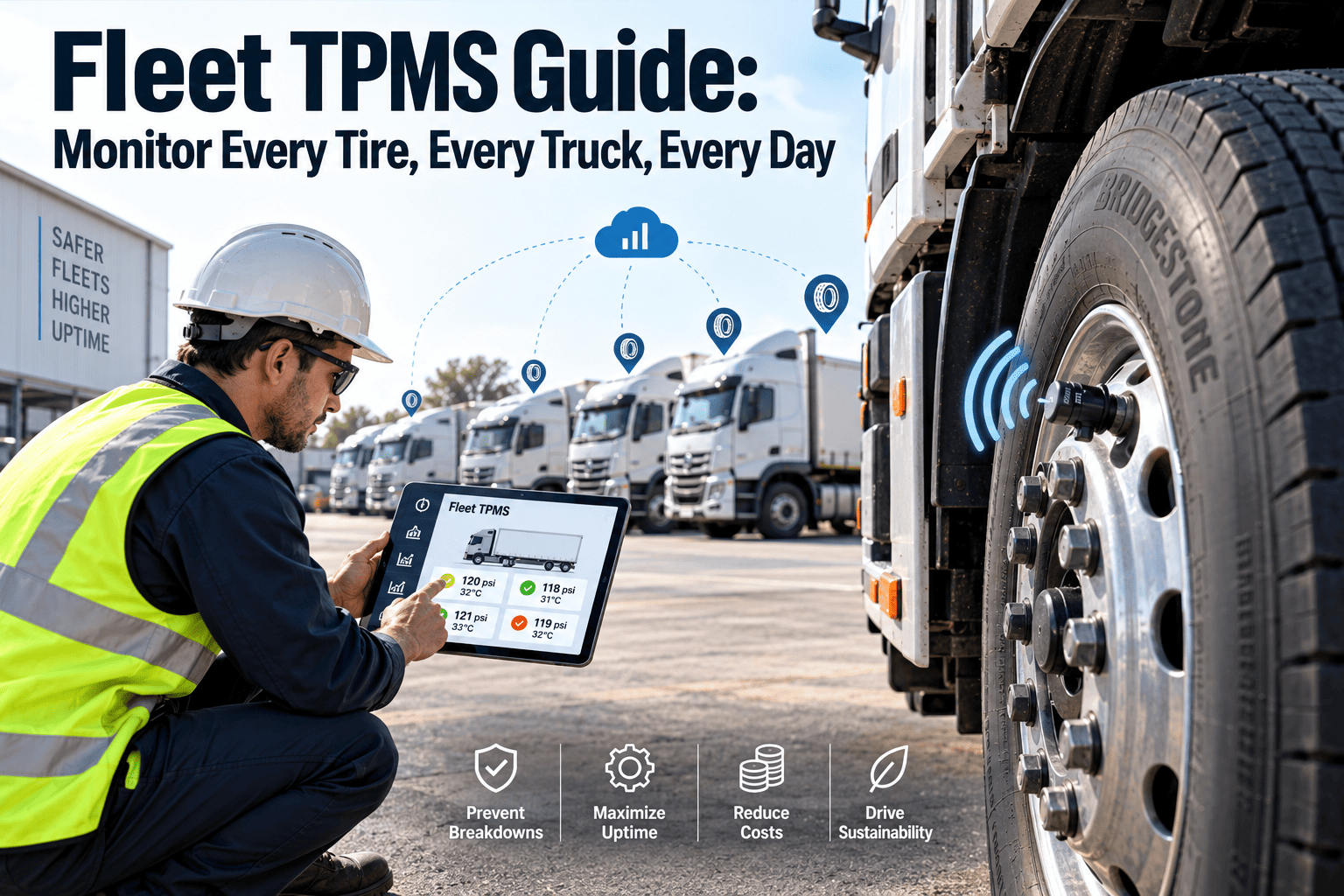
Fleet TPMS Guide: Monitor Every Tire, Every Truck, Every Day
How direct and indirect tire pressure monitoring systems work, where each sensor type belongs on a commercial fleet, and how to route every pressure alert straight into a scheduled repair instead of a dashboard nobody checks — covering hardware selection, rollout sequencing, and the alert-to-work-order workflow that makes continuous monitoring worth the investment.
See every tire's pressure and temperature in one place.
55%
Of commercial vehicles have at least one tire running 10 or more PSI below optimal pressure right now
$87K–$175K
Annual waste from invisible pressure loss across a fifty-truck fleet before TPMS is deployed
Under 12 Months
Typical payback period industry analysts assign to a TPMS investment across fuel, tire, and roadside savings
The Hidden Cost
What a Soft Tire Is Actually Costing the Fleet
Underinflation does not announce itself the way a flat tire does. It builds gradually, shaving fractions of a percent off fuel economy and tire life every day until the numbers add up to a real line item on the annual budget. These are the four places that cost shows up most consistently across fleets that have not yet deployed continuous monitoring, and in every case the loss keeps compounding for as long as the underinflation goes unnoticed.
0.2–0.3%
Fuel Economy Lost Per 1 PSI
The economics are straightforward once the loss is made visible: the U.S. Department of Energy estimates every single PSI drop below optimal pressure reduces fuel economy by this amount, and the loss compounds across every tire position on the truck, turning a small daily inefficiency into a real annual expense.
15–20%
Tire Life Lost Per 10 PSI
A tire running 10 PSI under target wears out significantly faster than one held at the correct pressure, pulling replacement schedules forward and adding avoidable spend to the tire budget that a continuous monitoring program would have caught and corrected weeks earlier.
$3,000–$5,000
Total Cost of a Single Blowout
Emergency roadside service, a replacement tire, driver downtime, and a missed delivery window all stack onto a single blowout event, most of which start as a slow, detectable leak that a continuous monitoring system would have flagged days or weeks before the failure occurred.
2–3 Cycles
Retread Cycles Lost to Casing Damage
Running underinflated damages the casing structure enough to eliminate retread cycles that would otherwise have been available, turning what should have been a routine retread expense into a full tire replacement cost across the fleet's entire trailer position count.
System Types
Direct vs Indirect TPMS: Which One Actually Fits a Commercial Fleet
The system type decision shapes everything downstream, from installation cost to how early a slow leak gets caught. Indirect systems infer pressure from wheel-speed data already available through the ABS system, while direct systems place a physical sensor inside or on each tire to report actual pressure and temperature readings continuously, rather than only when a difference between wheel speeds becomes large enough to notice.
| Factor |
Direct TPMS |
Indirect TPMS |
| How it measures |
Physical sensor inside or on each tire reporting actual pressure and temperature |
Infers pressure from wheel-speed differences through the existing ABS system |
| Detects gradual leaks |
Yes, catches 5–15% underinflation early |
No, misses the gradual loss that drives most fuel and tire waste |
| Installation cost |
Higher, sensor per tire position required |
Lower, uses existing ABS hardware |
| Best fit |
Primary long-haul units and high-value trailers |
Low-mileage or backup vehicles on a tighter budget |
| First-year blowout impact |
Measurable reduction from early detection |
Largely unchanged versus no monitoring at all |
Scroll horizontally on smaller screens to view all columns
Stop guessing which tire is losing pressure
Oxmaint pulls continuous pressure and temperature data from direct or indirect TPMS hardware into one fleet-wide dashboard, so a slow leak becomes a scheduled repair instead of a roadside emergency.
Sensor Placement
Three Sensor Placement Options — and Where Each One Belongs
Within direct TPMS, the sensor itself can sit in three different places on the wheel assembly, and each option trades off installation ease against durability and reading accuracy. Matching the placement to the route type and turnover rate of the position keeps replacement costs from eroding the return on investment, since the wrong sensor type in the wrong position tends to become the most expensive line item in the entire deployment.
Internal Sensors
Mounted to the wheel rim inside the tire cavity
Best fit
Primary long-haul tractor and trailer positions that stay on the vehicle for years at a time
Tradeoff
Requires a tire technician to install and remove, but is protected from theft, road debris, and impact damage
Valve-Cap Sensors
External sensor threaded onto the valve stem
Best fit
Fast retrofits across a mixed fleet where installation speed matters more than long-term durability
Tradeoff
Fastest to install without dismounting the tire, but exposed to theft, road debris, and impact — budget for annual replacement
Indirect Wheel-Speed Sensing
Uses existing ABS wheel-speed data, no added hardware
Best fit
Low-mileage yard trucks or backup vehicles where budget constraints rule out per-tire hardware
Tradeoff
No added hardware cost, but only catches large, sudden pressure loss rather than the gradual leaks that drive most fuel and tire waste
Rollout Plan
The Four-Phase TPMS Rollout Roadmap
A TPMS deployment does not need to happen all at once across the whole fleet. The phases below reflect how fleets typically sequence a rollout to get the highest-value units monitored first while working out installation and alert-threshold details on a smaller group before committing hardware spend across the entire fleet at once.
Phase 1
Priority Unit Selection
Identify the highest-mileage long-haul units and the trailers carrying the most fragile or time-sensitive cargo. These units see the fastest payback and establish the baseline alert thresholds for the rest of the fleet.
Phase 2
Sensor and Gateway Install
Install direct sensors on the priority units and configure the in-cab or telematics gateway that relays pressure and temperature readings back to the fleet management platform in real time.
Phase 3
Threshold Tuning and CMMS Connection
Set pressure deviation thresholds tight enough to catch real leaks without flooding drivers with normal temperature-related alerts, then connect the alert feed to automatic work order creation.
Phase 4
Fleet-Wide Expansion
Extend sensor coverage to secondary and backup units once the priority group has validated installation practices, sensor durability, and alert accuracy across a full duty cycle, so the lessons learned on the highest-value units carry forward instead of being relearned fleet-wide.
Turn every pressure alert into a scheduled repair
Oxmaint routes TPMS alerts directly into work orders with the affected unit, position, and severity already attached — no dashboard sitting idle waiting for someone to notice.
Alert to Repair
From Pressure Drop to Completed Repair: How the Loop Closes
A pressure reading sitting in a telematics dashboard is not predictive maintenance — it is monitoring. The value comes from what happens after the sensor fires, and a well-connected system carries the alert through to a completed repair with no manual review step in between, closing the gap that lets a slow leak turn into a roadside emergency.
1
Sensor detects gradual pressure loss
A trailer tire drops below the configured threshold over several days, a pattern consistent with a slow leak rather than a single sudden event caused by road debris or impact damage.
2
Severity is classified
The system distinguishes a gradual leak needing scheduled attention from a rapid drop that requires the driver to pull over immediately.
3
CMMS creates a work order
Oxmaint auto-generates a work order naming the unit, tire position, and pressure trend, scheduled into the next available maintenance window.
4
Technician is routed and parts reserved
If the trend suggests a repair rather than a simple reinflation, the required tire or valve stem is reserved from inventory automatically, preventing it from being pulled for another job before the scheduled repair happens.
5
Repair completed before failure
The leak is fixed during planned maintenance rather than on the shoulder of a highway, and the pressure history is logged against the unit.
Results
What Fleets Typically See After a Full TPMS Deployment
These figures reflect the range industry analysts and fleet operators commonly report after moving from manual spot checks to continuous tire pressure and temperature monitoring across a fleet, with most of the return concentrated in the first twelve months of deployment.
50%
Fewer Blowout Incidents
Early detection of gradual pressure loss prevents the slow leaks that account for most blowout events before they reach failure.
1–3%
Fuel Economy Recaptured
Correcting fleet-wide underinflation recovers fuel economy that was quietly being lost across every tire position on every truck, without requiring a single change to driver behavior or route planning.
15–25%
Longer Tire Life
Proper inflation extends tire lifespan and preserves casing integrity for additional retread cycles that damaged casings would have lost.
Fewer
Roadside Service Calls
Early leak detection lets a repair happen in the shop instead of on the shoulder, avoiding the cost and downtime of a roadside call.
Avoidable Errors
Common Mistakes Fleets Make With a TPMS Rollout
Most TPMS deployments that fail to deliver the expected return are not victims of bad hardware — they are undermined by a handful of predictable decisions made during rollout. Watching for these four mistakes keeps a deployment on track to hit the payback window analysts expect.
Choosing indirect TPMS to save money everywhere
Indirect systems are cheaper to deploy, but they miss the gradual 5–15% underinflation that drives most fuel and tire waste, so the savings on hardware get spent several times over on fuel and tire replacement.
Retrofitting only with external valve-cap sensors
External sensors install fastest, but eight to twelve percent of them go missing to theft, damage, or off-road impact in the first year, eroding the return on investment through constant replacement, particularly on urban or high-turnover routes where exposure to curbs and debris is highest.
Leaving alert thresholds at factory defaults
Untuned thresholds fire on every minor temperature-related deviation, generating twenty or more alerts per shift and training drivers to tune out the notifications entirely, including the real ones.
Leaving alerts in a dashboard with no work order link
A pressure reading that sits in a telematics dashboard without routing to a scheduled repair is monitoring, not maintenance — the value only appears once the alert reaches a technician.
FAQ
Frequently Asked Questions on Fleet TPMS
Is TPMS legally required for commercial trucks?
No federal TPMS mandate applies to Class 8 commercial trucks the way FMVSS 138 applies to passenger vehicles, so the adoption decision for fleets comes down to economics rather than compliance, and most fleets that deploy it do so because the fuel, tire, and roadside savings pay for the hardware within a year.
Can a fleet mix direct and indirect TPMS across different vehicle types?
Yes, and most fleets do — direct sensors on primary long-haul units and indirect monitoring as a lower-cost backup on low-mileage vehicles is a common hybrid approach.
Oxmaint supports both hardware types in one dashboard.
How often do valve-cap sensors need to be replaced?
Budget for five to ten percent annual replacement due to theft, road debris, and impact damage, or use anti-theft locking caps on high-turnover urban routes to reduce that loss rate.
How many alerts should a driver expect to see per shift?
Well-tuned thresholds should limit alerts to genuine deviations rather than routine temperature swings that occur naturally as a tire heats up over the course of a driving shift; poorly tuned systems can generate twenty or more alerts a shift, which trains drivers to ignore the real ones and defeats the entire purpose of continuous monitoring in the first place.
How quickly can a fleet start seeing TPMS data in its maintenance workflow?
Once sensors and a gateway are installed, pressure and temperature data flows immediately, and connecting that feed to automatic work order creation typically takes a short setup pass rather than a lengthy integration project.
Book a demo to see the connection walked through live.
See every tire's pressure and temperature before it becomes a breakdown
Oxmaint connects direct or indirect TPMS hardware to automatic work order creation, so a slow leak turns into a scheduled repair instead of a roadside call.

-for-commercial-fleets.png)


