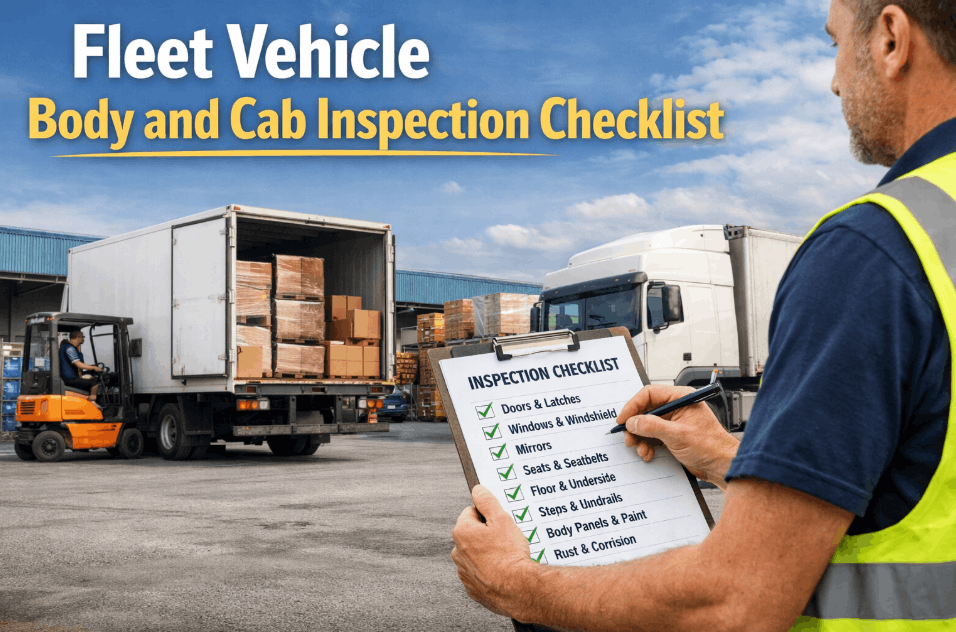
A cab with a broken door latch, cracked windshield, or inoperative mirror is not an aesthetic issue — it is a DOT citation and a driver liability. Body corrosion doubles repair costs every six months it is left untreated. A systematic body inspection catches every compliance defect, documents every damage baseline, and identifies corrosion at the surface treatment stage before it becomes structural. Oxmaint guides inspectors through every zone, records damage per panel with photos, and tracks corrosion progression across successive inspections.
6-Zone Walk-Around Inspection Guide
A systematic body inspection follows six fixed zones — each approached in the same sequence on every vehicle, every time. A random walk-around misses the same items on every vehicle because it has no fixed sequence. The zone cards below show what to check in each zone and what the common compliance risks are for that position.
Technology Improving Fleet Body Inspection
Manual body inspections produce inconsistent results because different inspectors assess severity differently, record findings in different formats, and miss damage in poor lighting or from awkward angles. Three technologies standardise the inspection output and make damage tracking automatic. Oxmaint integrates all three into one guided body inspection workflow.
1. Windshield, Windows and Mirrors Checklist
Glass and mirrors are the only body components that are direct OOS conditions at roadside inspection. A windshield crack in the driver's critical area, a missing mirror, or an inoperative mirror adjustment are all enforcement items under §393.60 and §393.80 — not recommendations. Record windshield and mirror findings per vehicle in Oxmaint.
Windshield — no cracks in driver's critical area
Any crack in the area swept by the driver's wiper blade is OOS under §393.60. A stone chip that does not impair vision is a defect but not OOS. OOS — crack in swept area
All mirrors — present, adjustable and unobstructed view
Every required mirror must be present and provide the required field of view — a mirror that cannot be adjusted to its correct position is non-compliant even if physically present. OOS — missing or inoperative mirror
Mirror glass — no cracked or discoloured reflective surface
A cracked mirror glass that distorts the reflected image is non-compliant — the regulation requires a clear view, not just a mirror being present. Defect — cracked or discoloured glass
Side windows — no cracks impairing rearward or lateral visibility
Side window cracks extending into the driver's lateral field of view are a defect — replace before the next dispatch. Defect — crack in lateral view area
Windshield wipers — operation and blade condition
Test wipers on both speeds with washer fluid — a blade that streaks or judders at low speed will fail to clear the screen under heavy rain. Defect — streaking or inoperative wiper
Windshield washer fluid — level and both jets operational
Both washers must operate — a blocked washer jet on the driver's side is a visibility compliance defect in jurisdictions requiring functional washers. Defect — blocked or inoperative jet
AI Camera tip: Oxmaint's AI camera vision detects windshield cracks as small as 3mm by scanning the glass surface at the inspection lane — logging the position, length, and proximity to the critical area before the driver's pre-trip inspection even begins. See Oxmaint's AI windshield crack detection.
2. Doors, Latches, Steps and Handrails Checklist
Door latches, steps, and handrails are the contact points between the driver and the vehicle — and the components most frequently damaged by daily use. A door that does not latch positively can swing open at speed. A step that shifts under load causes falls. Log door and step findings with repair priority in Oxmaint per vehicle.
Cab door latch — positive engagement and secondary safety catch
Test latch by closing the door and pulling the external handle — the door must not open without operating the exterior handle from outside. OOS — door opens without handle operation
Door hinges — no excessive lateral or vertical play
Lift each door at the leading edge — more than 5mm of vertical movement indicates a worn hinge requiring replacement before the door drops and catches the sill. Defect — excessive hinge play
Cab entry step — secure mounting, no flex or rock
Load each step with full body weight and verify no flex, rotation, or shift — a step that moves under load is a slip-and-fall waiting to happen. Defect — step movement under load
Grab handles — fully secured at both mounting points
Pull each grab handle with both hands — any movement at the mounting bolts indicates a failed captive nut or corroded mounting plate requiring immediate repair. Defect — any grab handle movement
Cargo doors — latch bars, seals and hinge condition
Test all cargo door latches through their full rotational range — a latch bar that does not reach its stop position leaves the door partially unlatched. OOS — cargo door not latching fully
3. Body Panels, Corrosion and Cab Interior Checklist
Panel corrosion, cab floor condition, and interior cleanliness are the inspection items most commonly treated as cosmetic issues — until surface corrosion reaches a structural member, the cab floor rusts through above a fuel line, or an interior defect becomes a customer complaint or regulatory finding. Track panel corrosion grade and floor condition per vehicle in Oxmaint's body inspection records.
All exterior panels — dents, cracks and deformation assessment
Document every dent and crack with a photo against the panel reference grid — establishes the damage baseline that protects the fleet from disputed customer claims. Record — all damage with photos
Surface corrosion — grade 1–4, location and progression
Grade 1 (surface staining) requires treatment within 3 months. Grade 3+ (rust through) requires immediate repair — panel replacement is now unavoidable and delays increase cost. OOS — Grade 4 structural corrosion
Cab floor — no rust-through, holes or lifting rubber
A cab floor with any rust-through hole exposes the driver to exhaust gas from below — carbon monoxide risk and an OOS condition under §393.83. OOS — any floor rust-through
Seats — condition, adjustment mechanism and belt anchors
Test full seat adjustment range — a seat that cannot be locked in any position is a driver safety item. Inspect belt anchor points for corrosion at the floor mounting. Defect — inoperative adjustment
Seat belts — all positions, webbing and latch operation
Test every seat belt latch for positive engagement and pull the webbing sharply — the inertia reel must lock. Any webbing with cuts, fraying, or chemical staining must be replaced. OOS — inoperative or damaged belt
Dashboard, instruments and switches — all controls functional
Verify all dashboard warning indicators extinguish after start and all cab switches operate. A non-functional hazard switch or cab light is a defect requiring repair before dispatch. Defect — inoperative control
Digital Twin tip: Oxmaint's vehicle digital twin maps every documented panel damage point and corrosion location across successive inspections — automatically calculating progression rate and flagging panels moving from Grade 1 surface corrosion to Grade 2 before the next inspection is due. Book a demo to see Oxmaint's body damage tracking.
We had four disputed customer damage claims in one quarter — all rejected because we couldn't prove pre-existing damage. After deploying Oxmaint's photo-documented body inspection at every service, we've had zero successful claims against us in eight months. The timestamped photos settled two disputes in our favour before they went to insurers.
Frequently Asked Questions
The most common questions from fleet inspectors and compliance managers about body inspection standards, windshield requirements, and corrosion grading.
When the crack is in the area swept by the driver's primary wiper blade. Cracks outside this zone are defects — they must be repaired but are not immediate OOS conditions. A single stone chip inside the swept area that does not impair vision may not be OOS, but cracks longer than 6 inches always are.
At minimum, one mirror providing a view to the rear and both sides when the driver is seated. In practice, commercial vehicles require a main mirror and at least one wide-angle mirror per side — check the specific vehicle class requirements as cab-over and sleeper configurations have additional requirements.
Grade 1 = surface oxidation (treat and paint), Grade 2 = active rust (treat before structural risk), Grade 3 = rust through non-structural panel (replace panel), Grade 4 = structural member corrosion (immediate OOS — vehicle cannot operate safely until repaired).
At every PM event — minimum quarterly. Vehicles operating in coastal salt environments, winter road salt conditions, or construction sites require monthly body inspections as corrosion progression is significantly faster in these conditions.
Yes if the hole allows exhaust gas ingress — §393.83 applies to any exhaust gas entering the cab from below as much as from the exhaust system forward. A cab floor with rust-through above the exhaust routing is an OOS condition and a carbon monoxide risk.
Oxmaint provides a zone-by-zone body inspection guide with photo capture per panel, corrosion grade logging, and automatic repair work order generation. Each inspection is timestamped and archived per vehicle — providing irrefutable damage baseline records for insurance and dispute purposes.