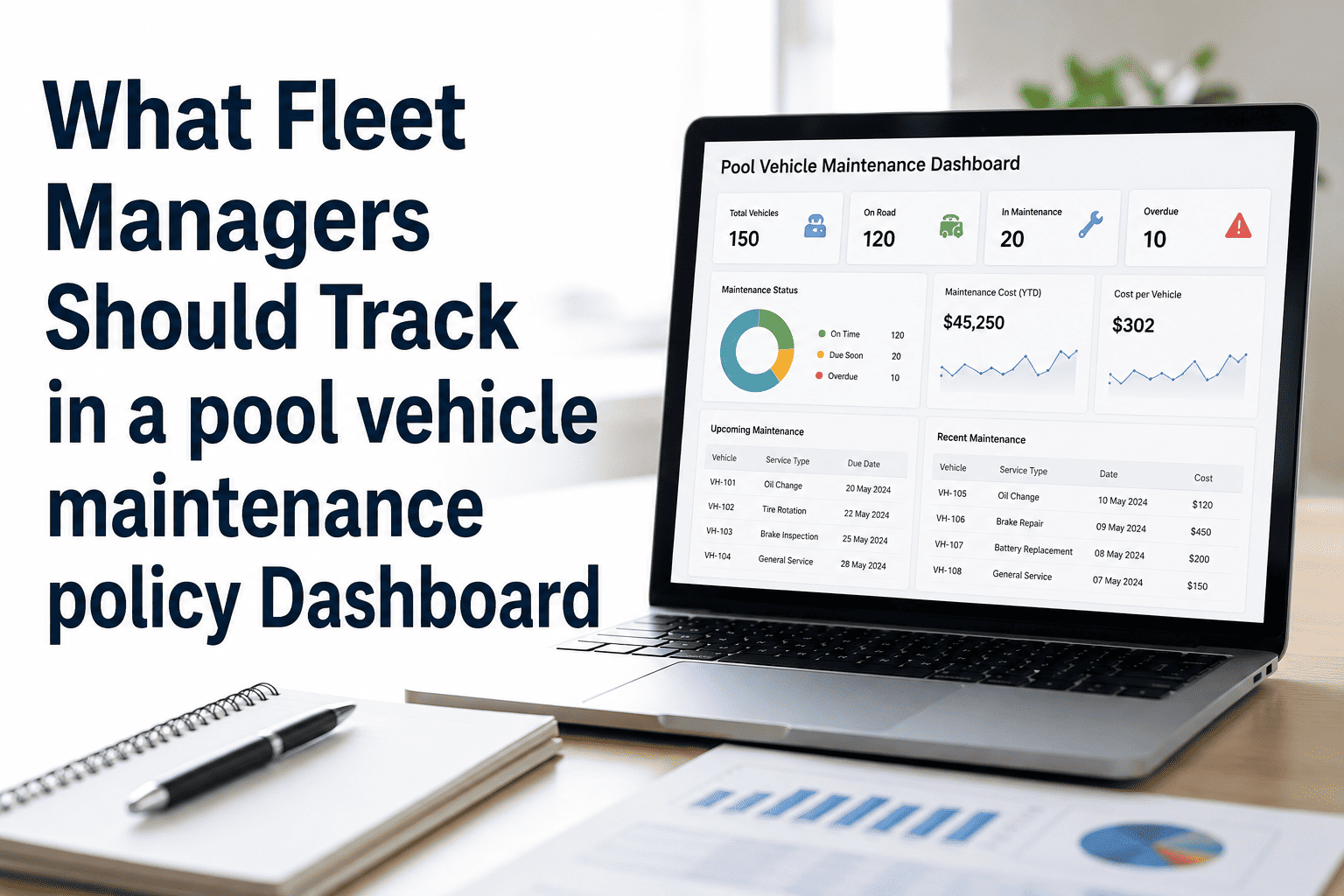
Fleet managers who cannot answer "what is our cost per mile by vehicle class this quarter" within 60 seconds are making every budget decision, replacement decision, and driver accountability decision on instinct rather than data — and in a 50-vehicle fleet, instinct typically costs $80,000 to $140,000 per year in avoidable maintenance spend, fuel waste, and premature replacements. The 25 KPIs in this guide are the metrics that separate fleets running at $0.38/mile from fleets running at $0.61/mile on identical vehicle types — and every one of them is trackable automatically in Oxmaint without a spreadsheet or a manual reporting cycle. Book a demo to see your fleet's current KPI baseline built in Oxmaint within the first session.
Oxmaint calculates cost per mile, vehicle utilization, PM compliance, MTBF, and 21 more KPIs from live fleet data — updated every shift, available on any device, with automated alerts when any metric drifts outside your target range.
The 25 most important fleet management KPIs fall into five categories: financial KPIs (cost per mile, total cost of ownership, maintenance cost per vehicle, fuel spend per route, emergency parts ratio), operational KPIs (vehicle utilization rate, on-time delivery rate, route efficiency, fleet availability, idle time percentage), maintenance KPIs (PM compliance rate, mean time between failures, mean time to repair, unplanned downtime rate, work order backlog), safety KPIs (accident rate per million miles, driver safety score, near-miss frequency, vehicle inspection compliance, seatbelt compliance rate), and sustainability KPIs (CO₂ emissions per mile, fuel efficiency trend, idle reduction rate, electric vehicle charging cost, fleet carbon intensity). Oxmaint tracks all 25 from live telematics and maintenance data — no manual entry.
Category 1: Financial KPIs — The Five Numbers That Drive Every Fleet Budget Decision
Financial KPIs determine whether your fleet is a profit center or a cost sink. These five metrics answer the questions fleet directors and CFOs ask in every quarterly review. Book a demo to see your fleet's financial KPI baseline in Oxmaint.
The single most important fleet financial KPI — it integrates fuel, maintenance, insurance, and depreciation into one comparable number per vehicle class. Top-quartile fleets run $0.32–$0.42/mile for light commercial vehicles. Oxmaint calculates CPM automatically per vehicle and per route — identifying which vehicles are running 40% above fleet average CPM before the cost accumulates undetected.
TCO tracks the full lifetime cost of owning and operating each vehicle — the only metric that correctly informs replacement decisions. A vehicle with low monthly maintenance cost but poor residual value and high fuel consumption has a worse TCO than its maintenance history suggests. Oxmaint builds TCO per vehicle from day one of ownership — so replacement decisions are made on lifetime data, not last quarter's repair bill.
Monthly maintenance cost per vehicle identifies outliers — vehicles consuming 3× the fleet average in repair costs that should be reviewed for replacement or root-cause investigation. Oxmaint tracks this by vehicle, by class, and by route — separating planned PM cost from reactive repair cost to show the true health of each asset.
Fuel is typically 30–40% of total fleet operating cost — making fuel cost per mile the highest-leverage financial KPI after CPM. A 5% improvement in fuel efficiency across a 50-vehicle fleet saves $18,000–$32,000 annually. Oxmaint integrates telematics and fuel card data to calculate fuel CPM per driver, per route, and per vehicle — identifying idle time, aggressive driving, and route inefficiency as the three most addressable fuel cost drivers.
Emergency parts procurement carries a 35–55% premium over planned orders — and a high emergency ratio signals that PM compliance is failing to predict component wear before failure. Fleets above 20% emergency parts ratio are overpaying for the same parts their top-quartile competitors source 8 weeks in advance. Oxmaint reduces emergency parts ratio to <8% by triggering procurement from condition trend data, not from failure events.
Category 2: Operational KPIs — Fleet Utilization and Availability Metrics
Operational KPIs measure how effectively your fleet assets are being used — a fleet with 72% vehicle utilization rate is carrying 28% excess capacity that costs money every day it sits unused. Book a demo to see your fleet's utilization baseline in Oxmaint.
Utilization rate exposes hidden fleet overcapacity — vehicles that are owned but not deployed generate insurance, depreciation, and maintenance costs with zero revenue contribution. Top-quartile fleets maintain 82–88% utilization; industry average is 64–72%. Oxmaint tracks utilization by vehicle, by depot, and by day of week — identifying patterns that enable right-sizing decisions and shift scheduling improvements.
Fleet availability is the operational complement to utilization — it measures how many vehicles are ready-for-dispatch versus out of service for maintenance or repair. A fleet with 88% availability has 12% of its assets unavailable on any given day — for a 50-vehicle fleet, that is 6 vehicles generating zero revenue. Oxmaint improves availability by shifting unplanned repairs to planned PM, reducing the average maintenance duration from 2.1 days to 0.8 days.
Idle time above 15% of engine hours represents pure cost — fuel burned, engine hours consumed, and emissions generated with zero productive output. A fleet averaging 22% idle time across 50 vehicles wastes approximately $34,000/year in fuel alone. Oxmaint flags vehicles above your configured idle threshold and scores drivers by idle behavior — the two highest-leverage inputs to idle reduction programs.
On-time rate is the operational KPI most directly linked to customer satisfaction and contract retention — and the most common root cause of late deliveries is vehicle unavailability from unplanned breakdown, not traffic or driver factors. Oxmaint's predictive maintenance approach reduces vehicle-caused delivery failures by 68% — converting the maintenance program from a service-level risk into a service-level enabler.
Route efficiency below 92% indicates drivers are deviating from optimized routes — adding fuel cost, tire wear, and engine hours beyond the operational plan. Oxmaint integrates telematics routing data against planned routes — identifying systematic deviations by driver and by route corridor so fleet managers can address route compliance or plan re-optimization where road conditions justify different paths.
KPIs 1–10 Live in Oxmaint Within 48 Hours of Telematics Integration
Cost per mile, utilization rate, idle time, and on-time delivery — all calculated automatically from your existing telematics data. No manual data entry. No spreadsheet formulas. Book a demo to see your fleet's first KPI dashboard live.
Category 3: Maintenance KPIs — The Five Metrics That Predict Breakdowns Before They Happen
Maintenance KPIs are the leading indicators of fleet financial performance — a fleet with 94% PM compliance will always have lower CPM than a fleet with 71% PM compliance, because planned maintenance is 3–4× cheaper than reactive repair for the same component. Book a demo to see your PM compliance baseline in Oxmaint.
PM compliance is the foundational maintenance KPI — every percentage point below 90% represents an increasing probability of a breakdown that costs 3–4× the PM cost it replaced. Fleets at 94% PM compliance average 0.4 unplanned breakdowns per vehicle per year; fleets at 71% average 2.8. Oxmaint sends mobile PM alerts to drivers and technicians, tracks completion in real time, and escalates to the fleet manager when any PM exceeds your configured overdue threshold.
MTBF measures reliability — how long your fleet runs between unplanned breakdown events. A rising MTBF means your PM program is working; a falling MTBF means failures are accelerating and your maintenance approach needs adjustment. Oxmaint tracks MTBF by vehicle class, by component type, and by driver — identifying whether failures cluster on specific vehicles, specific routes, or specific drivers that indicate systematic rather than random causes.
MTTR measures how efficiently your maintenance team responds to and resolves failures — it is the KPI most sensitive to parts availability, technician skill, and work order management quality. A fleet with 4.2-hour average MTTR loses twice as much revenue per breakdown event as one with 1.9-hour MTTR. Oxmaint reduces MTTR by routing work orders to the nearest available qualified technician, pre-staging parts from predictive alerts, and eliminating 80% of administrative time between detection and repair start.
Unplanned downtime is the most expensive fleet metric — each hour of downtime costs $420–$700 in lost revenue, emergency repair premium, driver standby, and customer impact. Fleets with 4.2% unplanned downtime rate on a 50-vehicle fleet lose approximately 840 vehicle-hours per year — at $500/hour, that is $420,000 in annual avoidable cost. Oxmaint reduces unplanned downtime by 60% through predictive alert scheduling that converts reactive repairs into planned maintenance windows.
Work order backlog is the leading indicator of future breakdowns — every overdue PM work order is a failure event waiting to happen. A backlog rate above 15% signals that maintenance capacity is undersized relative to fleet size, or that work order prioritization is misaligned. Oxmaint's dashboard shows backlog rate in real time by depot and by technician — so fleet managers can reallocate capacity before the backlog converts into breakdown events.
Category 4: Safety KPIs — The Five Metrics That Reduce Insurance Cost and Regulatory Exposure
Safety KPIs directly affect insurance premiums, regulatory standing, and liability exposure — a fleet that reduces accident rate per million miles by 30% typically sees insurance premium reductions of $18,000–$45,000 annually on a 50-vehicle fleet.
The DOT standard fleet safety benchmark — used by insurers to set commercial vehicle premiums and by regulators to assess safety program adequacy. Industry average for commercial light vehicles is 6.8 accidents per million miles; top-quartile safety programs achieve 2.1–3.4. Oxmaint integrates telematics harsh event data and driver scoring to predict which drivers are elevated accident risk before an event occurs.
Driver safety score is the single most predictive leading indicator of accident risk — drivers in the bottom quartile of safety scores have 4.2× the accident rate of drivers in the top quartile. Oxmaint calculates a daily driver safety score from telematics events, ranks drivers fleet-wide, and sends coaching alerts to fleet managers when any driver's score drops below your configured threshold — enabling proactive intervention before a claim occurs.
DVIR compliance is a DOT regulatory requirement — missing pre-trip or post-trip inspections creates $1,270–$16,000 in civil penalties per violation and exposes the fleet to negligence liability if a vehicle with a missed inspection is involved in an accident. Oxmaint's mobile DVIR system captures driver inspection completion with photo evidence, GPS stamp, and driver signature — making compliance a 3-minute driver task and a 30-second fleet manager verification.
Near-miss frequency is the safety KPI most fleets do not track — and the one with the highest predictive value for accident prevention. Fleets with active near-miss reporting programs have 38% lower accident rates than fleets that only track actual incidents. Oxmaint provides a one-tap mobile near-miss reporting tool for drivers — integrating near-miss data into the safety KPI dashboard alongside telematics harsh event data for a complete risk picture.
Speeding incidents above 10 mph over the limit increase fuel consumption by 7–14% and increase accident severity by 40% for any collision that occurs. Speeding rate above 2.4 events per 1,000 miles indicates a fleet that needs driver coaching or speed limiter policy review. Oxmaint's driver scorecard ranks speeding performance by driver and sends automated coaching notifications when a driver's weekly speeding rate exceeds your fleet threshold.
Category 5: Sustainability KPIs — Five Metrics That Reduce Fuel Cost and Carbon Exposure
Sustainability KPIs are no longer optional reporting — they are procurement requirements for government contracts, ESG reporting obligations for public companies, and direct cost reduction levers for any fleet above 20 vehicles.
Fleet carbon intensity per mile is the primary ESG reporting metric for commercial vehicle operations — required for CDP, GHG Protocol Scope 1 reporting, and most government fleet procurement standards. Oxmaint calculates CO₂/mile from fuel consumption data per vehicle and integrates EV charging data for mixed fleets — producing the emissions reports required for sustainability disclosures without manual data collection.
MPG trend is more valuable than a point-in-time MPG reading — a vehicle dropping 8% in fuel efficiency over 6 months is signaling engine degradation, tire pressure issues, or driver behavior change that, if caught and corrected, recovers $400–$800 in annual fuel cost per vehicle. Oxmaint tracks MPG trend per vehicle and alerts when any vehicle drops more than 5% below its 90-day baseline — the threshold that typically indicates an actionable maintenance or behavior issue.
Idle reduction is the fastest-payback sustainability initiative in fleet management — 1 hour of unnecessary diesel idling burns 0.8 gallons ($3.20 at current rates) and generates 7.2 kg of CO₂ with zero productive output. A fleet reducing idle time from 22% to 12% across 50 vehicles saves approximately $38,000/year in fuel alone. Oxmaint scores idle reduction progress by driver and by depot — making it a team accountability metric, not just a fleet average.
Fleet electrification rate tracks progress against EV transition targets — increasingly a procurement requirement and an ESG board reporting metric. Oxmaint manages EV-specific maintenance schedules (battery health monitoring, charging system PM, regenerative brake inspection intervals), tracks charging cost per vehicle, and produces the EV TCO comparison against equivalent ICE vehicles that justifies — or challenges — electrification investment decisions.
Maintenance ROI is the ultimate KPI that justifies every maintenance program investment to fleet ownership and CFOs. A fleet spending $42,000/year on Oxmaint and delivering $261,000 in avoided breakdown costs, emergency parts savings, and fuel efficiency gains has a 6.2× maintenance ROI. Oxmaint calculates this automatically — tracking avoided downtime value, emergency spend reduction, and efficiency gains against platform cost in one dashboard panel that speaks the language of leadership, not workshop management.
All 25 KPIs. One Dashboard. Live From Your Telematics Data.
Oxmaint connects to your existing telematics system and calculates all 25 KPIs automatically — financial, operational, maintenance, safety, and sustainability metrics updated every shift. Book a demo to see your fleet's current performance across all 25 KPIs.
How Top-Quartile Fleets Use These 25 KPIs — A Scoring Framework
Use this scoring framework to assess where your fleet stands against industry benchmarks across all five KPI categories. Score each category 1–5 and identify where the highest improvement potential lies.
We scored ourselves against these 25 KPIs before deploying Oxmaint. We were a 2 on financial KPIs and a 1 on maintenance. Eighteen months later we are at 4 and 5 respectively — cost per mile dropped from $0.59 to $0.41, PM compliance went from 68% to 93%, and we have not had an unplanned breakdown in 11 weeks. The KPI framework made it obvious where to start.
Frequently Asked Questions
Know Your CPM. Know Your MTBF. Know Exactly Where Your Fleet Is Losing Money.
All 25 fleet KPIs tracked automatically in Oxmaint — live from your telematics data, no spreadsheets, alerts when any metric drifts outside target.