AI Fill Level Monitoring for FMCG Lines (Accuracy Guide)
By Jack Edwards on April 16, 2026
A beverage line running 1,200 units per minute in a plant in New South Wales had a fill valve develop a 0.8% low-drift across six heads on the fourth filling station. The plant's checkweigher caught individual units outside the ±5g tolerance band — but at 1,200 units per minute, 340 underfilled bottles left the line in the 17 seconds between detection and rejection confirmation. Each one had 94.2ml instead of 100ml — technically compliant on checkweigher tolerance but legally deficient under Australia's Trade Measurement Act. The AI vision fill monitoring system that was installed six months later catches the same drift pattern on the first bottle, adjusts the rejection threshold in 80 milliseconds, and links the fill deviation event directly to the valve asset record in OxMaint. Start a free OxMaint trial and connect your fill inspection data to your filling line asset records — or book a demo to see AI fill level monitoring integrated with production maintenance.
AI Vision & Quality · FMCG Fill Control
AI Fill Level Monitoring for FMCG Production Lines
Detect underfill, overfill, and valve drift at 100% coverage and line speed — before non-compliant product reaches the checkweigher, the retailer, or the trading standards inspector.
Average fill variance achievable with AI-monitored valve feedback loops
£18K
Average UK Trading Standards fine for systematic underfill violation
2.4%
Product giveaway reduction when AI fill monitoring replaces spot-check only
80 ms
Per-unit AI fill measurement vs. 3–8 seconds for manual sample check
What AI Fill Level Monitoring Measures — and What It Catches That Checkweighers Miss
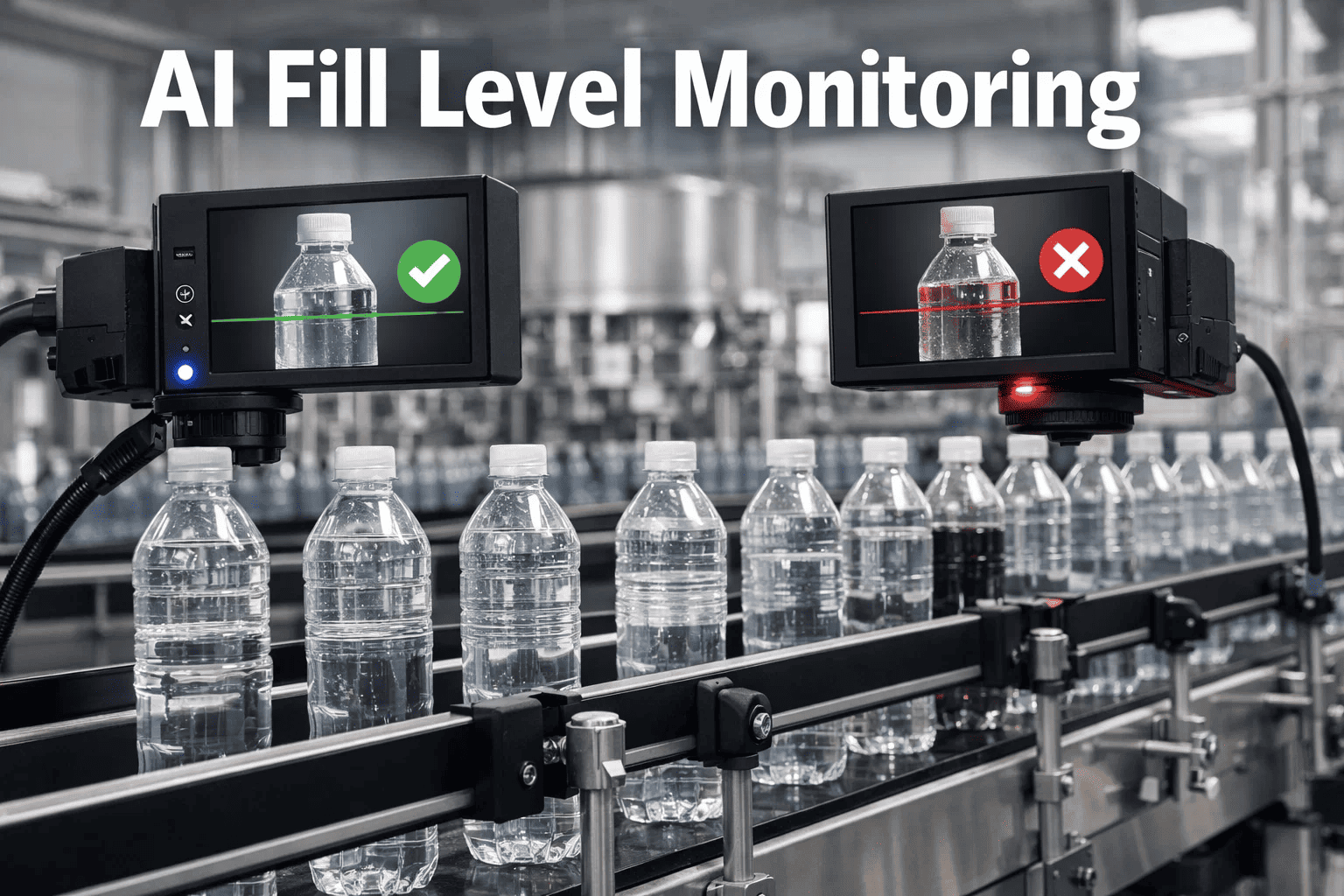
Checkweighers measure total weight — they catch gross underfill and overfill, but they miss fill level variance within tolerance bands that creates cumulative product giveaway and regulatory exposure. A 1% low-drift across a 12-head filler running 800 units per minute represents 144,000ml of product giveaway per hour — invisible to any checkweigher configured within standard ±3% tolerance. AI vision measures actual fill level independently, per head, per unit — catching the drift before it becomes a compliance event or a giveaway problem.
Transmitted Light (Liquid)
Transparent & Translucent Containers
Camera backlit with structured light measures meniscus position. Accurate to ±0.5mm fill height. Detects fill variation across all heads simultaneously. Works on glass, clear PET, HDPE bottles.
Accuracy: ±0.5mm fill height
X-Ray Vision
Opaque & Foil-Sealed Containers
Opaque & Foil-Sealed Containers
X-ray fill inspection measures product mass distribution independent of container opacity. Detects fill level, foreign object inclusion, and void space simultaneously. Used for canned goods, foil pouches, and opaque HDPE.
Accuracy: ±1% of declared weight
Near-Infrared (NIR)
Dense Liquids & Sauces
NIR absorption imaging detects product presence and density variation in high-viscosity fills — sauces, pastes, and thick dairy products where transmitted light cannot penetrate. Distinguishes product from air void at product/air boundary.
Accuracy: ±1.5% volume equivalent
3D Laser Profilometry
Solids & Granular Products
Laser line scanner creates 3D surface height map of solid or granular product in open containers — detects low-fill, product bridging, and void pockets in snack, cereal, and powder applications.
Resolution: 0.1mm surface height
Why Fill Level Deviations Happen — and Which Asset Causes Each Type
Every fill deviation traces back to a specific asset — a valve, a pump, a level sensor, a temperature controller, or a CIP sequence that affected product viscosity. Knowing the defect type reveals which asset needs the work order.
Underfill
Worn or Partially Blocked Fill Valve
Valve seat wear or product residue on valve face reduces flow rate during timed fill cycles. Manifests as progressive low-drift across the affected heads. Increases with run duration as residue accumulates.
OxMaint action: PM work order for valve inspection and seat replacement
Overfill
Level Sensor Calibration Drift
Float or pressure-based level sensors in product supply tanks drift over time, reporting incorrect product height to fill control systems. Results in systematic overfill — invisible to checkweighers within tolerance and significant giveaway cost.
OxMaint action: Calibration work order triggered by fill deviation alert
Variable Fill
Product Viscosity Fluctuation
Temperature variation in product supply affects viscosity — changing flow rate through fixed-time or fixed-volume fill cycles. High-viscosity products at lower temperatures fill slower per cycle than the fill controller expects.
OxMaint action: PM check on heat exchanger and temperature control loop
Underfill
Pump Pressure Drop
Centrifugal or positive displacement pump wear reduces system pressure over campaign length. Gradual pressure drop causes fill rates to decrease progressively — showing as a slow downward drift across all heads simultaneously.
OxMaint action: Pump condition scoring update and PM scheduling
Variable Fill
Starved Head Syndrome
Uneven product distribution to individual fill heads in rotary fillers causes specific heads to underfill while adjacent heads fill correctly. Caused by blocked distribution channel or unbalanced manifold pressure. Requires manifold inspection.
OxMaint action: Manifold inspection work order linked to affected head assets
Overfill
Pneumatic Actuator Fault
Pneumatic actuators controlling valve timing develop seal wear that causes delayed valve closure — extending the fill cycle duration and producing systematic overfill per cycle. Detectable as step-change overfill coinciding with actuator seal failure.
OxMaint action: Actuator seal replacement work order from AI deviation event
How OxMaint Closes the Loop Between Fill Inspection and Asset Maintenance
AI vision detects the fill deviation. OxMaint identifies the asset, assigns the work order, and tracks the resolution — so every fill quality event produces a corrective action, not just a rejection count.
01
Fill Head Asset Registry by Position
Each fill head, valve, and actuator is registered in OxMaint as an individual asset component — numbered by position on the filler carousel. When AI vision flags head 7 as low-filling, the work order is created for head 7's valve assembly specifically. No guessing which head needs service.
02
Fill Deviation Threshold Work Orders
When AI vision detects fill level deviation above threshold — ±1.5% of target fill — OxMaint generates a maintenance work order automatically. The work order includes deviation magnitude, head position, current run data, and the last PM date for that asset. Technicians see full context before they arrive at the line.
03
Valve PM by Cycles Produced
Fill valve PM is scheduled by fill cycles — not calendar days. A filler running 3 shifts reaches valve service intervals 3x faster than a 1-shift equivalent. OxMaint triggers valve seat inspection and replacement at the correct cycle count for each head independently — preventing asymmetric wear patterns across the filler carousel.
04
Calibration Schedule for Level Sensors
Product supply tank level sensors, flowmeters, and fill controllers are scheduled for calibration at defined intervals in OxMaint. Calibration work orders are created in advance, assigned to the instrumentation team, and required to be closed with recorded pre- and post-calibration readings before the asset is marked serviceable again.
05
Giveaway Cost Reporting by Asset
OxMaint's reporting layer calculates product giveaway cost per fill head from AI vision fill deviation data — expressing the financial cost of each asset's fill performance against target. Assets with highest giveaway contribution are prioritized for PM investment, giving maintenance managers a direct ROI justification for each service event.
06
GMP-Compliant Fill Inspection Records
Every fill inspection session — pass rates, deviation events, rejection counts, corrective actions — is logged with digital signatures in OxMaint. Fill inspection records are linkable to batch records and exportable for BRC, IFS, and FSSC 22000 audit submissions. Inspectors see a complete inspection trail from production line to audit report in under 5 minutes.
Checkweigher-Only vs. AI Fill Level Monitoring
Quality Control Parameter
Checkweigher Only
AI Fill Level Monitoring
Coverage rate
100% — weight only
100% — fill level + weight independent verification
Within-tolerance giveaway detection
None — tolerance band invisible
Detects 0.3% low drift — invisible to checkweigher
Per-head fault localisation
No — total weight only
Yes — fill level by head position
Valve drift detection
Only if weight exits tolerance
Detects progressive drift before tolerance breach
Maintenance trigger
None — no asset linkage
Automatic work order to specific valve asset
Audit documentation
Weight records only
Per-unit fill inspection records with batch traceability
Foam/aeration detection
None
Detects foam head as fill level deviation from product meniscus
Product giveaway reduction
Minimal — reactive only
2.4% average reduction across monitored lines
Scroll right to view full table on mobile
Stop Giving Away Product You're Not Being Paid For
AI vision catches the fill drift at head 7. OxMaint creates the work order for valve seat 7. That is how giveaway stops at the source.
Fill Level Monitoring ROI — Where the Numbers Come From
2.4%
Product giveaway reduction
AI monitoring vs. checkweigher-only — on a £5M/yr product line, that is £120,000 recovered
£18K
Typical UK underfill fine avoided
Per systematic violation event under UK Trade Measurement Act regulations
0.3%
Fill variance with AI monitoring
vs. 1.2–1.8% typical fill variance on checkweigher-controlled lines
1 unit
First non-compliant unit detected
vs. 200–500 units before checkweigher batch sample flags the same issue
Frequently Asked Questions
What is the difference between AI fill level monitoring and a standard checkweigher?
A checkweigher measures total product weight after filling and rejects units outside the programmed tolerance band. AI fill level monitoring measures actual fill height or volume using camera-based vision — independently of weight — and can detect within-tolerance giveaway that a checkweigher cannot see. AI fill monitoring also identifies which specific fill head is deviating, enabling targeted maintenance intervention rather than a line stop or blanket rejection event. The two systems are complementary — AI vision provides upstream fill quality control, checkweighers provide downstream weight compliance verification.
How does fill level monitoring handle foamy or aerated products?
Carbonated beverages and aerated dairy products produce foam heads that distort fill level readings from simple transmitted-light systems. AI vision systems trained on foam products use the product meniscus position below the foam layer as the fill level reference — ignoring the foam surface as a fill indicator. The model is calibrated on actual product samples during system commissioning and validated against declared fill volumes. For highly variable foam products, NIR imaging is often preferred because it responds to actual product density rather than surface appearance.
What fill variance is achievable with AI vision-monitored filling systems?
AI-monitored filling lines with closed-loop feedback to fill controllers achieve ±0.3–0.5% fill variance on liquid products in rigid containers — compared to ±1.2–1.8% typical variance on checkweigher-only controlled lines. The improvement comes from two factors: early detection of head-specific drift before it compounds, and the ability to trigger preventive maintenance on valve and actuator assets before they drift outside acceptable tolerance bands rather than reacting after the checkweigher flags a rejection.
How does OxMaint link fill inspection records to regulatory compliance documentation?
OxMaint stores fill inspection records against the production line asset and the batch record simultaneously. When a regulatory inspection or BRC audit requires fill compliance records for a specific date range or product batch, the records are filterable by line, date, SKU, and batch number — exportable as a timestamped, digitally signed PDF that satisfies EU Regulation 76/211, UK Weights and Measures Act requirements, and BRC Global Standard for Food Safety Issue 9 documentation requirements. The audit trail includes inspection pass rates, deviation events, corrective actions taken, and maintenance work orders linked to each deviation event.
Eliminate Giveaway. Eliminate Compliance Risk.
AI Fill Monitoring Finds the Drift. OxMaint Fixes the Valve. Your Product Stays On the Right Side of the Law.
Fill head asset registry by position. Valve PM scheduled by fill cycles. Deviation-triggered work orders at first non-conforming unit. Giveaway cost reporting per asset. Calibration scheduling for level sensors. GMP-compliant inspection documentation for BRC, IFS, and FSSC 22000 audits. OxMaint connects every fill quality event to the maintenance action that prevents it from becoming a recall, a fine, or a retailer chargeback.




-in-fmcg-monitoring-production-quality-in-real-time.png)
