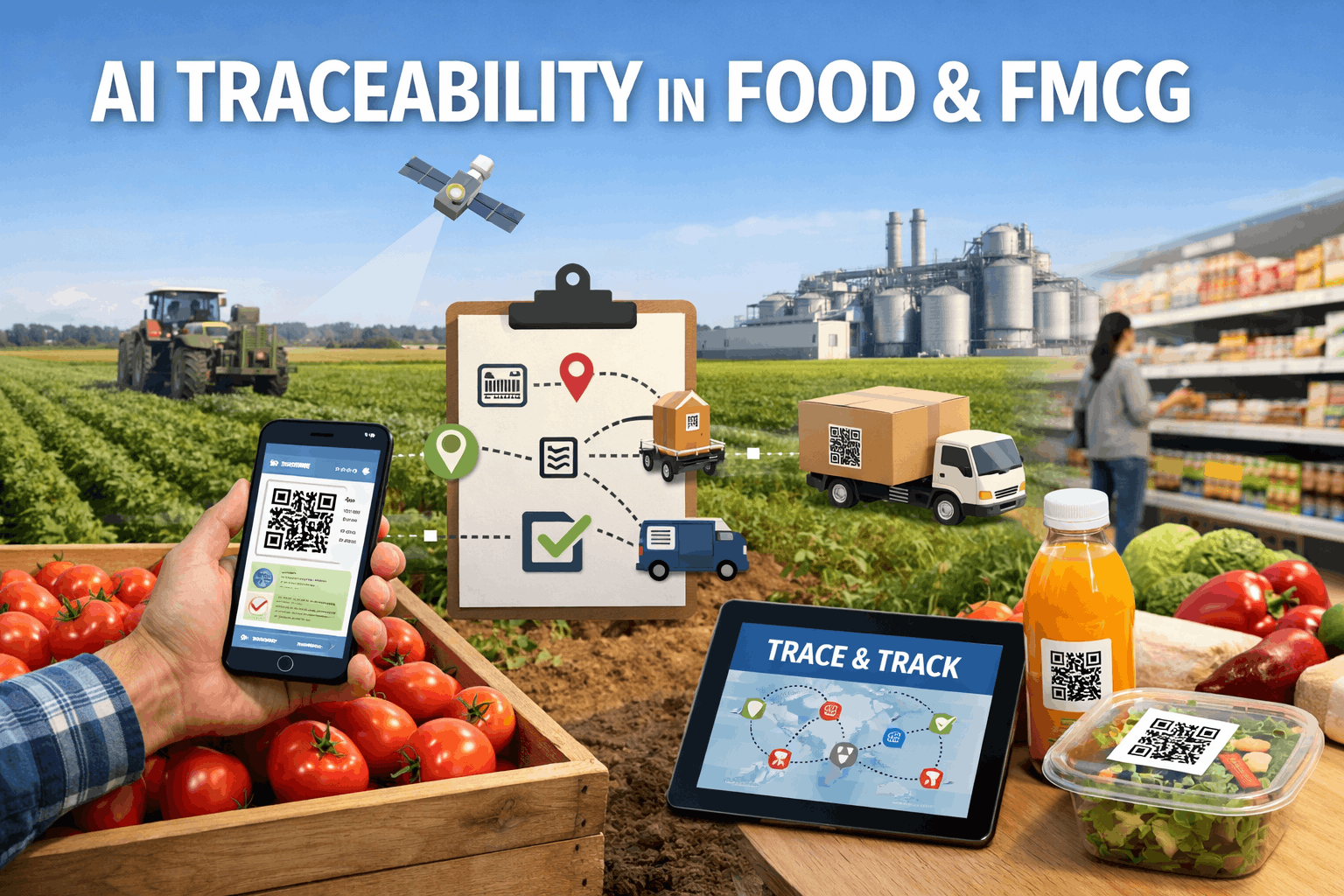
A major European food distributor faced a listeria outbreak that affected multiple retail chains across six countries. The recall required tracing contaminated products through a complex web of suppliers, co-packers, and distribution centers. Paper records and disconnected systems meant the investigation took 11 days to identify the source—during which time the contaminated products remained on shelves and consumer trust plummeted. The company faced €47 million in recall costs and reputational damage that persisted for years. After implementing blockchain traceability through integrated supply chain systems, the same company identified and isolated a potential contamination source in 2.3 hours, containing the issue before products reached consumers. Blockchain creates an immutable, transparent record of every product movement from farm to fork, transforming food safety response from reactive crisis management to proactive protection.
FMCG supply chains involve dozens of touchpoints—farmers, processors, manufacturers, distributors, retailers—each maintaining separate records that rarely connect. Traditional traceability relies on batch codes and paper documentation that fragment across organizational boundaries. When contamination, fraud, or quality issues emerge, investigators must manually reconstruct supply chain paths through disconnected systems, losing critical hours or days. Blockchain technology creates a shared, tamper-proof ledger where every supply chain participant records product movements and transformations in real time. Each transaction links cryptographically to the previous one, creating an unbreakable chain of custody from raw material origin through final consumer sale. This architecture delivers instant traceability, supplier verification, and supply chain transparency that paper systems cannot match—which is why forward-thinking FMCG companies are deploying blockchain to protect brand integrity and consumer safety. Book a demo to explore how Oxmaint integrates blockchain traceability with asset management and maintenance systems for complete operational visibility.
Blockchain for FMCG Traceability & Supply Chain Transparency
Immutable supply chain records, instant product tracing, supplier verification, and farm-to-fork transparency with blockchain technology.
What is Blockchain Traceability?
Blockchain traceability applies distributed ledger technology to supply chain management, creating permanent, tamper-proof records of product movements from origin to consumer. Unlike traditional databases controlled by single entities, blockchain distributes identical copies of supply chain data across multiple participants—farmers, processors, manufacturers, distributors, retailers. Each transaction (harvest, processing, shipment, quality inspection) gets recorded as a "block" containing timestamp, location, product details, and participant signatures. These blocks link cryptographically to previous blocks, forming an immutable chain that cannot be altered without detection. Every supply chain participant sees the same verified history, eliminating information asymmetries and manual reconciliation.
For FMCG companies, blockchain transforms opacity into transparency. A consumer scanning a QR code on yogurt packaging instantly accesses the dairy farm origin, milk collection date, processing facility certifications, temperature records during transport, and distribution path—all verified by independent parties. Retailers gain confidence in product authenticity and ethical sourcing claims. Regulators access complete compliance documentation without requesting files from multiple entities. When contamination occurs, manufacturers trace affected batches to specific production runs and supplier lots within minutes instead of days. This capability matters critically in food manufacturing where hours determine whether contaminated products reach consumers or get intercepted at distribution centers, and where supply chain fraud—counterfeit ingredients, mislabeled origins, quality certificate fabrication—costs the industry billions annually while eroding consumer trust. Start a free trial to see how Oxmaint connects blockchain supply chain data with production asset management for unified operational intelligence.
Blockchain Architecture for FMCG Supply Chains
Enterprise blockchain platforms designed for supply chain transparency balance security, performance, and practical implementation needs.
Permissioned Networks
Private blockchains where verified supply chain participants receive access credentials. Prevents unauthorized data viewing while maintaining transparency among legitimate parties.
Smart Contracts
Automated verification rules that execute when conditions meet—releasing payment when temperature sensors confirm proper cold chain, triggering quality alerts when inspection parameters fail.
Distributed Consensus
Multiple network nodes validate each transaction before permanent recording. Prevents single-party manipulation while ensuring all participants agree on supply chain truth.
Immutable Audit Trail
Cryptographic hashing makes historical records tamper-evident. Any attempt to alter past transactions breaks the mathematical chain, immediately signaling fraud.
IoT Integration
Sensors automatically record temperature, humidity, location, and handling conditions directly to blockchain—eliminating manual data entry errors and increasing trustworthiness.
API Connectivity
Blockchain networks connect with existing ERP, WMS, and CMMS systems through standard APIs, integrating supply chain transparency into current operational workflows without system replacement.
Traditional Traceability Challenges
Paper-based and siloed digital systems create dangerous gaps in FMCG supply chain visibility.
Fragmented Records
Each supply chain participant maintains separate systems with incompatible formats. Tracing products across organizational boundaries requires manual data requests, phone calls, and email chains that consume days.
Data Manipulation Risk
Centralized databases allow single parties to alter historical records without detection. Falsified quality certificates, backdated inspections, and modified batch codes undermine traceability integrity.
Verification Delays
Auditing supplier compliance, certifications, and quality documentation requires requesting files from multiple entities. Verification processes extend weeks, delaying product launches and market entry.
Consumer Trust Gaps
Marketing claims about ethical sourcing, organic certification, and sustainability lack transparent verification. Consumers cannot independently confirm product origin stories, creating skepticism even for legitimate brands.
Recall Inefficiency
Product recalls require manually reconstructing distribution paths through disconnected records. Incomplete information forces overly broad recalls that destroy safe products alongside contaminated ones, multiplying costs unnecessarily.
Counterfeit Infiltration
Complex supply chains with multiple intermediaries create opportunities for counterfeit products to enter legitimate channels. Detecting and removing fake goods requires supply chain transparency that paper systems cannot provide.
How Blockchain Solves FMCG Traceability
Distributed ledger technology eliminates information silos and creates verifiable supply chain transparency that protects brands and consumers.
Instant Product Tracing
Scan any product code to access complete supply chain history—origin, processing steps, quality inspections, transport conditions—in seconds instead of days of investigation.
Tamper-Proof Records
Cryptographic hashing makes historical supply chain data immutable. Any alteration attempt breaks the mathematical chain, immediately signaling fraud and maintaining record integrity.
Automated Compliance
Smart contracts verify certifications, temperature logs, and quality parameters automatically. Non-compliance triggers immediate alerts and prevents non-conforming products from advancing through supply chain.
Supplier Verification
Blockchain records document supplier certifications, audit results, and performance history transparently. New partners prove compliance through verifiable blockchain credentials instead of unverifiable paper claims.
Precision Recalls
Trace contaminated batches to specific suppliers, production runs, and distribution channels within hours. Targeted recalls remove only affected products, minimizing waste and financial impact.
Consumer Transparency
QR codes link consumers directly to verified supply chain data—farm location, harvest date, processing facility, sustainability certifications—building trust through transparent proof instead of marketing claims.
Traditional vs Blockchain Supply Chain Traceability
Blockchain fundamentally transforms how FMCG companies track products and verify supplier compliance.
| Capability | Traditional Systems | Blockchain Traceability |
|---|---|---|
| Trace Time | 7-14 days manual investigation | 2 hours automated tracking |
| Data Integrity | Vulnerable to manipulation | Cryptographically immutable |
| Supplier Verification | Request documents, manual review | Real-time blockchain credentials |
| Consumer Access | No visibility beyond packaging | Complete supply chain via QR scan |
| Recall Precision | Broad recalls due to uncertainty | Targeted removal of affected batches |
| Compliance Auditing | Sample-based, periodic reviews | Continuous automated verification |
| Cross-Organization Data | Fragmented, incompatible systems | Shared ledger, single truth |
| Counterfeit Detection | Difficult, often post-incident | Real-time authentication at each step |
The difference matters critically when contamination events, supplier fraud, or compliance failures threaten consumer safety and brand reputation. Traditional systems discover problems too late, after products reach consumers and damage occurs. Blockchain architecture prevents issues through real-time verification and enables instant response when problems emerge—which is why leading FMCG companies view blockchain traceability as essential infrastructure rather than experimental technology. Start a free trial to experience how Oxmaint connects blockchain supply chain data with production operations for unified visibility, or book a demo to see blockchain integration with your specific supply chain architecture.
Blockchain Implementation Results
FMCG companies deploying blockchain traceability report measurable improvements in supply chain performance, recall efficiency, and consumer trust.
Reduce contamination source identification from 7-14 days to hours, minimizing consumer exposure and recall costs.
Precision tracing eliminates unnecessary product destruction by identifying only affected batches instead of broad date ranges.
Faster response and targeted recalls reduce total recall costs including product destruction, logistics, legal exposure, and brand damage.
Transparent supply chain access through QR codes increases brand trust and purchase intent among consumers valuing authenticity and sustainability.
Blockchain-based credential verification accelerates new supplier qualification from weeks to days by eliminating manual document review.
Cryptographic product authentication at each supply chain step completely prevents counterfeit infiltration into verified channels.
Frequently Asked Questions
How does blockchain integrate with existing ERP and supply chain systems?
Enterprise blockchain platforms connect through standard APIs that read and write data from existing ERP, WMS, and TMS systems. Organizations do not replace current systems—blockchain acts as an additional transparency layer that synchronizes supply chain data across participants. Smart contracts can trigger automated actions in connected systems based on blockchain-verified events, creating seamless integration between distributed ledger and traditional enterprise applications. Book a demo to explore blockchain integration with your specific system architecture.
What data privacy protections exist in supply chain blockchains?
Permissioned blockchain networks restrict data access to verified supply chain participants through credential-based authentication. Organizations control what information shares publicly versus privately through selective disclosure—product safety data might be consumer-visible while commercial pricing remains restricted to trading partners. Zero-knowledge proofs allow verification of conditions (temperature maintained properly) without revealing underlying data (specific temperature readings), balancing transparency with competitive confidentiality.
How long does blockchain implementation take for FMCG supply chains?
Pilot implementations typically launch in 8-12 weeks covering limited product lines and key suppliers. Full supply chain rollout across multiple categories and hundreds of suppliers generally completes in 6-12 months. Implementation timeline depends on supply chain complexity, number of participants requiring onboarding, and integration requirements with existing systems. Phased approaches start with high-value or high-risk products, then expand coverage progressively.
What happens if supply chain partners refuse to participate in blockchain?
Leading FMCG companies increasingly make blockchain participation a supplier requirement, similar to existing quality certifications and compliance standards. For existing suppliers, transition periods provide time for adoption with technical assistance from the implementing manufacturer. For critical suppliers unwilling to participate, alternative solutions include third-party data entry services that bridge blockchain and traditional record-keeping, though this reduces some automation benefits. Market pressure drives adoption as blockchain transparency becomes industry standard for food safety and authenticity verification. Start a free trial to see how Oxmaint helps manage supplier compliance and blockchain participation across your supply network.
Stop Losing Trust to Supply Chain Opacity
Turn every product into a transparent, verifiable supply chain story that protects consumers and builds lasting brand trust.