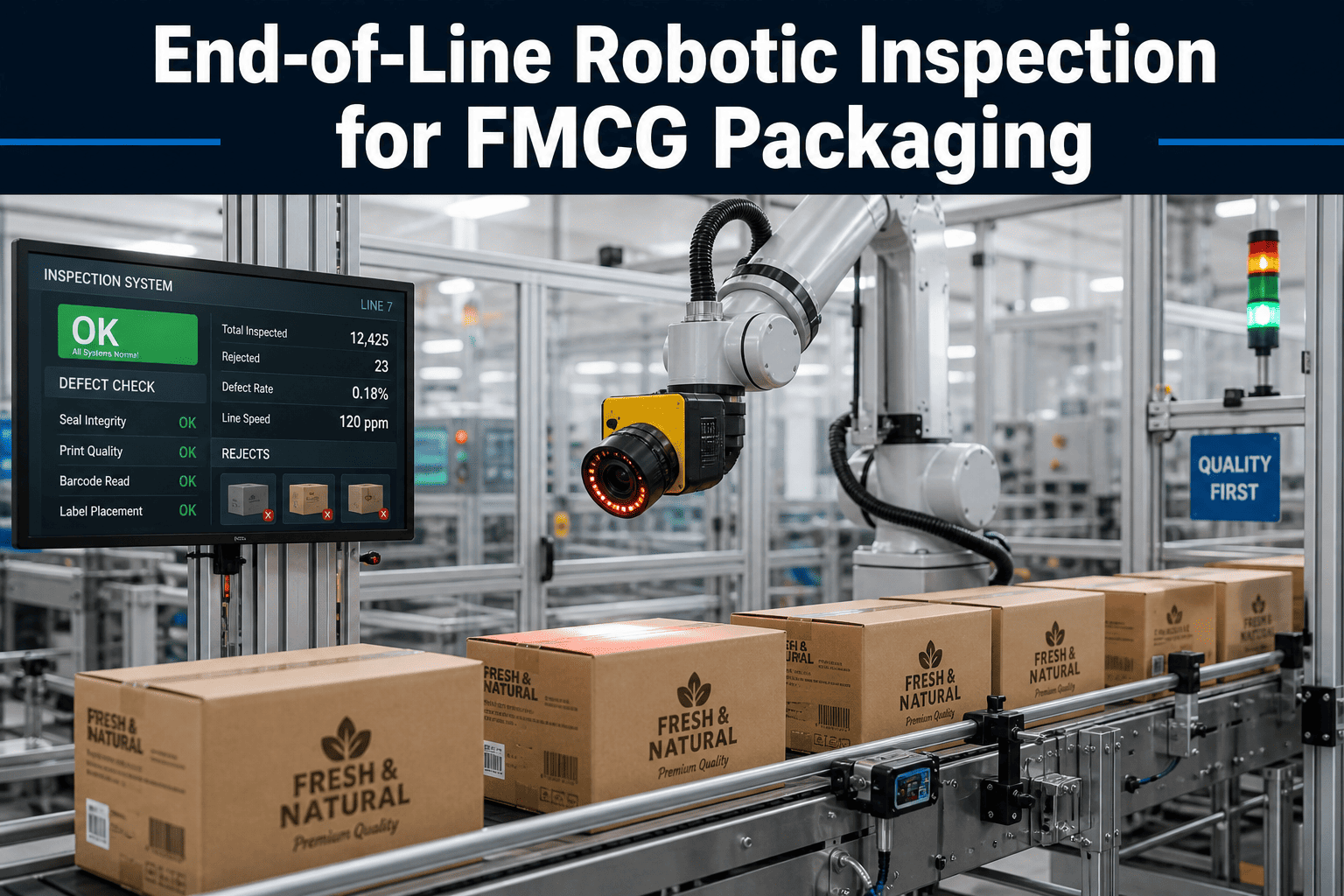
Your packaging line runs 600 units/minute. Manual inspectors catch 85% of label defects, miss fill-level variations under 3mm, and cannot verify 100% of seal integrity. AI vision systems inspect every package at full speed—detecting misaligned labels within 0.5mm tolerance, verifying fill levels to 99% accuracy, identifying seal defects invisible to human eyes, and confirming cap placement in milliseconds. Leading manufacturers achieve 99.8% defect detection accuracy reducing recalls 75%, preventing $10M+ incidents, and eliminating 45% of label-error-driven recalls. FMCG producers ready to sign up for AI-powered vision inspection systems can implement OXmaint's Packaging Vision Inspection automating quality control across high-speed production lines.
AI vision systems combine high-resolution cameras, specialized lighting, and deep learning algorithms inspecting packages at production speeds up to 1,200 units/minute. Convolutional neural networks trained on millions of labeled examples detect defects measuring 0.1mm with 99.8% accuracy—37% more critical defects than expert human inspectors. Manufacturers wanting to schedule a vision inspection demonstration can see OXmaint systems performing real-time quality verification on FMCG packaging lines.
Label Verification
OCR confirms text accuracy, barcode readability, allergen declarations, lot codes, expiry dates matching specifications
45% of recalls prevented (label errors primary cause)
Fill Level Inspection
3D sensors measure liquid/product levels detecting underfills, overfills, inconsistencies within 1mm tolerance
99%+ fill accuracy across transparent/opaque containers
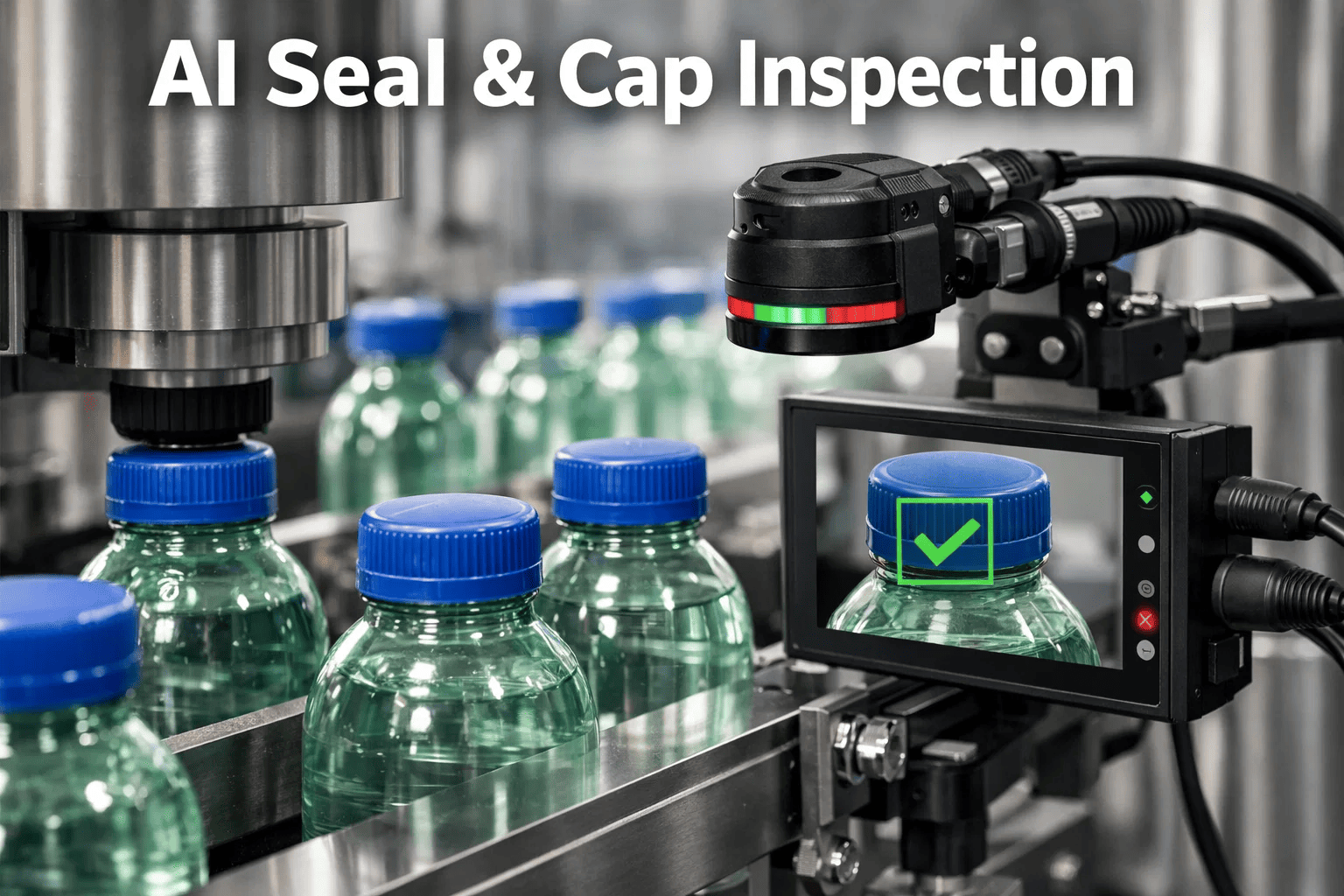
Seal Integrity Verification
High-resolution imaging detects unsealed edges, partial closures, improper heat seals preventing contamination
$259M market by 2025 (seal inspection AI)
Cap Placement Detection
Vision confirms cap presence, orientation, torque indicators, tamper-evident features across bottle/jar packaging
Millisecond inspection preventing distribution errors
Packaging Defect Identification
Surface inspection detecting tears, dents, scratches, contamination, foreign objects in transparent packaging
30% defect rate reduction after AI implementation
Assembly Verification
Component count, orientation, placement validation ensuring complete packages with proper item arrangement
Prevents costly returns from missing components
High-Resolution Cameras
Industrial cameras capture multi-angle images at production speed with specialized lighting highlighting defects
Thousands of images/second processing capability
Deep Learning Models
Convolutional neural networks trained on millions of labeled examples identifying subtle defects and anomalies
99.8% accuracy detecting 0.1mm surface defects
3D Vision Systems
Depth sensors capturing surface contours, volume, shape for fill-level verification and dimensional measurement
Micron-level measurement accuracy
Real-Time Processing
Edge computing analyzing images instantly enabling immediate reject decisions without slowing production
Millisecond decision latency at line speed
Continuous Learning
AI improves over time encountering new defect variants becoming more intelligent with operational use
Adaptive models reducing false rejects
Data Logging System
Every inspection logged with images, decisions, timestamps providing FDA/ISO compliance documentation
Complete traceability and audit trails
1
Assessment & Design
Identify inspection requirements, define quality specifications, select camera/lighting configurations, design integration
2-4 weeks
2
Model Training
Collect defect samples, label training data, train neural networks, validate accuracy against specifications
4-6 weeks
3
Line Integration
Install cameras/sensors, configure reject mechanisms, integrate with line controls, perform production testing
2-3 weeks
4
Optimization & Scale
Fine-tune detection thresholds, reduce false rejects, expand to additional lines, continuous model improvement
Ongoing
How does AI vision inspection achieve higher accuracy than human inspectors?
AI vision systems use high-resolution cameras capturing thousands of images per second, deep learning models trained on millions of labeled defect examples, and consistent algorithms unaffected by fatigue or lighting conditions. Studies show AI detects 37% more critical defects than expert human inspectors under optimal conditions, with 99.8% accuracy identifying surface defects as small as 0.1mm. Human eyes process 10-12 images/second and experience fatigue during extended shifts—AI inspects 100% of packages at speeds up to 1,200 units/minute maintaining consistent accuracy. Continuous learning enables AI to improve over time as it encounters new defect variants.
What packaging defects can AI vision systems detect on FMCG lines?
AI vision detects: (1) Label errors—misaligned labels, incorrect text, missing allergens, unreadable barcodes, wrong lot/expiry codes, (2) Fill-level issues—underfills, overfills, inconsistencies detected within 1mm tolerance using 3D sensors, (3) Seal defects—unsealed edges, partial closures, improper heat seals, contamination risks, (4) Cap problems—missing caps, incorrect orientation, loose placement, damaged tamper-evident features, (5) Packaging damage—tears, dents, scratches, surface contamination, foreign objects, (6) Assembly errors—missing components, wrong orientation, incorrect placement. Label errors alone drive 45% of food recalls—AI prevention saves $10M+ per incident avoided.
Can AI vision inspection keep pace with high-speed FMCG packaging lines?
Yes—modern AI vision systems inspect packages at production speeds up to 1,200 units/minute without slowing throughput. Edge computing enables real-time processing with millisecond decision latency, immediately triggering reject mechanisms for defective packages. Documented results show 27X speed improvements (inspection time reduced from 60 seconds to 2.2 seconds) with 6X output increase using 1/4 the manual inspection labor. Systems process thousands of images per second analyzing multiple inspection points simultaneously—label verification, fill-level measurement, seal integrity, cap placement—in parallel. 100% inspection coverage achieved vs. manual sampling approaches missing defects between checks.
What ROI should FMCG manufacturers expect from AI vision inspection?
Typical returns include: 75% recall reduction preventing $10M+ incidents (average recall costs $10M-$100M), 99.8% defect detection accuracy vs. 85% manual inspection, 30% defect rate reduction after implementation, 22% customer complaint reduction from quality/contamination issues, 50% faster inspection (27X speed documented), 100% inspection coverage eliminating sampling gaps. Single prevented recall often justifies entire system investment. Additional value: reduced labor costs (1/4 inspection workforce), improved first-pass yield, complete traceability with logged images/timestamps for FDA/ISO compliance, continuous improvement as AI learns new defect patterns. Payback periods typically 12-18 months with ongoing operational savings.
How is AI vision inspection implemented on existing packaging lines?
Implementation follows phased approach: (1) Assessment (2-4 weeks)—identify inspection requirements, define quality specifications, design camera/lighting configurations, plan line integration points, (2) Model training (4-6 weeks)—collect defect samples from production, label training datasets, train convolutional neural networks, validate accuracy against specifications achieving 99%+ detection rates, (3) Line integration (2-3 weeks)—install cameras/sensors at inspection stations, configure reject mechanisms, integrate with line controls and CMMS platforms, perform production testing, (4) Optimization (ongoing)—fine-tune detection thresholds reducing false rejects, expand to additional lines/SKUs, continuous model improvement. Total deployment 8-13 weeks from assessment to full production operation with minimal line downtime during installation.


.png)

