AI Vision Inspection for FMCG Packaging Quality

By Jack Edwards on April 15, 2026

ai-vision-inspection-fmcg-packaging-quality

A premium pet food manufacturer running 240 units per minute on a pouch line discovered — through a retailer return analysis, not a production alert — that 0.3% of units shipped over a 4-week period had label registration errors significant enough to obscure the nutritional declaration panel. The vision camera on that line was operational. The inspection algorithm was running. The problem was that the camera had been requalified after a lens replacement six weeks earlier using a qualification image set that did not include the updated label artwork introduced at the same time as the lens change. The system was inspecting every label — against the wrong reference image. 72,000 affected units had to be located in the distribution network. Total recovery cost: $340,000. Start a free trial to track vision system qualification records, reference image versions, and calibration history in Oxmaint. Book a demo to see how Oxmaint connects packaging line inspection assets to maintenance and quality management.

AI Vision · FMCG Packaging · Label Inspection · Quality Control · High-Speed Lines

Your AI vision system is only as effective as the maintenance program behind it. A miscalibrated camera, an outdated reference image, or a worn illumination unit produces confident wrong answers — at 300 units per minute.

Label registration. Fill level. Seal integrity. Barcode legibility. Date code accuracy. Print quality. Each inspection parameter depends on hardware that degrades, software that must track product changes, and records that prove your system was operating correctly when a complaint arrives.

$340K
recovery cost from a single vision system qualification failure at a high-speed pouch line

99.97%
achievable inspection accuracy for label verification on properly maintained AI vision systems

5,400
monthly searches for AI packaging inspection terms — growing 34% year-on-year as FMCG lines upgrade
Inspection Parameters

Eight Packaging Quality Parameters AI Vision Systems Inspect — and What Degrades Each

Label Registration
Position accuracy of label on container — offset, rotation, skew
Degrades when: Camera mount vibration loosens, applicator head wears, conveyor timing drifts
Fill Level Verification
Product level within defined tolerance — underfill and overfill detection
Degrades when: Illumination intensity drops, camera exposure drifts, reference image not updated for product change
Seal Integrity Inspection
Seal width, continuity, wrinkling, and jaw impression uniformity
Degrades when: Sealing jaw temperature drifts, jaw surface coating wears, camera lens fogging from steam exposure
Barcode & QR Legibility
Print contrast, bar width, quiet zone — must meet GS1 grade C minimum
Degrades when: Print head nozzles clog, ink viscosity changes seasonally, camera resolution calibration drifts
Date Code Verification
Best-before or use-by date — correct format, legibility, correct date value
Degrades when: Ink jet print head service is overdue, substrate temperature affects ink adhesion, camera angle shifts
Print Quality Grading
Colour registration, text sharpness, image density versus golden sample
Degrades when: Illumination spectrum shifts with lamp ageing, camera sensor sensitivity changes over service life
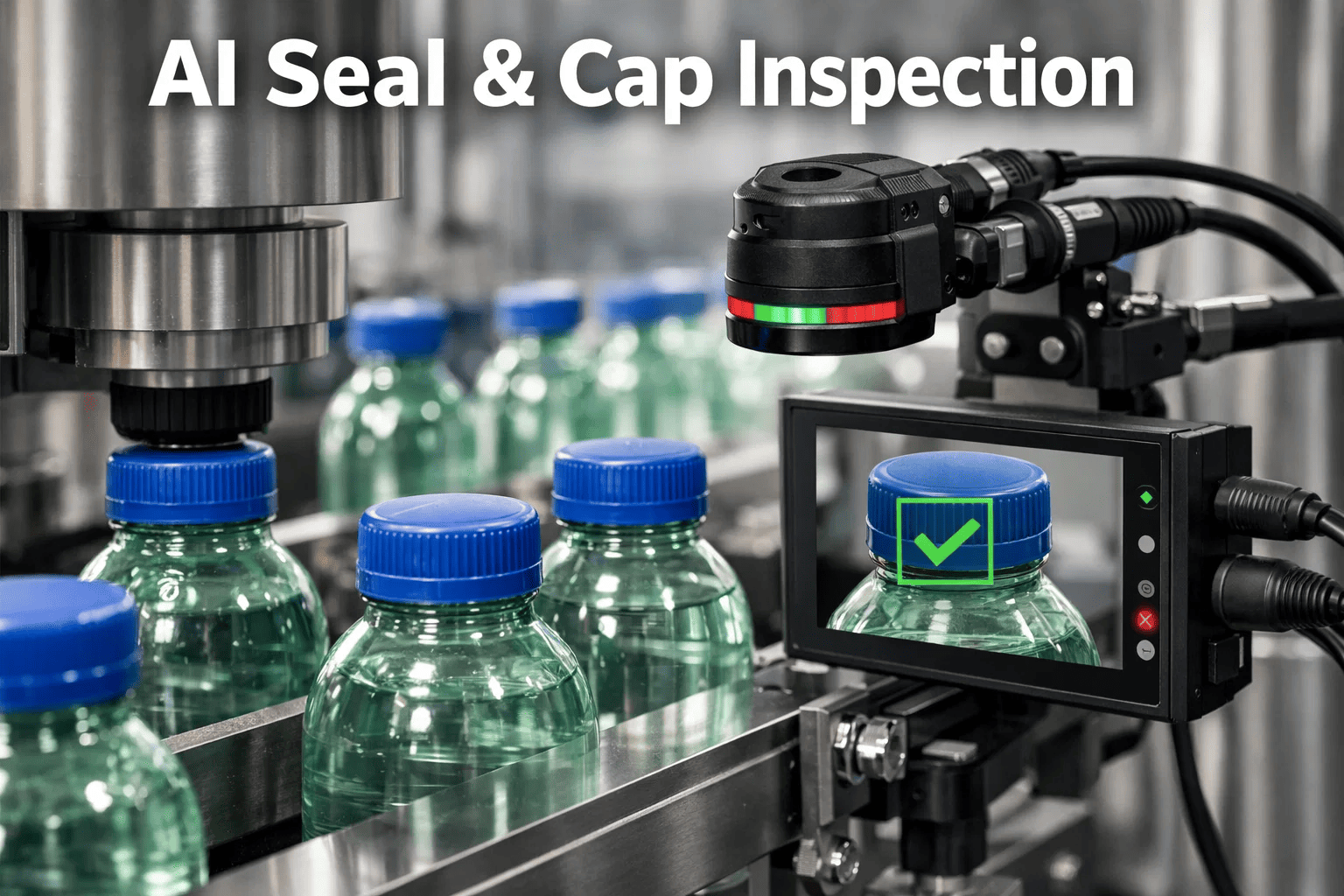
Cap and Closure Presence
Cap presence, seating position, tamper-evident band integrity
Degrades when: Camera height drifts on vibrating line, lighting angle shifts, reference model not updated after cap supplier change
Defect & Damage Detection
Dents, tears, crushed corners, surface contamination, foreign matter
Degrades when: Illumination uniformity drops, model sensitivity threshold drifts after software update
The Maintenance Requirement

AI Vision Systems Need Maintenance Programs — Not Just Calibration Certificates

Hardware Maintenance
Camera lens cleaning
Weekly — particle contamination on food lines
Illumination intensity check
Monthly — LED intensity degrades from rated output
Camera mount torque verification
Quarterly — vibration loosens fixings on high-speed lines
Full optical alignment check
Semi-annual — or after any mechanical intervention
Software & Reference Management
Reference image update on artwork change
Every product artwork revision — version controlled
Algorithm requalification after hardware change
After every lens, camera, or illumination replacement
False reject rate trending
Weekly — sensitivity drift detected by FRR increase
Escape rate audit (sample check)
Quarterly — validate that rejects are correctly classified

Every vision system maintenance event must create a record — because when a quality complaint arrives, the first question your QA manager will be asked is: was the vision system properly maintained and qualified at the time this unit was produced? Oxmaint maintains that answer automatically. Start a free trial to configure vision system maintenance schedules in Oxmaint. Book a demo to see how qualification records and reference image version control work in the platform.

ROI & Results

Packaging Quality Inspection — What the Numbers Show

0.3%
Defect escape rate
typical escape rate at FMCG packaging lines running manual inspection only — AI vision reduces this to below 0.01%
34%
Annual growth in AI vision adoption
year-on-year increase in FMCG packaging lines upgrading from manual QC to automated AI inspection
18 months
Average payback period
for AI vision installation on high-speed FMCG lines — driven by reduced rework, lower recall risk, and labour reallocation
Faster complaint investigation
when vision system maintenance records, reference image versions, and qualification dates are accessible in a CMMS at the time of the complaint
Reactive vs Managed

Vision System Management: Untracked vs. Oxmaint-Managed

Without Oxmaint
Reference image versionUnknown — may be months out of date
Lens cleaning scheduleWhen someone remembers — no formal task
Requalification after hardware changeMay not happen — no system-triggered reminder
False reject trendingNot tracked — sensitivity drift undetected
Complaint investigationNo records to confirm system status at production time
Illumination checkAt failure — LED degradation silent until output drops
VS
With Oxmaint
Reference image versionVersion-controlled — update task triggered on artwork change
Lens cleaning scheduleWeekly recurring task — overdue tasks auto-escalated
Requalification after hardware changeAuto-triggered work order on every component replacement
False reject trendingWeekly data entry — trend alert on FRR increase
Complaint investigationFull maintenance history at production time — instantly retrievable
Illumination checkMonthly intensity check scheduled — LED replacement before output drops
FAQ

Frequently Asked Questions — AI Vision Inspection for FMCG Packaging

How often should AI vision systems on FMCG packaging lines be requalified?
Full system requalification is required after any hardware change — camera replacement, lens change, illumination unit replacement, or camera mount adjustment. Partial requalification covering reference image verification is required on every product artwork revision. Routine performance verification — using a test board or golden sample — should run at every shift start. Oxmaint schedules all three tiers of qualification activity as recurring tasks, auto-generates requalification work orders after hardware maintenance events, and links reference image update tasks to artwork change notifications. Start a free trial to configure vision system qualification schedules in Oxmaint.
What is a false reject rate (FRR), and why does it matter for AI vision maintenance management?
The false reject rate is the percentage of conforming units that the vision system incorrectly rejects as defective. An increasing FRR is one of the earliest indicators of system degradation — lens contamination, illumination intensity drop, or algorithm sensitivity drift — before the system begins allowing genuine defects through. Tracking FRR as a regular KPI in your CMMS allows maintenance teams to identify degradation and schedule corrective maintenance before the system begins generating escapes. Oxmaint records FRR against the vision system asset and generates a maintenance alert when the rate deviates more than 2× from baseline. Book a demo to see FRR trending in Oxmaint.
How does Oxmaint support quality complaint investigations involving packaging vision systems?
When a packaging quality complaint is received, the first question from any FMCG quality manager is: was the vision system operating correctly during the production run that generated this unit? Oxmaint maintains a timestamped record of every calibration event, qualification activity, reference image version, maintenance task, and inspection result against the specific vision system asset. Filtering by production date returns the complete system status at that point in time — qualifications completed, hardware condition, reference image version in use — without manual file searching. This reduces complaint investigation time by up to 6× compared to paper-based maintenance records.
Can Oxmaint manage vision system records alongside other packaging line equipment maintenance?
Yes. Oxmaint's asset hierarchy allows vision systems to be registered as sub-assets within the packaging line asset — alongside the sealing jaw assembly, date coding unit, conveyor system, and filling station. This means a single packaging line view in Oxmaint shows the maintenance status, upcoming tasks, and recent work order history for every piece of equipment on that line simultaneously — including the vision systems. A maintenance manager planning a shift can see that the vision system lens is overdue for cleaning, the sealing jaw thermocouple is due for calibration, and the date coding print head service is due this week — all in one screen. Start a free trial and configure your packaging line asset hierarchy in Oxmaint.
Oxmaint · AI Vision Inspection · FMCG Packaging Quality · Maintenance Management

Your vision system is inspecting every unit. Is Oxmaint tracking every maintenance task, qualification event, and reference image version that determines whether those inspections are correct?

Vision system maintenance scheduling. Requalification work orders. Reference image version control. FRR trending. Complaint investigation records. Packaging line asset hierarchy. All in one platform.
Share This Story, Choose Your Platform!