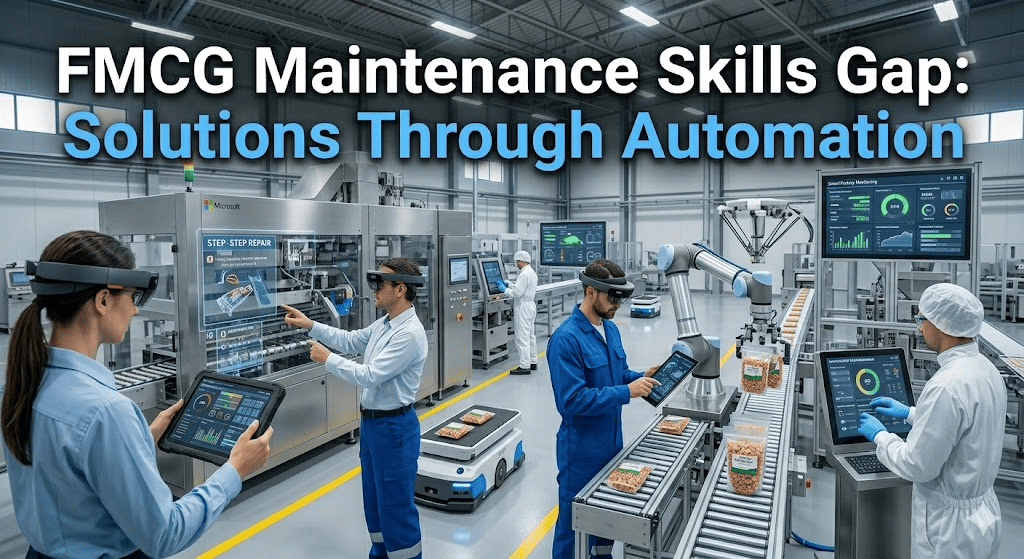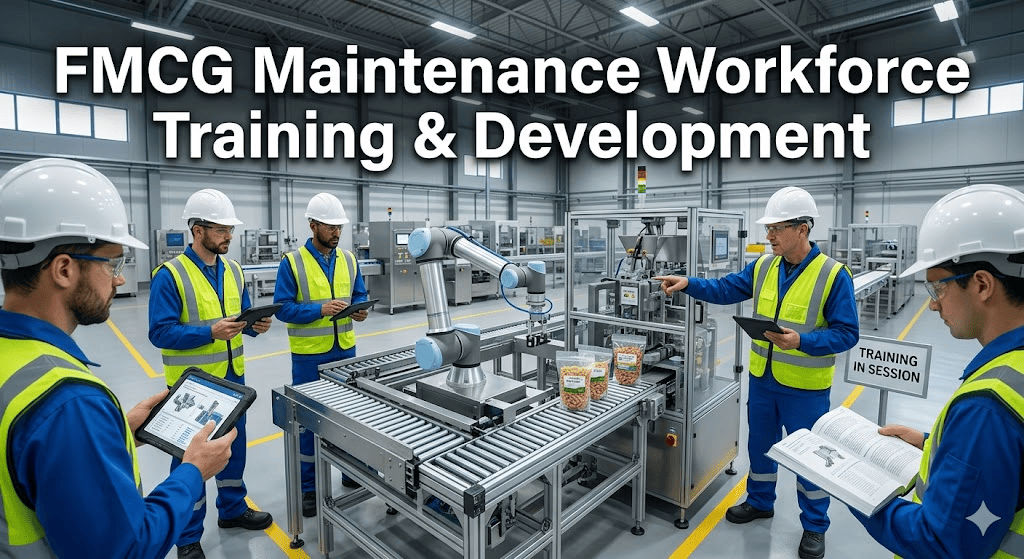
FMCG maintenance teams are the backbone of food production reliability — yet workforce training programs in fast-moving consumer goods manufacturing remain inconsistent, underfunded, and disconnected from real operational demands. According to Food Industry Executive research, 47% of food manufacturing operations leaders cite lack of qualified maintenance candidates as their top challenge, while the Deloitte and Manufacturing Institute 2024 study projects manufacturers may need 3.8 million new workers by 2033 with up to 1.9 million roles potentially unfilled. In FMCG specifically, the gap is sharpest in technical maintenance — mechatronics technicians trained in both PLCs and sanitary equipment design, HACCP-aware technicians who understand food safety implications of every repair, and multi-skilled workers who can handle pneumatics, hydraulics, and electrical systems on the same shift. Structured training programs — supported by digital maintenance platforms that capture procedures, task histories, and technician performance data — are the foundation for closing that gap. Start a free trial to build your FMCG maintenance training framework in Oxmaint, or book a demo to see how leading food manufacturers use CMMS to accelerate technician development.
Build a Training-Ready Maintenance Team — Start With Oxmaint
Oxmaint captures every procedure, repair note, and task history your veteran technicians carry in their heads — turning institutional knowledge into structured, searchable training content for every technician on every shift.
What Is FMCG Maintenance Workforce Training?
FMCG maintenance workforce training is a structured program for developing the technical, regulatory, and operational skills required to maintain food and consumer goods production equipment at the standard the industry demands. Unlike general industrial maintenance training, FMCG maintenance training must integrate food safety awareness — including GMP compliance, HACCP principles, allergen control during maintenance, and post-maintenance sanitation verification — into every technical discipline from electrical fault-finding to precision lubrication.
Effective FMCG training programs operate on three levels: foundational technical skills (electrical, mechanical, pneumatic, hydraulic), food-manufacturing-specific compliance knowledge (HACCP, GMP, SQF, FSSC 22000), and equipment-specific operational training on the production lines the technician will actually maintain. Modern programs increasingly use digital CMMS platforms as both training delivery tools and competency tracking systems — linking task completion, work order quality, and inspection scores directly to individual technician development records.
The stakes are high: FPSA research shows that audit non-conformances directly increase when maintenance roles are vacant or undertrained, because GFSI, SQF, and USDA/FDA audits require evidence that every maintenance technician understands the food safety implications of their work. Facilities that treat training as a continuous, documented process — not a one-time induction event — see measurably lower breakdown rates, higher OEE, and far fewer compliance gaps. Start a free trial to see how Oxmaint supports technician development through structured task management.
Core Training Competency Areas for FMCG Maintenance Technicians
Electrical Systems & Controls
Motor drives, PLC fault-finding, sensor calibration, and safe isolation procedures. Critical for high-speed packaging, conveyor, and filling line maintenance across FMCG operations.
Mechanical & Precision Maintenance
Bearing replacement, shaft alignment, gearbox servicing, and belt/chain tensioning on food-grade equipment. Emphasis on food-safe tools and contamination prevention during repair.
Pneumatics & Hydraulics
Diagnosing pneumatic faults on high-speed fillers and hydraulic systems on forming and pressing equipment. Seal replacement and pressure testing in food-manufacturing environments.
HACCP & Food Safety Awareness
Understanding how maintenance activities create food safety risk — foreign body contamination, allergen cross-contact, microbiological hazards from equipment returned dirty to service.
GMP Compliance in Maintenance
Correct tool and spare parts management, food-grade lubricant identification, hygiene procedures during maintenance, and post-maintenance sanitation sign-off protocols.
Predictive & Condition-Based Monitoring
Vibration analysis basics, thermal imaging interpretation, oil sampling, and ultrasound inspection. Increasingly standard for maintenance technicians managing high-value FMCG production assets.
Digital CMMS & Work Order Management
Using mobile maintenance platforms to execute PM tasks, complete digital checklists, document repairs with photos, and update asset records — eliminating paper-based gaps that generate audit findings.
Lockout/Tagout & Safe Systems of Work
LOTO procedures specific to FMCG equipment including multi-energy isolation on high-speed packaging lines. OSHA 1910.147 and equivalent UK/AUS/UAE compliance built into every maintenance task.
Pain Points: Why FMCG Maintenance Training Programs Fail
Knowledge Locked in Retiring Technicians
The average FMCG maintenance team has 2–3 veteran technicians who carry years of equipment-specific knowledge — failure patterns, workarounds, calibration quirks — in their heads with no documented transfer path. When they retire, that knowledge leaves with them.
Training Disconnected From Real Equipment
Generic industrial maintenance courses do not address the specific equipment, tolerances, and food safety implications of the lines technicians actually maintain. Time-to-competency stays high because training content has no operational anchor.
No Competency Tracking or Progression Paths
Most FMCG facilities cannot demonstrate which technicians are trained on which equipment to which standard — creating both audit risk and operational risk when technicians are assigned tasks beyond their verified capability.
Food Safety Knowledge Gaps in Maintenance Teams
Maintenance technicians who do not understand HACCP, allergen management, or GMP requirements during repair create food safety risks — including foreign body contamination, allergen cross-contact, and microbiological hazards from improperly returned equipment.
High Turnover Erases Training Investment
FMCG maintenance roles see annual turnover of 15–25% in many facilities. Without structured knowledge capture in a CMMS, every departure resets the team's operational expertise — and every new hire requires expensive restart from scratch.
Multi-Site Training Inconsistency
FMCG portfolio operators running multiple plants find that training standards, procedures, and competency levels vary dramatically between sites — creating operational inconsistency, audit exposure, and uneven production reliability across the network.
Facilities that shift from ad-hoc technician development to structured CMMS-supported training programs report 10–15 point improvements in first-year technician retention and audit non-conformance rates that drop by 30% or more — start a free trial to build that foundation in Oxmaint, or book a demo to see competency tracking in action.
How Oxmaint Accelerates FMCG Maintenance Workforce Development
Turn Veteran Expertise Into Permanent Procedures
Every repair note, root cause finding, and equipment-specific workaround recorded in Oxmaint work orders becomes searchable institutional knowledge. New technicians access years of plant-specific expertise on their phones — not at 2am during a breakdown.
Step-by-Step Work Orders That Train While They Manage
Oxmaint work orders include asset history, required tools, step-by-step instructions, food safety checkpoints, and photo documentation requirements — so every task execution is also a structured learning event for the technician completing it.
Track Which Technicians Are Trained on Which Assets
Work order completion data, inspection scores, and task history create a real-time competency map across your maintenance team — giving supervisors the data to match technician capability to task criticality, and to identify training gaps before they become incidents.
Consistent Training Standards Across Every Plant
Oxmaint deploys the same PM task templates, food safety checklists, and inspection standards across every site in your FMCG portfolio — so a technician moving between plants works from the same procedures, not tribal knowledge that varies by location.
58 Minutes of Daily Productivity Recovered Per Technician
Technicians receive tasks on mobile devices, complete checklists at the machine, scan QR codes for asset history, and upload photos in real time. Frost & Sullivan research shows mobile-first workflows recover 58 minutes per technician daily — equivalent to a part-time hire without the headcount.
Maintenance Training Evidence Ready for Every Audit
GFSI, SQF, and FSSC 22000 auditors require evidence that maintenance technicians are competent and working to documented procedures. Oxmaint generates that evidence automatically — timestamped work orders, inspection records, and task completion histories that answer auditor questions before they are asked.
Reactive Training vs. Structured Workforce Development
| Training Dimension | Reactive / Ad-Hoc Training | Structured CMMS-Supported Development |
|---|---|---|
| Knowledge Transfer | Informal shadowing — knowledge leaves with retiring technician | Digital procedures captured in CMMS — knowledge stays permanently |
| Time-to-Competency | 6–12 months before new hire works independently on critical equipment | 25–40% faster with structured task-guided learning and asset history access |
| Food Safety Awareness | Covered in induction only — rarely reinforced during maintenance tasks | Food safety checkpoints embedded in every work order and PM task |
| Competency Tracking | Paper training records — incomplete, hard to audit, rarely current | Real-time task completion and work quality data linked to technician profiles |
| Multi-Site Consistency | Wide variation in procedures and standards between plants | Standardized templates deployed uniformly across every site in the portfolio |
| Audit Readiness | Scramble to assemble evidence before every external audit | Continuous digital audit trail generated automatically by daily operations |
ROI of Structured FMCG Maintenance Training Programs
Operations teams that invest in CMMS-supported maintenance training see measurable ROI within the first year — through fewer breakdowns, faster repairs, and lower audit risk. Start a free trial to see how Oxmaint drives that return across your FMCG workforce.
Frequently Asked Questions
What food safety training should every FMCG maintenance technician have?
Every FMCG maintenance technician should be trained in GMP compliance during maintenance activities, basic HACCP awareness (understanding critical control points and how maintenance can affect them), allergen management during equipment changeovers and repairs, food-grade lubricant identification and use, post-maintenance sanitation requirements and sign-off procedures, and foreign body contamination prevention — including tool and parts control. This food safety foundation should be refreshed annually and documented in the facility's training records to satisfy GFSI, SQF, and FSSC 22000 audit requirements. Start a free trial to embed food safety checkpoints directly into your maintenance work orders.
How does a CMMS support maintenance technician development?
A CMMS supports technician development in three direct ways: first, structured work orders with step-by-step instructions guide technicians through tasks correctly from their first attempt — reducing errors and accelerating competency. Second, asset history and repair records give technicians context for every job, building equipment-specific knowledge faster than traditional shadowing. Third, completion records and work quality data create a competency profile for each technician — enabling supervisors to track progress, identify skill gaps, and assign training before an incident forces the issue. Book a demo to see Oxmaint's technician management tools in action.
How do we retain trained maintenance technicians in a competitive FMCG labor market?
Retention in FMCG maintenance is highest in facilities that offer clear technical progression pathways, modern digital tools that reduce administrative burden, and work environments where technicians do planned maintenance rather than constant firefighting. FPSA research shows 10–15 point improvements in first-year retention when structured training academies and clear competency progression are in place. Oxmaint directly supports retention by reducing emergency callouts — which Food Industry Executive research identifies as the primary driver of burnout in food plant maintenance teams — and by giving technicians the tools and information to work effectively.
How do multi-site FMCG operators standardize maintenance training across plants?
Multi-site standardization requires a central library of equipment-specific PM procedures, food safety checklists, and competency assessment frameworks that are deployed uniformly across every plant — with local adaptation only where equipment or regulatory differences demand it. The most effective approach combines a portfolio-level CMMS (like Oxmaint) with a structured training academy model: the CMMS delivers standardized task procedures to every technician at every site, while the academy ensures foundational competencies are assessed and documented to the same standard across the network. This approach eliminates the wide procedure variation that generates inconsistent audit outcomes across sites.
Stop Losing Maintenance Knowledge When Your Best Technicians Leave
Oxmaint captures procedures, repair histories, and equipment knowledge in a searchable digital system — so every technician on every shift has access to the expertise your team has built, regardless of who's on the floor tonight.
- Real-time asset visibility and work order management
- Step-by-step task guidance that trains while it manages
- Competency tracking and audit-ready documentation built-in
Used by operations teams managing 10,000+ assets — live in days, not months.