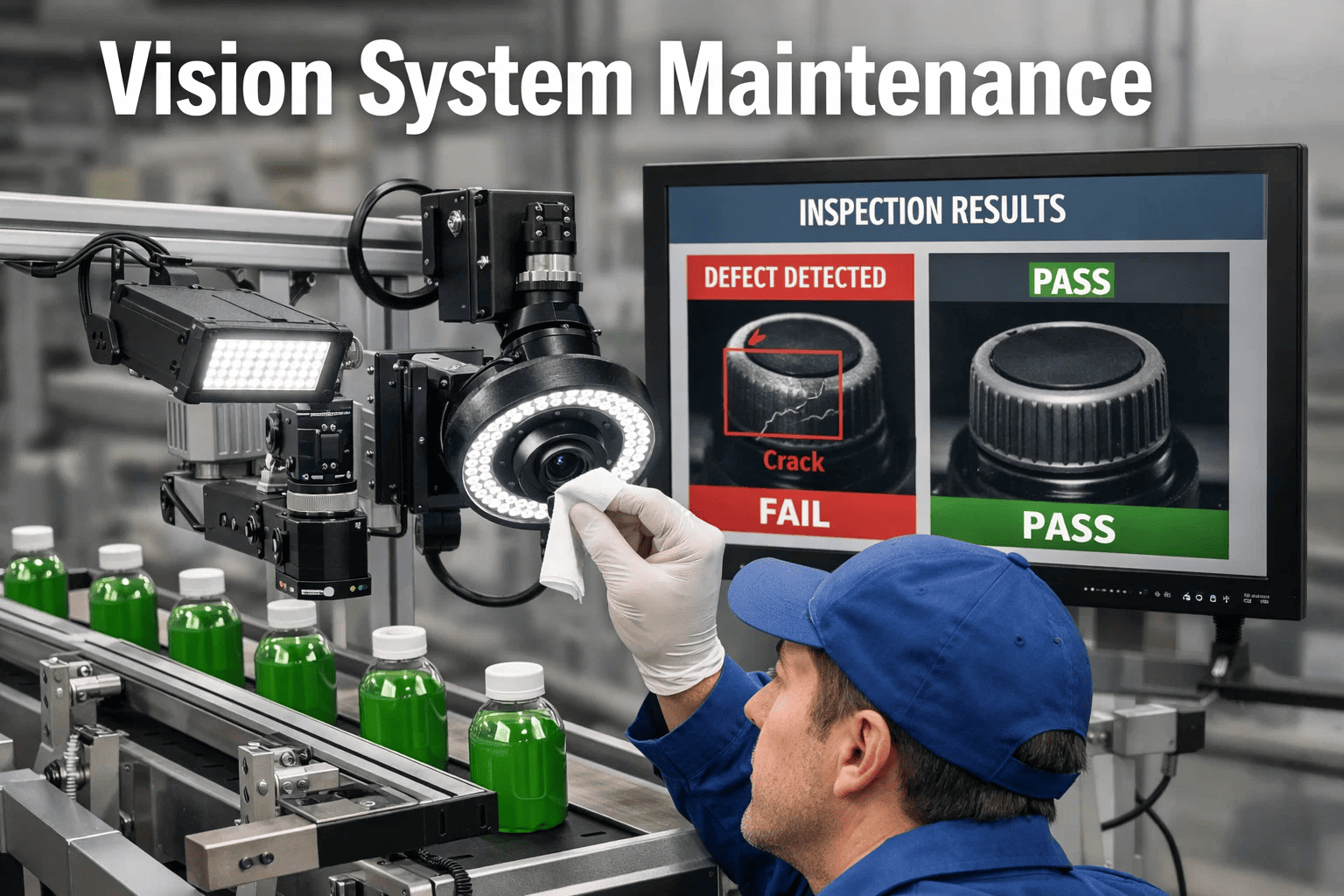
AI Vision Inspection System Maintenance Checklist for FMCG Lines

By Jason miller on March 19, 2026

ai-vision-inspection-system-maintenance-checklist-fmcg

AI vision inspection systems are only as accurate as the maintenance routines behind them. Camera drift, lighting degradation, contaminated lenses, and AI model decay are silent — they erode inspection accuracy gradually until a defect escapes, a line stops, or a recall is triggered. OxMaint's AI Vision Inspection Integration automates every PM task across your vision systems — camera calibration, lighting validation, model drift review, and sensor cleaning scheduled and logged so accuracy never silently degrades. Book a free demo to see automated vision system PM in action.

Checklist · FMCG · AI & Vision · 2026
AI Vision Inspection System Maintenance Checklist for FMCG Lines
A complete zone-by-zone PM checklist for AI vision inspection systems. Camera calibration, lighting validation, AI model drift review, and sensor cleaning tasks organised by daily, weekly, and monthly schedules — so inspection accuracy stays at peak performance and defects never silently escape.
4
maintenance zones every AI vision system requires on a structured PM schedule
60%
of vision system accuracy loss is caused by deferred camera and lighting PM
100%
inspection accuracy traceability — every calibration result timestamped and audit-ready
Zero
missed PM intervals when OxMaint auto-schedules every vision system task per shift
Schedule: Daily Pre-shift check every production day Weekly Once per maintenance week Monthly Full calibration and model review

PM Coverage Across the 4 Vision System Zones

Every zone in an AI vision inspection system generates maintenance data — calibration records, lighting measurements, model performance logs, and connectivity checks. Without structured PM, accuracy degrades silently. OxMaint captures every task at completion — traceable per camera, per shift, and per line, instantly available for food safety, GMP, and quality audit review.

Zone 1
Camera & Optics
DailyLens cleaning and focus check
WeeklyCalibration target validation
MonthlyFull geometric and colour calibration
Zone 2
Lighting Systems
DailyIllumination level and uniformity check
WeeklyDiffuser cleaning and intensity log
MonthlyLED output measurement and replacement review
Zone 3
AI Model & Software
DailyFalse reject and miss rate review
WeeklyThreshold audit and edge case log review
MonthlyModel drift assessment and retraining trigger
Zone 4
Sensors & Connectivity
DailyTrigger sensor and encoder signal check
WeeklyNetwork latency and data pipeline test
MonthlyFull I/O, cable, and integration audit

Before You Start: Configure Your Vision System PM Schedule

Effective vision system PM starts before the first shift. Teams must register every camera, lighting unit, and sensor with asset IDs, set PM intervals per system criticality, assign calibration responsibilities, and establish baseline performance benchmarks — so every scheduled task is meaningful and every deviation from accuracy baseline is immediately flagged. OxMaint's setup wizard configures your full vision system PM schedule in under a day.

Pre-Checklist: Vision System PM Platform Setup
All cameras, lighting units, and sensors registered with asset IDs
Every vision system component registered with make, model, serial number, install date, and line/station assignment before PM scheduling begins.
Baseline accuracy, false reject rate, and lighting benchmarks recorded
Inspection accuracy %, false reject rate, false pass rate, and illumination lux levels recorded per camera station as deviation baselines before PM schedule begins.
PM intervals set per system criticality and defect class
Daily, weekly, and monthly task frequencies configured per camera station and defect detection class — high-criticality lines get tighter intervals than secondary inspection points.
Calibration targets, cleaning supplies, and spare components staged
Calibration reference targets, approved lens cleaning materials, spare LEDs, and trigger sensors confirmed on-site and linked to the relevant PM tasks before the schedule goes live.
ZONE 1
Camera & Optics — PM Checklist
Vision Technician + Quality Engineer3 daily · 2 weekly · 1 monthlyUse approved optical cleaning materials only
Camera lens contamination is the single most common cause of AI vision accuracy degradation on FMCG lines. Even a thin film of product dust or condensation reduces contrast detectability. Complete lens checks at every shift start — do not assume a clean lens from the previous shift.
#TaskScheduleAcceptance CriteriaSign-Off
1.1Lens surface inspected for dust, condensation, smear, or product build-up using a bright light source before line start. Clean with approved optical cloth if any contamination found.DailyLens confirmed optically clear. No visible contamination under inspection light. Cleaning logged if performed.________
1.2Camera housing and protective glass inspected for cracks, condensation on inner surface, or loose seals that could allow ingress during production or CIP cycles.DailyHousing sealed with no cracks or condensation. Any seal breach triggers immediate maintenance hold.________
1.3Live image quality confirmed against reference frame — contrast, sharpness, and field of view checked at the start of each shift using the system's built-in reference check or a standard test card.DailyImage matches reference within defined contrast and sharpness tolerance. Result logged with timestamp.________
1.4Calibration target run and result compared against baseline accuracy. Focus and aperture checked against the last recorded settings. Any drift from baseline logged and escalated.WeeklyAccuracy within ±2% of baseline. Focus confirmed locked. Drift above threshold triggers recalibration.________
1.5Camera mounting bracket, angle, and standoff distance checked against installation spec. Vibration from nearby machinery can shift camera position over time — confirm with a physical measure.WeeklyMount angle and standoff distance within ±1mm of installation spec. Fastener torque confirmed.________
1.6Full geometric calibration run using certified calibration target across the full field of view. Colour calibration verified for colour-sensitive inspection applications. All results recorded in CMMS asset history.MonthlyGeometric distortion within OEM spec. Colour deviation below threshold. Full results archived in asset record.________
PM records: lens condition, image quality, calibration result, mount check, geometric calibration — timestamped, technician-signed, GMP and quality audit-ready
OxMaint AI Vision Integration
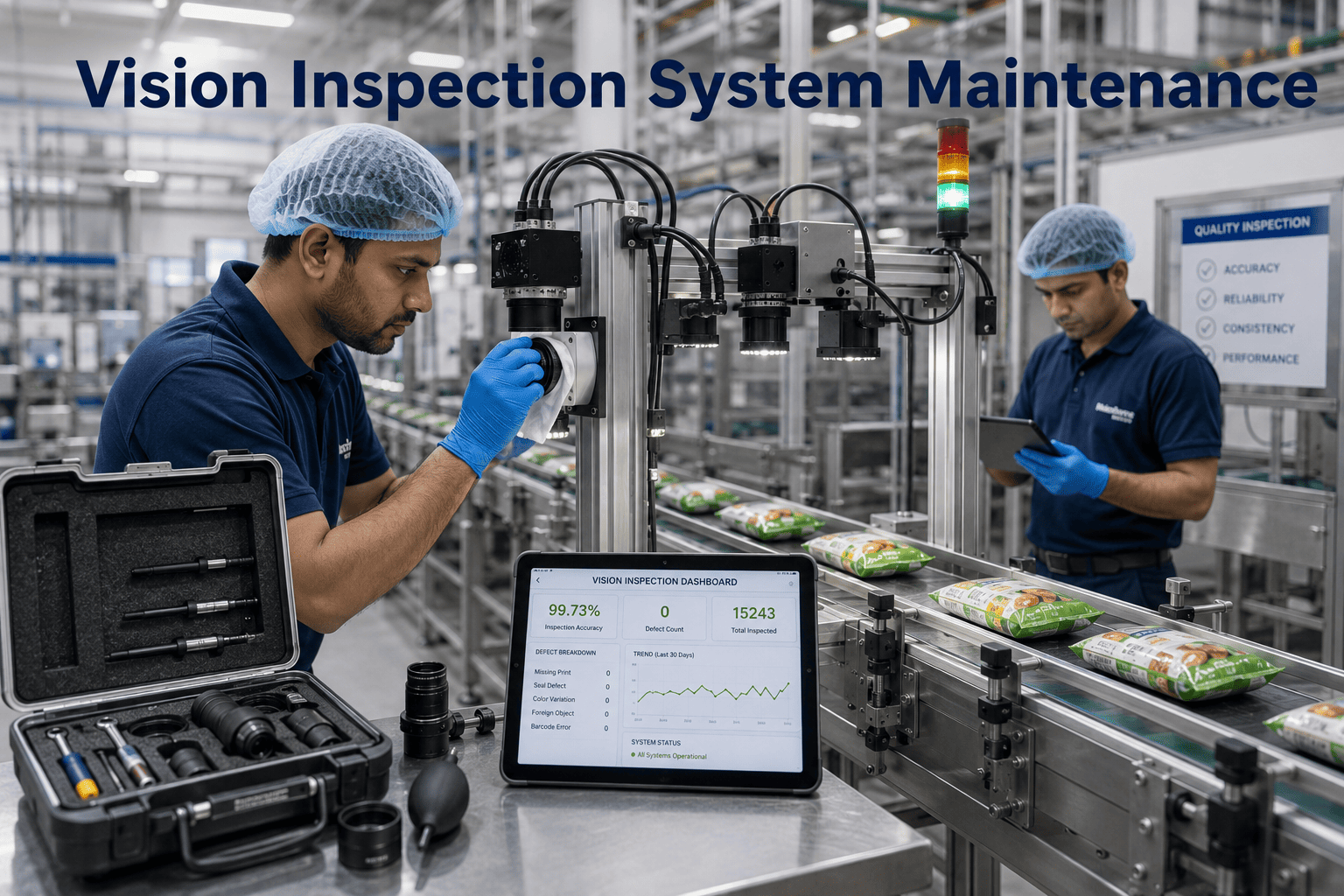
Camera PM tasks are scheduled automatically — daily lens checks trigger every shift, weekly calibration validations queue at the right interval, and every result is logged with technician ID and timestamp against the camera asset record. See how OxMaint automates camera PM scheduling.
ZONE 2
Lighting Systems — PM Checklist
Vision Technician2 daily · 2 weekly · 1 monthlyLED output degrades ~20% per 5,000 operating hours
Lighting is the most overlooked variable in AI vision system accuracy. LED arrays degrade gradually — a 15% drop in illumination can shift the inspection accuracy of a model trained on full-brightness images by 10–20%. Never assume lighting is stable because it looks adequate to the human eye.
#TaskScheduleAcceptance CriteriaSign-Off
2.1Illumination level measured at inspection point with calibrated lux meter and compared against the baseline lux value recorded during system commissioning or last full calibration.DailyMeasured lux within ±10% of baseline value. Readings below threshold trigger lighting maintenance before production begins.________
2.2Lighting uniformity checked by measuring lux at four corners and the centre of the inspection field. Non-uniform lighting creates shadow artefacts that cause false rejects or missed detections.DailyMax variance between measurement points below 15% of centre reading. Any hotspot or shadow logged immediately.________
2.3Diffuser panels and light shields inspected for product contamination, scratches, or discolouration. Contaminated diffusers create uneven transmission that is not detectable by a simple lux reading.WeeklyDiffuser optically clear with no product build-up or scratches. Cleaned or replaced if contamination is found.________
2.4LED array operating hours logged and compared against OEM replacement threshold. Running hours recorded against the lighting asset record in CMMS for lifecycle tracking.WeeklyOperating hours logged. Replacement triggered at OEM threshold or if output has dropped >15% from baseline.________
2.5Full photometric measurement of LED array output recorded using calibrated lux meter and spectrophotometer where applicable. Results compared against commissioning baseline and archived in CMMS.MonthlyOutput within 10% of commissioning baseline. Colour temperature stable within ±150K for colour-sensitive applications.________
PM records: lux readings, uniformity map, diffuser condition, LED hours, photometric results — timestamped, technician-signed, vision system audit-ready
60% of Accuracy Loss Is Preventable
Most AI vision accuracy degradation on FMCG lines traces back to deferred lighting and camera PM — not model failure. OxMaint schedules lighting checks and lux logging automatically, triggering alerts when readings drift below threshold before accuracy is affected. See the lighting PM workflow live.
ZONE 3
AI Model & Software — PM Checklist
AI Engineer + Quality Engineer2 daily · 2 weekly · 1 monthlyModel version and threshold changes require change control
AI model drift is not an event — it is a gradual process. As products, packaging materials, or production conditions change, the model's training data becomes less representative of current reality. Daily performance metrics are the earliest warning signal. Never adjust thresholds without a documented review and change control record.
#TaskScheduleAcceptance CriteriaSign-Off
3.1False reject rate reviewed against the rolling 7-day baseline. A sudden increase in false rejects without a corresponding change in product quality indicates model or environment drift.DailyFalse reject rate within ±1.5% of 7-day baseline. Increases above threshold trigger immediate model review.________
3.2False pass rate and missed defect log reviewed against acceptable quality level. Any confirmed defect escape — product passing AI inspection that a human inspector would have caught — is logged as a critical event.DailyZero confirmed defect escapes. Any escape triggers model review and a corrective action work order.________
3.3Detection threshold settings reviewed against current production output and defect profile. Any threshold change since the last review is logged with justification, approver, and effective date.WeeklyThresholds within approved operating range. Any undocumented change raises a non-conformance. Change log current.________
3.4Edge case and borderline detection log reviewed. Images from the current week where the model scored close to the decision boundary are sampled and assessed by a human inspector for classification accuracy.WeeklyHuman reclassification agreement rate above 95%. Systematic misclassification patterns trigger model drift review.________
3.5Full model drift assessment conducted: performance metrics trended over 30 days, training data relevance reviewed against current product/packaging specs, and retraining decision documented with sign-off from Quality and AI Engineering.MonthlyDrift below retraining threshold, or retraining initiated and documented. Monthly review record filed in CMMS.________
PM records: false reject rate, defect escape log, threshold change log, edge case review, monthly drift assessment — timestamped, quality-signed, change-controlled
100% Model Performance Traceability
OxMaint logs every AI model PM review — threshold changes, drift assessments, and retraining decisions — against the system asset record with approver ID and timestamp. Full change control audit trail generated automatically for quality and regulatory review. Book a demo to see AI model PM tracking in OxMaint.
ZONE 4
Sensors & Connectivity — PM Checklist
Controls / Automation Technician2 daily · 2 weekly · 1 monthlyTrigger timing errors cause missed inspections, not model failures
A well-calibrated camera with a perfect AI model will miss defects if the trigger sensor fires at the wrong time. Encoder slip, trigger jitter, and network latency are the most common causes of inspection gaps that appear as model failures. Always verify sensor and connectivity performance before concluding the AI model needs retraining.
#TaskScheduleAcceptance CriteriaSign-Off
4.1Trigger sensor signal confirmed active and responding at correct position using the system diagnostic panel. Trigger timing verified against the inspection window for the current product and line speed.DailyTrigger firing at correct position. No missed or double-trigger events in previous shift log. Timing within spec.________
4.2Encoder feedback signal checked for slip or dropout events. Encoder counts compared against expected line speed values in the control system. Any slip event is logged and escalated to automation.DailyNo encoder slip or dropout events in previous shift. Count variance within ±0.1% of expected value.________
4.3Network latency between camera, vision processor, and PLC/MES measured and compared against the maximum allowable latency for the line speed. Latency above threshold causes rejection signal timing errors.WeeklyNetwork latency below maximum threshold defined in system specification. Results logged per device pair.________
4.4Data pipeline integrity verified — inspection results confirmed reaching the MES, quality system, and rejection control output correctly. End-to-end test run with known-reject product or test signal.WeeklyTest signal triggers rejection output correctly. Data confirmed in quality system and MES. No dropped results.________
4.5Full I/O audit: all cable connections inspected for wear, pinch, or corrosion at camera, trigger sensor, encoder, rejection solenoid, and network switch. Connector pin condition checked and re-seated where needed.MonthlyAll cables intact with no damage or corrosion. Connectors secure and pin condition confirmed. Findings logged.________
PM records: trigger timing, encoder slip log, latency test, data pipeline check, I/O audit — timestamped, technician-signed, controls and quality audit-ready

System Sign-Off — Issued When All 4 Zones Are Confirmed


1
Camera & Optics
PM Done ✓
2
Lighting Systems
PM Done ✓
3
AI Model & Software
PM Done ✓
4
Sensors & Connectivity
PM Done ✓
System
Sign-Off
SYSTEM SIGN-OFF ISSUED — VISION INSPECTION APPROVED FOR PRODUCTION
Any failed check — work order raised immediately, task cannot be bypassed
Open work order holds the zone until corrective action is completed and re-checked
Threshold or model changes require Quality Engineer sign-off — change control record mandatory
Every sign-off carries the full four-zone record for GMP, quality audit, and regulatory review

Performance Metrics — AI Vision Inspection PM Programme

Inspection Accuracy Rate

Percentage of defects correctly detected across all inspection stations. AI tracking surfaces which cameras or stations show accuracy drift — enabling targeted recalibration before escapes occur.

False Reject Rate

Percentage of conforming product incorrectly rejected. Rising false rejects without a quality change signal model drift, lighting degradation, or calibration slip — not a product problem.

Defect Escape Rate

Confirmed defective units passing AI inspection undetected. Target zero. Any confirmed escape triggers a mandatory four-zone PM review before the line restarts.

PM Completion Rate

Percentage of scheduled vision system PM tasks completed on time. Target 100% — missed PM tasks are the leading predictor of accuracy degradation events on FMCG inspection lines.
60%
of AI vision accuracy losses are prevented by structured camera and lighting PM completed on schedule
100%
model change traceability per system — every threshold and retraining decision timestamped and change-controlled
Zero
missed PM intervals when OxMaint auto-schedules every daily, weekly, and monthly vision task per camera
Deploy This Checklist Digitally
AI Vision PM Scheduling
Daily lens checks, weekly calibration runs, and monthly drift reviews auto-triggered per camera asset.
Mobile Sign-Off
Technicians complete and sign off every task on mobile — timestamped, named, and logged instantly.
!
Drift & Accuracy Alerts
Automatic alerts when inspection accuracy or lux readings drift below threshold — before escapes occur.
Change Control Audit Trail
Every threshold change and model update logged with approver ID — GMP and quality audit-ready at any time.
Replace Manual Vision System PM with OxMaint
OxMaint gives AI vision teams a fully automated, camera-specific PM programme — lens checks, calibrations, model reviews, and connectivity audits scheduled automatically and logged in a GMP-compliant digital record.
Trusted by FMCG plants across 40+ countries · GMP & HACCP compliant

Frequently Asked Questions

What does this AI vision inspection PM checklist cover?
This checklist covers four maintenance zones: Zone 1 (Camera and Optics — lens cleaning, calibration, mount checks), Zone 2 (Lighting Systems — lux measurement, uniformity, diffuser condition, LED lifecycle), Zone 3 (AI Model and Software — false reject/pass rates, threshold review, drift assessment), and Zone 4 (Sensors and Connectivity — trigger timing, encoder, network latency, I/O audit). Each zone includes daily pre-shift checks, weekly PM tasks, and monthly full reviews. Configure your vision system PM schedule with OxMaint — free 14-day trial.
How does OxMaint schedule vision system PM tasks automatically?
OxMaint assigns PM tasks per camera or system asset based on your configured intervals — daily tasks trigger every shift, weekly tasks queue at the start of each maintenance week, and monthly calibration reviews are scheduled against the asset's last completion date. Tasks are automatically assigned to the correct technician role (vision tech, quality engineer, or controls tech) and escalated if overdue. Every result is logged with timestamp and technician ID without manual paperwork. Book a demo to see automated vision PM scheduling in action.
How does the platform handle AI model change control requirements?
OxMaint logs every AI model PM event — threshold adjustments, drift assessments, retraining decisions, and version changes — against the system asset record with the approver's identity, timestamp, and justification. This creates an immutable change control audit trail that satisfies GMP change management requirements and is immediately retrievable for quality or regulatory audit without manual assembly.
What happens when a vision system PM check fails or accuracy drifts?
Any failed check or reading outside the defined threshold automatically raises a corrective work order, flags the asset in the dashboard, and notifies the responsible engineer per your escalation rules. The PM record stays open until the corrective action is completed and the check re-passed. Accuracy drift events — rising false reject rates, low lux readings, or calibration failures — can be configured to hold the line until the zone is cleared, preventing defect escapes during degraded system performance.
Can OxMaint manage vision system PM across multiple cameras and production lines?
Yes. OxMaint runs all four zone PM programmes simultaneously across multiple cameras, vision stations, and production lines — applying the same task schedules, escalation rules, and audit logging at every asset. Quality and engineering managers see PM completion rates, accuracy trends, open work orders, and overdue tasks across all vision systems in one dashboard, with complete records stored per camera asset without manual assembly. Start your free OxMaint trial and deploy automated vision system PM today.

Share This Story, Choose Your Platform!