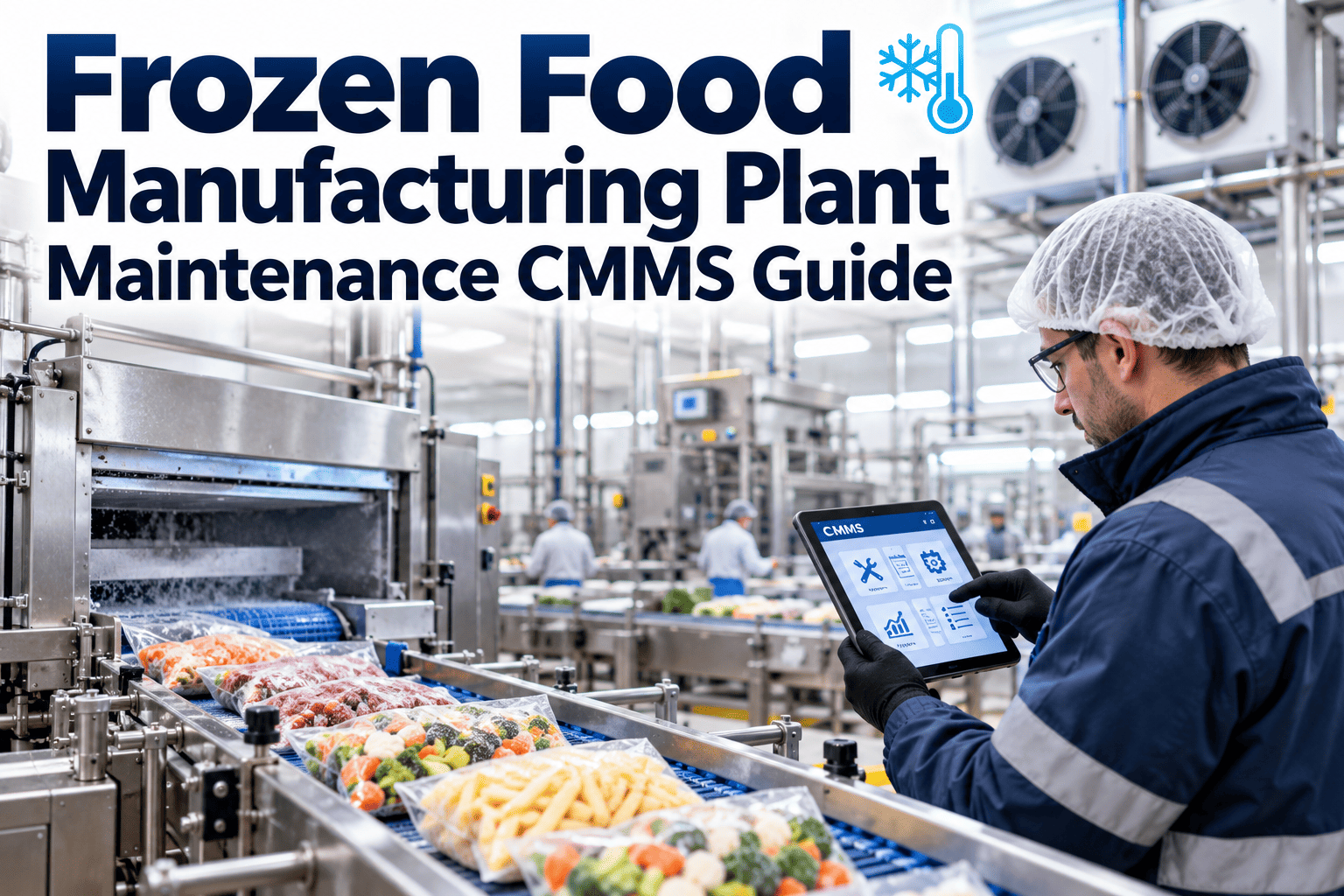
A production manager at a frozen vegetables facility in Michigan discovered during a Monday morning walk-through that the IQF tunnel freezer had experienced a partial compressor failure at 2:47 AM — the tunnel temperature had drifted from -35°C to -24°C over 90 minutes before the high-temperature alarm triggered, and 4,200 kg of partially frozen broccoli had already exited the tunnel and been loaded into cold storage cartons before the shift supervisor received the alert. Temperature exceedance above -18°C compromises microbial safety and ice crystal structure in frozen vegetables, requiring the entire batch to be quarantined pending microbiological testing, causing $58,000 in product loss, cold storage reallocation, and emergency compressor repair costs. The facility's CMMS had no refrigeration PM schedule — the compressor had not received its monthly oil analysis or quarterly vibration inspection in 8 months due to production schedule pressure. OxMaint tracks IQF refrigeration PM schedules and triggers alerts before compressor degradation leads to temperature exceedances compromising product safety. Book a demo to see how frozen food manufacturing maintenance prevents $58K cold chain failures.
Michigan IQF facility cost from compressor failure — 4,200 kg broccoli quarantined, temperature exceedance above -18°C, emergency repair
$325B
Global frozen food market size in 2025 — blast freezing holds 53% technology share, driving continuous refrigeration equipment investment
-18°C
Critical temperature threshold — exceedance above this point compromises microbial safety, ice crystal structure, and USDA cold chain compliance
Why Frozen Food Equipment Maintenance Demands Are Unlike Any Other FMCG Sector
Frozen food processing equipment operates under extreme thermal conditions — IQF tunnels at -35°C to -40°C, blast freezer cells at -30°C to -40°C, cold storage at -18°C to -25°C — where equipment degradation occurs silently and invisibly until a critical threshold is crossed, product is compromised, and a food safety incident begins. Refrigerant system failures do not announce themselves with unusual noise or vibration visible to operators during production; compressor oil contamination builds over months of operation, reducing lubrication film thickness until bearing failure occurs without warning during a peak-volume shift. Evaporator coil ice buildup that reduces cooling capacity by 15–20% is invisible from the outside but measurable only through temperature differential trending across zones — without CMMS-tracked defrost cycle logs and coil surface temperature verification, efficiency losses accumulate silently until product temperatures drift above spec. Cold chain documentation requirements under USDA and FDA food safety regulations demand equipment maintenance records proving temperature control was maintained at every processing and storage step — a requirement that post-incident paper records cannot satisfy. OxMaint provides frozen food manufacturing PM templates with refrigeration system PM, defrost cycle validation, temperature exceedance documentation, and cold chain compliance reporting integrated for IQF, blast freezer, and spiral freezer operations.
IQF Tunnel Freezer
-35°C to -40°C
Individual quick freezing — vegetables, fruit, seafood, poultry pieces freeze in 4–15 minutes, preserving cell structure and texture
Compressor failure drifts product to -18°C within 90 minutes — microbial safety compromised, ice crystals grow, product texture destroyed
Blast Freezer Cell
-30°C to -40°C
High-velocity air blast freezing for portioned meals, seafood blocks, and bakery products requiring 2–6 hour freeze cycles
Evaporator coil icing reduces airflow — product freeze time extends, center temperatures remain above -18°C, USDA hold required
Spiral Freezer
-25°C to -35°C
Continuous belt spiral system for pizza, ready meals, and coated products — long residence time in compact footprint
Belt misalignment causes product jams and temperature zone bypassing — product exits underthermal, compromising shelf life
Cold Storage Warehouse
-18°C to -25°C
Long-term frozen product storage — temperature stability critical for shelf life, microbiological safety, and retail compliance
Refrigeration unit failure during weekend undetected — entire product inventory may require quarantine pending temperature audit
Refrigeration System PM Requirements — Preventing Silent Failures at Ultra-Low Temperatures
Frozen food refrigeration system failures follow a predictable degradation pattern that structured PM programs intercept — compressors show elevated discharge temperatures 4–6 weeks before bearing failure, condenser coils with 15% fouling cause 8–12% energy consumption increases visible in utility trending before cooling capacity drops, evaporator coils with progressive ice buildup show temperature differential increases measurable weekly before airflow restriction causes product temperature exceedances, and refrigerant leaks detectable at 2–5% system charge loss through electronic leak detection cause COP degradation months before total system failure. The problem in most frozen food facilities is that reactive maintenance waits for equipment to fail rather than intercepting these warning signals — because ultra-low temperature equipment shows no visible, audible, or tactile deterioration signals accessible to operators during normal production. Start a free trial to schedule refrigeration system PM with compressor oil analysis, condenser fouling trending, evaporator defrost cycle validation, and electronic leak detection integrated into frozen food manufacturing maintenance.
Ammonia / CO₂ Compressor System
Monthly
Oil analysis — viscosity, particle count, acidity, water contamination trending
Vibration analysis — bearing wear detection 4–6 weeks before failure
Discharge temperature trend — elevated temps signal valve inefficiency
Current draw monitoring — motor efficiency and capacity verification
Weekly temperature differential monitoring — defrost cycle adjustment before capacity drops below threshold
Condenser fouling efficiency loss
Visible only as increased energy bills — 8–12% consumption increase before maintenance triggered
Monthly approach temperature trending — chemical cleaning scheduled at 15% fouling index, efficiency maintained
Refrigerant charge loss
Detected when cooling capacity drops — system operating below spec for weeks, product risk
Electronic sensor daily monitoring — 2% charge loss triggers investigation protocol before COP degradation affects product
Cold chain documentation
Paper temperature logs — unavailable for USDA audit, retroactive records impossible
Continuous digital temperature records linked to equipment PM — 30-second export for USDA/FDA audit compliance
Spiral freezer belt alignment
Discovered when belt derails — line shutdown, product jam, 6hr maintenance outage
Weekly alignment check with tension trending — proactive adjustment prevents derailment, maintains zone temperatures
-2°C rule
Temperature exceedance monitoring threshold — USDA frozen food standards require product temperatures to be maintained within 2°C of spec throughout processing
53%
Global frozen food blast freezing technology market share in 2024 — largest single freezing method, driving highest refrigeration PM investment requirements
5.14%
Frozen food market CAGR through 2034 from $325B base — continuous production capacity expansion requiring refrigeration reliability investment
Frequently Asked Questions
Why does IQF compressor failure cause product loss before alarms trigger?
IQF compressor bearing failures develop over weeks of progressive wear that causes no audible or visible symptoms during production. When the bearing finally fails, the compressor capacity drops rapidly — IQF tunnel temperatures drift from -35°C toward -18°C within 60–90 minutes, well faster than high-temperature alarms trigger response actions from personnel who may be on break or off-shift during overnight production runs. OxMaint's monthly vibration analysis trending detects bearing wear signatures 4–6 weeks before failure, enabling scheduled replacement during planned maintenance windows rather than emergency repair during production — eliminating the 90-minute product temperature drift window that costs $58K per incident in product quarantine, emergency parts, and cold storage reallocation.
How does OxMaint handle cold chain documentation for USDA and FDA audits?
OxMaint links equipment maintenance records directly to continuous temperature monitoring data — IQF tunnel PM work orders include temperature log references showing product was processed within spec at the time of maintenance, defrost cycle records show coil surface temperatures were validated before each production run, compressor oil analysis certificates are linked to the refrigeration system asset records proving maintenance was performed. During USDA or FDA audit inspections, OxMaint generates a cold chain compliance report exportable in under 30 seconds showing equipment PM history, temperature exceedance events with corrective action documentation, and refrigerant handling records — a process that takes facilities with paper logs days to reconstruct.
What is the maintenance frequency for evaporator coils in IQF tunnels?
IQF evaporator coils require weekly temperature differential measurement between inlet and outlet air streams because ice buildup of 5–10mm reduces heat transfer efficiency by 15–20%, causing progressive cooling capacity loss that is invisible externally but measurable through temperature trending. When differential temperature increases beyond 3°C from baseline, OxMaint schedules an extended defrost cycle with surface temperature verification before next production run. Monthly coil visual inspection with documented photographic evidence and quarterly chemical cleaning with fouling index assessment prevent ice buildup from accumulating to the 20–30mm thickness that causes product temperature exceedances. Defrost cycle time is validated against design specifications per individual coil — shorter-than-spec defrost cycles that feel efficient to operators actually allow residual ice to accumulate batch-over-batch.
What EPA compliance documentation is required for ammonia refrigeration systems in frozen food plants?
Ammonia refrigeration systems in frozen food facilities require EPA Section 608 compliance documentation including technician certification records for all personnel handling refrigerant, electronic leak detection sensor calibration certificates proving sensor accuracy at legally required detection thresholds, refrigerant charge tracking logs showing additions, removals, and leak investigation events, repair records documenting leak source identification and correction within required timeframes, and annual leak rate calculation proving the system is below EPA leak rate thresholds for systems above 50 pounds of charge. OxMaint stores all compliance records per refrigeration circuit with automatic alerts when calibration certificates expire or annual leak rate assessments are due — preventing violations discovered during surprise inspections.
Frozen Food Equipment PM — OxMaint
Prevent $58K Cold Chain Failures — PM Built for Ultra-Low Temperature Frozen Food Manufacturing.