Barcode, RFID & Robotic Asset Tracking for FMCG Maintenance Teams
By Jonas on March 9, 2026
A mid-size FMCG plant runs 1,000 to 5,000 maintainable assets — motors, gearboxes, conveyors, filling heads, labellers, heat exchangers, and palletisers — spread across production lines that operate 20+ hours a day. When a maintenance technician receives a work order, the first task is almost never the repair itself — it is finding the right asset, confirming its identity, and pulling the correct maintenance history. In facilities that still rely on handwritten equipment tags and paper-based asset registers, this identification step alone accounts for 12–18 minutes per work order. Multiply that across 40 work orders per day and the facility loses 8–12 productive maintenance hours every shift to asset identification friction. Barcode, RFID, and autonomous robotic scanning eliminate this friction entirely — and when integrated with a CMMS platform like Oxmaint, they transform the asset register from a static spreadsheet into a live, scannable, auditable system that accelerates every maintenance workflow. Book a demo to see how Oxmaint's barcode scanning and asset registry work on a live FMCG equipment register.
Oxmaint's built-in barcode scanning and asset registry turn every smartphone into an asset identification tool — no dedicated hardware required to get started.
Average Time Lost Per Work Order to Manual Asset Identification in Paper-Based Facilities
1,000+
Maintainable Assets at a Typical Mid-Size FMCG Production Facility
92%
Work Order Accuracy Improvement After Barcode/RFID Asset Identification Deployment
3–6 weeks
Typical Payback Period for Barcode Asset Tracking Implementation in FMCG Plants
The Asset Identification Problem in FMCG Maintenance
FMCG production environments create a uniquely difficult asset identification challenge. Equipment is densely packed on production lines, visually similar machines perform different functions at different stations, and nameplates deteriorate under washdown conditions, chemical exposure, and thermal cycling. A facility running six packaging lines might have 24 nearly identical servo-driven case packers — differentiated only by a stamped serial number plate that has been unreadable since the last caustic wash. When a technician opens a work order for "Case Packer 3, Line 4" and walks onto a production floor with 24 case packers, the probability of servicing the wrong machine is not trivial — and wrong-asset maintenance is one of the most common root causes of repeat failures and misallocated spare parts in FMCG plants.
Paper-based and spreadsheet asset registers compound the problem. The register says the motor on Filler 2 is a 7.5 kW unit — but it was replaced with a 5.5 kW motor during an emergency repair six months ago and nobody updated the spreadsheet. The technician orders the wrong bearings, discovers the mismatch on arrival, and the filler sits idle for another shift while the correct parts are sourced. Every one of these failures traces back to the same root cause: the asset register is disconnected from the physical equipment. Barcode and RFID tagging close this gap by making the physical asset the source of truth — scan the tag, get the correct asset record, every time.
Three Technology Tiers: Barcode, RFID, and Robotic Scanning
Asset tracking technology for FMCG maintenance falls into three implementation tiers. Each tier builds on the previous one, and the right starting point depends on facility size, asset count, and maintenance team maturity. Most facilities start at Tier 1 and progress as the value becomes measurable.
Three Technology Tiers for FMCG Asset Tracking
Tier 1: Barcode & QR Code Scanning
Lowest Cost — Fastest Deployment
Printed barcode or QR code labels applied directly to equipment. Scanned using any smartphone camera or dedicated handheld scanner. Links instantly to the asset record in the CMMS — maintenance history, spare parts, procedures, and open work orders. Deployment cost is under $2 per asset. Best for facilities starting their digital asset management journey with 500–2,000 assets. Limitation: requires line-of-sight and manual scanning by the technician.
Tier 2: RFID Tag Scanning
No Line-of-Sight — Harsh Environment
Passive UHF RFID tags embedded in industrial-grade enclosures mounted to equipment. Readable through dirt, grease, and paint at distances up to 10 metres with handheld RFID readers. No line-of-sight required — technician walks near the asset and the reader identifies it automatically. Deployment cost is $5–$15 per asset plus $1,500–$3,000 per handheld reader. Best for facilities with 2,000+ assets, harsh washdown environments, or assets in hard-to-access locations.
Tier 3: Autonomous Robotic Scanning
Zero-Labour — Continuous Inventory
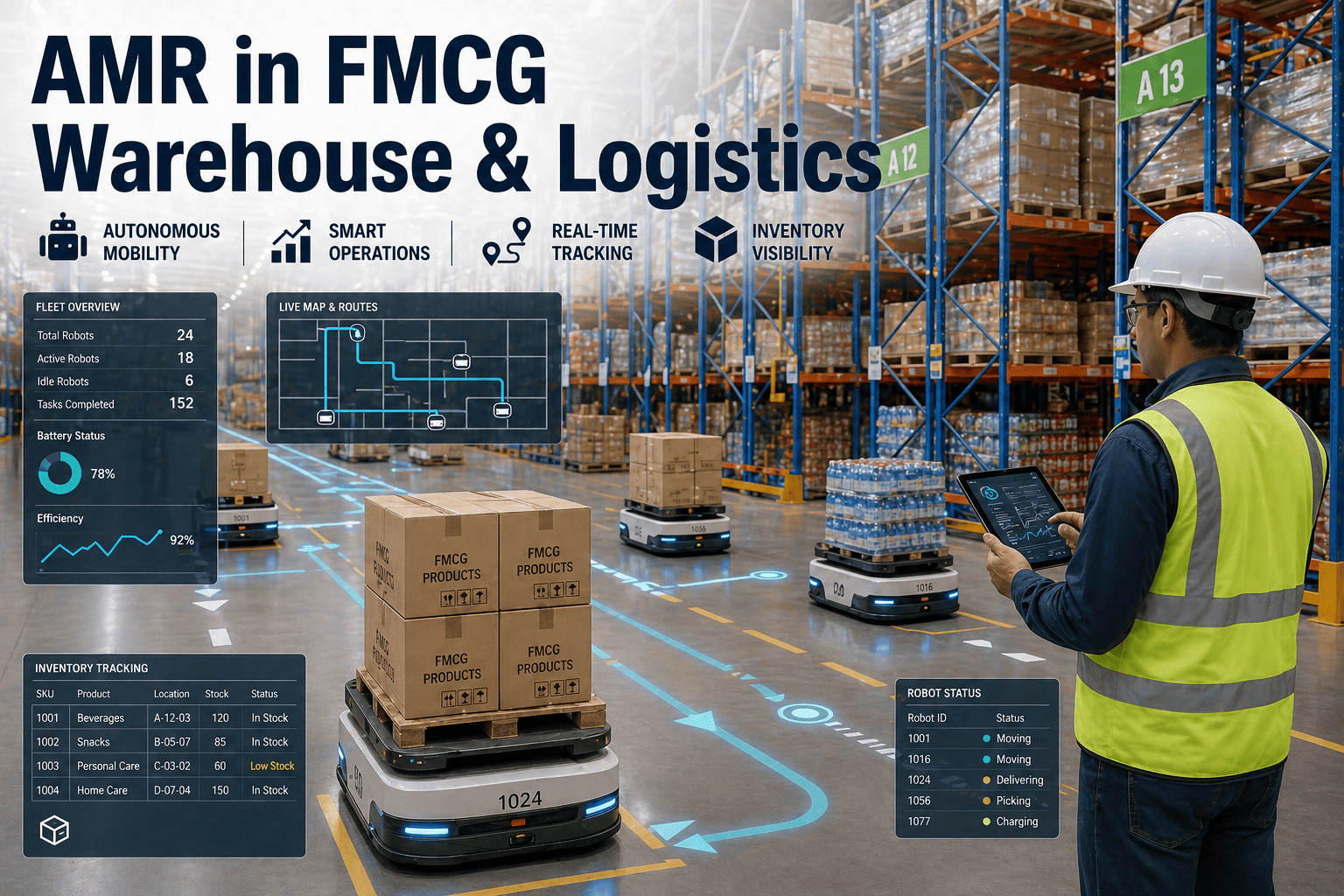
Autonomous mobile robots (AMRs) equipped with RFID readers and visual sensors patrol production areas on scheduled routes, scanning every tagged asset automatically. Generates a complete facility asset inventory without any technician involvement. Identifies missing, relocated, or untagged equipment and flags discrepancies against the CMMS register. Best for large facilities with 5,000+ assets across multiple buildings where manual inventory audits consume hundreds of labour hours annually.
How Barcode & QR Code Scanning Works in Maintenance Workflows
Barcode and QR code scanning is the entry point for digital asset tracking — and for most FMCG facilities with under 2,000 assets, it is the only tier they will ever need. The implementation is straightforward: every maintainable asset receives a durable label with a unique barcode or QR code that links to its record in the CMMS. When a technician arrives at the equipment, they scan the label with their smartphone or tablet, and the full asset record opens instantly — maintenance history, open work orders, spare parts list, attached procedures, and the equipment's position in the facility hierarchy.
The value is not just speed — it is accuracy. A scanned asset ID eliminates transcription errors, prevents wrong-asset work orders, and ensures every maintenance action is logged against the correct equipment. For facilities running regulatory compliance programmes (GMP, FSSC 22000, BRC), the scan record also creates a timestamped, GPS-tagged audit trail proving the technician was physically at the correct asset when the work was performed. This audit trail is increasingly required by food safety auditors and is virtually impossible to replicate with paper-based systems.
Six Maintenance Workflows Transformed by Barcode Scanning
Work Order Execution
Speed + Accuracy
Technician scans asset QR code → work order opens with full history, procedures, and spare parts list. Eliminates manual asset lookup and wrong-equipment servicing.
PM Route Completion
Compliance Proof
Preventive maintenance routes require scan at each asset before the PM checklist opens. Proves the technician physically visited each machine — no more "desk PMs".
Spare Parts Matching
Zero Mismatch
Scan reveals the exact BOM for the asset — no guessing whether it is the 5.5 kW or 7.5 kW motor, which bearing SKU, or which seal kit version is required for this specific machine.
Breakdown Reporting
Instant Logging
Operator scans the failed asset to raise a breakdown request — the request arrives in the CMMS pre-populated with asset details, location, and criticality rating. No phone calls or verbal descriptions.
Asset Audit & Verification
Register Accuracy
Annual asset verification becomes a walk-and-scan exercise. Scan each asset, confirm it exists and matches the register — unscanned assets are flagged as potentially decommissioned or relocated.
Safety & LOTO Linkage
Procedure Access
Scan opens the equipment-specific LOTO procedure and safety checklist. Technician accesses isolation points, energy sources, and PPE requirements directly from the asset tag — no searching for paper procedures.
RFID Asset Tracking: When Barcodes Are Not Enough
Barcode and QR code labels work well in clean, accessible environments — but FMCG production floors are neither. Washdown cycles, caustic chemicals, steam, and mechanical abrasion destroy printed labels within months. Equipment inside enclosed guarding, behind conveyor frames, or mounted at height makes visual scanning impractical. RFID tags solve both problems: they are readable without line-of-sight, through dirt and packaging, and industrial-grade encapsulated tags withstand the full range of FMCG environmental conditions including IP69K washdown, chemical exposure, and temperatures from -40°C to +200°C.
For maintenance teams, the workflow change is significant. Instead of searching for a readable barcode label on a grease-covered gearbox behind a safety guard, the technician walks within range of the RFID tag and the reader identifies the asset automatically. In practice, this means a technician carrying a handheld RFID reader can walk a production line and identify every asset on the line in the time it would take to manually scan six barcodes. The per-asset cost is higher than barcode labels — $5 to $15 per industrial RFID tag versus under $2 for a printed QR label — but for facilities with assets in harsh or hard-to-access environments, the labour savings and scan reliability make RFID the better investment.
Barcode/QR vs RFID: Technical Comparison for FMCG Maintenance
Side-by-side capability comparison for asset tracking technology selection
Barcode / QR Code
Read Method
Line-of-sight required — camera or laser scanner
Read Range
5–30 cm typical — label must be visible and clean
Durability
6–18 months in washdown environments — requires replacement
Cost Per Asset
Under $2 per label — smartphone scanning, no dedicated hardware
Passive UHF RFID
Read Method
No line-of-sight — reads through dirt, grease, and packaging
Read Range
1–10 metres with handheld reader — automatic identification
Durability
10+ years in encapsulated housing — IP69K, chemical, and thermal resistant
Cost Per Asset
$5–$15 per tag + $1,500–$3,000 per handheld reader
Recommendation for FMCG: Start with QR codes, upgrade critical assets to RFID
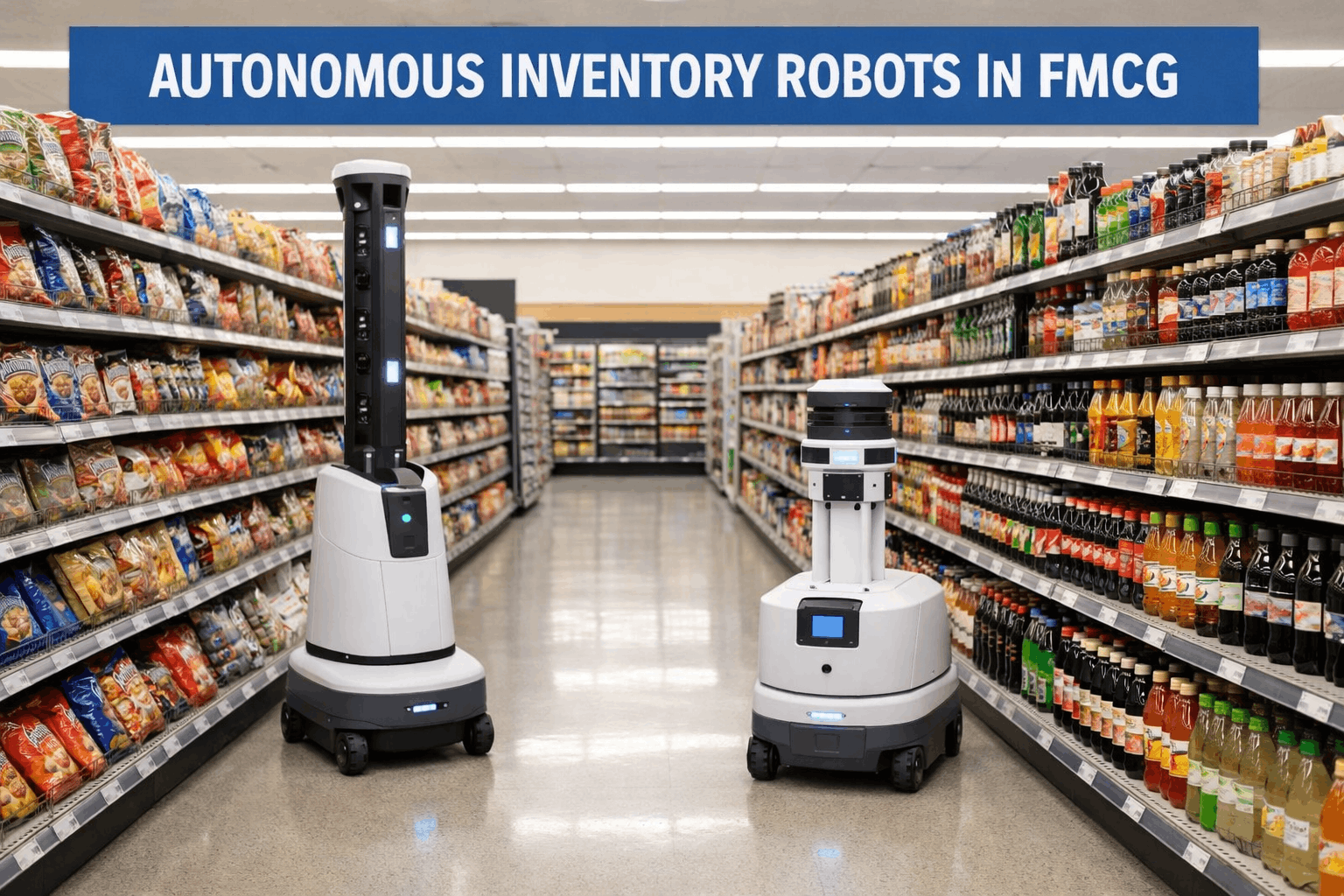
The third tier of asset tracking — autonomous mobile robots (AMRs) with integrated RFID readers and visual sensors — eliminates human involvement in asset inventory entirely. These robots navigate production areas on pre-programmed or dynamically mapped routes, scanning every RFID-tagged asset they pass. The result is a complete, timestamped facility inventory generated without a single technician-hour of effort.
For large FMCG operations with 5,000+ assets across multiple buildings, the value proposition is compelling. A manual asset verification audit at this scale typically requires 2–3 technicians working full-time for 2–4 weeks — a commitment most maintenance teams cannot afford without deferring other work. An AMR completes the same audit autonomously, typically during off-shift hours, and delivers a discrepancy report showing assets that have been moved, removed, or added since the last scan. The robot also captures visual condition data — photographs of nameplates, corrosion indicators, and physical damage — that feeds into condition-based maintenance programmes without requiring dedicated inspection rounds.
The integration architecture is straightforward: the AMR scans RFID tags, matches them against the CMMS asset register via API, and flags any discrepancy — missing assets, unregistered assets, or assets that have moved outside their designated production area. For facilities using Oxmaint, these discrepancies generate automated work orders or audit tasks that route directly to the responsible maintenance planner.
Oxmaint's asset registry supports barcode, QR code, and RFID tag integration — with open API for robotic scanning platforms and automated discrepancy reporting.
Implementation Strategy: Four Phases to Full Asset Tracking
The most common failure in asset tracking implementations is trying to tag every asset on day one. Successful FMCG deployments follow a phased approach that delivers measurable value at each stage and builds organisational confidence before scaling.
Four-Phase Implementation Strategy for FMCG Asset Tracking
Pilot Line Deployment
Weeks 1–4
Select one production line (50–100 assets). Clean and verify the asset register. Apply QR code labels. Train maintenance team on scan-to-work-order workflow. Measure baseline: time per work order, wrong-asset rate, PM completion accuracy.
Full Facility Rollout
Weeks 5–12
Extend QR tagging to all production lines and utility systems. Standardise label placement, naming conventions, and hierarchy structure. Integrate barcode scanning into all work order and PM workflows. Set scan-to-close as mandatory for work order completion.
RFID Upgrade — Critical Assets
Months 4–6
Identify assets where QR labels fail: washdown zones, enclosed guarding, high-temperature areas. Replace QR labels with industrial RFID tags on these assets. Deploy 2–4 handheld RFID readers. Maintain QR codes on accessible assets — hybrid approach maximises ROI.
Robotic Scanning Integration
Month 6+
Deploy AMR with RFID scanning for facilities with 5,000+ tagged assets. Programme automated inventory routes. Integrate AMR data feed with CMMS for automated discrepancy reporting. Shift from periodic manual audits to continuous robotic inventory verification.
Six Common Asset Tracking Failures in FMCG Plants
Asset tracking technology is only as effective as its implementation discipline. These six failures appear repeatedly in FMCG facilities that have invested in barcode or RFID systems but are not realising the expected value — and each one is avoidable with the right programme design. Book a demo to see how Oxmaint's asset registry design prevents these failure modes from the start.
Six Asset Tracking Failures That Undermine FMCG Maintenance Performance
Labels Destroyed by Washdown
Implementation Failure
Standard paper or vinyl barcode labels dissolve within weeks in CIP washdown environments. FMCG facilities must use polyester or ceramic labels rated for chemical and thermal exposure — or switch to RFID for washdown-intensive zones. Label material selection must match the harshest environmental condition the asset will experience.
Asset Register Not Updated After Replacements
Process Failure
Motor replaced during emergency repair but the CMMS record still shows the original specification. Scan returns outdated information — technician orders wrong spare parts. Every asset replacement must trigger a register update and new tag application as part of the work order closure process.
Scanning Optional — Not Mandatory
Adoption Failure
Tags are applied and scanners provided, but technicians can still complete work orders without scanning. Adoption drops to below 30% within 3 months. Scan-to-open and scan-to-close must be mandatory steps in the CMMS workflow — the system should not accept work order completion without a verified scan.
Inconsistent Label Placement
Implementation Failure
Labels placed in random locations on each asset — behind guards, under pipework, on surfaces that face walls. Technicians cannot find labels, defeating the purpose of the system. Establish a facility-wide standard for label placement: always on the operator side, always at eye height, always on the same component type per equipment class.
No Hierarchy in Asset Register
Design Failure
Every asset tagged as a flat list with no parent-child relationship. Scanning a gearbox does not show it belongs to Conveyor 3 on Line 2. The asset register must reflect the physical hierarchy: site → area → line → equipment → component — so that every scan provides full context, not just an isolated asset record.
RFID Tags Without CMMS Integration
Integration Failure
Facility invests in RFID tags and readers but the RFID system operates as a standalone inventory tool — disconnected from the CMMS. Scanned data does not flow into work orders, PM routes, or maintenance history. RFID value is only realised when the scan triggers a CMMS action: opening a work order, verifying a PM route, or updating an asset location.
ROI of Digital Asset Tracking for FMCG Maintenance
The ROI of barcode and RFID asset tracking is driven by three categories of value: labour time recovered from eliminated asset identification friction, cost avoidance from prevented wrong-asset maintenance, and audit cost reduction from automated inventory verification. For a mid-size FMCG facility, the combined annual value typically exceeds the full implementation cost within the first month of operation. Start your free trial to begin building your scannable asset register, or book a demo to see Oxmaint's asset tracking ROI calculation for your facility size.
Annual ROI of Digital Asset Tracking — FMCG Facility
12 min saved per work order × 40 WOs/day × 250 days × $45/hr blended rate
$90,000
Wrong-Asset Cost Avoidance
Wrong parts, repeat visits, and misallocated labour — average 3 incidents/week at $850 each
$132,600
PM Compliance Improvement
Scan-verified PM completion drives 15% reduction in unplanned breakdowns — valued at $2,400/event avoided
$86,400
Audit & Inventory Cost Reduction
Annual asset audit reduced from 120 technician-hours to 8 hours with scan verification
$5,040
Asset Tracking Implementation
QR labels ($2 × 1,500), RFID tags for critical assets ($10 × 200), CMMS configuration, and training
$15K–$25K Year 1
Net Annual Value of Digital Asset Tracking Programme
$314K+ 12–21x ROI
Against $314K+ in annual value, a QR-based asset tracking deployment pays back in under 3 weeks. Facilities that add RFID for harsh-environment assets and robotic scanning for automated inventory achieve additional value that compounds with each tier deployed.
Frequently Asked Questions
What type of barcode label survives FMCG washdown environments?
Standard paper and vinyl barcode labels will not survive CIP washdown conditions. For FMCG production environments, use polyester or ceramic-based labels with UV-resistant lamination and industrial adhesive rated for the chemical and thermal conditions present. Metalphoto (anodised aluminium) labels are the most durable option for extreme environments — they withstand temperatures up to 350°C, chemical exposure, and outdoor weathering. For assets in the harshest washdown zones, RFID tags in IP69K enclosures are more cost-effective than repeatedly replacing barcode labels.
Can we use smartphone cameras for barcode scanning or do we need dedicated scanners?
Modern smartphones with autofocus cameras scan QR codes reliably — and for most FMCG facilities starting with barcode-based asset tracking, smartphones are the best starting point because there is no additional hardware cost. Oxmaint's mobile app uses the device camera directly. Dedicated handheld barcode scanners become worthwhile when technicians wear heavy gloves that make touchscreen operation difficult, or when scan volume is high enough (100+ scans per shift) that the faster trigger-and-scan action of a dedicated device saves measurable time. RFID requires dedicated readers — smartphone-based RFID reading is not yet reliable enough for industrial use.
How many assets should we tag before going live?
Start with one production line — typically 50 to 100 assets. Tag every maintainable asset on that line, verify the register data is accurate, train the maintenance team, and run the scan-based workflow for 2–4 weeks before expanding. Trying to tag 1,000+ assets before going live creates a multi-month project that delays value delivery and risks losing organisational momentum. The pilot line approach delivers measurable results within weeks and builds the case for full facility rollout based on actual data rather than projections.
What is the difference between active and passive RFID tags for maintenance?
Passive RFID tags have no battery — they are powered by the radio signal from the reader and are readable at distances up to 10 metres. They last indefinitely (10+ years), cost $5–$15 each, and are the standard choice for maintenance asset tracking. Active RFID tags have a built-in battery, transmit continuously, and are readable at 50–100 metres — but they cost $25–$100 each and batteries last 3–5 years. For maintenance asset tracking in FMCG, passive UHF RFID is the correct choice in almost all cases. Active RFID is only justified for real-time location tracking of mobile assets like forklifts or portable equipment.
How do autonomous scanning robots integrate with a CMMS?
AMRs with RFID scanning capabilities connect to the CMMS via API integration. The robot scans all tagged assets on its route and transmits the scan data — asset ID, timestamp, location coordinates, and visual imagery — to the CMMS. The CMMS compares the scan data against the asset register and generates automated actions: discrepancy alerts for missing or relocated assets, condition-based work orders from visual inspection data, and inventory verification reports. Oxmaint's open API supports integration with major AMR platforms for automated asset inventory workflows.
How does Oxmaint support barcode and RFID asset tracking?
Oxmaint provides built-in QR code generation for every asset in the register — printable directly from the platform. The mobile app supports camera-based QR scanning that opens the full asset record, work order, or PM checklist instantly. For RFID deployments, Oxmaint's asset registry accepts RFID tag identifiers and maps them to asset records, so handheld RFID reader scans resolve to the correct CMMS record. The open API supports integration with robotic scanning platforms for automated inventory verification. Book a demo to see barcode scanning and asset registry management in action.
Asset Tracking for FMCG Maintenance
Every Asset. One Scan. Complete Maintenance History.
Oxmaint's barcode scanning and asset registry turn your equipment register into a live, scannable system — eliminating asset identification friction, wrong-equipment servicing, and paper-based audit trails across your entire FMCG operation.
Built-In QR Code Generation for Every Asset in Your Register
Smartphone Camera Scanning — No Dedicated Hardware Required
Scan-to-Work-Order and Scan-to-PM Workflow Integration
RFID Tag Support with Handheld Reader Integration
Hierarchical Asset Registry — Site → Line → Equipment → Component
Open API for Robotic Scanning and Automated Inventory Verification