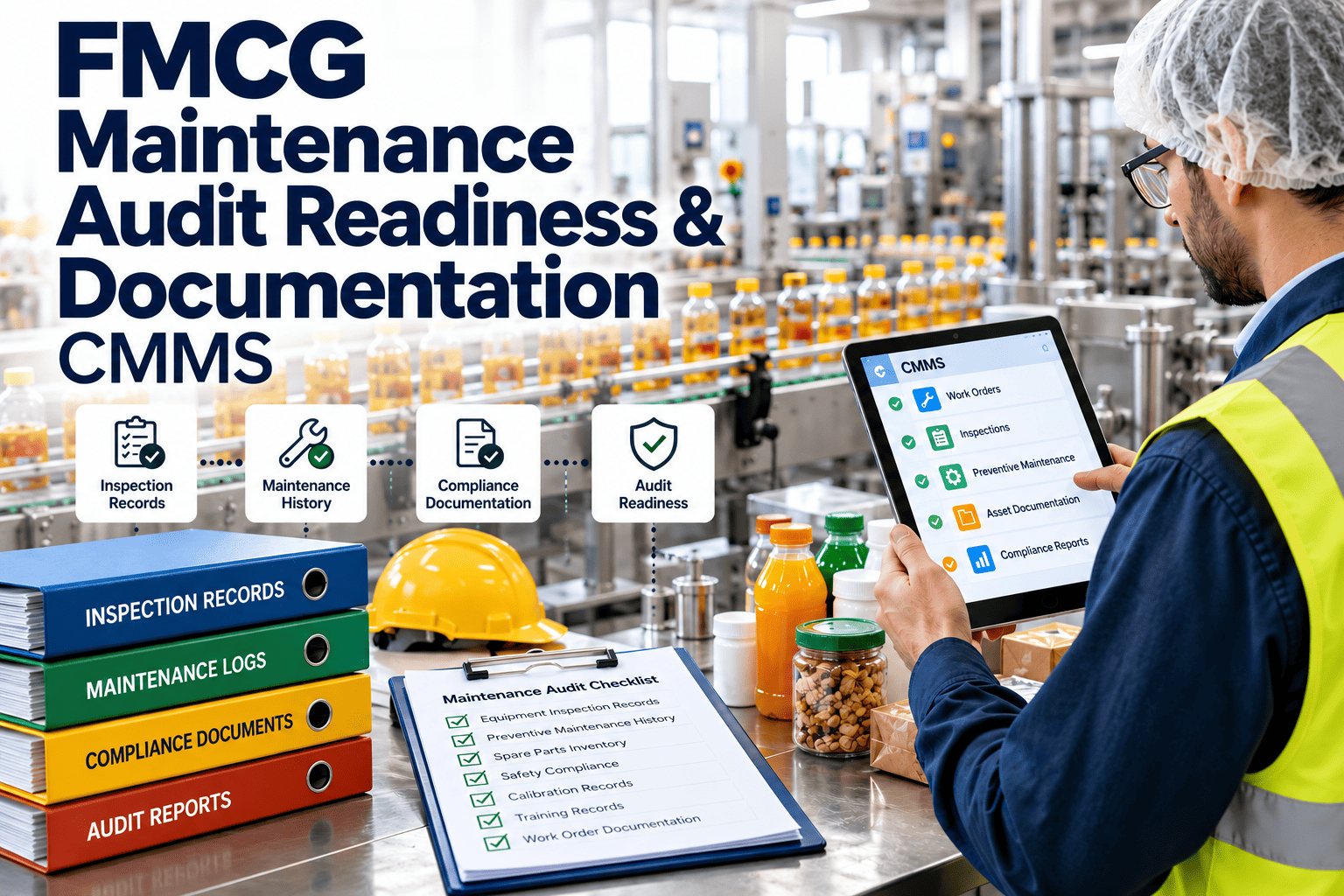
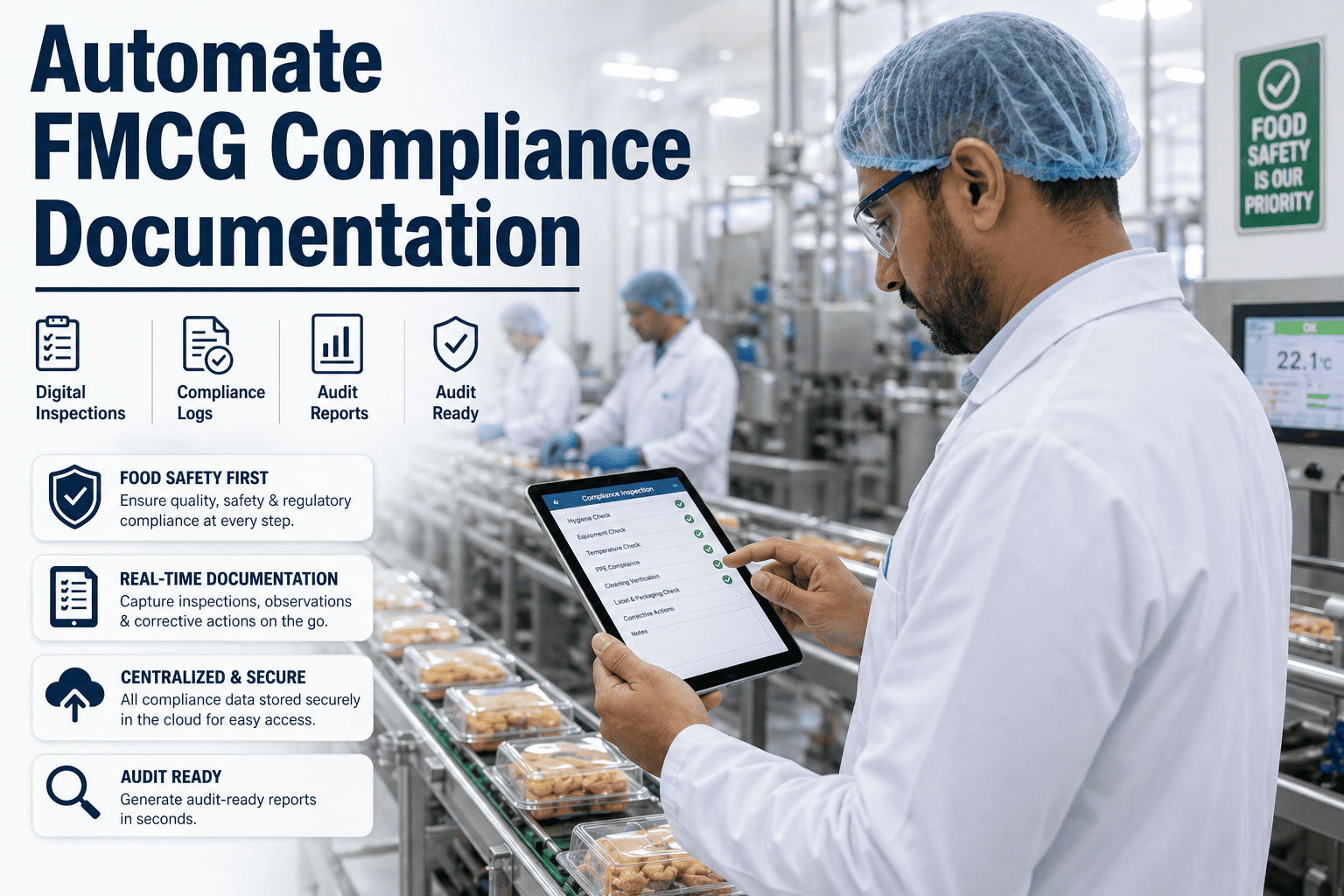
When the FDA arrived unannounced at a pharmaceutical-grade FMCG facility in New Jersey, the Compliance Manager pulled the complete 18-month maintenance and calibration record package in under 4 minutes — using OxMaint. The inspector reviewed 312 GMP assets worth of records, issued zero Form 483 observations, and described the system as "well-controlled and complete." It was the facility's first clean FDA inspection in its 11-year history. Book a demo to see how OxMaint delivers audit-ready compliance records automatically.
Case Study · Food Safety & Compliance · United States
Pharmaceutical-Grade FMCG Facility Passes FDA Audit with Zero Findings Using OxMaint
How a US pharmaceutical-grade food manufacturing facility eliminated documentation gaps, automated compliance record generation, and passed an FDA unannounced inspection with zero findings — for the first time in its operating history.
Zero
FDA findings — first in 11-year history
<4 min
To retrieve any compliance record
100%
PM and calibration schedule compliance
$1.4M
Consent decree risk avoided
Company Profile
IndustryPharmaceutical-grade FMCG — nutraceuticals, dietary supplements, and medical food products
LocationNew Jersey, United States
FacilitySingle site, 145,000 sq ft, FDA-registered, GMP-compliant manufacturing
RegulatoryFDA 21 CFR Part 111 (Dietary Supplements), Part 117 (Food Safety), Part 11 (Electronic Records)
Production4 GMP production lines, 280 production days per year, 2 shifts per day
Workforce210 employees · 12 maintenance technicians · 4-person QA compliance team
The Challenge: Paper Records Were a Consent Decree Risk
FDA inspections of pharmaceutical-grade FMCG facilities are document-intensive by design. The inspector is not primarily assessing the physical condition of the facility — they are assessing whether the quality management system can demonstrate control. A well-maintained facility that cannot produce its maintenance records on demand fails an FDA inspection. A facility with documented, timestamped, electronically signed records that demonstrate continuous control passes. The distinction between these two outcomes is almost entirely a records management question.
3
FDA citations in the previous two inspection cycles — all documentation-related, not physical compliance failures
In the two previous FDA inspection cycles, the facility received a total of 3 Form 483 observations. None were for physical non-compliance — the equipment was maintained, the calibrations were current, and the procedures were followed. All three citations were for documentation failures: records that could not be located in time, records missing electronic signatures, and a corrective action with no documented closure verification.
3 days
Minimum preparation time needed before an announced FDA inspection — paper records system could not respond faster
The facility's SOP required 3 business days to prepare a comprehensive maintenance and calibration record package for FDA review. For announced inspections this was manageable. For unannounced inspections — which FDA conducts increasingly frequently for 21 CFR Part 111 facilities — it was a critical vulnerability. An unannounced inspection with a 24-hour notification window left the compliance team unable to produce a complete record package.
21 CFR
Part 11 electronic records compliance was incomplete — paper signatures did not satisfy e-record requirements
Under 21 CFR Part 11, electronic records must have electronic signatures that are uniquely identifiable, time-stamped, and linked to the individual who performed the action. The facility's previous system — handwritten paper signatures scanned and filed digitally — did not satisfy Part 11 requirements. Every maintenance record and calibration log produced under that system was technically non-compliant with federal electronic records law.
$1.4M
Estimated consent decree exposure — the cost of a warning letter escalating to regulatory action
The compliance team's regulatory counsel estimated that a third successive inspection cycle with documentation citations would trigger a Warning Letter, and a fourth would initiate a consent decree proceeding. The estimated cost of a consent decree for a facility of this type — legal fees, remediation, production shutdown, and FDA oversight costs — was $1.4M minimum. The facility was one inspection cycle away from that outcome.
"
We had never failed a physical inspection. Our equipment was maintained, our calibrations were current, our team was trained. We were failing on paper. The FDA doesn't care that the bearing was replaced — they care that you can prove it was replaced, by whom, at what time, against which work order, with what parts. OxMaint gave us that proof for every single maintenance event, automatically.
VP of Quality and Compliance, Pharmaceutical-Grade FMCG Facility — New Jersey, USA
Why OxMaint: The Compliance Platform Selection
The facility's QA team evaluated five CMMS platforms against a compliance-first requirements matrix. The evaluation was conducted with input from their FDA regulatory counsel to ensure the selected platform would satisfy 21 CFR Part 11 without custom configuration.
✓
21 CFR Part 11 Compliance — Native, Not Custom-Built
OxMaint's electronic signatures are 21 CFR Part 11-compliant as deployed — uniquely identifiable, time-stamped, linked to the individual user's authenticated account, and non-repudiable. No custom configuration was required. The facility's regulatory counsel reviewed the OxMaint Part 11 compliance documentation and confirmed it satisfied FDA requirements without supplementary technical controls. Three of the five evaluated platforms required custom development to achieve Part 11 compliance — adding 4–8 months to deployment and significant cost uncertainty.
✓
Audit Trail Immutability — Records Cannot Be Altered After Creation
FDA 21 CFR Part 11 requires that electronic records be protected against alteration — every change must be documented with the original value, the new value, the timestamp, and the identity of the person who made the change. OxMaint's audit trail is append-only: records cannot be deleted or modified without a documented change entry. The complete change history of any record is accessible to the FDA inspector at any time. This immutability was confirmed by OxMaint's validation documentation package — a requirement the QA team specified as non-negotiable at the outset of evaluation.
✓
FDA-Ready Export — Complete Record Package in Under 4 Minutes
OxMaint's compliance export function produces a complete, date-ranged record package — all PM records, calibration logs, corrective actions, and equipment change history for any specified asset or time period — in a format structured for FDA review. During the evaluation, the QA team timed how long it would take to produce the equivalent of their standard FDA pre-inspection record package. In OxMaint: 3 minutes 47 seconds. With the existing paper-based system: 3 business days. That result ended the evaluation.
FDA Audit-Ready in Under 4 Minutes. Not 3 Days.
OxMaint automatically generates 21 CFR Part 11-compliant maintenance records, calibration logs, and corrective action documentation — every event timestamped, signed, and exportable for any FDA reviewer on demand.
The Deployment: From Paper Records to FDA-Ready Digital System in 5 Months
The compliance team set a hard deadline: full deployment and validation complete before the next FDA inspection window, estimated at 8–14 months from contract signature. The 5-month deployment timeline was built around this constraint — with a documented validation protocol required for FDA-regulated systems that added specific IQ/OQ/PQ steps not required in a standard CMMS deployment.
01
Installation Qualification (IQ)
OxMaint installation documented against approved design specification. Hardware, software version, and configuration parameters recorded. Validation documentation package reviewed and approved by QA — system confirmed as installed per specification.
02
Operational Qualification (OQ)
All electronic signature functions, audit trail generation, record immutability, and access control features tested against acceptance criteria. 47 test cases executed — all passed. Part 11 compliance functions confirmed operational as specified.
03
Performance Qualification (PQ)
System tested under actual production conditions across a 4-week period. All 12 technicians completed work orders with electronic signatures. Calibration records generated for all 84 calibrated instruments. Compliance manager confirmed record completeness and export function performance.
04
Validation Summary Report
Validation Summary Report issued and approved — system confirmed as validated per 21 CFR Part 11 requirements. Report filed as a permanent GMP document. Regulatory counsel reviewed and confirmed report satisfied FDA validation documentation expectations.
✓Phase 1 outcome: OxMaint validated per 21 CFR Part 11. All 47 OQ test cases passed. Validation Summary Report issued and approved. System cleared for GMP use.
01
GMP Asset Register
All 312 assets registered with equipment ID, description, location, and GMP classification. Historical maintenance records from the previous 24 months imported against each asset.
02
PM Schedule Migration
186 active PM tasks rebuilt from paper schedules with required intervals, acceptance criteria, and technician qualifications. PM completion became trackable for the first time.
03
Calibration Programme Migration
84 calibrated instruments migrated — due dates, tolerances, and historical data imported. Advance alerts trigger 30 days before expiry; out-of-tolerance results auto-raise CAPA.
04
Corrective Action Workflow
CAPA workflow configured with four mandatory closure fields, electronic sign-off chain, and automatic escalation beyond SLA. Open CAPA count and overdue status visible on the compliance dashboard.
✓Phase 2 outcome: 312 assets registered. 186 PM tasks live. 84 calibration records migrated. CAPA workflow operational. First electronic PM records generated with Part 11 signatures.
01
Full Team Live
All 12 technicians live, paper work orders retired. Every maintenance event generating a Part 11-compliant record automatically. PM completion averaged 96% in the first month.
02
100% Calibration Compliance
Advance alerts ensured no instrument exceeded its calibration interval. First full quarter: 100% on-time calibration for all 84 instruments — first time in facility history.
03
FDA Unannounced Inspection
FDA conducted an unannounced inspection at month 9. Notification arrived at 8:14 AM — by 8:18 AM, the complete 18-month record package was ready. No preparation sprint. Records retrieved before the inspector entered the building.
04
Zero Findings
The inspector reviewed maintenance records, calibration logs, and CAPA documentation across 2.5 days. Zero Form 483 observations — first clean FDA inspection in 11 years. Documentation described as "well-controlled and complete."
✓Phase 3 outcome: Zero FDA findings. First clean inspection in 11 years. All records retrieved in under 4 minutes. FDA inspector described documentation system as "well-controlled and complete."
The Results: 12-Month Performance Summary
FDA Form 483 Observations
First zero-finding FDA inspection in the facility's 11-year operating history. Previous two inspection cycles produced 3 combined documentation citations. Inspector described the maintenance documentation system as "well-controlled and complete" in exit briefing.
To Retrieve Complete FDA Record Package
From 3 business days to under 4 minutes. The complete 18-month maintenance and calibration record package for all GMP-critical assets was produced before the inspector had entered the building. No preparation sprint. No documentation assembly. Every record instantly available.
On-Time Calibration Compliance
All 84 calibrated instruments maintained within calibration interval for the entire post-deployment period. First time this metric was achieved in facility history. Previously 3–5 instruments per quarter were identified as out-of-calibration during pre-inspection review.
PM Completion Rate — First Month Live
From an untracked baseline (paper records did not support reliable completion rate calculation) to 96% tracked PM completion in the first month of OxMaint operation. Rising to 99% by month 6 — effectively 100% on-time PM for GMP-critical assets.
Consent Decree Risk Avoided
Regulatory counsel's minimum estimate of consent decree costs had a third inspection cycle produced documentation citations. Zero-finding result eliminated this risk entirely. The $1.4M exposure was the primary business case for the OxMaint investment.
12-Month ROI
$1.4M consent decree risk avoided plus QA labour savings (pre-inspection prep eliminated) plus reduced external consultant costs — against the full OxMaint implementation and annual licence cost. 9.3× return calculated on risk-adjusted basis; higher on expected-value basis.
"
The inspector asked to see the maintenance log for our tablet press from the previous 18 months. I pulled it up while she was still writing the request on her notepad. Complete record — every PM, every corrective action, every part replacement, every technician signature, timestamped. She looked at it for about 30 seconds and moved on. That 30 seconds was the return on our entire OxMaint investment.
VP of Quality and Compliance, Pharmaceutical-Grade FMCG Facility — New Jersey, USA
Financial Summary
12-Month Financial Return — FDA Compliance Deployment
Primary return is risk avoidance — calculated against regulatory counsel's documented consent decree cost estimate
Consent Decree Risk Avoided (zero findings — third citation cycle avoided)
Regulatory counsel minimum estimate: $1.4M — legal fees, remediation, shutdown, and FDA oversight costs
+$1,400,000
Pre-Inspection Preparation Labour Eliminated
4-person QA team × 3 days × 2 inspection cycles per year × $320/day fully loaded = $7,680 direct; $65K total with consultant fees
+$65,000
External Regulatory Consultant Cost Reduction
Pre-inspection documentation review by external FDA counsel — reduced from 3-day engagement to 4-hour review
+$28,000
Out-of-Calibration Instrument Incident Avoidance
3–5 OOC events per quarter eliminated — each requiring investigation, impact assessment, and potential batch recall evaluation
+$44,000
OxMaint Platform Investment (12 months)
Validation, implementation, annual licence — 312 assets, 21 CFR Part 11 compliant deployment
−$164,000
Net 12-Month Financial Return
$1,373,000 · 9.3× ROI
ROI calculated on risk-adjusted basis using regulatory counsel's minimum consent decree estimate. Expected value basis — probability-weighted against historical citation escalation rates — produces a higher ROI figure not included here as it involves judgment assumptions.
Frequently Asked Questions
Compliance & Audit Trail — OxMaint
Pass Your Next FDA Audit. With Records Ready in Under 4 Minutes.
21 CFR Part 11-compliant electronic records, calibration management, CAPA workflows, and immutable audit trails — every maintenance event documented automatically, retrievable instantly, and defensible to any FDA inspector.
100%
Calibration compliance