A snack manufacturer in Ohio faced a Form 483 observation during a 2025 FDA audit — not for a sanitation breach, not for a process deviation, but for a single missing electronic signature on a calibration record from eight months earlier. The Quality Assurance team had logged the activity, the maintenance technician had completed the task on schedule, the asset was in spec — but the digital signature workflow had been bypassed because the printer was offline that morning. One missing signature created a documentation gap that triggered a chain of inspector queries spanning 142 records. The plant spent 11 weeks and $186,000 on a retrospective documentation review that an automated, AI-driven compliance documentation system would have prevented in real time. Start a free trial to see how OxMaint locks every compliance record at the point of capture, generates immutable audit trails automatically, and produces inspection-ready reports in under 90 seconds. FDA Warning Letters citing 21 CFR Part 11 deficiencies have grown 35% over the past three years — the cost of manual documentation is now measurably higher than the cost of automating it. Book a demo to walk through a live FDA-ready documentation workflow.
Automate FMCG Compliance Documentation with AI-Driven Audit Trails
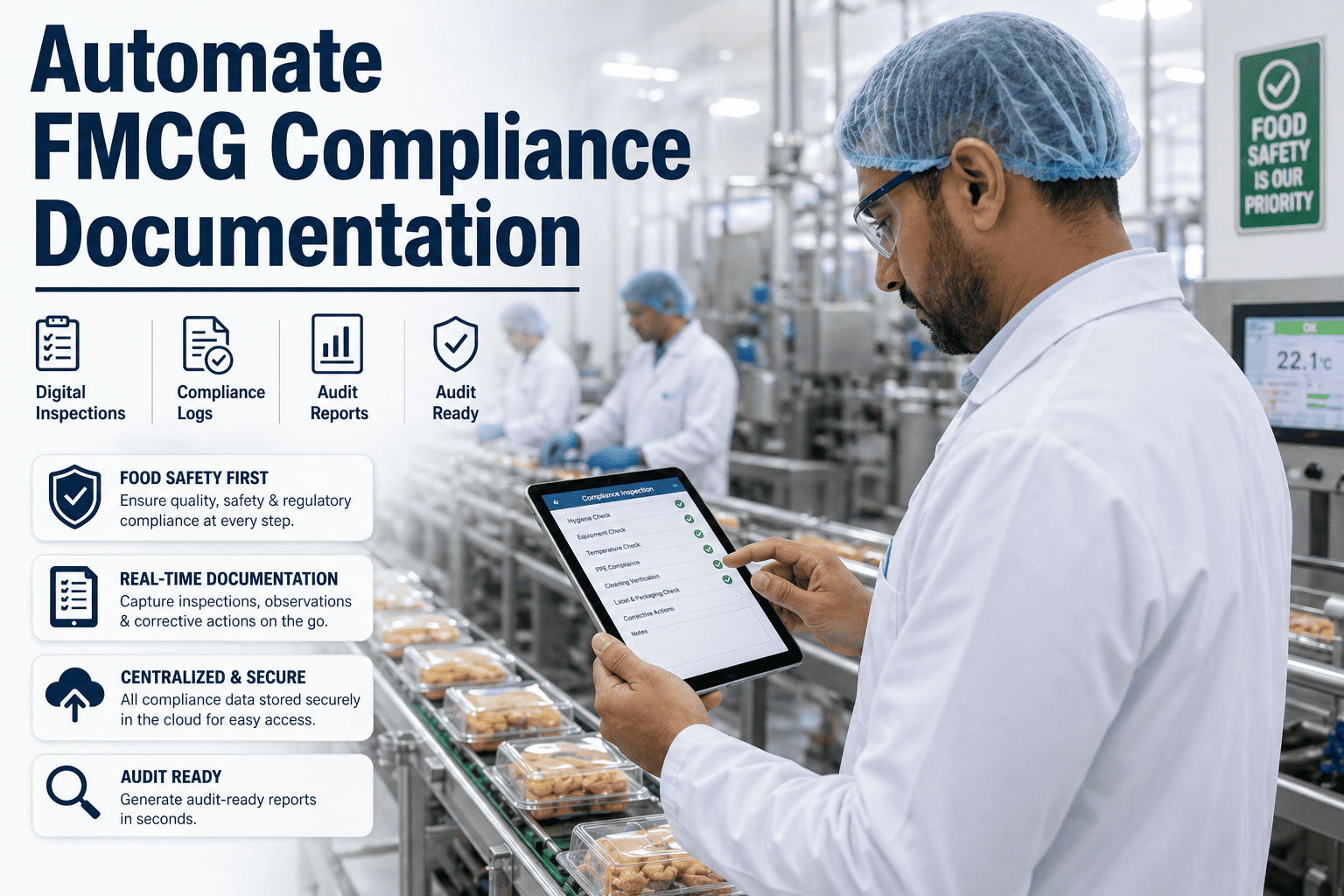
Manual compliance documentation in food manufacturing is the largest single source of audit failures, regulatory citations, and quality team burnout. AI-driven automation closes the gap — generating inspection logs, e-signed audit trails, and regulatory reports automatically from the work order layer.
Compliance Documentation, Generated by the System — Not by Spreadsheets
Automated compliance documentation in FMCG is the practice of producing every regulatory record — preventive maintenance logs, calibration certificates, inspection reports, deviation forms, CAPA tickets, and audit trails — directly from the operational system that performs the work, with no manual transcription, no spreadsheet aggregation, and no human-keyed signatures. The system enforces ALCOA+ principles (Attributable, Legible, Contemporaneous, Original, Accurate, Complete, Consistent, Enduring, and Available) at the moment of capture, satisfying 21 CFR Part 11, EU GMP Annex 11, BRC, SQF, FSSC 22000, and HACCP requirements simultaneously. Most facilities handle 40+ document types across maintenance, quality, sanitation, and calibration — automation collapses that into a single workflow. Ready to see it in action? Start a free trial and see your documentation auto-generate from day one.
The Six Document Categories Every FMCG Plant Must Automate
FDA, USDA, and GFSI auditors do not separate "important" records from "supporting" records — every electronic record used to demonstrate compliance must meet Part 11 standards. These six categories cover roughly 92% of the documentation reviewed during a typical FMCG audit.
Every PM completion on food-contact equipment must include who, what, when, how, and verification — automatically captured at work order close-out with technician e-signature.
Instrument verification logs for CCPs — temperature probes, pH meters, scales — must show traceability to NIST standards and within-tolerance results, time-stamped and signed.
Every Critical Control Point excursion requires immutable timestamps, root cause, corrective action, and disposition — with linked CAPA opened automatically the moment threshold is breached.
Pre-op inspections, ATP swab results, allergen verification, and CIP cycle reports — auto-attached to the asset record with photos, timestamps, and supervisor approval signature.
Every system change, equipment modification, or corrective action gets a structured workflow with risk assessment, validation, approval gates, and effectiveness check — all electronically signed.
Every create, modify, delete, and view event captured automatically with user identity, timestamp, and reason — tamper-proof, retention-compliant, and inspector-ready on demand.
Why Manual Compliance Documentation Fails in FMCG Plants
Documentation gaps are not caused by careless people — they are caused by paper-based and spreadsheet-based systems that depend on memory, manual transcription, and end-of-shift batch entry. The four failure modes below explain over 80% of Form 483 documentation observations.
Technicians complete tasks during the shift and back-fill records at the end of the day — violating the "Contemporaneous" requirement of ALCOA+. FDA inspectors specifically look for time-stamp clustering as evidence of batch entry.
Plants use a single shared login for the maintenance terminal — making attribution impossible. Persōn & Covey (September 2025) was cited specifically for this; the entire system was traceable only to "System Administrator".
Maintenance, quality, and calibration each maintain separate audit logs in different systems. When an inspector asks for cross-functional traceability of a single deviation event, reconstruction takes weeks instead of minutes.
The CMMS itself is treated as a "tool" rather than a GMP-controlled asset. Without IQ/OQ/PQ validation packages, every record produced by the system is challengeable — and FDA's September 2025 CSA guidance reinforced this expectation.
Stop Reconstructing Records During Audits. Start Generating Them at the Source.
OxMaint captures every compliance event the moment it happens — with biometric or password e-signatures, automatic time-stamps, immutable audit trails, and validation packages aligned with GAMP 5 and 21 CFR Part 11. When the inspector arrives, the report is already written.
How OxMaint Automates the Full Compliance Documentation Workflow
OxMaint converts every maintenance, quality, and calibration event into a Part 11-compliant electronic record automatically. The six-step workflow below runs without human transcription — eliminating the gap where 80% of audit findings originate.
PM due date, sensor threshold, calibration cycle, or operator-initiated request automatically opens a structured work order with regulatory record type pre-tagged. No spreadsheet entry, no email chain.
Technician completes the task on a mobile device with photos, readings, and a biometric or password-based e-signature. Each entry receives a server-side time-stamp the user cannot override — satisfying contemporaneous requirements.
Every create, modify, delete, and view event is logged automatically with user identity, action type, timestamp, and reason. Audit trail entries cannot be edited or deleted by any user — including system administrators.
CCP deviations automatically link to CAPA records, calibration excursions trigger work orders, and sanitation failures attach to allergen verification logs. Inspector queries that took 11 weeks now resolve in 11 minutes.
One-click report generation produces FDA-formatted, USDA-formatted, BRC-formatted, or SQF-formatted compliance packages — including the underlying audit trails — within 90 seconds. No retrospective review needed.
OxMaint ships with IQ/OQ/PQ validation templates, system risk assessments, and GAMP 5-aligned change control — meaning the platform itself satisfies CSV expectations on day one. Book a demo to review the validation package.
Manual Documentation vs. AI-Automated Documentation
The financial gap between paper-and-spreadsheet compliance and automated documentation widens every quarter as regulatory expectations tighten. The comparison below reflects 2025 audit benchmark data from FMCG facilities operating both models.
| Capability | Manual / Spreadsheet | OxMaint Automated | Cost / Risk Gap |
|---|---|---|---|
| QA time spent on documentation | 30-40% of total hours | Under 8% of total hours | $120K-$300K saved annually |
| Time to assemble audit package | 11 weeks (retrospective) | Under 90 seconds | ~5,500x faster |
| ALCOA+ contemporaneity | Frequent batch entry violations | Server-enforced time-stamps | Eliminates 62% of 483 risk |
| User attribution | Often shared logins | Unique e-signature per user | Closes top warning letter cause |
| Audit trail completeness | Partial, multi-system | Unified, immutable, automatic | Eliminates reconstruction effort |
| System validation status | Rarely formally validated | IQ/OQ/PQ shipped with platform | Satisfies CSV from day one |
| Annual compliance cost | $420K-$680K (mid-size plant) | $95K-$170K (mid-size plant) | 40-75% reduction |
| Risk of FDA Form 483 | High — most plants flagged | Low — automated controls in place | $186K avg. remediation avoided |
What FMCG Plants See After Automating Compliance Documentation
Across snack, beverage, dairy, frozen food, and personal-care manufacturers in our 2025 customer cohort — measured 12 months post-implementation against pre-automation baselines.
Frequently Asked Questions
Does OxMaint satisfy 21 CFR Part 11 and EU GMP Annex 11 requirements out of the box?
How long does compliance documentation automation take to implement?
Can OxMaint integrate with our existing QMS or ERP systems?
What happens to our existing paper and spreadsheet records during transition?
Your Next FDA Audit Should Be a 90-Second Report — Not an 11-Week Reconstruction.
OxMaint automates every compliance record from the work order layer — Part 11 e-signatures, immutable audit trails, ALCOA+ time-stamps, validated CSV documentation, and one-click inspection packages — so your QA team spends time improving operations, not defending paperwork.