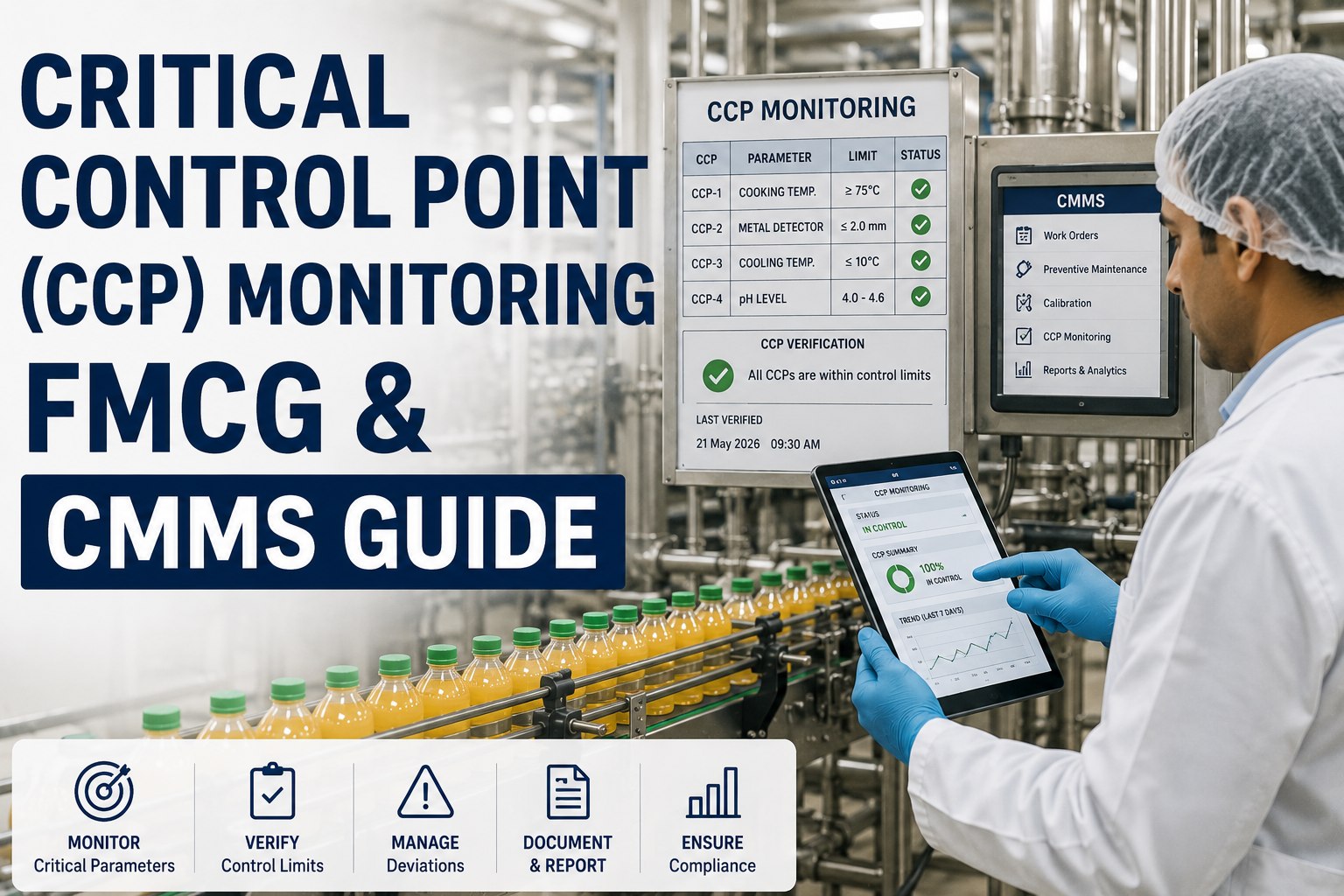
Critical Control Point monitoring is the continuous operational loop at the center of every HACCP plan and every FSMA Food Safety Plan — measure, compare to critical limit, act on deviation, verify, record. Miss a monitoring event on an instrumented CCP and the exposure is documented; miss the corrective action after a deviation and the exposure escalates from a records finding to a potential product recall. Under 21 CFR Part 117 (FSMA Preventive Controls for Human Food) and 9 CFR Part 417 (USDA FSIS HACCP), the monitoring, corrective action, and verification records are retained for two years and must be producible on request — with the actual date and time of each observation, who performed it, the reading, and the disposition. OxMaint is the maintenance management software FMCG plants use to run the CCP loop as a live workflow: sensor thresholds tied to auto-issued deviation work orders, corrective action routed through the four regulatory elements, and a record structure that maps line-for-line to 21 CFR 117 and 9 CFR 417 evidence requirements. Start free on OxMaint to load the CCP monitoring template, or book a demo to see a live deviation-to-CAPA close.
CCP Monitoring · Where Food Safety Compliance Is Won or Lost
21 CFR 117 · 9 CFR 417 · HACCP 7 Principles · Live CMMS routing.
7
HACCP principles — hazard analysis, CCP identification, critical limits, monitoring, corrective action, verification, records
4
Regulatory elements required in every corrective-action record under 9 CFR 417.3
2 yr
Minimum retention for preventive-controls monitoring, corrective action & verification records under 21 CFR 117
5 fields
Mandatory per record: date, time, monitor identity, result, disposition (+ corrective action if applicable)
The Continuous CCP Monitoring Loop · The Operational Cycle Every Plant Runs
The FDA-endorsed HACCP methodology and the FSMA preventive-controls framework both describe the same closed loop at the CCP: measure the parameter, compare to the critical limit, act on any deviation, verify the action, record everything. The loop below is that cycle rendered as it actually runs on the shop floor — with instrumented CCPs streaming continuously, operator checks captured digitally, and every deviation routed to a corrective-action workflow before the next measurement.
01
Measure
Sensor stream (temp, pH, aw, pressure) or operator check (metal-detector challenge, visual seal) at defined frequency per CCP.
→
02
Compare to CL
Reading evaluated against the validated critical limit — the numerical floor or ceiling between safe and unsafe.
→
03
In Control
or Deviation
In control → log & continue. Deviation → CCP is out of control, immediate corrective action triggers automatically.
→
04
Corrective Action
Four regulatory elements executed: cause, control restored, recurrence prevention, no adulterated product to commerce.
→
05
Verify & Record
Verification activity (calibration check, record review) and the full record retained for 2 years per 21 CFR 117.
Loop discipline
The loop runs continuously — instrumented CCPs stream automatically; operator checks are captured at the line with real timestamps. What separates a compliant program from an audit finding is the deviation branch at step 3: every deviation must trigger the corrective-action workflow before the next reading, not at the end of the shift.
The HACCP 7 Principles Mapped to CMMS Configuration
The seven HACCP principles endorsed by the FDA and NACMCF are what auditors verify against — but each principle requires a specific CMMS configuration to be evidentially defensible. The mapping below is how each principle translates into what OxMaint actually stores, triggers, and produces on request.
| HACCP Principle | Regulatory Requirement | CMMS Configuration |
|---|
| P1 Hazard Analysis | Identify biological, chemical, physical hazards per process step | Hazard library attached to asset hierarchy (line → step → hazard) |
| P2 Identify CCPs | Determine each CCP using the decision-tree logic | CCP flag per asset with mandatory reason-code and validation link |
| P3 Critical Limits | Set numerical CL per CCP validated by science or regulation | Limit thresholds stored per CCP with validation-doc attachment |
| P4 Monitoring Procedures | Defined observation/measurement sequence at set frequency | Auto-scheduled monitoring PMs; sensor streams tied to thresholds |
| P5 Corrective Actions | Defined procedures for every deviation (9 CFR 417.3 elements) | Deviation → auto-WO through 4-element CAPA workflow |
| P6 Verification | Calibration, record review, validation activities on schedule | Calibration register w/ expiry alerts; scheduled record-review PMs |
| P7 Records & Documentation | Complete monitoring, corrective action, verification records retained 2 yr | Timestamped, e-signed records auto-attached to CCP and lot number |
The Corrective-Action Four Elements · What 9 CFR 417.3 Actually Requires
The deviation-response requirement is the highest-consequence part of the CCP loop, and the regulation is explicit. Under 9 CFR 417.3, every corrective-action record must document four elements — miss any one and the record itself fails audit even if the physical response was correct. OxMaint's CAPA workflow routes every deviation through all four before allowing closure.
Element 01
Cause Identified & Eliminated
The cause of the deviation is identified and eliminated. Documented root-cause analysis on every deviation — sensor drift, equipment failure, procedural miss, ingredient variance.
Element 02
CCP Under Control After Action
The CCP will be under control after the corrective action is taken. Post-action verification measurement confirmed and attached to the record.
Element 03
Recurrence-Prevention Measures
Measures to prevent recurrence are established. This is where trend analysis feeds preventive action — repeated deviations at the same CCP trigger a design or procedural change.
Element 04
No Adulterated Product to Commerce
No product injurious to health or otherwise adulterated as a result of the deviation enters commerce. Product disposition (hold, rework, reject, release with justification) recorded per lot.
Enforcement stakes
Repeated deviations at USDA-inspected facilities can trigger an FSIS Notice of Intended Enforcement (NOIE) with suspension of operations. FDA-regulated facilities under FSMA face warning letters, consent decrees, and in severe cases facility closure. Product involved in an undetected deviation released to commerce is a recall event.
Sample CCP Record · What a Compliant Monitoring Record Looks Like
Every regulator, every third-party auditor, and every internal reviewer looks for the same seven fields on a CCP record. Below is a sample compliant record structure — the shape every entry in the CMMS should take, matched to 21 CFR 117 and 9 CFR 417 requirements.
CCP Monitoring Record · Lot 26-0847
21 CFR 117 · 9 CFR 417 Compliant
Date & Time
2026-09-02 · 14:32:07
CCP
CCP-02 Cook Temperature
Monitor
Op. M. Reyes · Badge 4471
Critical Limit
≥ 165°F for ≥ 15 sec
Corrective Action
N/A · deviation not triggered
Product Disposition
Released to next step
E-Signature
Reyes.M · verified 14:32:11
Retained 2 yr per 21 CFR 117.315 · Lot-linked for FSMA 204 traceability · Verified by daily record review per HACCP Principle 6
Load the CCP Monitoring Loop into OxMaint — Free Forever
Sign up on OxMaint's free forever plan and configure your CCPs with critical limits, monitoring frequencies, and the four-element deviation workflow pre-loaded. Instrumented CCPs stream continuously; operator checks capture at the line with real timestamps and e-signatures. No card, no time limit.
Common FMCG CCP Types & Their Critical Limits
The CCPs below are the ones that appear on virtually every food-and-beverage HACCP plan — with the critical-limit form each takes and the monitoring cadence field-standard programs run. Real limit values come from the plant's validated Food Safety Plan; the shapes below are the reference.
Thermal
Cook Temperature & Time
CL: minimum temp for minimum hold time (e.g. ≥165°F for ≥15 sec RTE poultry)
Continuous instrumented; every batch / every unit
Thermal
Cooler / Refrigeration Temperature
CL: ≤41°F for TCS foods (FDA Food Code reference)
Continuous instrumented; excursion alarms on threshold breach
Thermal
Pasteurization Time-Temperature
CL: PMO-defined (e.g. 161°F for 15 sec HTST milk)
Continuous instrumented + chart recorder verification
Chemical
pH / Water Activity (aw)
CL: pH ≤4.6 or aw ≤0.85 for shelf-stable classification
Batch sampling at defined frequency; instrument calibration verified
Physical
Metal Detection
CL: rejection at test-piece sensitivity (Fe/NFe/SS by product)
Test-piece challenge at start-up, shift change, every 4 hr
Physical
Foreign-Object / X-Ray
CL: detection & rejection at validated defect size
Continuous inline; challenge tests on start-up + every 4 hr
How OxMaint Runs the Full CCP Monitoring Program
The continuous loop, the 7-principle mapping, the 4-element deviation workflow, and the record structure all live in the same platform — sensor thresholds tied to auto-issued deviation work orders, operator checks captured at the line with real timestamps, corrective action routed through the regulatory elements, and a records archive that meets 21 CFR 117 and 9 CFR 417 retention requirements out of the box.
Configure
CCPs with Validated Critical Limits
CCP flag per asset with critical-limit thresholds, validation-document attachment, and reason-code per HACCP Principle 3.
Stream
Instrumented Monitoring on Threshold
Continuous sensor readings evaluated against critical limits every cycle; excursion auto-issues deviation work orders in real time.
Capture
Operator Checks at the Line
Metal-detector challenges, visual inspections, batch sampling captured on the phone with real timestamps and e-signatures.
Escalate
4-Element CAPA Workflow
Every deviation routes through cause / control-restored / recurrence-prevention / disposition per 9 CFR 417.3 — no closure without all four.
Verify
Calibration & Record-Review Schedules
Verification activities per HACCP Principle 6 scheduled as recurring PMs — calibrations, record reviews, validation studies.
Retain
Lot-Linked Records for 2 Years
Every CCP record attached to lot number, retained 2 years per 21 CFR 117, exportable on demand for FDA / FSIS / third-party audit.
Turn CCP Monitoring From a Paper Exercise Into a Live Compliance Loop
Free forever plan — no card, no time limit. Configure your CCPs, wire the deviation workflow to the four regulatory elements, and every reading — instrumented or operator-captured — enters the record archive with real timestamps and e-signatures. Or book 30 minutes and we'll walk your highest-risk CCP end-to-end on the platform.
Frequently Asked Questions
What are the seven HACCP principles a CMMS needs to support?
The FDA/NACMCF-endorsed seven principles are: hazard analysis, CCP identification, critical limits, monitoring procedures, corrective actions, verification, and record-keeping. A defensible CMMS supports each principle with a specific configuration — hazard library on the asset, CCP flag with validated limit, monitoring PMs at defined frequency, deviation workflow routed through the four regulatory elements, verification activities scheduled as recurring calibrations and record reviews, and every record retained for the required period.
What are the four regulatory elements every corrective-action record must document?
Under 9 CFR 417.3, every deviation record must document four elements: (1) the cause of the deviation identified and eliminated, (2) the CCP under control after the corrective action is taken, (3) measures to prevent recurrence established, and (4) no product injurious to health or otherwise adulterated as a result of the deviation entering commerce. Miss any one of the four and the record itself fails audit — even if the physical response to the deviation was correct.
How long must CCP monitoring and corrective-action records be retained?
Under 21 CFR 117 (FSMA Preventive Controls for Human Food), monitoring, corrective action, and verification records are retained for a minimum of two years. USDA-inspected facilities under 9 CFR 417 follow the same field-standard retention window, with certain records extending further based on product shelf life and traceability requirements under FSMA 204. Electronic storage with immutable timestamps is the current standard.
What are the enforcement consequences of repeated CCP deviations?
USDA-inspected facilities can receive an FSIS Notice of Intended Enforcement (NOIE) for repeated deviations, escalating to suspension of operations in serious cases. FDA-regulated facilities under FSMA can receive warning letters, consent decrees, and in severe cases facility closure. Beyond regulatory action, product released to commerce that later ties back to an undetected deviation is a recall event — with the direct financial exposure plus the brand consequence.
Book a demo to see the deviation workflow prevent that path.
Does OxMaint handle both instrumented CCPs and operator-captured checks?
Yes. Instrumented CCPs (cook temperature probes, cooler thermocouples, pasteurization chart recorders, pH meters, aw analyzers) stream continuously with thresholds evaluated every cycle — excursions auto-issue deviation work orders. Operator-captured CCPs (metal-detector challenge tests, visual seal inspections, batch pH sampling, foreign-object checks) capture on the phone at the line with real timestamps and e-signatures. Both flow into the same record archive with the same 4-element CAPA workflow on deviation.
Sign up free to configure both on your first shift.

.png)