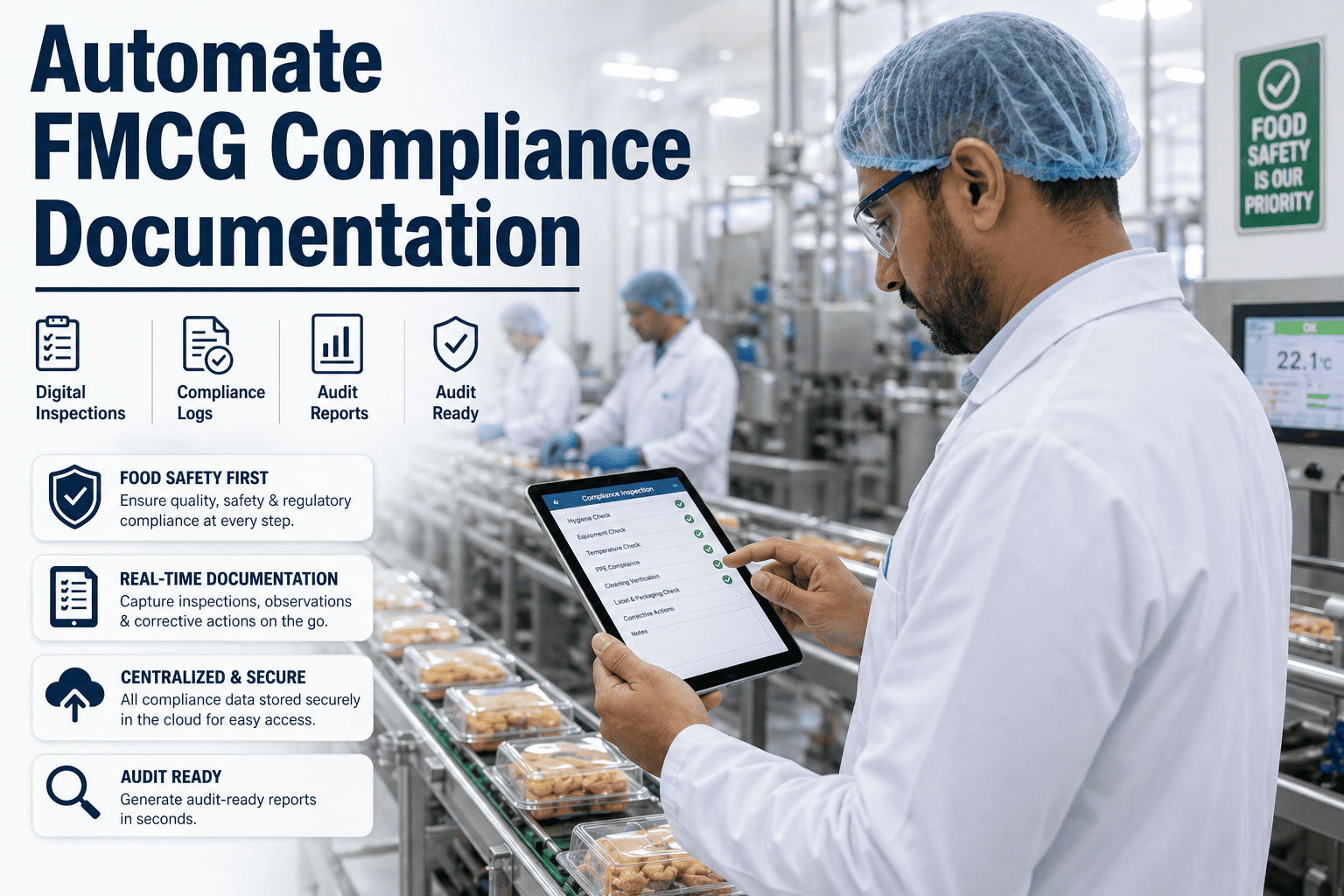
SQF certification isn't a documentation exercise — it's an audit against your operating discipline. And under SQF Code Edition 9, Module 11 Section 11.7 explicitly requires a written maintenance program, NIST-traceable calibration records, documented corrective actions on every food-safety finding, and pest-control documentation accessible on-site. FMCG plants that run this on paper binders and spreadsheets consistently accumulate Major findings — and every Major finding is one step from certification suspension. This guide covers what SQF actually requires from maintenance, the Element 11 sub-clauses, the finding classification ladder, and how OxMaint's maintenance management software makes SQF audit-readiness continuous. Start free or book a demo.
FMCG · SQF Edition 9 · Certification · CMMS 2026
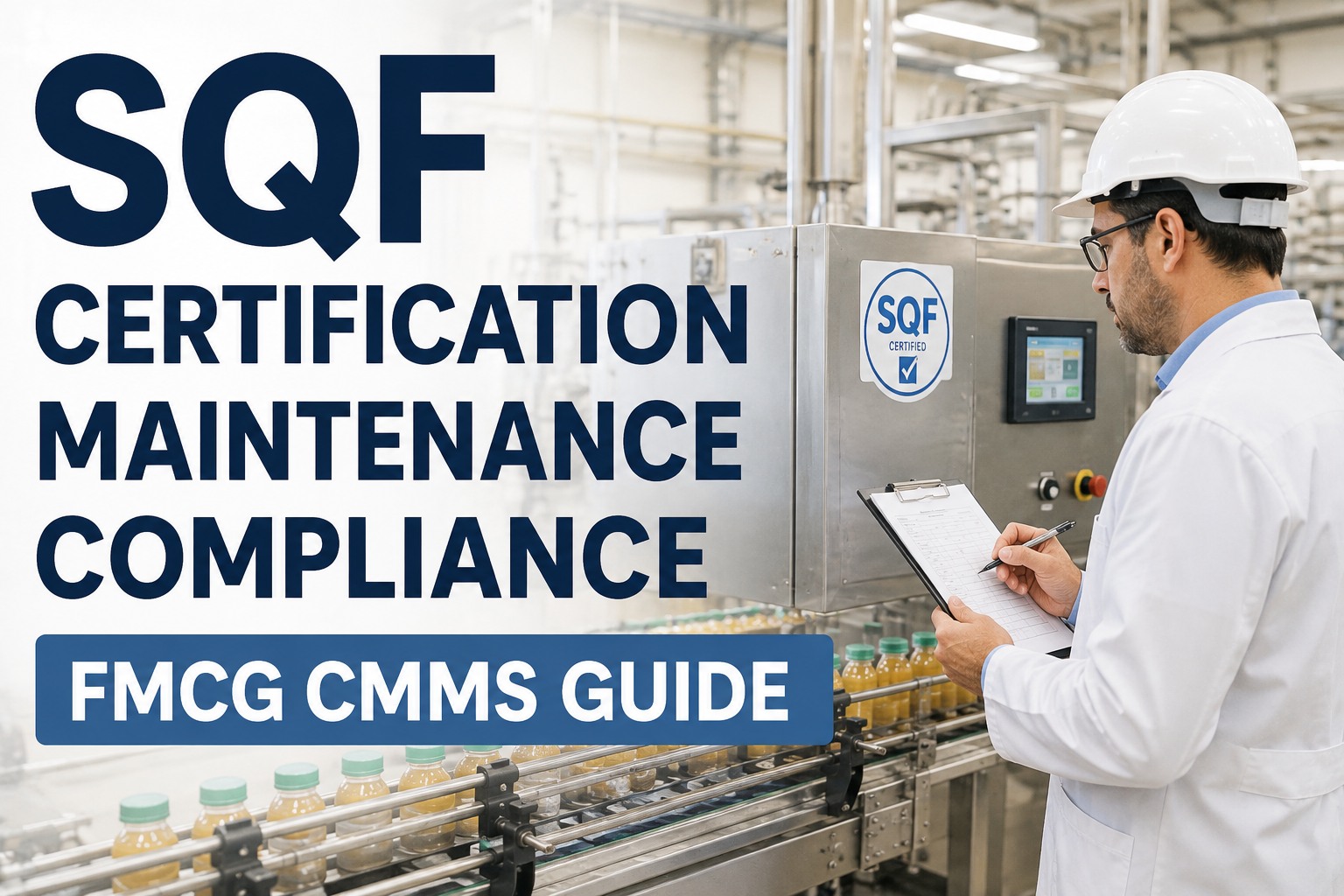
SQF Certification Maintenance Compliance FMCG CMMS Guide
SQF certification maintenance compliance guide for FMCG plants: prerequisite program records, equipment maintenance documentation, and OxMaint's CMMS-based SQF audit-readiness workflow.
Edition 9
Current SQF Code — mandatory for certified FMCG facilities
Element 11
Maintenance Programme — the audit-critical prerequisite
< 2 min
Auditor record-retrieval expectation — 30-40% audit-time reduction
1 Major
= One step from certification suspension. Zero tolerance for gaps.
SQF Code Architecture — Where Maintenance Lives
SQF Edition 9 organizes certification into modules, and maintenance obligations sit primarily in two of them: Module 2 (SQF Food Safety Plan) governs the HACCP-aligned structure, and Module 11 (Good Manufacturing Practices) contains Element 11 — the Maintenance Programme every audit examines in detail. Below is the module map every SQF practitioner works against. Sign up free and OxMaint's FMCG library ships with SQF Edition 9-aligned templates — every PM task is linked to the SQF clause it satisfies, so audit evidence is generated automatically as a byproduct of routine maintenance execution.
MODULE 2
SQF Food Safety Plan
ScopeHACCP-based food safety system, hazard analysis, CCP identification
Maint. LinkEvery CCP is an asset the maintenance team keeps functional
Audit FocusCCP monitoring records, calibration of CCP instruments, revalidation after repair
MODULE 11
Good Manufacturing Practices
ScopeGMP prerequisite programs — sanitation, pest control, personnel, maintenance
Maint. LinkElement 11.7 = written Maintenance Programme
Audit FocusPM completion, calibration NIST-traceability, corrective actions, food-grade lubricants
Element 11 Maintenance Programme — The Six Sub-Clauses Auditors Verify
Element 11 (specifically Section 11.7 in Module 11) breaks the maintenance programme into six sub-clauses, each with distinct documentation requirements. An SQF auditor works through these systematically — miss one and you accumulate the finding. Below is the sub-clause map. Book a 30-minute demo and an OxMaint FMCG specialist will walk each sub-clause against your current maintenance program — you'll leave with a specific gap list before your next SQF audit window.
11.7.1
Written Maintenance Programme
Documented programme covering all production and processing equipment. Asset register must be complete, current, and accessible during audit.
11.7.2
PM Schedules Aligned to Food Safety Risk
PM intervals must reflect food safety criticality — CCP-linked equipment on tighter cadences than non-food-contact assets. Random calendar PM = finding.
11.7.3
Calibration Programme — NIST Traceable
Every measuring device affecting food safety calibrated on defined schedule, records traceable to national standards. Certificate linked to specific machine serial number.
11.7.4
Food-Grade Lubricant Control
Approved lubricants per application documented. Non-food-safe lubricants segregated. Application on food-contact surfaces prohibited without approval.
11.7.5
Corrective Actions with Root Cause Analysis
Every food-safety maintenance finding requires documented corrective action — immediate correction, root cause, systemic preventive action, effectiveness verification.
11.7.6
Contractor & Temporary Worker Controls
Individual accounts (no shared credentials), current training records, certification verification before work assignment, immediate deactivation on departure.
The SQF Finding Classification Ladder — What Each Level Actually Costs
SQF auditors classify every non-conformance into one of four categories, and the consequences escalate sharply. Most facilities focus on avoiding Critical findings but underweight the compounding risk of accumulated Minor findings — which trigger downgrade to a lower certification rating and lost customer contracts. Below is the classification reality. Sign up free and OxMaint auto-escalates any open corrective action approaching its due date — the pattern that causes most Minor and Major findings during SQF audits gets closed before the auditor arrives.
CRITICAL
Immediate Food Safety Risk
Audit terminated. Immediate certification suspension. Product recall consideration. Return audit at facility's cost.
CONSEQUENCE: Certification suspended · Contract loss
MAJOR
Significant System Breakdown
30-day corrective action window. One Major = downgrade risk. Multiple Majors = one step from certification suspension.
CONSEQUENCE: Downgrade · Re-audit fee
MINOR
Isolated Documentation or Process Gap
30-day corrective action window. Individually manageable — but accumulated Minors during one audit re-classify to Major.
CONSEQUENCE: Corrective action required
OBSERVATION
Improvement Recommendation
No corrective action required, but noted in audit report and re-examined at next audit. Ignored observations often become future Minor findings.
CONSEQUENCE: Track for next audit
The Facilities That Pass Cleanly Aren't the Ones with Better Binders — They're the Ones Where Compliance Runs Continuously.
OxMaint's maintenance management software keeps SQF audit-readiness continuous rather than pre-audit panic. Every PM linked to its SQF clause, every calibration NIST-traceable, every corrective action auto-escalated before overdue, and the full Module 11 audit package generated in under 20 minutes on any day of the year.
The SQF Prerequisite Programs — Where Maintenance Overlaps
SQF's Prerequisite Programs (PRPs) are the foundational control measures below the HACCP layer. Maintenance touches multiple PRPs directly or indirectly, and audit gaps in any adjacent PRP often trace back to maintenance execution. Below is the maintenance-relevant PRP map. Book a scoping call and an OxMaint compliance specialist will map your maintenance program against these adjacent PRPs — you'll leave with a clear picture of which PRP gaps sit inside the maintenance workflow before you commit to a trial.
Premises & Equipment Maintenance
CORE
Element 11.7 — the primary maintenance PRP. Written programme, PM records, corrective actions, revalidations.
Calibration of Equipment
CORE
NIST-traceable calibration on every food-safety measuring device. Certificate linked to specific machine serial number.
Cleaning & Sanitation
ADJACENT
CIP/COP systems maintained by the maintenance team — spray ball inspection, dosing calibration, temp verification.
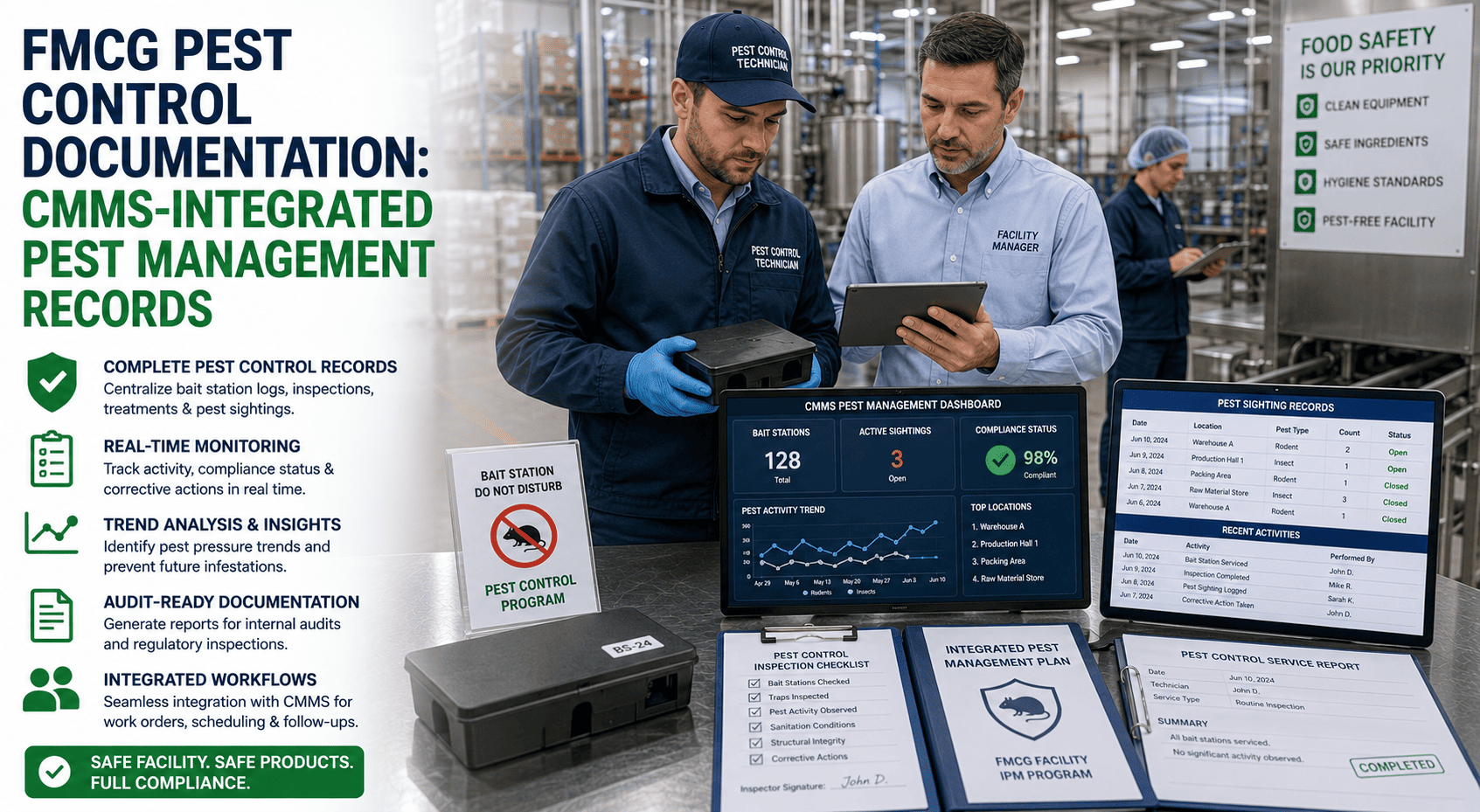
Pest Management
ADJACENT
Pest control device records — insect light traps, rodent stations. Often managed alongside PM scheduling.
Control of Physical Contaminants
CORE
Metal detector, x-ray, magnet, sifter — all CCP-linked, calibration-heavy, and audit-scrutinized.
Water Microbiology & Quality
ADJACENT
Water treatment equipment PMs, RO system integrity, chlorine dosing — maintenance-executed, food-safety-critical.
Paper & Spreadsheet SQF vs. OxMaint Continuous-Readiness CMMS
Facilities running SQF on paper binders and spreadsheet trackers accumulate the exact document-control non-conformances and PRP gaps that generate Major findings. Facilities running OxMaint don't — because compliance is the byproduct of the maintenance workflow, not a separate documentation exercise. Start free — no credit card, unlimited users, and the FMCG library ships pre-configured with SQF Edition 9-aligned templates, Element 11 sub-clause mapping, and audit-package export ready on day one.
FMCG operations that put SQF Element 11 execution inside OxMaint stop entering audit windows in pre-audit panic and start passing cleanly with zero Major findings. Start your free forever workspace to configure your first Element 11-aligned PM this week, or book a demo to see a live simulated-SQF-audit walkthrough before you commit.
"
We hold SQF Level 3 across two FMCG plants — the "excellent" tier, not just "certified." Getting there took two years of pre-audit binder scrambles and a Major finding on our last audit for calibration documentation gaps on our metal detectors. The finding wasn't that the metal detectors weren't calibrated — they were. The finding was that we couldn't produce the NIST-traceable certificate linked to the specific machine serial number in under 2 minutes when the auditor asked. Rolled OxMaint six months before the next audit with SQF Element 11 templates and Part 11 configuration. This year's SQF audit closed with zero Major findings, three Minors (all documentation-adjacent, all closed within 10 days), and the auditor commented on how quickly records surfaced. Continuous compliance instead of pre-audit war rooms.
SQF Practitioner & Quality Director · 2-Plant SQF Level 3 FMCG Manufacturer · US Midwest
Frequently Asked Questions
What does SQF Element 11 actually require from maintenance?
SQF Code Edition 9, Module 11, Section 11.7 requires: a written maintenance programme covering all production and processing equipment (11.7.1); PM schedules aligned to food-safety risk (11.7.2); calibration programme with NIST-traceable records and certificates linked to specific machine serial numbers (11.7.3); food-grade lubricant control with approved lubricants per application (11.7.4); corrective actions with root cause analysis on every food-safety finding (11.7.5); and contractor/temporary worker controls with individual accounts and training verification (11.7.6).
How does OxMaint keep SQF audit-readiness continuous?
Every PM task in OxMaint is linked to the specific SQF clause it satisfies. Every calibration record captures the standard used, the traceability chain, and the linkage to a specific machine serial. Every corrective action follows structured CAPA workflow with mandatory root cause and effectiveness verification. Contractor accounts are individually managed with training-record-gated work assignment. When the auditor arrives, the full Module 11 evidence package generates in under 20 minutes — same discipline any day of the year.
Sign up free to load the SQF Element 11 templates.
What triggers a Major finding at SQF audit?
Significant breakdown in a system that could affect food safety — for example, calibration records that cannot be produced in under 2 minutes, PM schedules not aligned to food-safety risk, undocumented food-grade lubricant use, corrective actions overdue past their 30-day window, or contractor work assignments without training verification. One Major = downgrade risk. Multiple Majors during one audit = one step from certification suspension. Accumulated Minors during one audit can re-classify to Major.
How long must SQF maintenance records be retained?
SQF certification requires records to cover product shelf life plus one year — which for ambient shelf-stable FMCG products can mean 5-7 years. Multi-standard plants (SQF + BRC + FSSC 22000) typically default to a 3-year minimum across all record types to cover the most stringent overlapping requirement. OxMaint stores records indefinitely by default with configurable retention rules per record type — no purging risk, instant retrieval throughout the retention window.
Book a demo to see retention configuration live.
How does OxMaint handle contractor and temporary maintenance workers?
Every contractor gets an individual OxMaint user account — no shared credentials, which meets both SQF Element 11.7.6 and 21 CFR Part 11 attribution requirements. Each contractor account links to their training-record status (food hygiene certificate, site induction, LOTO authorization). The system prevents assignment of restricted work orders to contractors without current required certifications. Contractor accounts are deactivated immediately on departure — a specific SQF and Part 11 requirement.
Does OxMaint work for multi-standard plants (SQF + BRC + FSSC 22000)?
Yes. All three GFSI-benchmarked schemes overlap by roughly 90% on documentation expectations, so OxMaint captures records once and generates scheme-specific audit packages on demand. During an SQF audit, one click exports the SQF Module 11-formatted package; during a BRC audit, one click exports the BRC-formatted package — same underlying data, format tuned to the scheme. Consolidating multi-standard audit prep into a single workflow is one of the highest-ROI reasons multi-plant FMCG groups deploy OxMaint.
Is a credit card or CAPEX approval needed to start?
No. OxMaint's free forever plan requires no credit card, no CAPEX request, and no consulting engagement — you can
sign up in under 2 minutes and register your first SQF Element 11-linked asset the same shift. FMCG asset templates ship pre-built for metal detectors, x-ray scanners, thermal processors, chillers, magnets, sifters, scales, fillers, and CIP/COP systems — all pre-mapped to the SQF clauses they satisfy.
Make SQF Audit-Readiness Continuous. Not a Pre-Audit War Room.
OxMaint's maintenance management software delivers SQF Element 11 execution as an automatic output of your normal maintenance workflow — Element 11 sub-clause mapping, NIST-traceable calibration, auto-escalated corrective actions, contractor account control, and one-click Module 11 audit exports. Start free — no credit card, unlimited users, forever. Or book a demo for a plant-specific SQF walkthrough.