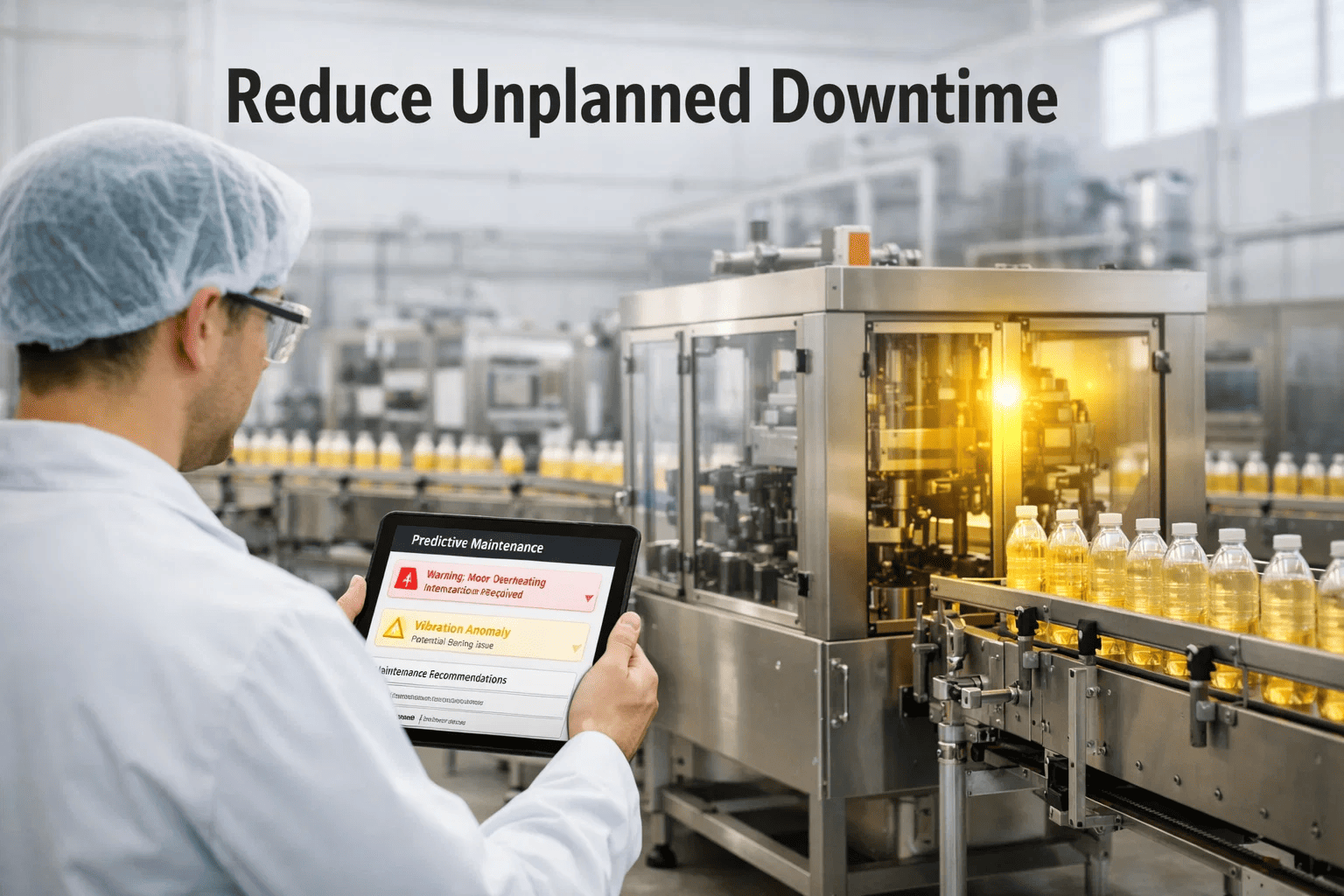
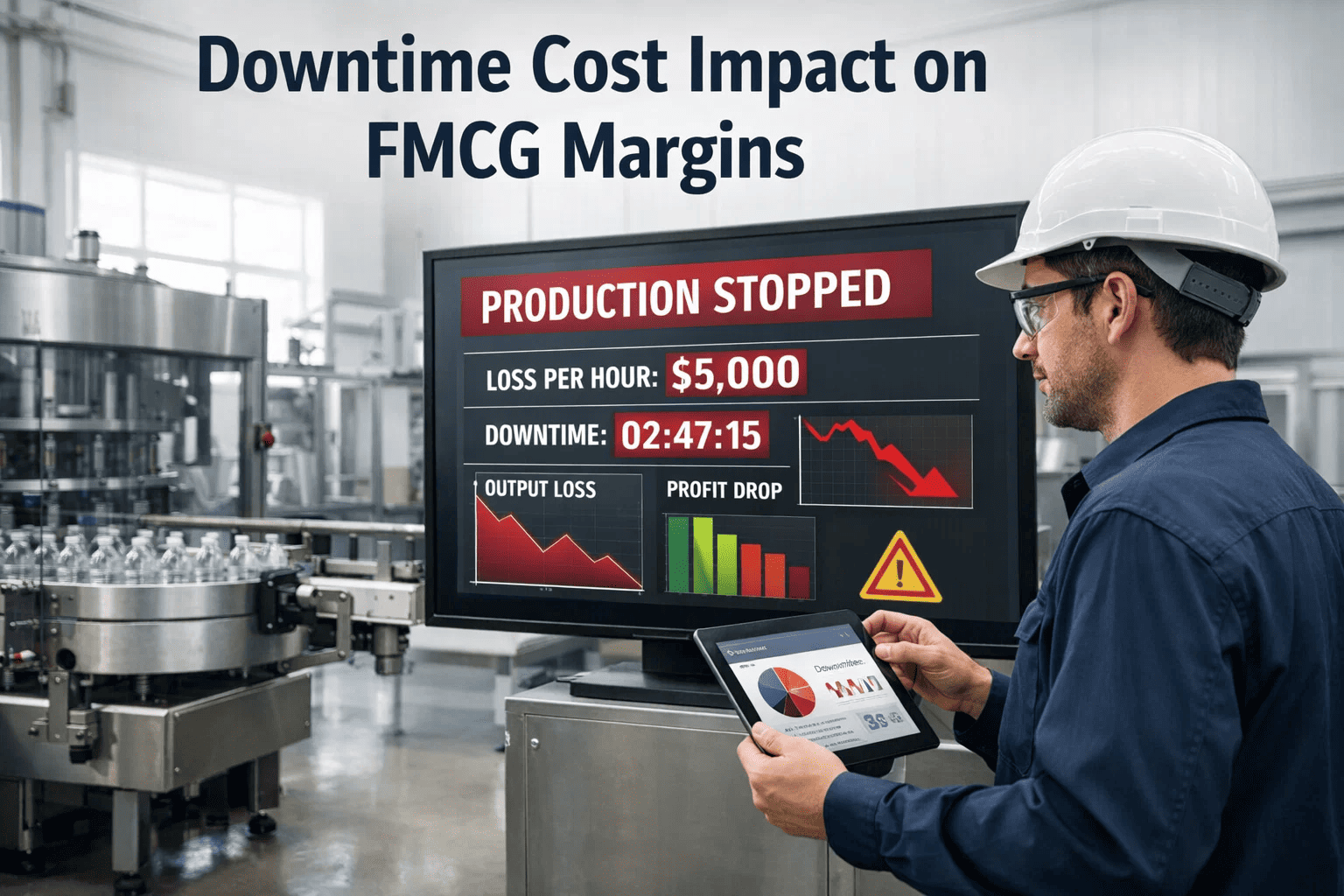
A 47-minute production stoppage can drain $28,200 in lost output—that’s $600 every minute. In FMCG manufacturing, where net margins often hover around 6%, a single unplanned breakdown can wipe out the profit generated from 147 hours of production.This is exactly where Oxmaint Maintenance Management Software delivers measurable value for FMCG manufacturers. By enabling predictive maintenance, real-time asset monitoring, automated work orders, and downtime analysis, Oxmaint helps plants prevent unexpected failures before they halt production.
The 47-Minute Disaster
How one conveyor jam erased profit from 147 production hours
47
minutes downtime
Lost production value
$28,200
×
Operating margin (6%)
$1,692
÷
Profit per hour ($11.50)
147 hrs
To recover the profit lost in 47 minutes, this FMCG line must run perfectly for 147 hours—over 6 full days—just to break even.
Why FMCG Margins Are Uniquely Vulnerable to Downtime
FMCG manufacturers lose $36,000 per hour to unplanned downtime, but the real impact on profitability is far more severe. With thin margins (35% gross, 6% net), downtime doesn't just reduce output—it obliterates profitability. Unlike automotive manufacturing where downtime costs $2.3 million per hour but operates on healthier margins, FMCG faces brutal economics where one hour of downtime eliminates profit from 16.7 hours of perfect production. FMCG manufacturers ready to protect their margins can start with Oxmaint today to begin tracking equipment health and preventing costly failures.
The FMCG Margin Structure
Why every minute of downtime cascades through profitability
Revenue per Hour
$36,000
100%
Cost of Goods Sold
$23,400
65%
Gross Profit
$12,600
35%
Operating Expenses
$10,440
29%
Net Operating Profit
$2,160
6%
The Downtime Multiplier: With 6% net margins, one hour of downtime ($36,000 lost revenue) eliminates profit from 16.7 hours of perfect production.
Fixed Costs Continue: Labor, utilities, and overhead don't stop during downtime. You're paying full operating costs to produce nothing.
Opportunity Cost: In FMCG's high-velocity market, lost production hours can never be recovered. Missing delivery windows means lost revenue forever.
The Cascade Effect: How Downtime Multiplies Through Operations
The $36,000-per-hour figure captures only immediate production loss. In FMCG, downtime triggers cascading consequences: perishable raw materials degrade, just-in-time supply chains experience bullwhip effects, and retailers shift shelf space to competitors. Average FMCG facilities experience 25 hours of unplanned downtime monthly—$10.8 million in direct annual losses. Total financial impact including cascading effects typically reaches 2.5-3x the direct cost.
The Downtime Cascade
From production stop to permanent market share loss
Immediate (0-2 hours)
Production Loss
$72,000
Fixed Costs Continue
$18,000
Raw Material Waste
$5,200
Immediate Impact: $95,200
Short-Term (2-48 hours)
Expedited Logistics
$12,000
Overtime Labor
$8,400
Quality Issues
$6,800
Retailer Penalties
$15,000
Added Cost: $42,200
Long-Term (Weeks-Months)
Lost Shelf Space
Permanent
Customer Switching
$45,000+
Brand Reputation
Unmeasured
Retailer Relationship
At Risk
Total Measurable: $182,400+
2.5-3x
Total cost multiplier when cascading effects are included
FMCG manufacturers scheduling Oxmaint demos see ROI within 6-9 months by preventing these cascading losses through automated equipment monitoring and predictive maintenance.
OEE and Profitability: The Direct Correlation
Overall Equipment Effectiveness (OEE) measures how efficiently production assets convert scheduled time into quality output. World-class targets 85% OEE, but average FMCG facilities operate at 55-60%. This gap represents massive profit leakage. At $36,000 per production hour, improving OEE from 55% to 70% captures an additional $5,400 per hour—$31.1 million annually for a facility running 240 days.
OEE Impact on FMCG Profitability
Revenue capture comparison at different OEE levels
Current State
Revenue Captured
$118.8M
Lost Opportunity
$97.2M
Net Profit
$7.1M
Improve to 70%
Improved State
Revenue Captured
$151.2M
Lost Opportunity
$64.8M
Net Profit
$9.1M
Annual Profit Increase
$2.0 Million
From 15-point OEE improvement alone
Calculate Your OEE Profit Gap with Oxmaint
Most FMCG manufacturers discover they're leaving $1-3 million annually on the table through preventable downtime. Oxmaint's maintenance management software shows you exactly where profit leakage is occurring and automates equipment monitoring to prevent failures before they impact production.
FMCG-Specific Vulnerabilities That Amplify Downtime
FMCG manufacturing operates under constraints that magnify downtime consequences: perishable inputs, just-in-time supply chains, high SKU complexity, and retailer penalties create cascading financial damage beyond other manufacturing sectors.
FMCG-Specific Downtime Amplifiers
Perishable Inputs
Raw materials degrade during downtime. Dairy, produce, and temperature-sensitive ingredients can't wait—they become waste, adding cost to already-stopped production.
Impact: +15-25% to downtime cost
JIT Vulnerability
Just-in-time supply chains amplify disruptions. One facility's downtime triggers bullwhip effects through multi-tier distribution networks, multiplying the impact.
Impact: Cascades 3-5 tiers
SKU Complexity
FMCG facilities manage hundreds of SKUs. Downtime during changeovers or mid-run means scrapped partial batches and extended recovery times to restart different products.
Impact: 2-4hr recovery time
Retailer Penalties
Major retailers impose financial penalties for missed delivery windows. These contractual penalties add direct costs beyond lost production value.
Impact: $5K-$50K per incident
Shelf Space Loss
Stockouts give competitors your shelf space. In FMCG, retail placement is earned through consistent delivery—once lost, it's extraordinarily difficult to reclaim.
Impact: Permanent market share
No Recovery Time
High-velocity markets don't allow catch-up. Unlike capital equipment manufacturing, FMCG demand is continuous—lost production today can't be made up tomorrow.
Impact: Revenue lost forever
From Reactive Failures to Predictive Prevention
The world's 500 largest companies lose $1.4 trillion annually to unplanned downtime—11% of revenues. For FMCG manufacturers on 3-8% net margins, the difference between profitable and unprofitable operations comes down to one question: are you fixing equipment after it fails, or preventing failures before they occur? FMCG facilities that get started with Oxmaint's predictive maintenance platform report 25-30% reductions in unplanned downtime within the first year through automated equipment monitoring and work order generation.
Maintenance Strategy Impact on FMCG Margins
Metric
Reactive Maintenance
Preventive Maintenance
Predictive Maintenance
Annual Downtime Hours
320-400 hours
180-240 hours
85-120 hours
Direct Downtime Cost
$11.5M - $14.4M
$6.5M - $8.6M
$3.1M - $4.3M
Cascading Cost Multiplier
3.0x ($34.5M)
2.2x ($17.9M)
1.5x ($5.8M)
Average OEE
48-53%
58-65%
68-78%
Net Margin Impact
-4.2 percentage points
-1.8 percentage points
-0.6 percentage points
Equipment Life Extension
Baseline
+15-20%
+30-40%
Based on $36,000/hour downtime cost for mid-sized FMCG facility running 240 days annually
Expert Perspective: Operational Excellence in FMCG
With 6% net margins, every hour of unplanned downtime requires 17 hours of perfect production just to break even. The facilities that succeed have connected real-time production monitoring to automated maintenance systems that prevent failures before they impact output. Oxmaint's CMMS software transforms equipment health data into automated work orders—predicting failures weeks in advance rather than discovering them during production. The difference between profitable and struggling FMCG operations comes down to one thing: predicting equipment failures versus discovering them.
Monitor Critical Assets First
Start with single-point-of-failure assets where downtime stops entire lines—mixers, fillers, packaging equipment. These deliver fastest ROI.
Connect Maintenance to Production
Oxmaint's integrated CMMS platform triggers automated maintenance before failures occur, connecting equipment sensors directly to work order generation for margin protection.
Measure Total Cost
Include raw material waste, retailer penalties, expedited logistics, and opportunity cost—not just direct downtime.
FMCG manufacturers ready to move from reactive to predictive maintenance can book a free Oxmaint consultation to identify which equipment monitoring will deliver fastest margin protection and see live demonstrations of automated maintenance management.
Building Margin-Protective Operations with Oxmaint
FMCG manufacturers see measurable results within 90-180 days by implementing Oxmaint's maintenance management software on high-impact assets. Start by identifying your 5-10 highest-impact assets where unplanned downtime creates disproportionate margin erosion—mixing systems, filling lines, packaging equipment, and single-point-of-failure assets. Oxmaint connects these to condition monitoring that triggers maintenance before failures occur, automatically generating work orders when equipment health data indicates developing problems. Sign up for Oxmaint now to start protecting your margins with automated predictive maintenance on your critical FMCG equipment.
Protect Your FMCG Margins with Oxmaint
Join FMCG manufacturers using Oxmaint's maintenance management software to connect equipment monitoring to automated maintenance—preventing failures that erode margins. See exactly how our predictive CMMS protects profitability in high-volume FMCG operations.
Why does downtime impact FMCG margins more severely than other manufacturing sectors?
FMCG operates on thin margins (3-8% net) where one hour of downtime ($36,000) erases profit from 16.7 hours of perfect production. Additionally, FMCG faces unique amplifiers: perishable raw materials waste during downtime, just-in-time supply chains cascade disruptions, retailer penalties for missed deliveries, and permanent shelf space loss. The combination of thin margins and cascading consequences means downtime threatens fundamental profitability.
What is OEE and why is it critical for FMCG profitability?
Overall Equipment Effectiveness (OEE) measures how efficiently production assets convert scheduled time into quality output, combining availability, performance, and quality. World-class targets 85% OEE, but FMCG averages 55-60%. At $36,000 per production hour, improving OEE from 55% to 70% captures $5,400 per hour—$31.1 million annually. In FMCG's thin-margin environment, OEE directly determines profitability.
How quickly can FMCG manufacturers see ROI from predictive maintenance?
Most FMCG facilities using Oxmaint's maintenance management software achieve positive ROI within 6-9 months. Preventing just 3-4 major downtime events ($36,000/hour direct, $90,000-$108,000 total with cascading effects) typically exceeds annual investment. Oxmaint's predictive CMMS also reduces emergency repair costs, extends equipment life 30-40%, and improves OEE by 8-15 percentage points through automated equipment monitoring and work order generation. Targeting high-impact assets first delivers fastest returns.
What FMCG equipment should be monitored first for maximum margin protection?
Prioritize single-point-of-failure assets where downtime stops entire production lines: primary mixing systems, filling and bottling lines, packaging equipment, and critical material handling systems. These deliver fastest ROI because their failure cascades through downstream operations. Secondary priorities include assets with highest repair costs, longest replacement lead times, or direct quality impact.
How do I calculate the true cost of downtime beyond direct production losses?
True downtime cost includes: (1) Direct production loss (revenue per hour × downtime hours), (2) Fixed costs continuing during stoppage (labor, utilities, overhead), (3) Raw material waste from perishable inputs, (4) Quality issues during restart, (5) Expedited logistics and overtime labor, (6) Retailer penalties for missed deliveries, and (7) Opportunity cost from lost market access. Total cost typically runs 2.5-3x the direct production loss. Track these costs separately during 30-60 days of unplanned events to establish your facility's specific multiplier.