Food Safety Data Traceability Architecture: Ensuring Compliance & Transparency
By Brydon Carse on January 23, 2026
The FDA inspector asks for your traceability records. You have 24 hours to provide them in electronic spreadsheet format. Can you do it? If your answer isn't an immediate "yes," you're not alone—and you're facing a $1 million problem. FSMA 204 compliance arrives in 2026 (now delayed to July 2028), requiring food manufacturers to track Key Data Elements across Critical Tracking Events for every item on the Food Traceability List. The facilities that meet this deadline aren't scrambling to manually compile data from disconnected systems. They've built integrated data traceability architectures that connect IoT sensors, maintenance systems, and production records into a single, queryable framework. OXmaint helps food manufacturers establish this architecture by connecting equipment maintenance data to quality tracking systems, ensuring every piece of the traceability puzzle links together seamlessly. This guide explains exactly what food safety data traceability architecture entails and how maintenance management systems form its foundation.
FSMA 204 Compliance Reality
What food manufacturers must deliver by July 2028
Response Time
Hours to provide complete traceability data to FDA in electronic spreadsheet format
Data Requirements
Key Data Elements (KDEs) for every Critical Tracking Event (CTE) across the supply chain
Food manufacturers ready to build their traceability architecture must integrate production data, equipment maintenance records, quality control logs, and supply chain documentation into a unified system capable of generating FDA-compliant reports within hours, not days.
What Food Safety Data Traceability Architecture Actually Means
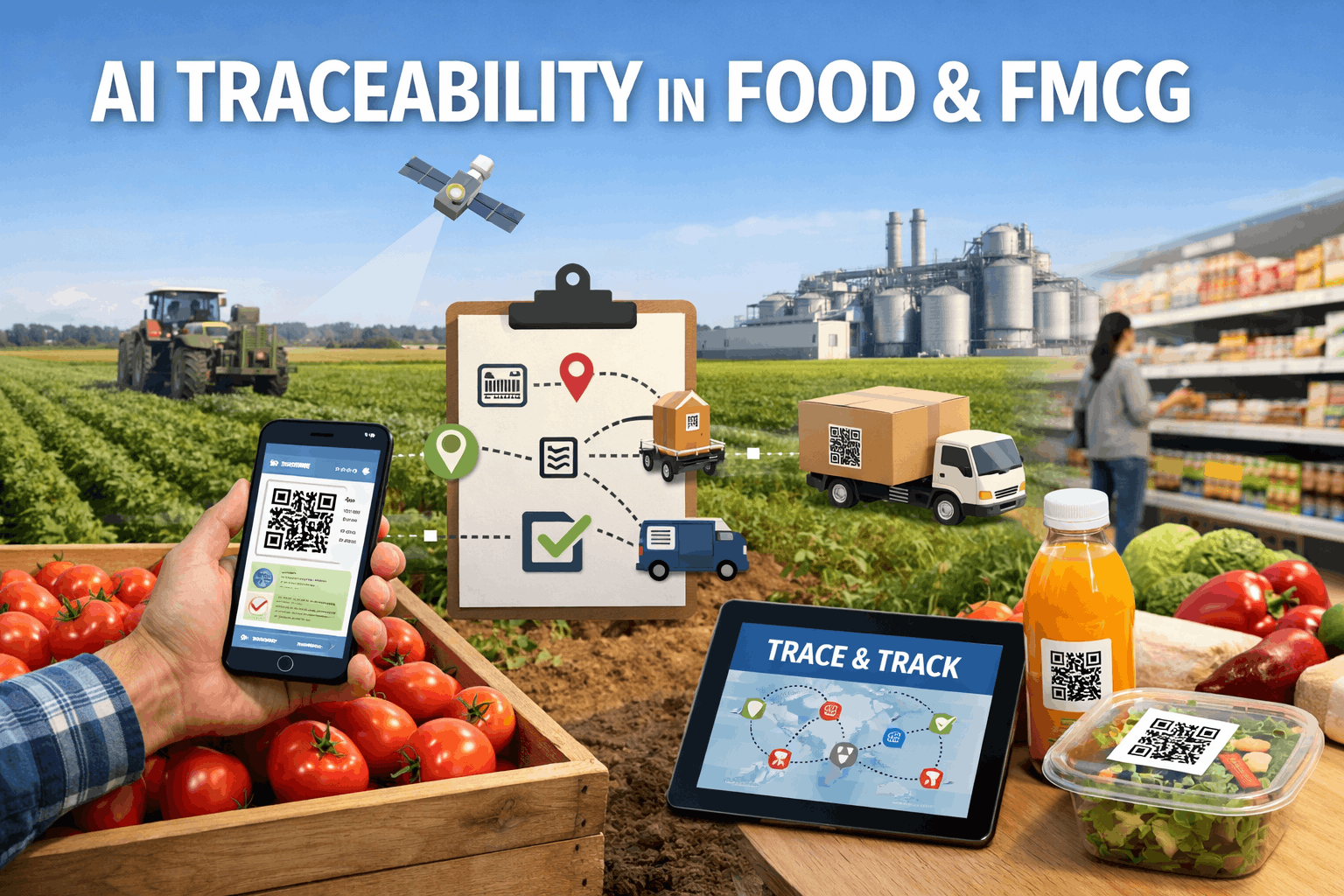
Traceability architecture isn't software—it's the systematic organization of data flows, storage systems, and integration points that enable end-to-end product tracking. In food manufacturing, this architecture connects farm-level harvest data to processing equipment logs, from packaging line records to distribution tracking systems. Every system that touches your product must speak the same language, timestamp events consistently, and link data through unique identifiers like Traceability Lot Codes (TLCs). Food manufacturers implementing OXmaint's integrated maintenance platform establish a critical component of this architecture—connecting equipment performance data to product quality outcomes so that when contamination is detected, you can trace it back to specific machinery, maintenance events, and operational conditions.
The Four-Layer Traceability Architecture
How data flows from physical assets to regulatory reports
4
Application Layer
Regulatory reporting interfaces, traceability queries, recall management dashboards. Provides FDA-compliant data exports and consumer-facing transparency tools.
Technologies: Web portals, mobile apps, QR code systems, API endpoints for supply chain partners
3
Blockchain/Data Layer
Immutable ledger storing Critical Tracking Events and Key Data Elements. Links all supply chain nodes through cryptographically secured transactions.
Collects data from sensors, equipment, and operational systems. Validates, normalizes, and routes information to permanent storage.
Technologies: RFID readers, temperature sensors, GPS trackers, CMMS platforms, ERP systems, MES software
1
Physical/Equipment Layer
Production equipment, processing lines, packaging machinery, storage facilities, transportation vehicles. Where actual food production and handling occurs.
Critical Integration Point: OXmaint operates in Layer 2, connecting equipment maintenance data to quality outcomes and feeding traceability information upward to blockchain storage and regulatory reporting systems.
Critical Tracking Events and Key Data Elements: The Regulatory Foundation
FSMA 204 doesn't leave room for interpretation. The regulation defines exactly which events must be recorded (Critical Tracking Events) and precisely what data points must be captured (Key Data Elements). For food manufacturers, this means every harvesting operation, cooling cycle, packaging run, and shipment requires specific documentation. When your cooling system fails and temperatures rise above safe thresholds, that's a CTE requiring immediate documentation. When your packaging line jams and you switch to backup equipment, those product lots need separate TLCs. Manufacturers using OXmaint to automate CTE documentation ensure that equipment-related events automatically generate the required traceability records without manual data entry.
Every CTE generates 5-12 data points that must be stored, linked, and retrievable within 24 hours. Food facilities that integrate CMMS data into traceability systems automatically capture equipment-related KDEs without additional manual documentation burden.
Build FSMA 204 Compliance Into Your Operations
OXmaint connects equipment maintenance data to food safety traceability requirements automatically. See how our platform captures Critical Tracking Events from maintenance operations and generates FDA-compliant documentation.
The Technology Stack: IoT, Blockchain, and Integration Middleware
Modern traceability architecture combines three technology categories: data capture devices, immutable storage systems, and integration platforms. IoT sensors and RFID tags capture real-time data from equipment and products. Blockchain technology creates tamper-proof records of every transaction. Integration middleware connects legacy systems to modern infrastructure. Food manufacturers don't need to implement all of this simultaneously. The most successful deployments start with integration middleware that connects existing systems—ERP, MES, CMMS—before adding IoT sensors and blockchain layers. This approach ensures data flows correctly before investing in expensive infrastructure.
Core Technology Components
IoT Sensor Networks
RFID tags for product tracking, temperature sensors for cold chain monitoring, weight sensors for portion control, GPS for transportation tracking, moisture sensors for storage conditions
Integration Value: Automatic data capture eliminates manual entry errors and provides continuous monitoring
Blockchain Ledger
Hyperledger Fabric for enterprise deployments, Ethereum smart contracts for automated compliance verification, distributed databases ensuring data immutability across supply chain nodes
Integration Value: Tamper-proof records provide audit trail for FDA inspections and recall investigations
CMMS Integration
OXmaint connects equipment maintenance schedules, work order completion, calibration records, and sanitation verification to traceability data—linking product quality outcomes to equipment conditions
Integration Value: Automatically captures equipment-related CTEs and generates maintenance-linked KDEs
ERP/MES Systems
Production scheduling, inventory management, batch tracking, recipe management, quality testing results, supplier data, customer shipping records
Integration Value: Provides business context for traceability events—linking production lots to orders and shipments
Cloud Data Platforms
Centralized data lakes aggregating information from all systems, real-time analytics dashboards, API layers enabling supply chain partner access, automated FDA report generation
Integration Value: Single source of truth for all traceability queries with 24-hour response capability
Mobile/QR Interfaces
Consumer-facing QR code scanning for product origin verification, operator mobile apps for shop floor data entry, supplier portals for KDE submission, auditor access for inspection records
Integration Value: User-friendly access to traceability data for all stakeholders without technical expertise
Building vs. Buying: Implementation Strategy
The $500,000 question: do you build a custom traceability architecture or buy integrated solutions? Most food manufacturers need both. Enterprise systems like SAP or Oracle handle business transactions but weren't designed for FSMA 204 granularity. Specialized traceability platforms understand regulatory requirements but don't connect to production equipment. The practical approach combines commercial platforms for core functionality with custom integrations for facility-specific needs. OXmaint serves as the maintenance data bridge—connecting equipment performance to traceability systems without requiring custom development on either end.
Implementation Pathways
Custom Development
Timeline: 18-24 months
Cost: $750K - $2M+
Advantages
Perfect fit for unique processes
Complete control over functionality
No ongoing licensing fees
Proprietary IP ownership
Disadvantages
Extended development timeline misses compliance deadlines
Requires in-house technical expertise
No proven regulatory compliance track record
Ongoing maintenance burden
Recommended
Hybrid Integration
Timeline: 6-12 months
Cost: $150K - $500K
Advantages
Commercial platforms for core traceability
OXmaint bridges maintenance to quality data
Proven FSMA 204 compliance templates
Faster deployment with lower risk
Considerations
Requires integration planning across systems
Annual licensing fees for platforms
Some customization still needed
Dependency on vendor support
Enterprise Suite
Timeline: 12-18 months
Cost: $500K - $1.5M
Advantages
Single vendor for entire ecosystem
Pre-integrated modules
Enterprise-grade support
Comprehensive training programs
Disadvantages
Highest total cost of ownership
Vendor lock-in limitations
Often includes unnecessary features
Complex configuration requirements
Most successful implementations combine specialized platforms: traceability software for CTE/KDE management, OXmaint for maintenance-to-quality linkage, and cloud infrastructure for data aggregation. This approach balances cost, timeline, and regulatory compliance.
The Maintenance Connection: Why CMMS Is Critical Infrastructure
Equipment failures cause contamination events. Improper sanitation leaves residue. Sensor drift produces inaccurate data. Every one of these maintenance-related issues creates traceability liabilities. When FDA investigators ask "How do you know your temperature sensors were accurate on the day this lot was processed?" you need calibration records. When contamination appears in specific production batches, you need equipment work order histories showing what machinery was serviced, when, and by whom. This is where CMMS platforms like OXmaint become mandatory infrastructure rather than nice-to-have tools.
Maintenance Data in the Traceability Chain
How equipment records connect to product safety outcomes
Completion timestamps, technician IDs, parts used, test results
→
Quality Event
Temperature deviation, contamination detection, packaging defect
→
Traceability Link
Product lot linked to equipment condition, maintenance history, sensor calibration
→
FDA Compliance
Complete audit trail from product to equipment to maintenance action
Example Scenario 1: Temperature Excursion
Refrigeration unit fails at 2:15 AM. Temperature rises from 38°F to 52°F before backup system engages. OXmaint automatically logs equipment failure, generates emergency work order, records repair completion time, and links all product lots in cold storage during the incident to the equipment failure event. FDA query returns complete timeline from sensor alert to corrective action.
Example Scenario 2: Contamination Investigation
Listeria detected in finished product batch LP-2024-1847. Investigation requires equipment history for all machinery that contacted this lot. OXmaint provides: packaging line sanitation records (completed 6:45 AM, verified by Inspector ID 284), metal detector calibration (last calibrated 3 days prior, within spec), conveyor belt replacement (new belt installed 2 weeks prior), and seal integrity test results (passed all checkpoints). Complete maintenance chain of custody documented.
Connect Maintenance to Food Safety Compliance
OXmaint automatically links equipment maintenance records to production traceability data, ensuring complete FSMA 204 compliance. See how our platform captures maintenance-related CTEs and generates the KDEs FDA requires for equipment-linked quality events.
The biggest mistake I see food manufacturers make is treating traceability as a software problem. They buy expensive blockchain platforms and IoT sensors, then can't answer basic questions like "Which equipment touched this product lot?" because their CMMS doesn't talk to their traceability system. You need data architecture, not just data storage. Every system that interacts with food production—from harvest tracking to maintenance management to shipping logistics—must feed a unified data model. OXmaint solves the maintenance integration piece that most traceability platforms ignore, creating that crucial link between equipment condition and product quality that FDA investigators specifically look for during recalls.
Start With Data Mapping
Before implementing any technology, map every data flow: where information originates, which systems transform it, where it's stored, and who needs access. This reveals integration gaps before they become compliance failures.
Unique Identifiers Are Non-Negotiable
Traceability Lot Codes must link across all systems. If your CMMS uses different equipment IDs than your MES, you can't connect maintenance events to product lots. Standardize identifiers first, then integrate systems.
Test With Mock Recalls
Don't wait for FDA inspection to discover gaps. Run quarterly mock recalls: select a random lot, set a 24-hour timer, and see if you can compile complete traceability documentation. Every failure is a gap to fix.
Frequently Asked Questions
What's the difference between traceability architecture and a traceability system?
Architecture is the blueprint—how different systems connect, where data lives, and how information flows from source to regulatory report. A traceability system is one component of that architecture, typically the database and interface where CTE/KDE records are stored and queried. Complete architecture includes IoT sensors capturing data, CMMS platforms tracking equipment, ERP systems managing inventory, blockchain ensuring immutability, and cloud platforms aggregating everything into FDA-compliant reports. OXmaint functions as the maintenance data component within this broader architecture.
How does blockchain improve food traceability compared to traditional databases?
Blockchain creates immutable, timestamped records that cannot be altered retroactively—critical for FDA audits where data integrity is questioned. Traditional databases allow records to be modified or deleted without leaving audit trails. Blockchain's distributed nature also enables supply chain partners to access verified data without trusting a central authority to maintain accuracy. For food manufacturers, this means contamination investigations can trace products across multiple companies with confidence that records haven't been tampered with. However, blockchain is only valuable when integrated with reliable data capture systems like IoT sensors and CMMS platforms that ensure accurate information enters the chain initially.
Do small food manufacturers need the same traceability architecture as large enterprises?
FSMA 204 compliance requirements are identical regardless of company size—24-hour response time, complete CTE/KDE documentation, electronic spreadsheet format. However, implementation complexity scales with operation size. Small manufacturers might achieve compliance with cloud-based traceability software integrated to a CMMS like OXmaint, without requiring blockchain or extensive IoT sensor networks. Large multi-facility enterprises need sophisticated architectures with distributed databases, real-time sensor networks, and automated integration across legacy systems. The key is ensuring whatever architecture you build can generate compliant documentation within the 24-hour FDA requirement.
How should maintenance records integrate with traceability systems for FSMA 204?
Equipment maintenance events constitute Critical Tracking Events when they impact product safety or quality. Your CMMS must link equipment IDs to product lot codes, timestamp all maintenance activities, and record which personnel performed work. Essential integrations include: calibration records for all sensors that generate KDE data (temperature, weight, moisture), sanitation completion logs that verify cleaning between product runs, equipment failure alerts that may have compromised product integrity, and preventive maintenance schedules that demonstrate equipment was operating within specifications during production. OXmaint automates these linkages, ensuring maintenance data automatically flows into traceability records without manual documentation.
What happens if our traceability architecture fails during an FDA inspection?
Failure to provide traceability records within 24 hours violates FSMA 204, classified as a prohibited act under section 301(e) of the FDCA. FDA enforcement actions escalate from inspectional findings and warning letters to product detention, import refusal, injunctions, or criminal penalties for repeated violations. Beyond regulatory consequences, recall delays caused by poor traceability extend contaminated product market exposure, increasing foodborne illness risk and liability exposure. This is why architecture redundancy is critical—cloud backups, distributed data storage, and multiple access pathways ensure you can generate reports even if primary systems fail. Regular mock recalls validate your architecture can perform under pressure.