A frozen meals manufacturer in Tennessee discovered the true cost of traceability gaps when a customer complaint about an allergen triggered a recall investigation. The quality team needed to identify every package produced from a specific ingredient lot received three weeks earlier. What should have been a 30-minute query became a 72-hour scramble across paper logbooks, disconnected spreadsheets, and handwritten batch records from four production lines. By the time they identified the affected SKUs, product had already shipped to 340 retail locations across 12 states.
The recall cost $4.2 million — but the traceability failure cost far more than the recall itself. Three major retail partners placed the manufacturer on probationary supplier status, requiring quarterly audits at $15,000 each. Insurance premiums increased 22%. And the FDA's investigation revealed that the company could not demonstrate FSMA 204 compliance for any of the 47 high-risk food products they manufactured. Schedule a consultation to assess your facility's traceability readiness before your next audit or recall event.
72 hrs
avg manual trace time
Paper and spreadsheet traceability cannot meet the speed regulators and retailers demand
$10M
avg recall cost
Direct costs plus lost sales, retailer penalties, and brand damage compound rapidly
24 hrs
FSMA 204 requirement
FDA expects key data elements within 24 hours of a trace request — not 72
56%
recalls from traceability failure
Over half of food recalls expand because companies cannot quickly define scope
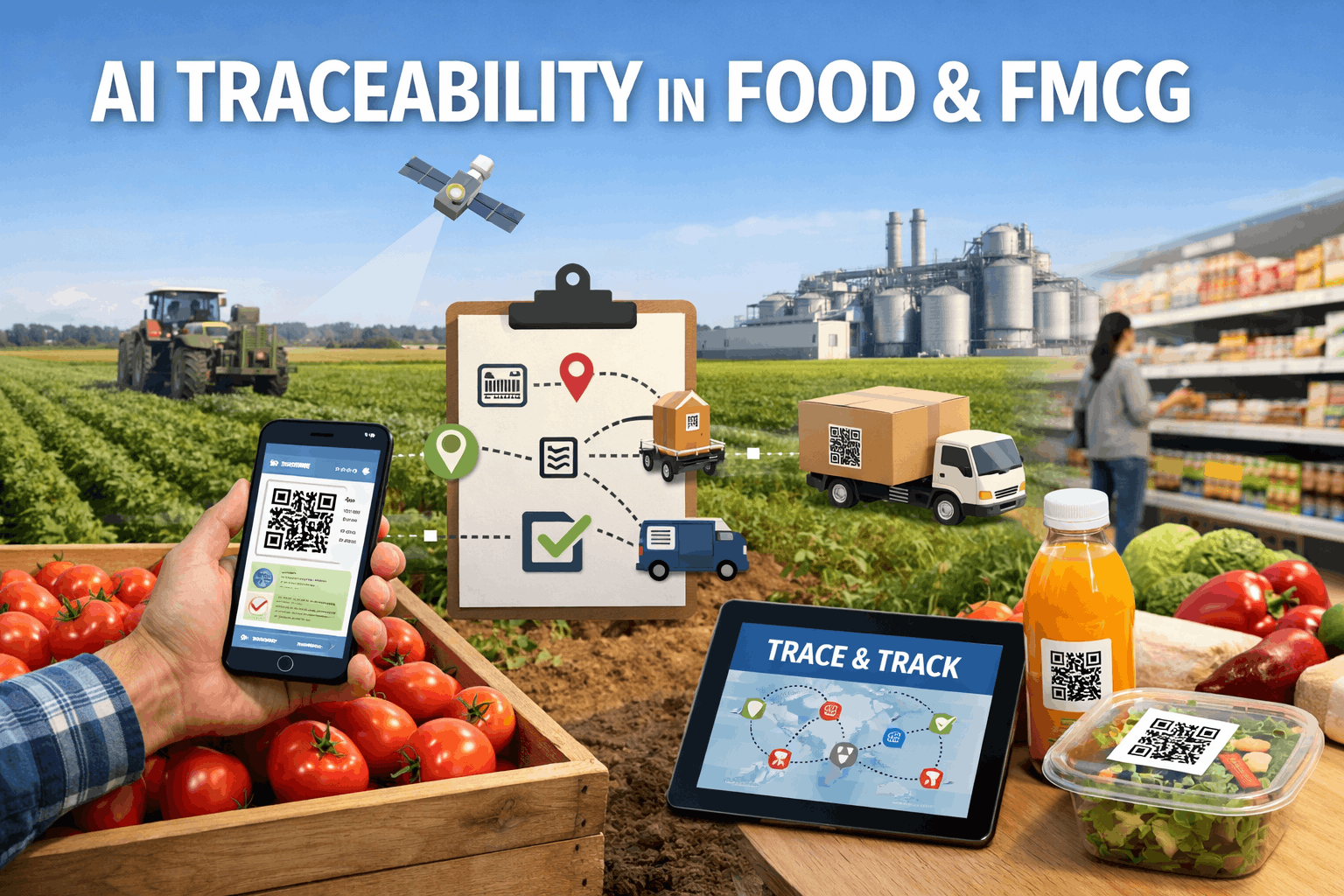
Traceability in food manufacturing is not a documentation exercise — it is the ability to answer a specific question in minutes: "Which finished products contain ingredients from this lot, and where are they now?" Every second that question goes unanswered, recall scope expands, regulatory exposure increases, and brand damage compounds.
Traditional traceability relies on humans recording lot numbers correctly on paper or spreadsheets at every transfer point. AI-powered traceability eliminates that dependency by building batch genealogy automatically from equipment data, process records, and CMMS maintenance logs — creating a digital thread from raw material receipt through finished goods shipment. Sign up for Oxmaint to connect equipment maintenance data directly to your batch traceability records.
What FSMA 204 Requires — and Why Most Plants Are Not Ready
The FDA Food Traceability Rule (FSMA Section 204) fundamentally changes traceability expectations for manufacturers handling foods on the Food Traceability List. Compliance requires maintaining Key Data Elements and Critical Tracking Events for every product — with the ability to produce records within 24 hours of an FDA request.
Key Data Elements (KDEs)
What: Traceability lot codes, quantities, locations, dates, and business identifiers for every Critical Tracking Event.
Challenge: Most plants capture some KDEs but not all — and not in a format that links events into a complete chain.
AI Solution: Automated KDE capture from equipment PLCs, scales, and scanners eliminates manual recording gaps.
Critical Tracking Events (CTEs)
What: Growing, receiving, transforming, creating, and shipping events that must be recorded with associated KDEs.
Challenge: The "transforming" CTE is where most manufacturers fail — linking input lots to output lots during production.
AI Solution: Batch genealogy built from production system data automatically links every input to every output.
Sortable Electronic Records
What: FDA requires records in electronic sortable format — not PDFs, not scanned paper, not spreadsheets with merged cells.
Challenge: Many plants still rely on paper batch records or disconnected spreadsheets that cannot be queried electronically.
AI Solution: Digital batch records with structured data fields that can be searched, filtered, and exported on demand.
24-Hour Response Capability
What: Records must be available within 24 hours of FDA request — for any product, any lot, any date range.
Challenge: Manual trace-back exercises routinely take 48–72 hours. Under audit pressure, errors multiply.
AI Solution: One-click trace queries return complete batch genealogy in minutes — forward and backward.
January 2026
FSMA 204 compliance deadline has passed. Facilities still relying on manual traceability face enforcement action with every FDA inspection.
How AI Builds Batch Genealogy Automatically
Manual batch genealogy requires operators to record which input lots went into which output lots at every production step. In practice, this recording is inconsistent, error-prone, and frequently incomplete — especially during high-speed production, changeovers, and rework scenarios.
AI-powered batch genealogy builds the input-to-output linkage automatically by correlating data from multiple sources: scale weights at ingredient dosing, PLC timestamps at mixing and filling, barcode scans at packaging, and CMMS equipment records that verify which production line processed which batch. Book a demo to see how Oxmaint connects equipment maintenance history to batch traceability data.
Raw Material Intake and Lot Assignment
Incoming ingredients scanned against purchase orders. Supplier lot codes linked to internal traceability lot codes. Certificate of Analysis data captured. Storage location recorded. AI validates completeness — flagging any shipment missing required KDEs before it enters production.
Supplier Lot Linkage
COA Capture
KDE Validation
Batch Transformation and Genealogy Building
As ingredients are dosed, mixed, and processed, AI correlates scale data, PLC batch records, and equipment line assignments to build the genealogy tree. Every input lot is linked to the output batch automatically — including partial lot usage, rework incorporation, and multi-line production splits.
Auto-Genealogy
Rework Tracking
Line Assignment
Finished Goods Lot Creation and Verification
Packaging line scanners verify date codes, lot codes, and label accuracy. AI links the finished goods lot to the production batch and all upstream ingredient lots. Checkweigher and vision system data confirm package integrity. Any packaging equipment issues logged in CMMS are correlated with the specific lots processed during that period.
Label Verification
FG Lot Linkage
Equipment Correlation
Distribution Tracking and Customer Linkage
Finished goods lots linked to shipping documents, customer purchase orders, and destination locations. AI maintains the complete chain: supplier lot → internal lot → production batch → finished goods lot → customer shipment. One-click trace returns every link in seconds.
Ship-To Tracking
Complete Chain
One-Click Trace
The Equipment–Traceability Connection: Why CMMS Data Matters
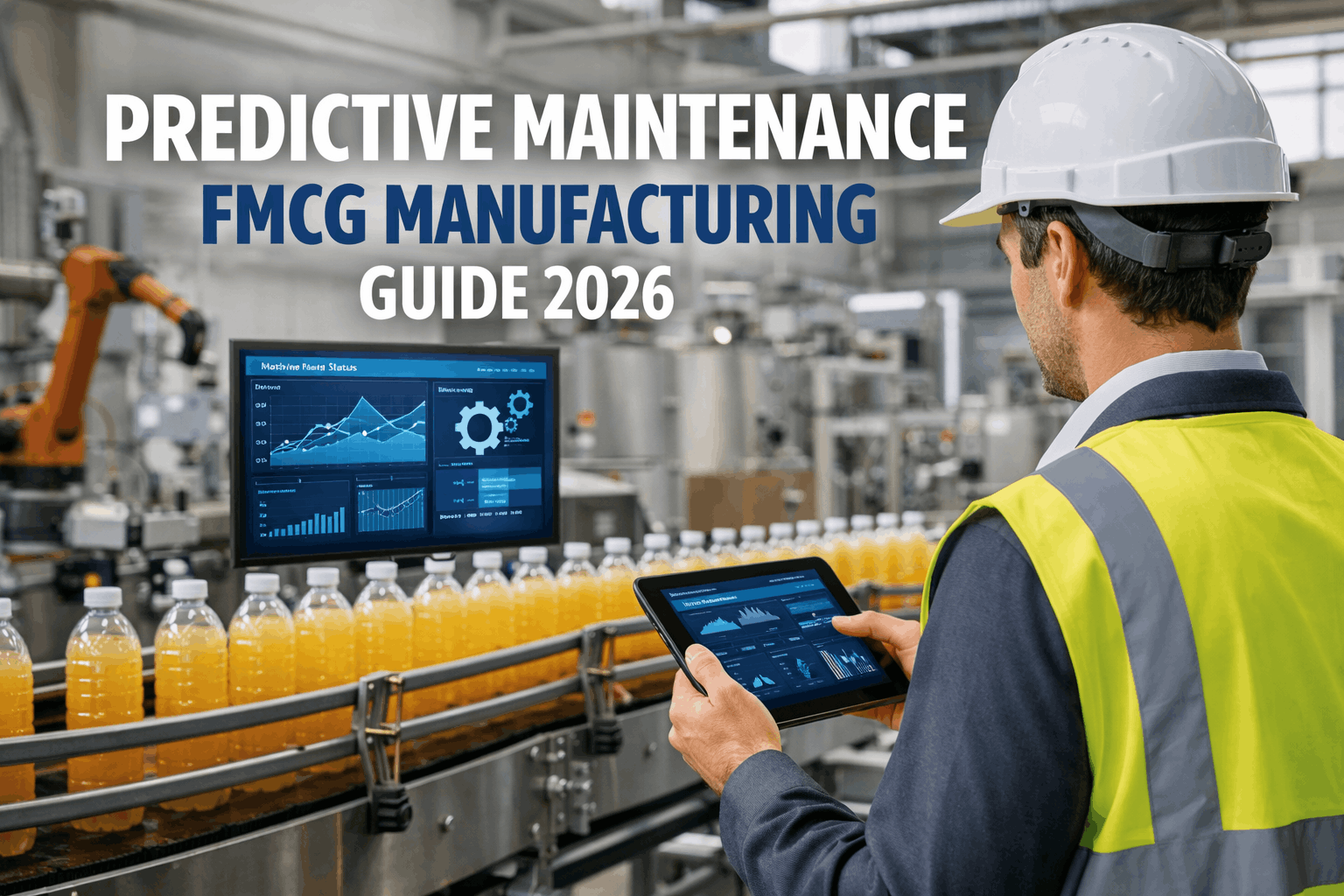
The most overlooked gap in food traceability is the connection between equipment condition and product safety. When a metal detector fails mid-shift, which lots passed through the line during the failure window? When a seal integrity tester drifts out of calibration, which packages were verified by that equipment before the deviation was caught?
AI traceability integrated with CMMS equipment data answers these questions instantly. Every maintenance event, calibration record, and equipment alarm is time-stamped and correlated with the specific production lots running on that equipment at that time. Sign up for Oxmaint to build the equipment-to-batch linkage that closes the most critical gap in food traceability systems.
Metal Detector Failure: AI identifies exactly which lots passed through Line 3 between 2:14 PM (last confirmed detection test) and 3:47 PM (failure discovered). Only those lots require hold and re-inspection — not the entire shift's production.
CCP Temperature Deviation: Pasteurizer temperature dropped below critical limit for 8 minutes. AI pinpoints the exact batch IDs in the system during that window, enabling targeted hold rather than blanket rejection.
Packaging Equipment Drift: Seal strength tester found 4% below specification during mid-shift calibration check. AI traces every package verified by that tester since last confirmed calibration, scoping the quality hold to affected lots only.
Allergen Changeover Verification: CIP system maintenance record shows shortened wash cycle on Line 2. AI identifies all products manufactured on Line 2 after the abbreviated changeover, flagging potential allergen cross-contact risk for specific lots.
Recall Simulation: Testing Before Crisis Strikes
The worst time to test your traceability system is during an actual recall. AI-powered recall simulation lets you run mock trace exercises on demand — measuring how quickly you can identify affected lots, locate them in the distribution chain, and generate the notifications required by regulators and retail partners.
| Recall Exercise Step | Manual Traceability | AI-Powered Traceability | Impact |
| Identify affected ingredient lot |
Search paper records, 2–4 hrs |
Instant query, under 30 sec |
Hours saved at most critical moment |
| Trace forward to finished goods |
Cross-reference spreadsheets, 4–8 hrs |
Auto-genealogy, under 2 min |
Recall scope defined in minutes |
| Locate product in distribution |
Call distributors manually, 6–12 hrs |
Ship-to query, under 5 min |
Targeted retrieval vs. blanket recall |
| Generate regulatory notifications |
Manual report compilation, 4–6 hrs |
Auto-generated report, under 15 min |
FDA submission within hours |
| Verify recall completeness |
Spreadsheet reconciliation, 2–3 days |
Real-time tracking dashboard |
Auditable proof of recall execution |
| Total mock recall time |
48–72 hours |
Under 4 hours |
Exceeds FSMA 204 and GFSI standards |
Regular recall simulations do more than test response speed. They identify gaps in data capture, broken links in batch genealogy, and process steps where traceability information is lost. Plants that run quarterly mock recalls consistently maintain audit-ready traceability — and avoid the catastrophic failures that occur when an untested system faces a real crisis. Schedule a consultation to discuss how Oxmaint's recall simulation capability tests your traceability system before regulators do.
4 hours
Target mock recall completion time with AI-powered traceability — from ingredient lot identification through distribution location and regulatory notification
Implementation: Building AI Traceability in Your Plant
Deploying AI traceability builds on existing production data infrastructure. Most food manufacturing plants already capture the raw data AI needs — the challenge is connecting disconnected systems into a unified batch genealogy. Implementation follows a phased approach that delivers compliance value at each stage rather than requiring a complete system overhaul before producing any benefit.
Data Audit and Gap Analysis
Map every traceability data source — receiving logs, production batch records, packaging line data, shipping documents, CMMS equipment records. Identify where KDEs are captured, where they are missing, and where data exists but is not linked to batch genealogy.
KDE Gap Map
Data Source Inventory
Linkage Assessment
System Integration and Genealogy Configuration
Connect production data sources to AI traceability platform. Configure batch genealogy rules for each product type — ingredient-to-batch, batch-to-finished-goods, finished-goods-to-shipment. Integrate CMMS equipment data for equipment-to-lot correlation.
Data Integration
Genealogy Rules
CMMS Linkage
Validation and Mock Recall Testing
Run mock trace exercises on historical production data to validate genealogy accuracy. Test forward and backward traces across multiple product types. Verify equipment-to-lot correlation for maintenance events. Calibrate AI anomaly detection for missing or inconsistent traceability data.
Mock Recall Pass
Genealogy Validation
Anomaly Tuning
Go-Live and Continuous Monitoring
Full AI traceability operational across all production lines. Real-time KDE completeness monitoring alerts when traceability data is missing or inconsistent. Automated FSMA 204 reporting capability active. Quarterly mock recall schedule established for ongoing validation.
Full Go-Live
KDE Monitoring
FSMA 204 Ready
Frequently Asked Questions
Does FSMA 204 apply to our products?
FSMA 204 applies to foods on the FDA's Food Traceability List, which includes fresh produce, certain cheeses, ready-to-eat deli salads, nut butters, fresh herbs, shell eggs, and specific seafood products. If your facility manufactures, processes, packs, or holds any FTL food, you are subject to the additional traceability recordkeeping requirements. Even if your primary products are not on the list, co-manufactured or private label products may trigger compliance obligations.
How does AI traceability handle rework and partial lot usage?
Rework is the most common point where manual traceability breaks down. AI handles rework by tracking the reworked material as a distinct traceability lot linked to its original batch. When rework is incorporated into a new production batch, the genealogy tree automatically includes both the new ingredients and the rework origin — maintaining the complete chain even through multiple rework cycles. Partial lot usage is tracked through scale integration data that records exactly how much of each lot entered each batch.
What happens when traceability data is missing or inconsistent?
AI monitoring continuously validates traceability data completeness. When a batch record is missing a supplier lot linkage, a production step lacks ingredient lot documentation, or shipping data does not connect to finished goods lots, the system generates real-time alerts. Quality teams can address gaps during production rather than discovering them during an audit or recall investigation weeks later.
How does equipment maintenance data improve traceability?
Equipment maintenance records provide time-stamped evidence of equipment condition during production. When a food safety device fails — metal detector, CCP monitor, seal integrity tester — CMMS records identify the exact failure window. AI correlates that window with production batch data to identify which lots were processed during the equipment issue, enabling targeted holds rather than blanket rejections that waste product and capacity.
Can AI traceability integrate with our existing ERP and quality systems?
Yes. AI traceability platforms connect to existing ERP systems for purchase orders and shipping data, quality management systems for inspection records and hold/release decisions, production control systems for batch records and line assignments, and CMMS platforms like Oxmaint for equipment maintenance correlation. The goal is not to replace existing systems but to connect them into a unified traceability chain that no single system provides alone.
Build the Traceability System That Works When It Matters
Recalls do not wait for your traceability system to be ready. FSMA 204 compliance deadlines have passed. Retailer audit expectations increase every year. Build the AI-powered batch genealogy that traces any ingredient to any finished product to any customer in minutes — and connect every trace to the equipment condition data that closes the most critical safety gaps.