Integrating Robotic Vision with Traceability for FMCG Food Safety
By Oxmaint on February 21, 2026
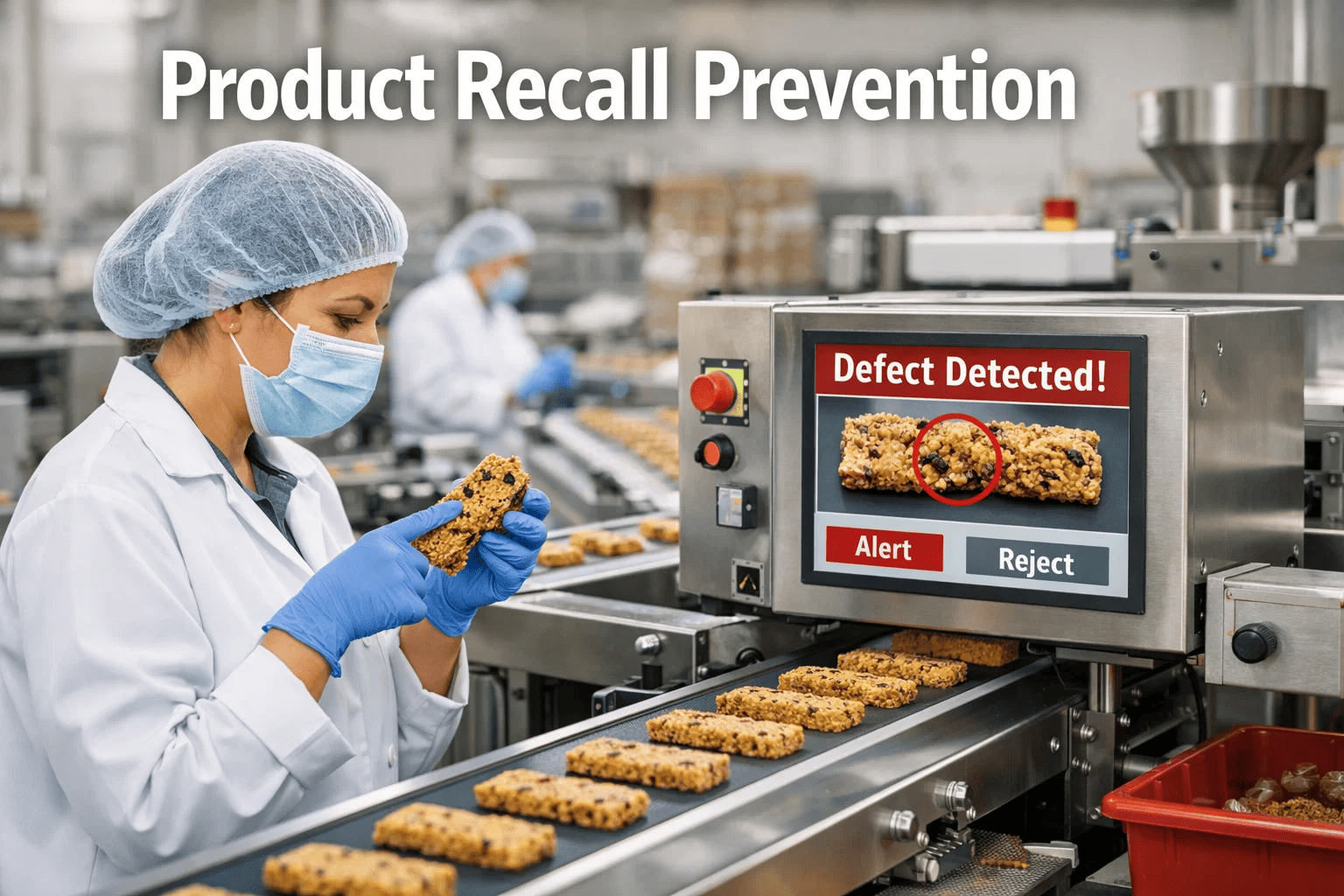
In March 2024, a frozen meal manufacturer recalled 8.7 million pounds of product after a vision system at a co-packer flagged a label mismatch — undeclared milk protein on a "dairy-free" SKU — but the finding never connected to the traceability system. The lot had already shipped to 14 distribution centers across three countries before a consumer reaction report triggered the recall. Total cost: $34 million in destroyed product, logistics, legal fees, and brand damage. The root cause was not a vision system failure. The camera caught the defect on line 4 at 2:47 AM. The failure was a traceability gap: vision inspection data and lot tracking lived in separate systems with no automated link between them. Robotic vision integrated with traceability platforms eliminates this gap — every inspection event is tied to a specific lot, case, and pallet in real time, and when a defect is confirmed, the affected scope is identified in seconds instead of days. Schedule a demo to see how Oxmaint connects robotic vision findings to lot-level traceability and recall workflows.
Why Vision and Traceability Must Be Connected
FMCG food manufacturers invest heavily in both robotic vision inspection and traceability systems — but most operate them as parallel, disconnected platforms. Vision systems catch defects. Traceability systems track lots. When these two data streams do not talk to each other, the result is a dangerous blind spot: you know something went wrong, but you cannot instantly determine which lots, cases, and pallets are affected. That blind spot turns a containable quality event into a full-scale recall.
$34M
Average cost of a major FMCG food recall including destroyed product, logistics, legal, and brand damage
72 hrs
Average time to determine recall scope when vision and traceability systems operate independently
<15 min
Time to identify affected lots when robotic vision is integrated with real-time traceability platforms
Sign up for Oxmaint in under 2 minutes. Get instant access to traceability-linked inspection logs, recall workflows, and audit-ready compliance records for your entire production operation.
What Robotic Vision Systems Inspect in FMCG Food Production
Modern robotic vision platforms inspect at line speed — 200 to 1,200 units per minute depending on format — using combinations of 2D cameras, 3D depth sensors, hyperspectral imaging, and AI classification models. Each inspection type generates data that becomes exponentially more valuable when linked to the lot and batch flowing through the line at that moment.
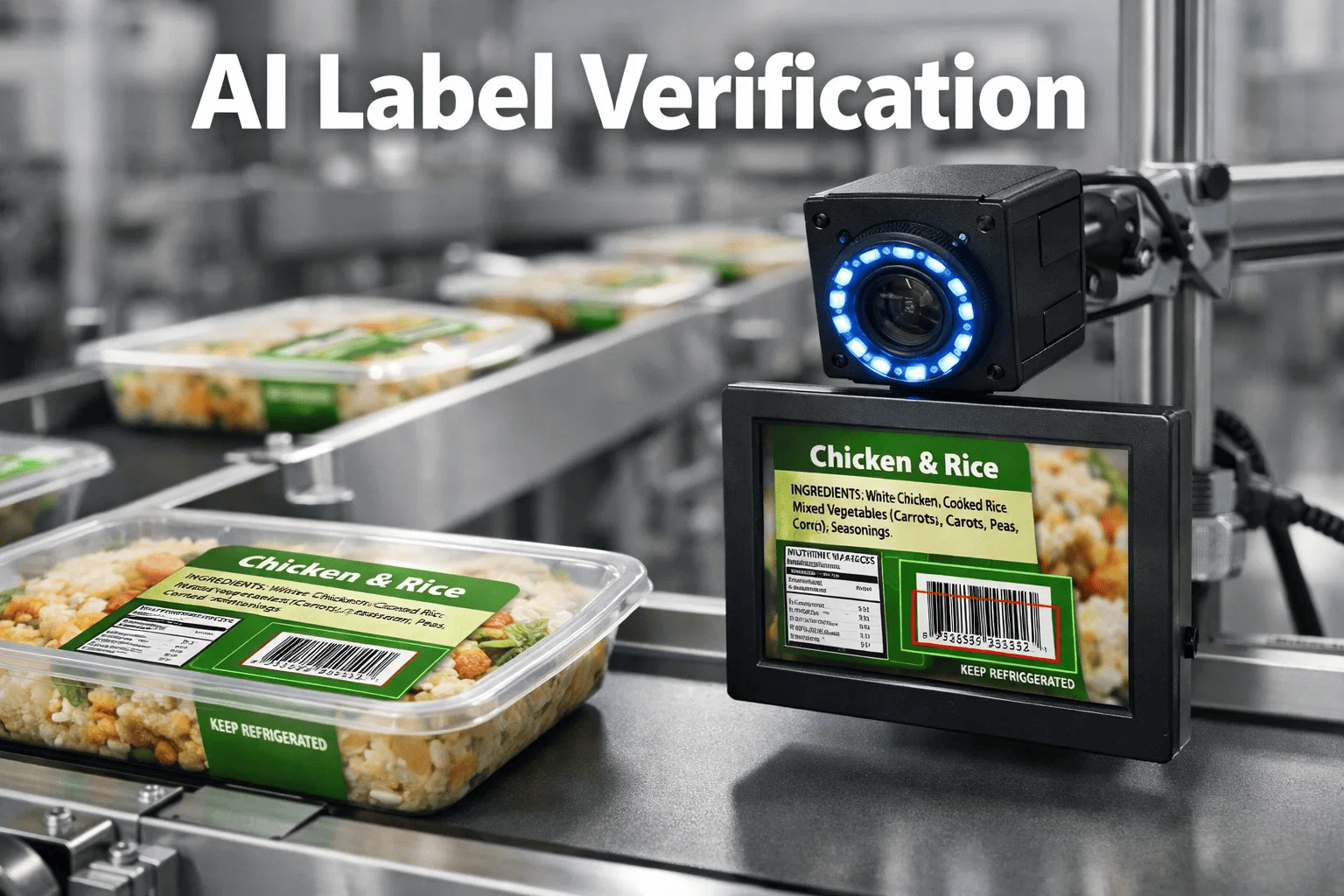
Label Verification — Text, Allergen, Barcode
OCR reads ingredient lists, allergen declarations, nutrition panels, date codes, and regulatory text against the master specification for the active SKU. Barcode and QR verification confirms the correct GTIN is printed and scannable. Mismatches trigger immediate rejection and lot-level flagging in the traceability system.
Foreign Object Detection — X-ray & Hyperspectral
X-ray systems detect metal, glass, stone, bone, and dense plastic contaminants as small as 0.8mm. Hyperspectral cameras identify organic foreign matter — wood, insects, mold — invisible to standard cameras. Every detection event links to the specific case and lot for targeted containment rather than broad-scope recalls.
Package Integrity — Seal, Fill, Closure
3D depth cameras and pressure-decay sensors verify seal completeness, fill level accuracy, cap torque compliance, and package dimensional conformance. Compromised seals expose product to contamination — linking seal failures to lot numbers enables targeted holds instead of warehouse-wide quarantines.
Product Appearance — Color, Shape, Surface
AI-trained classifiers evaluate product color uniformity, shape consistency, surface defects, and portion accuracy against golden-sample references. Appearance deviations that correlate with process drift — burned edges, under-filled portions, discoloration — trigger process investigation work orders linked to the production batch.
How Vision Data Connects to Lot-Level Traceability
The integration architecture between robotic vision and traceability platforms follows a specific data flow — from camera trigger to lot record — that must execute in real time at line speed. Without this connection, vision inspection is quality control. With it, vision inspection becomes a traceability event that strengthens your entire food safety program. Oxmaint logs every vision event against lot and asset records — Sign Up Free.
1
Product Scanning at Line Speed
Robotic vision cameras capture inspection data for every unit passing through the station — label content, barcode data, package integrity, foreign object screening, and appearance classification. Each inspection event generates a structured data packet containing pass/fail status, defect type, confidence score, and a timestamped image.
2
Real-Time Lot Association
The vision system reads the barcode or RFID tag on each unit and cross-references it against the active production order in the MES or ERP system. This links every inspection result to the specific lot number, batch code, production line, shift, and time window — creating a unit-level or case-level inspection record within the lot genealogy.
3
Defect Aggregation and Pattern Detection
Oxmaint aggregates vision rejection data by lot, line, time window, and defect type. When rejection rates exceed configurable thresholds — for example, label mismatches exceeding 0.5% of a lot or three consecutive foreign object detections within 10 minutes — the system escalates from unit-level rejection to lot-level investigation.
4
Automated Hold, Recall Scope, and Audit Trail
When a lot-level hold is triggered, Oxmaint identifies every case and pallet associated with the affected production window, flags their warehouse locations or shipment status, and generates the documentation required for regulatory notification. The complete chain — from camera image to lot hold to disposition decision — is stored as an auditable record.
See the full vision-to-traceability pipeline in action. Our team will walk you through how Oxmaint processes robotic vision findings into lot-level holds, recall scoping, and audit-ready compliance records.
Traceability Data Points That Vision Systems Generate
Every robotic vision inspection event produces structured data that enriches your traceability records far beyond what manual QC sampling provides. The difference is coverage: manual sampling inspects 1-3% of production. Robotic vision inspects 100% — and every result attaches to the lot record. For facilities building audit-ready traceability programs, Oxmaint links vision data to lot records automatically — Book a Demo.
Label Accuracy Record per LotEvery unit's label is verified against the master SKU specification. The traceability record for each lot includes the percentage of units passing label verification, any mismatches detected, and photographic evidence of defects — proving to auditors that 100% of production was inspected, not sampled.
Foreign Object Screening Certificate per BatchX-ray and hyperspectral screening results for every unit in the batch. The traceability record confirms that 100% of production passed foreign object detection at the specified sensitivity threshold. Retailers and food service customers increasingly require this documentation as a condition of supply.
Seal Integrity Verification per CasePackage seal status for every unit — verified by pressure decay, vacuum level, or 3D surface scan. Failed seals are rejected and logged with defect images. The lot record shows exactly how many units were rejected, when, and the disposition of each rejected unit.
Vision System Calibration and PM RecordsOxmaint tracks camera calibration schedules, lens cleaning intervals, lighting system replacements, and AI model version history as preventive maintenance work orders. Auditors can verify that the vision system was properly maintained and calibrated during the production of any specific lot.
Process Deviation CorrelationWhen vision rejection rates spike on a specific defect type, Oxmaint correlates the timing against process parameters — temperature logs, equipment alarms, changeover events — to identify the root cause. This links quality deviations to specific equipment conditions, strengthening both traceability and CAPA documentation.
Recall Scope Reduction: The Business Case for Integration
The financial argument for integrating vision with traceability is not about catching more defects — your vision system already does that. It is about knowing exactly which product is affected when a defect is found, so you can contain the problem to the smallest possible scope instead of recalling entire production days or weeks. Oxmaint narrows recall scope from days to minutes — Sign Up Free.
93%
Scope Reduction
Recall scope narrowed from entire production days to specific lots and time windows when vision is linked to traceability
<15 min
Scope Identification
Time to determine affected lots, cases, and pallets — down from 48-72 hours with disconnected systems
100%
Inspection Coverage
Every unit inspected and linked to lot record — vs. 1-3% manual sampling that leaves 97% of production unverified
$34M
Avg. Recall Cost
Average cost of a major FMCG food recall — the majority driven by scope uncertainty, not the defect itself
24 hrs
FSMA 204 Deadline
FDA Food Safety Modernization Act requires key data elements available within 24 hours — impossible without integrated systems
4 min
Audit Report
Time to generate a complete traceability report with vision inspection evidence in Oxmaint — vs. hours compiling manual records
Create your free Oxmaint account and start linking vision to traceability. Register every vision station, inspection line, and production asset — then let defect findings generate lot-level holds and audit trails automatically.
The difference between operating vision and traceability as separate systems versus an integrated platform is the difference between knowing something went wrong and knowing exactly where the affected product is right now.
Disconnected Systems
Vision catches defect but lot association requires manual cross-referencing of timestamps
Recall scope determined by production day — entire shifts quarantined for a single defect event
Audit evidence compiled manually from separate vision and traceability databases
Vision system maintenance not tracked against production lot integrity
FSMA 204 compliance requires days of manual data assembly
48-72 hrs to determine recall scope
Vision + Traceability + Oxmaint
Every inspection result auto-linked to lot, case, pallet, and shipment in real time
Recall scope narrowed to specific time windows — 93% smaller than day-level holds
Complete audit trail generated automatically from camera image to lot disposition
Vision system PM and calibration tracked as CMMS assets linked to lot validity
FSMA 204 key data elements available within minutes of request
<15 min to determine recall scope
Turn Every Vision Inspection into a Traceability Event
Oxmaint connects your robotic vision systems to lot-level traceability records — so every label check, foreign object scan, and seal verification becomes part of the product's auditable history. When a defect surfaces, you know exactly which lots are affected in minutes, not days.
Integrating robotic vision with traceability is not a rip-and-replace project. Most FMCG manufacturers already have both systems — the work is connecting them through a CMMS layer that links inspection events to lot records and automates the response workflow. Schedule a demo to get a roadmap tailored to your existing vision and traceability infrastructure.
Weeks 1-3
Vision & Traceability Audit
Map every vision inspection station, the data it generates, and the format it outputs. Map your traceability system's lot structure, case serialization method, and pallet aggregation logic. Identify the integration gaps — where vision data currently stops and traceability data begins.
Weeks 3-6
CMMS Configuration & API Connection
Register every vision system as a maintained asset in Oxmaint with calibration schedules and PM work orders. Configure API connections between vision output, traceability platform, and CMMS. Define threshold rules for escalation from unit-level rejection to lot-level investigation.
Weeks 6-9
Pilot Line Activation & Mock Recall
Go live on one production line with full vision-to-traceability integration. Run a mock recall exercise to validate that the system can identify affected lots within 15 minutes of a triggered event. Tune escalation thresholds based on actual production data.
Weeks 9-12+
Scale Across Lines & Continuous Improvement
Expand integration to all production lines. Build retailer-facing traceability reports with vision inspection evidence. Refine AI classification models based on accumulated defect data. Develop FSMA 204 compliance documentation from integrated records.
Best Practices for Vision-Traceability Integration
Successful integration programs share common design principles that separate facilities with audit-ready traceability from those with disconnected databases and manual workarounds.
01
Link Every Camera to a Maintained Asset in the CMMS
Vision systems that drift out of calibration produce unreliable traceability data. Track camera calibration, lens cleaning, lighting replacement, and AI model updates as preventive maintenance work orders in Oxmaint. An unverified vision system undermines the integrity of every lot it inspected.
02
Define Escalation Thresholds Before Go-Live
Not every rejected unit warrants a lot hold. Configure multi-level escalation: single-unit rejection triggers automatic divert, cluster rejection (3+ defects in 10 minutes) triggers line-level investigation, and threshold breach (defect rate exceeds 0.5% of lot) triggers lot hold with full traceability lockdown.
03
Run Mock Recalls Quarterly Using Vision-Triggered Scenarios
Standard mock recalls test traceability from lot number to customer. Vision-integrated mock recalls start from a camera detection event and test the entire chain — defect identification, lot association, scope determination, warehouse hold, and regulatory notification — within your target 15-minute window.
04
Store Vision Evidence With the Lot Record, Not Just the Camera Server
Defect images on a vision system hard drive are useless during an audit if the auditor cannot link them to the specific lot under review. Push defect images, rejection timestamps, and confidence scores to the traceability record in Oxmaint so every lot carries its own inspection evidence.
Our vision systems were catching defects. Our traceability system was tracking lots. But when we had an allergen labeling event on a Tuesday night shift, it took our quality team 52 hours to determine which pallets were affected because they had to manually cross-reference timestamps between two databases. After integrating through the CMMS, our last mock recall identified the affected scope in 11 minutes. That is not an incremental improvement — it is the difference between a targeted hold and a warehouse-wide quarantine.
— VP Quality & Food Safety, Top 10 North American Frozen Foods Manufacturer
Your Vision Systems Inspect Every Unit. Your Traceability Should Know.
Oxmaint connects robotic vision inspection data to lot-level traceability records, automates recall scoping from camera event to affected-product identification, tracks vision system maintenance as critical quality infrastructure, and builds the audit documentation that FDA, GFSI, and retailer auditors require.
Does Oxmaint replace our existing vision system or traceability platform?
No. Oxmaint is not a vision system or a traceability platform — it is the CMMS layer that connects them. Your existing vision systems (Cognex, Keyence, SICK, Mettler-Toledo, or others) continue to perform inspections. Your existing traceability platform (SAP, Oracle, TraceGains, or others) continues to manage lot genealogy. Oxmaint sits between them, linking inspection events to lot records, automating hold and recall workflows, tracking vision system maintenance, and generating the audit documentation that proves the entire chain is working.
How does this integration support FSMA 204 compliance?
FSMA 204 (Food Traceability Rule) requires manufacturers to maintain Key Data Elements (KDEs) for Critical Tracking Events (CTEs) and provide them within 24 hours of an FDA request. Integrated vision-traceability through Oxmaint auto-populates many of these KDEs — lot codes, inspection results, transformation events, shipping records — in real time. When a request comes, the data is already structured and retrievable in minutes rather than requiring days of manual compilation across disconnected systems.
What vision system brands and data formats does Oxmaint support?
Oxmaint integrates with any vision system that outputs structured data via REST API, OPC UA, database export, or CSV file transfer. This covers major platforms including Cognex In-Sight and DataMan series, Keyence CV-X and XG-X series, SICK Inspector and AppSpace platforms, Mettler-Toledo Safeline and CI-Vision systems, and Eagle Product Inspection x-ray units. The integration maps vision output fields to Oxmaint's traceability record structure during configuration.
How much does integration typically cost, and what is the ROI timeline?
Integration costs depend on the number of vision stations, the complexity of your traceability architecture, and whether API endpoints already exist on your vision systems. A typical single-line pilot runs $15,000-$40,000 for configuration, API development, and validation. ROI is driven primarily by recall scope reduction — if a single recall event is narrowed from an entire production week to a specific 4-hour lot window, the cost savings in destroyed product alone typically exceed the integration investment by 10-50x.
Can this approach work for co-packed or contract-manufactured products?
Yes, and this is where the integration provides the most value. Co-packing relationships frequently suffer from traceability gaps at handoff points. When the co-packer's vision systems feed inspection data into a shared Oxmaint instance linked to the brand owner's traceability records, both parties have visibility into inspection results and lot-level quality status. The brand owner can verify that 100% inspection occurred on their products without relying on co-packer self-reporting.