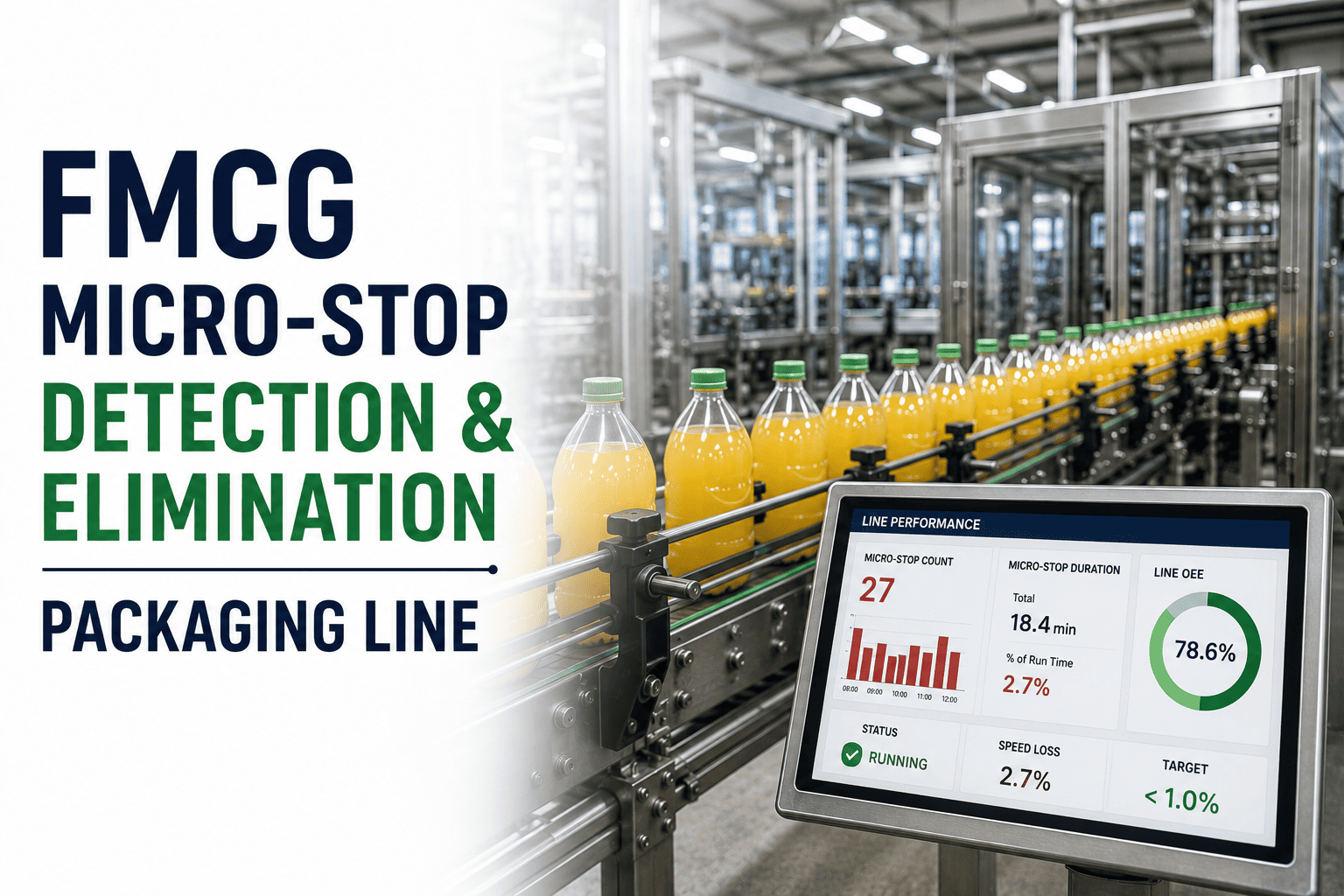
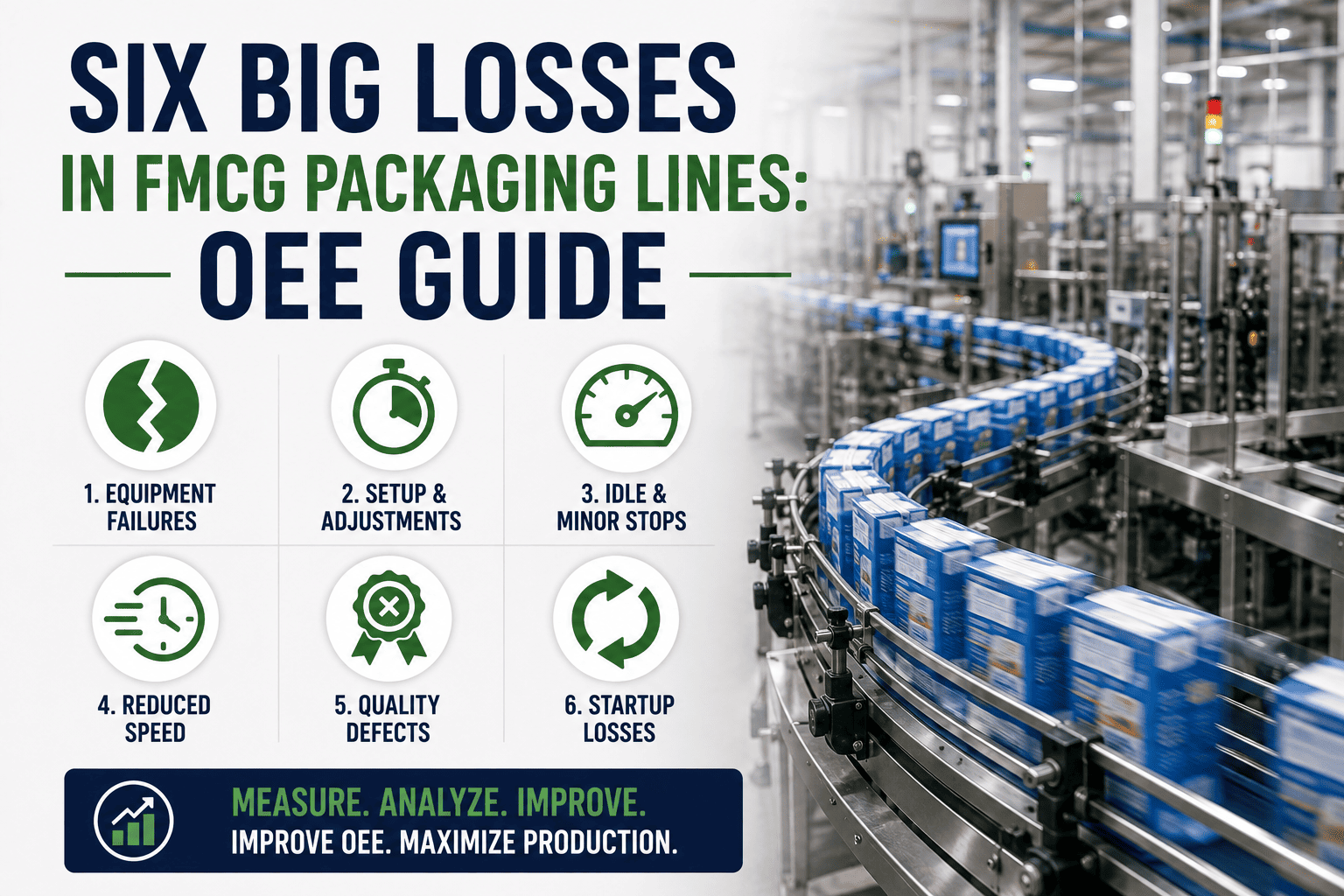
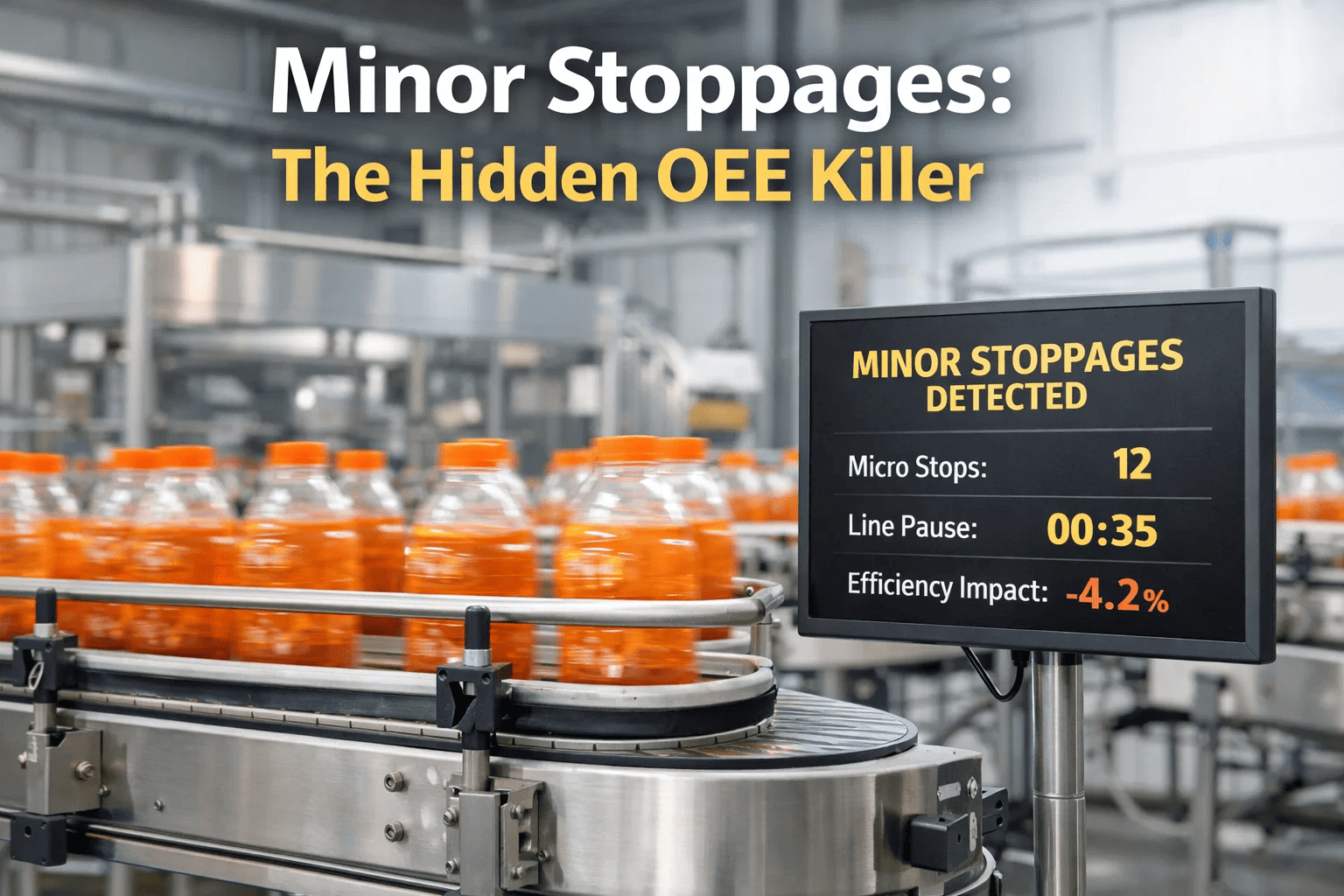
A snack food packaging plant running 5 lines at 200 packs per minute tracked zero downtime events on Line 3 last Tuesday — the OEE system reported 100% availability for the shift. Yet actual output was 18% below theoretical capacity. The missing 18% was not caused by a single recorded breakdown. It was consumed by 147 minor stoppages averaging 22 seconds each — a label misfeed here, a product jam at the infeed there, a sensor trip that cleared itself after the operator pressed restart. Each event was too short to log, too brief to investigate, and too small to notice individually. Collectively, they consumed 54 minutes of the 8-hour shift — more than most major breakdowns. This is the hidden OEE killer: minor stoppages of 10–120 seconds that fall below the recording threshold of manual tracking systems and OEE platforms configured to ignore events shorter than 2–5 minutes. They are invisible in your data, visible only in the gap between theoretical and actual output — and they are recoverable. Start your free trial to automatically track every stoppage down to 1 second. Book a demo to see OxMaint's Downtime Tracking and Root Cause Analysis module capturing the stoppages your current system misses.
Downtime Tracking & Root Cause Analysis
147 Stoppages. 54 Lost Minutes. Zero Logged Events. Until Now.
OxMaint captures every stoppage — from 1-second sensor trips to 4-hour breakdowns — with automatic duration logging, location tagging, and root cause categorization. The stoppages your operators never report become the improvement opportunities your engineers act on.
10–20%
of FMCG packaging line capacity hidden in minor stoppages that nobody tracks
80–200
minor stoppages per shift on a typical packaging line — invisible to manual logging
$150K–$400K
annual production value recoverable per line by eliminating top minor stoppage causes
Why Minor Stoppages Are Worse Than Breakdowns
A major breakdown is visible, urgent, and investigated. A 2-hour filler failure gets a root cause analysis, a corrective action, and a parts order. A 15-second label jam gets a button press. The breakdown happens once. The label jam happens 40 times per shift — consuming the same total time but generating zero data, zero investigation, and zero corrective action. This is why minor stoppages collectively cause more production loss than major breakdowns in most FMCG packaging operations.
Major Breakdowns
Events per shift0.3–1
Avg duration25–120 min
Total time lost25–60 min/shift
Logged?Always
Root cause done?Usually
Corrective action?Yes
VS
Minor Stoppages
Events per shift80–200
Avg duration10–45 sec
Total time lost40–90 min/shift
Logged?Never
Root cause done?Never
Corrective action?Never
The mathematics are stark. A line running 200 packs per minute that experiences 150 minor stoppages averaging 20 seconds each loses 50 minutes per shift — 3,000 packs of output. That is 9,000 packs per day across three shifts, 2.34 million packs per year — from a single line, from events that appear in no report because each individual stoppage is "too short to matter."
The Seven Most Common Minor Stoppages on FMCG Packaging Lines
Minor stoppages are not random. They cluster around specific failure points in the packaging process — and the top 3 causes typically account for 60–70% of all minor stoppage time. Identifying and eliminating these top causes is where the ROI concentrates.
Notice that every root cause in the table is a maintenance item — not an operator error. Guide rail alignment, sensor calibration, roller replacement, suction cup wear, and temperature drift are all PM tasks. Minor stoppages are not "just how the line runs" — they are the visible symptom of maintenance gaps that have become so normalized that nobody questions them.
Automatic Root Cause Categorization
Stop Counting Stoppages. Start Categorizing Them. Then Eliminate the Top 3.
OxMaint auto-categorizes every stoppage by location, duration, and cause type — building the Pareto chart that shows your engineering team exactly where to focus for maximum recovery.
How to Measure What Nobody Tracks: Automated Stoppage Detection
Manual logging cannot capture minor stoppages — a technician cannot record 150 events per shift that last 10–30 seconds each while also operating the line. The only way to make minor stoppages visible is automated detection at the machine level, where every start and stop is captured with millisecond precision.
PLC Signal Logging
Most packaging machines already generate a run/stop signal from the PLC. Connecting this signal to a data logger or SCADA historian captures every stoppage automatically — including duration, timestamp, and which zone triggered the stop. This costs nothing in hardware; it requires only PLC configuration and a data destination.
Captures: every stop event with zone identification and duration
Retrofit Sensors on Older Equipment
For machines without accessible PLC signals: a photoelectric sensor on the outfeed conveyor detects product flow. When product stops flowing, the system logs a stoppage. Add a current sensor on the main drive motor — current drop to zero indicates a full stop vs a speed reduction. Total per-machine cost: $150–$400.
Captures: stop events by flow interruption, no PLC access needed
Smart Counter + Edge Gateway
A product counter at the outfeed counts every unit produced. An edge gateway compares actual count vs theoretical count at 1-minute intervals. Any gap between theoretical and actual is a minor stoppage or speed loss — automatically categorized and logged with timestamp, duration, and magnitude without any operator input.
Captures: both full stops and speed reductions, with precise loss quantification
The Pareto: Focus on the Top 3 and Recover 60–70% of Hidden Capacity
Once minor stoppages are captured automatically, the data reveals a classic Pareto distribution: 3–4 causes account for 60–70% of all minor stoppage time. Eliminating or reducing these top causes recovers the majority of hidden capacity without touching the other 30+ stoppage types.
1
Product jam at infeed
18 min
33%
2
Label misfeed
12 min
22%
3
Photoeye false trip
8 min
15%
4
Carton erection failure
5 min
9%
6–12
All other causes combined
7 min
14%
The corrective actions for the top 3 are almost always simple, low-cost maintenance tasks: guide rail realignment (30 minutes, zero parts), label roller replacement ($40 part, 15-minute swap), and photoeye cleaning plus recalibration (10 minutes per sensor). The total cost to address the top 3 causes is typically under $500 — recovering $150K–$300K in annual production value per line. The only barrier is visibility: without automated tracking, these causes are invisible in the data.
The ROI: What Eliminating Minor Stoppages Recovers
Recovered production output
$280K/yr
Reduced scrap from jams
$68K/yr
Operator productivity gain
$48K/yr
OEE Performance improvement
$38K/yr
Automated tracking + sensor cost (per line)$1,500
Annual value recovered (per line)$434K
289x ROI — The Cheapest, Highest-Return Improvement Available on Any Packaging Line
The ROI is extraordinary because the investment is trivial. PLC signal logging costs zero hardware. Retrofit sensors cost $150–$400 per machine. The corrective actions are standard PM tasks. The value recovered — $434K per line per year — comes from production capacity that already exists but has been invisible. You are not buying new capacity. You are uncovering capacity your line already has but cannot use because 150 minor stoppages per shift consume it in 10–30 second increments that nobody sees.
Implementation: 30-Day Minor Stoppage Elimination Programme
Week 1
Deploy Automated Stoppage Detection on Pilot Line
Connect PLC run/stop signals to data logger or install retrofit sensors. Configure stoppage capture threshold at 3 seconds (catches everything meaningful, ignores normal cycle gaps). Begin collecting data with automatic timestamp, duration, and zone logging. Zero manual input required from operators.
Week 2
Build the Pareto — Identify Top 3 Causes
After 5 operating days, generate the Pareto chart from captured data. Identify the top 3 stoppage causes by total time lost. Assign each to a root cause category (maintenance, material, operator, design). For the top 3 maintenance-related causes, create corrective work orders in CMMS.
Week 3
Execute Corrective Actions on Top 3
Fix the top 3 causes: realign guide rails, replace worn rollers, recalibrate sensors, adjust tension systems. Add each corrective action to the recurring PM schedule so the fix is permanent. Continue automated data collection to measure improvement against baseline.
Week 4
Measure, Report, and Expand
Compare Week 4 stoppage data to Week 1 baseline. Calculate recovered minutes, recovered output, and dollar value. Present results to plant leadership. Expand automated tracking to remaining lines. Establish weekly minor stoppage review meeting — 15 minutes, data-driven, targeting the current top 3 causes each week.
Frequently Asked Questions
Downtime Tracking & Root Cause Analysis
Every Stoppage Captured. Every Cause Categorized. Every Hidden Minute Recovered.
10–20%
hidden capacity recovered
30 Days
to measurable results