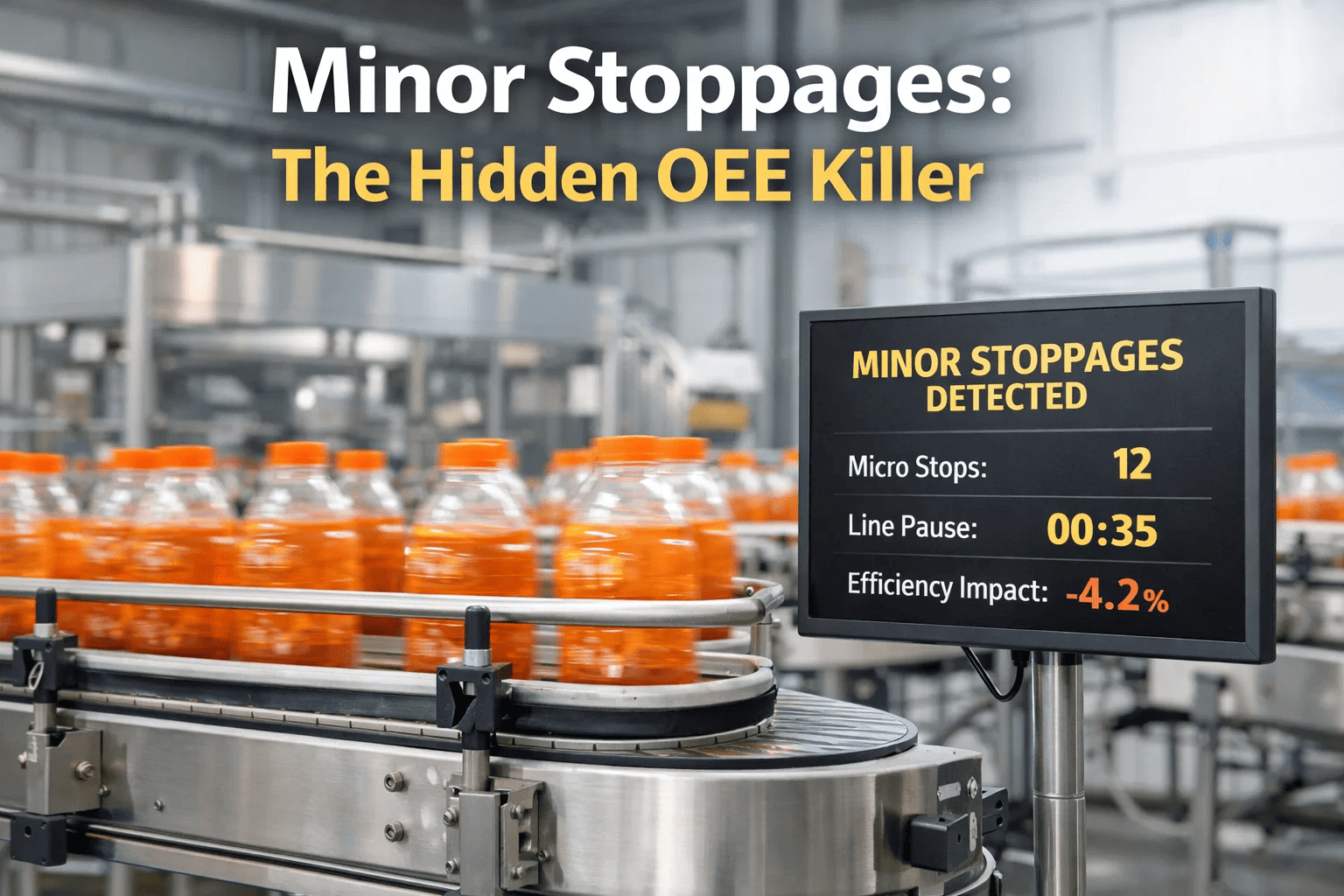
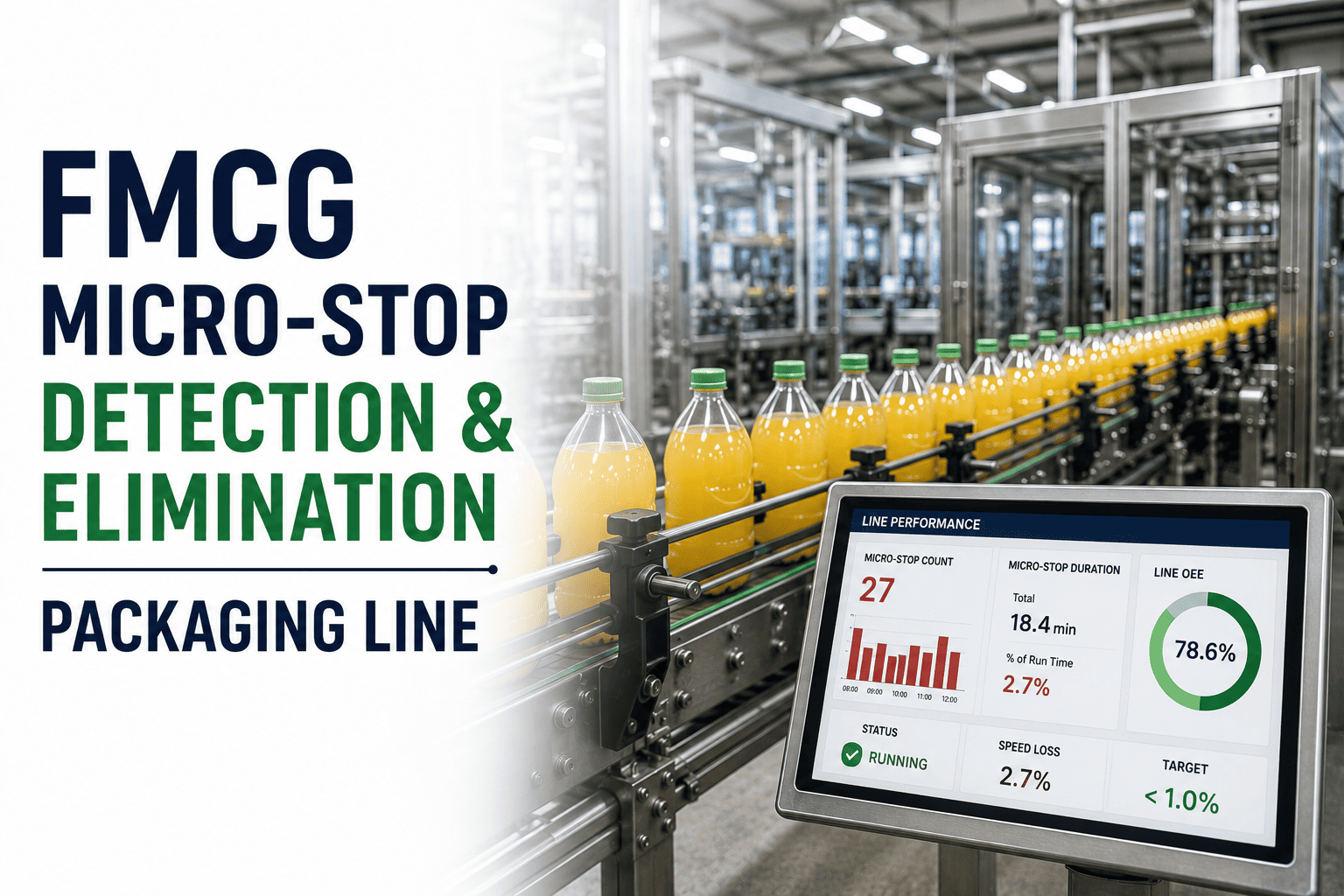
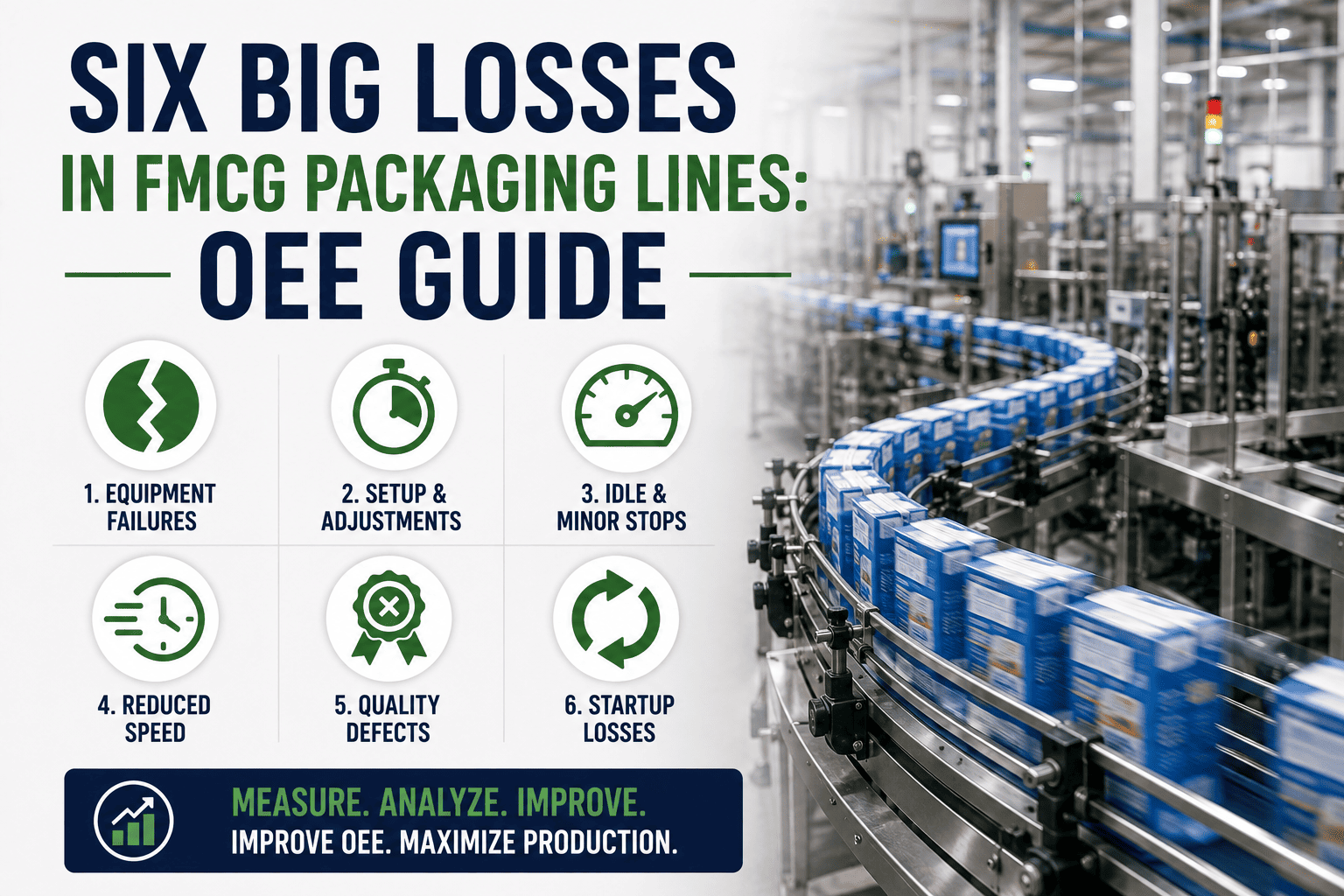
Ask most FMCG plant managers what is killing their OEE and they will tell you about the big equipment failures — the conveyor that seized, the filler that broke down mid-run. What they rarely see is the real performance drain: the hundreds of stoppages under 10 minutes that never make it onto a downtime report but collectively destroy 15 to 25 percent of total production capacity on high-speed packaging lines. A stop that lasts 4 minutes does not trigger a maintenance ticket. It does not appear in the shift handover notes. But if it happens 60 times per shift across a 300-unit-per-minute line, the losses add up faster than a single major breakdown — and they are hiding in plain sight. Start a free trial and start measuring the stops your team doesn't even know are happening, or book a demo to see how Oxmaint surfaces micro-stop data your current system cannot capture.
15–25%
OEE Loss from Micro-Stops
share of total production losses on high-speed packaging lines
60+
Micro-Stops per Shift
typical count on unmaintained high-speed FMCG packaging lines
0%
Captured Manually
of sub-10-minute stoppages are consistently logged in manual systems
8–12%
OEE Points Recoverable
from micro-stop elimination alone on targeted packaging lines
The stops you are not counting are the ones costing you most
Oxmaint automatically captures every stoppage — including the ones under 10 minutes — and links them to asset health data, maintenance history, and production context so you can find the root cause and eliminate it permanently.
What Are Minor Stoppages — and Why Does FMCG Ignore Them?
Minor stoppages — also called micro-stops, nuisance stoppages, or short stops — are defined as production line interruptions lasting under 10 minutes that do not require a maintenance technician call-out. The operator clears the jam, resets the sensor, or restarts the machine themselves, and production resumes. No ticket is raised. No log entry is made. And so a category of loss that in many FMCG plants exceeds the impact of major breakdowns remains completely invisible to management.
The Micro-Stop Math
Line Speed300 units/min
Stop Duration4 minutes each
Frequency60 stops/shift
Lost Output72,000 units/shift
Annual Loss52.5M units/year
Why They Stay Hidden
Manual logs require operator action — operators restart and move on
Under 10 minutes rarely triggers a formal downtime report
No CMMS ticket = no maintenance visibility
Individual stops seem trivial — cumulative impact is invisible
Where Micro-Stops Occur Most on FMCG Packaging Lines
Minor stoppages cluster at specific failure-prone points on FMCG packaging lines. Understanding which equipment types and failure modes generate the most micro-stops lets maintenance teams target their improvement effort with precision — not guesswork. The highest-frequency minor stoppage sources on FMCG lines are:
Filling Systems
Fill Head Dribble and Blockage
High frequency — typically 10–20 stops/shift
Worn fill head seals, product viscosity variation, and nozzle fouling cause inconsistent fill weights that trigger checkweigher rejects and brief line holds. Each reject event = a micro-stop not recorded.
Conveyor Systems
Product Jams and Mis-Tracking
High frequency — typically 8–18 stops/shift
Belt tension loss, worn transfer plates, and misaligned guide rails cause product tipping and jamming that requires a manual clear. Each 2–5 minute clear is logged nowhere. Cumulative impact can exceed 90 minutes of lost time per shift.
Sealing / Wrapping
Seal System Misalignment
Medium frequency — typically 6–14 stops/shift
Temperature drift in jaw sealers, worn sealing surfaces, and film tracking errors produce seal failures that eject product and halt the line. Each individual event is short — but seal-related micro-stops routinely generate 3–8% total performance loss alone.
Sensor / Detection
False Reject Triggering
Variable — often 5–12 stops/shift
Dirty or misaligned photoeye sensors, contaminated checkweigher conveyors, and uncalibrated metal detectors generate false product rejects — stopping the line unnecessarily. Sensor maintenance is among the highest-ROI minor maintenance tasks in packaging plants.
Labeling Systems
Label Application Failure
Medium-High — typically 8–15 stops/shift
Worn applicator pads, inconsistent label stock tension, and adhesive buildup on tamp cylinders generate label mis-apply events. Each event requires a manual operator intervention and a produced-but-rejected unit. Often dismissed as a "label supplier" issue, when root cause is equipment maintenance.
Cartoning / Case Packing
Carton Misfeeds and Jams
Variable — typically 4–10 stops/shift
Worn vacuum suction cups, degraded carton magazine guides, and erector timing drift cause intermittent misfeeds that stop the machine. Minor but cumulative — carton packing micro-stops consume 45–90 minutes of net production per shift on high-speed lines running aged equipment.
Invisible vs. Visible: How AI Detection Changes the Game
The fundamental problem with minor stoppages is not that plants lack the ability to fix them — it is that plants lack the ability to see them. Manual logging systems structurally miss the majority of micro-stops. AI-driven automated capture changes this entirely. When every PLC signal, machine cycle interrupt, and production pause is recorded automatically, the true picture of performance losses becomes visible for the first time — and it is almost always dramatically worse than operators and managers believed.
Eliminating Minor Stoppages: The Root Cause Framework
Once minor stoppages are captured and visible, elimination follows a structured four-stage process. This framework applies across all FMCG packaging line types — from high-speed beverage lines to confectionery flow wrap — and consistently delivers 8–12 OEE points of improvement when executed with discipline. Start a free trial and work through this framework with your actual line data from week one, or book a demo to see how Oxmaint's micro-stop analytics module structures this process automatically.
01
Measure
Capture Every Stop
Implement automated stop capture via PLC integration, IoT signals, or OEE sensor boxes on every target line. Run for 2 weeks before taking any action — the data picture needs to be complete before drawing conclusions about priorities.
02
Analyze
Pareto the Causes
Rank all captured stops by total time lost — not by count. A stop that happens 20 times for 3 minutes each may rank lower than one that happens 5 times for 12 minutes each. Focus the top 4–6 causes by total time lost, not total event frequency.
03
Investigate
Find the True Root Cause
For each top cause, investigate whether the root is a maintenance issue (worn component, missed lubrication, calibration drift), a design issue (incorrect guide width, wrong speed setting), or a material issue (packaging substrate variation). Most micro-stops have a maintenance root cause addressable in one planned PM event.
04
Eliminate
Fix and Verify
Execute the maintenance fix, process adjustment, or design modification. Track the specific stop cause in the two weeks post-fix to verify elimination. Document the fix in the asset's maintenance record to prevent recurrence. Repeat with the next ranked cause until micro-stop losses reach below 3% of planned production time.
How Oxmaint Detects and Eliminates Minor Stoppages
IoT Integration
Automatic Stop Capture via Machine Signals
Oxmaint integrates directly with packaging line PLCs, SCADA systems, and OEE sensor boxes — capturing every machine state change, production pause, and alarm event automatically. Every stop logged to the microsecond, no operator action required.
Analytics
Real-Time Micro-Stop Pareto
Automated Pareto analysis updated in real time — ranked by total time lost, by cause, by asset, by shift, and by time of day. Plant managers see exactly where 80% of micro-stop losses are concentrated before the shift ends.
Maintenance Trigger
Pattern-Based Maintenance Alerts
When a specific stop cause exceeds a frequency or duration threshold, an automated work order is generated and dispatched — linking the stop pattern to the asset record, the relevant maintenance task, and the required spare parts. No manual investigation required to initiate the fix.
Asset Health
Stop-to-Condition Score Correlation
Minor stoppages on an asset automatically influence its condition score — linking micro-stop frequency trends to the predictive maintenance engine. Rising micro-stop rates on a filler or sealer are a leading indicator of component failure, triggering inspection before a major breakdown occurs.
Minor Stoppage Elimination Results
8–12pts
OEE Points Recovered
Achievable from dedicated micro-stop elimination on high-speed packaging lines
100%
Stop Capture vs. 0% Manual
Automated IoT capture documents every stop — making the invisible visible for the first time
2 weeks
To First Actionable Insight
Time from sensor deployment to having a prioritized stop reduction roadmap with supporting data
60–75%
Stop Reduction per Cause
Typical reduction in each targeted micro-stop category within 60 days of structured root cause elimination
Frequently Asked Questions
How much OEE can you recover by eliminating minor stoppages?
Most FMCG packaging plants can recover 8 to 12 OEE points from focused minor stoppage elimination programs — making it one of the highest-ROI OEE improvement initiatives available without capital equipment investment. In plants where micro-stops have never been systematically measured, first-pass elimination of the top 4–6 causes commonly delivers 5–8 OEE points within 90 days.
Why don't manual systems capture minor stoppages?
Manual systems require an operator to actively decide to log a stoppage, enter a reason code, and record a duration — in the middle of responding to and clearing a line jam. In practice, operators clear short stoppages and restart, with no log entry made. Studies consistently show that manual OEE tracking systems capture fewer than 30% of sub-10-minute stoppages. Automated PLC-integrated capture eliminates this gap entirely by recording every machine state change without requiring any operator action.
What causes the most minor stoppages on FMCG packaging lines?
The most frequent minor stoppage causes on FMCG packaging lines are conveyor product jams (belt tension loss, worn transfer plates), fill head fouling and seal integrity issues, false reject triggering from dirty or misaligned sensors, label application failures from worn components, and carton misfeed events. Most root causes trace back to unmaintained components — worn parts, calibration drift, or lubrication deficiency — addressable through planned maintenance without equipment replacement.
How does micro-stop reduction connect to predictive maintenance?
Minor stoppages are early warning signals — a bearing beginning to fail will generate increasing vibration that causes intermittent conveyor belt tracking issues before it seizes completely. A filler nozzle seal beginning to degrade will cause fill weight variation and intermittent rejects before it fails catastrophically. AI-driven systems that correlate micro-stop frequency trends with asset condition scores can identify which minor stoppage patterns are leading indicators of major failures — converting the minor stoppage program into a predictive maintenance input, not just a performance recovery tool.
The stops you cannot see are the ones you cannot fix
Oxmaint's FMCG production platform automatically captures every micro-stop, runs real-time Pareto analysis, and converts stop patterns into maintenance work orders — turning invisible OEE losses into a structured, measurable improvement program. Join packaging plants already recovering 8–12 OEE points from minor stoppage elimination.