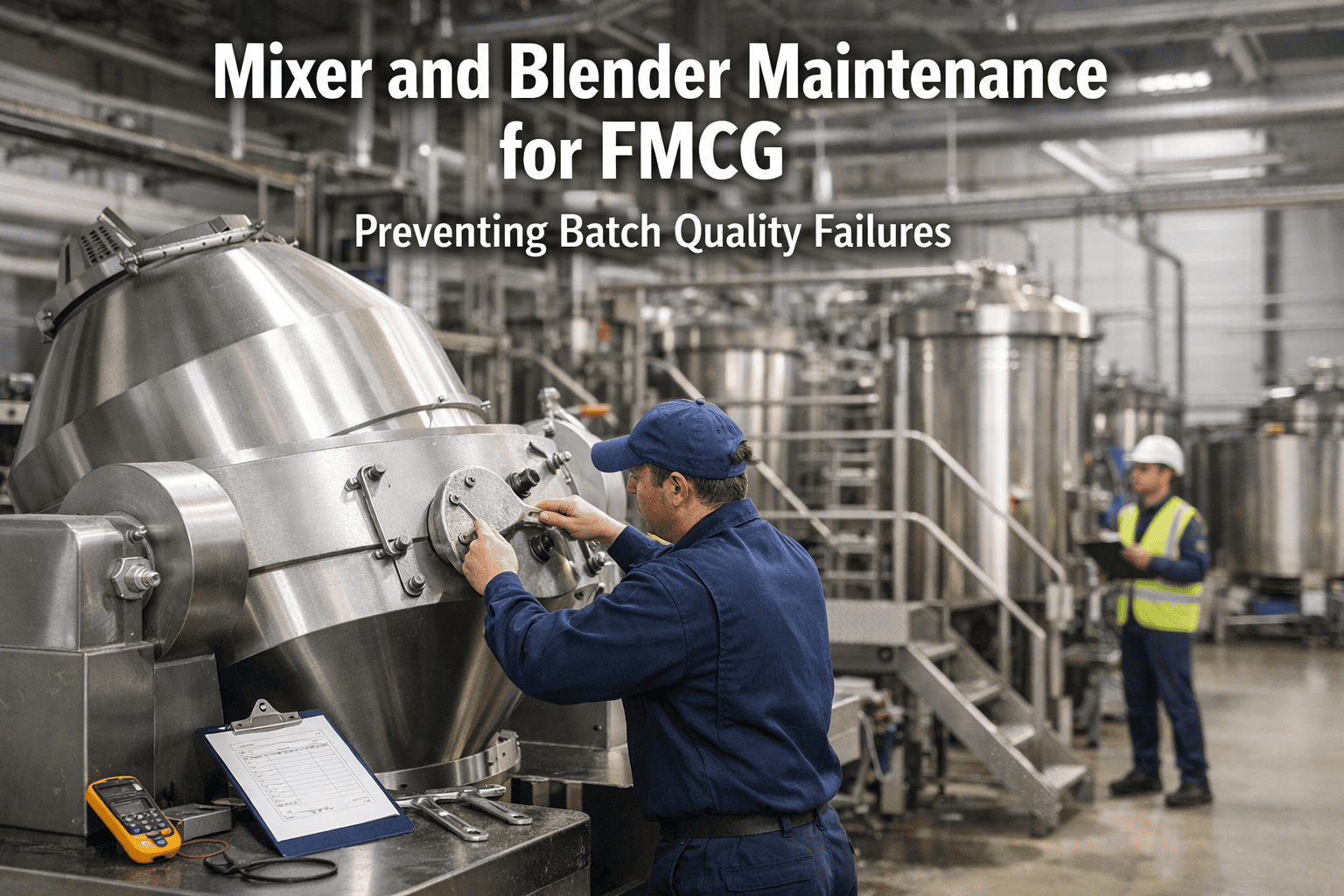
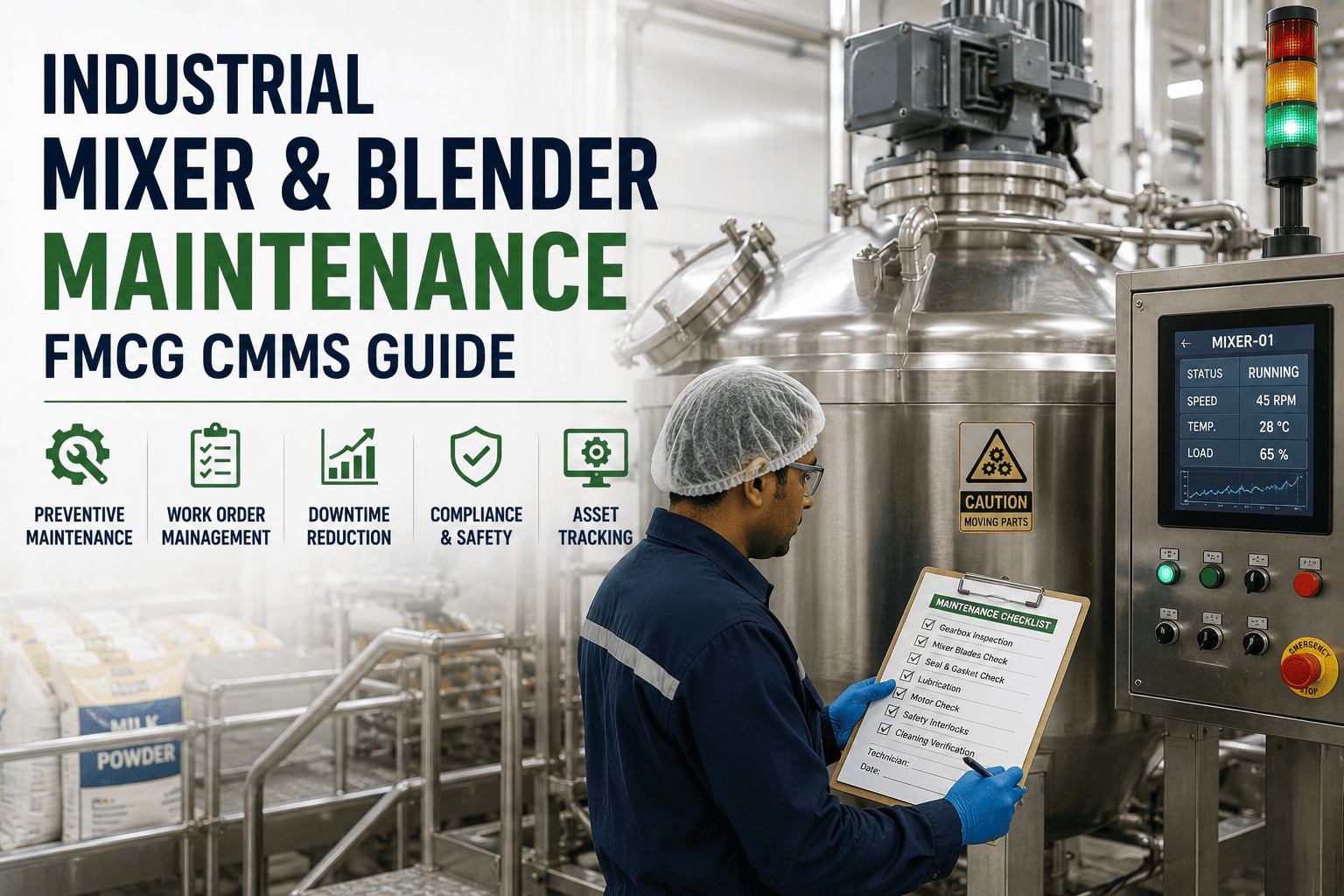
A processed food manufacturer in Tamil Nadu rejected 3 consecutive batches of spice blend — 4.2 tonnes worth $28,000 — because particle size was outside specification. The root cause was a worn impeller blade that had lost 8mm of edge profile over 6 months, reducing shear force by 22%. The blade condition had been obvious for weeks, but nobody was looking — because blenders are not on the PM schedule. Mixers and blenders are the most maintenance-neglected processing equipment in FMCG. They run behind closed doors, their failure modes are gradual, and by the time the quality lab catches the problem, 2–5 batches of off-spec product have already been produced. Start your free trial to build mixer-specific PM schedules. Book a demo to see OxMaint's Preventive Maintenance Scheduling for processing equipment.
Preventive Maintenance Scheduling
The Batch Failed at the Lab. The Failure Started at the Mixer 6 Weeks Ago.
OxMaint tracks mixer blade wear, seal condition, motor current trends, and vibration baselines — catching the gradual degradation that causes batch quality failures weeks before the quality lab detects the symptom.
$18K–$45K
average cost per batch rejection caused by mixer/blender maintenance failure
85%
of mixer-related quality failures are caused by gradual wear detectable with PM
3–8 batches
typically produced off-spec before lab results catch a mixer degradation issue
The Six Mixer Failure Modes That Destroy Batch Quality
Mixer and blender failures rarely stop the equipment — they degrade product quality while the machine continues to run. This makes them more dangerous than failures that halt production, because off-spec product enters the supply chain before anyone knows there is a problem.
Shaft seal leakage is the most dangerous failure mode because it creates a direct contamination pathway into the product. A mechanical seal that weeps lubricant into a food product batch triggers a full recall investigation — not just a batch rejection. The cost of a single seal failure that reaches the market can exceed $500K when recall logistics, retailer deductions, and brand damage are included. Weekly seal inspection takes 2 minutes per mixer and prevents the entire chain of consequences.
The Mixer PM Schedule: What to Check and When
Mixer and blender PM follows the same four-tier structure as other FMCG equipment — but the inspection focus is different because the primary concern is product quality, not equipment availability. A mixer that runs but produces off-spec product is worse than a mixer that stops, because the stopped mixer at least prevents bad product from entering the supply chain.
Every Batch
Pre-Batch Quality Checks
2 min per mixer
- Visual check of blade/impeller — no visible chips, cracks, or edge rounding
- Shaft seal inspection — no visible weeping or product residue below housing
- Verify mixing speed setpoint matches recipe specification
- Confirm discharge valve fully closed — no residue from previous batch
Weekly
Condition Monitoring
15 min per mixer
- Blade edge profile measurement with gauge — compare to new blade reference
- Motor current reading under load — compare to baseline; rising = friction increase
- Bearing vibration check — handheld or permanent sensor at bearing housing
- Vessel interior inspection — check liner/coating for chips, cracks, or wear spots
- Discharge valve seat inspection — check for erosion and gasket condition
Monthly
Detailed Inspection and Measurement
45 min per mixer
- Shaft seal pressure test — verify seal integrity under operating pressure
- Motor insulation resistance test (megger) — declining trend = winding degradation
- Shaft runout measurement — excessive runout accelerates seal and bearing wear
- VFD parameter verification — confirm speed, ramp times, and torque limits match recipe
- Gearbox oil level and condition check — milky = water ingress, dark = contamination
Quarterly
Overhaul Inspection
2 hrs per mixer
- Blade/impeller replacement if wear exceeds 15% of original profile
- Mechanical seal replacement per OEM interval or condition-based trigger
- Bearing lubrication — food-grade grease per OEM spec, clean fittings first
- Gearbox oil analysis — viscosity, TAN, particle count, moisture content
- Full electrical inspection — connections, cable condition, thermal scan under load
The pre-batch check is the most important tier because it is the last line of defence before product enters the mixer. A 2-minute visual inspection catches the blade chip that would contaminate 2 tonnes of product, the seal weep that would introduce lubricant into the batch, and the residue from the previous batch that would create a cross-contamination event. This check must be documented in the CMMS — not just performed — because auditors need evidence that the equipment was verified fit for use before each batch.
Pre-Batch Checklists
Every Mixer Verified Before Every Batch — Documented, Timestamped, Audit-Ready
OxMaint generates pre-batch inspection checklists linked to equipment and batch records. Operators complete the checklist on mobile in under 2 minutes — creating the documented evidence that auditors require for every production run.
Blade Wear: The #1 Quality Failure You Can Measure and Predict
Blade and impeller wear is the most common mixer-related quality failure in FMCG — and the most predictable. Blades wear at a linear rate determined by product abrasiveness, mixing speed, and operating hours. A simple edge profile measurement taken weekly produces a wear curve that predicts exactly when the blade will fall below the minimum specification for the validated process.
0–3 Months
0–5% profile loss
Full shear force. Product quality at specification. No action needed.
Status: Normal operation
3–6 Months
5–10% profile loss
Shear force declining. Mix time may increase 5–10% to achieve same result. Current draw drops slightly.
Action: Order replacement blade. Schedule swap at next planned stop.
6–9 Months
10–15% profile loss
Particle size distribution widening. Blend consistency declining. Quality lab may flag borderline results.
Action: Replace blade at next available opportunity. Do not defer.
9+ Months
15%+ profile loss
Batch rejections begin. Multiple off-spec batches before lab results identify the mixer as root cause.
Impact: 3–8 batches rejected before cause identified. $18K–$45K per event.
Motor Current Trending: The Free Predictive Tool for Mixer Health
Motor current is the single most informative parameter for mixer condition monitoring — and it costs nothing to measure. A CT clamp on the motor supply records current draw during every batch. Because the mixer operates at a known speed with a known product, any change in current indicates a change in mechanical condition.
Current Rising
Mechanical friction increasing
Bearing degradation, shaft misalignment, gearbox wear, product buildup on shaft
Investigate: vibration check on bearings, shaft runout measurement, gearbox inspection
Current Dropping
Mixing work decreasing
Blade wear reducing shear force, lower product viscosity, belt slip on drive
Investigate: blade profile measurement, product spec verification, drive belt tension
Current Fluctuating
Inconsistent mechanical load
Loose blade, worn coupling, product surging from uneven feed, VFD instability
Investigate: blade mounting torque, coupling inspection, feed system, VFD diagnostics
The baseline is established by recording current draw during 5 normal batches with the same product at the same speed. Any deviation beyond 5% from this baseline warrants investigation. Rising current predicts bearing failure 2–4 weeks in advance. Dropping current predicts quality failure from blade wear 4–8 weeks in advance. Both signals are available from a $100 CT clamp connected to any data logger — making motor current the highest-ROI predictive monitoring technique for mixers.
The ROI: What Mixer Maintenance Prevents
Batch rejection prevention
$145K/yr
Contamination event avoidance
$80K/yr risk
Equipment life extension
$30K/yr
Energy from maintained bearings
$12K/yr
Reduced rework / reprocessing
$24K/yr
Annual mixer PM programme cost (10 mixers)$8,500
Annual value delivered$291K
34x ROI — One Prevented Batch Rejection Pays for the Entire Year's Mixer PM Programme
Implementation: 30-Day Mixer PM Programme Launch
Week 1
Mixer Census and Baseline Assessment
Register every mixer and blender as individual CMMS assets with type, capacity, blade specification, seal type, and motor nameplate data. Inspect each unit: measure blade profiles, check seals, record motor current under load, take vibration baselines on bearings. Photograph current condition.
Week 2
Fix Critical Findings and Build PM Templates
Replace any blades below 85% profile. Replace any leaking seals. Create 4-tier PM templates: pre-batch checklist, weekly condition monitoring, monthly detailed inspection, quarterly overhaul. Link pre-batch checklist to production schedule so it auto-generates before every batch.
Week 3
Deploy Current Monitoring and Blade Tracking
Install CT clamps on critical mixer motors. Configure current baseline from 5 normal batches. Set up blade wear tracking in CMMS with measurement fields and replacement prediction dates. First full cycle of weekly PM executed and documented.
Week 4
Go Live with Pre-Batch Checklists and Full PM Schedule
Launch pre-batch checklists on mobile for all operators. Full PM schedule active with automated work order generation. Weekly blade wear and current trending review. Present baseline report to quality and production teams showing equipment condition and predicted replacement dates.
Frequently Asked Questions
Preventive Maintenance Scheduling
Every Blade Measured. Every Seal Checked. Every Batch Protected.
85%
quality failures preventable
30 Days
to full PM programme