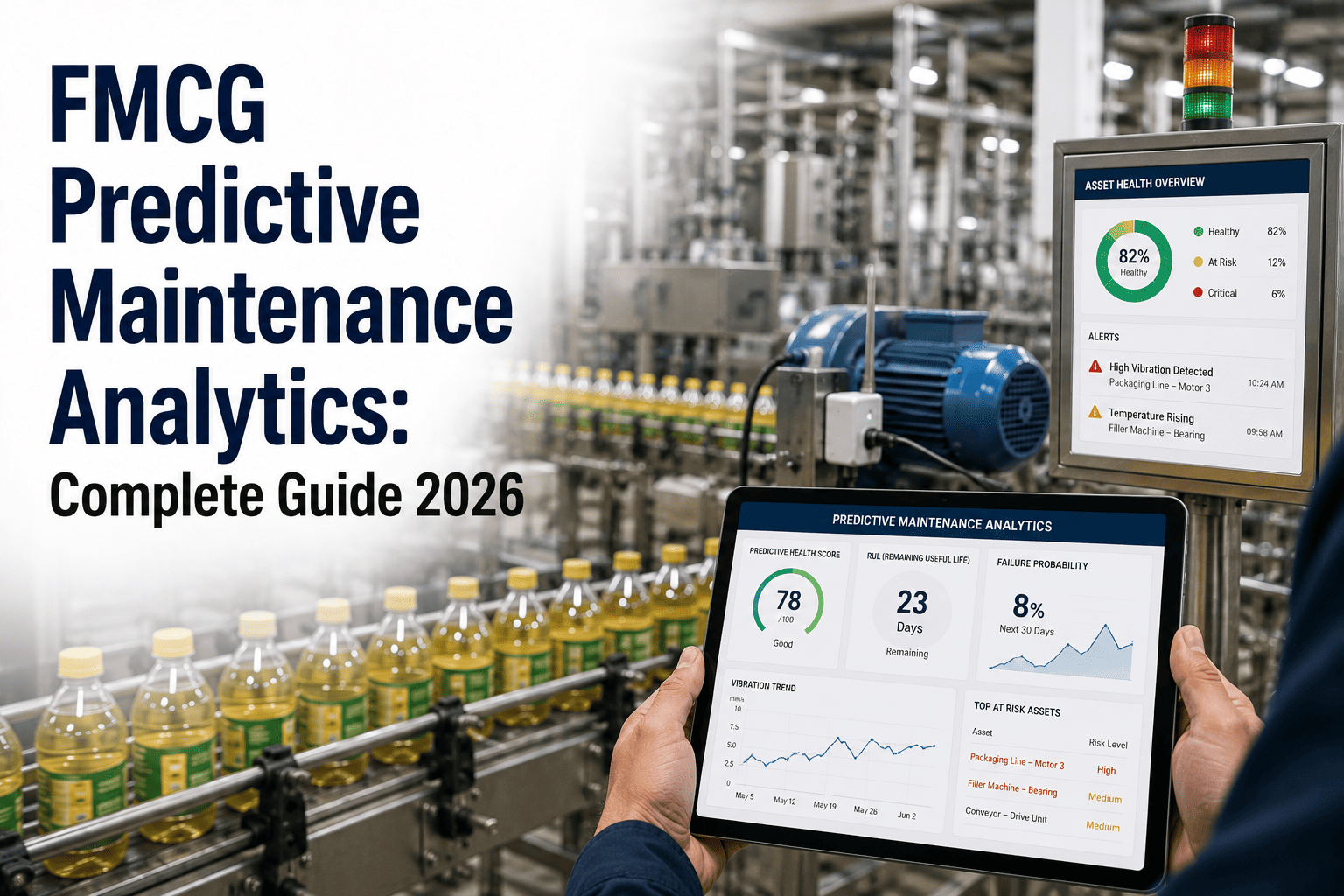
A vibration sensor detects bearing degradation on your primary mixer 14 days before failure. Scheduled replacement during weekend downtime costs $1,200. Without predictive warning: catastrophic failure during Tuesday production, $18,000 emergency repair, $32,000 lost output, 18-hour downtime. Predictive maintenance prevents this $50K event for $1,200—demonstrating 40:1 ROI on single intervention. Leading F&B manufacturers achieve $330K savings in first 6 months, while predictive approaches deliver 25% lower maintenance costs, 10-20% higher uptime, and 50% fewer downtime incidents. FMCG manufacturers ready to sign up for AI-powered predictive maintenance platforms can start with OXmaint connecting equipment sensors to failure prediction algorithms and automated workflows.
25%
Maintenance Cost Reduction
AI-powered prediction vs. reactive approach
50%
Fewer Downtime Incidents
Early detection preventing failures
3-6mo
Typical ROI Timeline
Leading manufacturers achieving payback
Predictive Maintenance Overview
Predictive maintenance uses sensors, AI, and analytics to continuously monitor equipment health—predicting failures based on actual degradation rather than fixed schedules. Unlike reactive maintenance (fix after breaking) or preventive (time-based servicing), predictive intervenes at optimal moments: after wear begins but before failure occurs. Manufacturers wanting to schedule a predictive maintenance assessment can discuss how OXmaint integrates sensor data with AI algorithms providing 5-14 days advance warning.
Trigger
After failure
Fixed schedule
Condition-based
Advance Warning
None
Scheduled intervals
5-14 days typical
Parts Waste
Low (run to failure)
High (early replacement)
Optimized timing
Downtime Risk
Highest (unplanned)
Medium
Lowest (planned)
Cost
Highest total
Moderate
25-40% lower
FMCG Use Cases
Mixer Bearing Monitoring
Vibration sensors detect bearing degradation weeks before failure preventing catastrophic breakdowns on critical mixing equipment
14-day advance warning typical, $50K+ single-event savings
Conveyor Motor Health
Current and temperature analysis identifying motor issues before halting production lines moving thousands of units hourly
Prevents cascading line stops affecting entire facility
Refrigeration System Reliability
Compressor monitoring ensuring cold chain integrity preventing spoilage of perishable inventory worth $10K-$50K+
HACCP/FSMA compliance + product safety assurance
Pump Performance Tracking
Flow and vibration analysis on liquid transfer pumps detecting seal degradation, cavitation, or bearing wear
Prevents contamination risks and production delays
Packaging Equipment Precision
Monitoring fillers, sealers, labelers maintaining mechanical precision preventing quality defects and waste
Reduces rejects, maintains OEE quality component
Oven Temperature Consistency
Heating element and control system monitoring ensuring consistent temperatures preventing batch quality issues
Product consistency, reduced rework and waste
Predict Failures Before They Happen
OXmaint integrates with IoT sensors and equipment monitoring systems—using AI algorithms to predict failures 5-14 days in advance, automatically generating work orders during optimal maintenance windows.
Data & Sensor Requirements
Predictive maintenance requires continuous equipment condition data. Modern wireless sensors install without production interruption, connecting to cloud platforms for AI analysis. Manufacturers ready to get started with sensor-based predictive monitoring can implement systems capturing critical equipment health indicators.
Vibration Sensors
Bearing wear, misalignment, imbalance, looseness
Motors, pumps, mixers, conveyors, gearboxes
Temperature Sensors
Overheating, cooling issues, electrical problems
Motors, bearings, electrical panels, refrigeration
Current/Power Monitors
Motor degradation, load changes, electrical faults
All electric motors and drives
Oil Analysis Sensors
Lubrication degradation, contamination, wear particles
Compressors, hydraulic systems, gearboxes
Pressure/Flow Sensors
Pump cavitation, blockages, seal failures
Pumps, pneumatic systems, process equipment
Ultrasonic Sensors
Compressed air leaks, steam traps, electrical arcing
Air systems, utilities, electrical equipment
Predictive Maintenance Data Pipeline
1
Sensor Data Collection
Continuous monitoring at millisecond intervals
→
2
Cloud Processing
AI/ML algorithms analyzing patterns
→
3
Failure Prediction
Anomaly detection and RUL calculation
→
4
Work Order Generation
Automated maintenance scheduling
Implementation Roadmap
Phase 1
Assessment & Prioritization
• Identify critical equipment (high downtime cost/frequency)
• Calculate baseline failure rates and costs
• Select 3-5 pilot assets for proof of concept
Duration: 2-4 weeks
Phase 2
Pilot Deployment
• Install sensors on pilot equipment
• Configure cloud platform and AI models
• Establish baseline patterns and thresholds
Duration: 4-8 weeks
Phase 3
Validation & Training
• Monitor predictions vs. actual failures
• Train maintenance teams on platform use
• Document ROI from pilot (prevented failures)
Duration: 3-6 months
Phase 4
Facility-Wide Scaling
• Expand to additional critical equipment
• Integrate with CMMS workflows
• Optimize models based on learnings
Duration: 6-12 months
ROI & Reliability Gains
25%
Lower Maintenance Costs
Optimized timing vs. reactive emergencies
50%
Fewer Downtime Incidents
Early intervention preventing failures
10-20%
Higher Uptime
Planned maintenance vs. unplanned stops
40%
Savings vs. Reactive
Total cost reduction from prevention
$330K
First 6-Month Savings
Leading F&B manufacturer example
3-6mo
ROI Timeline
Typical payback period for FMCG
Transform Maintenance From Reactive to Predictive
OXmaint connects IoT sensors, AI prediction algorithms, and automated workflows—delivering 5-14 days advance warning enabling planned interventions during optimal windows achieving measurable ROI within 3-6 months.
Frequently Asked Questions
How does predictive maintenance differ from preventive maintenance?
Preventive maintenance performs tasks on fixed schedules (every 500 hours) regardless of actual condition. Predictive maintenance monitors equipment continuously using sensors, intervening only when data indicates developing issues. Key differences: Preventive performs 30% unnecessary maintenance (IBM research), while predictive acts only when needed. Predictive provides 5-14 days advance warning vs. preventive's calendar schedules. Cost savings: predictive reduces expenses 25% and achieves 40% savings vs. reactive approaches. Most effective programs start with preventive establishing baseline practices, then add predictive capabilities on critical assets.
What equipment in FMCG plants should be monitored first?
Prioritize based on downtime impact and failure frequency: (1) Primary mixers—single points of failure where breakdowns halt entire production, (2) Refrigeration compressors—failures risk product spoilage worth $10K-$50K+, (3) High-speed packaging line motors—downtime costs $5K-$15K per hour, (4) Critical pumps—liquid transfer equipment where failures cause contamination risks, (5) Conveyor drives—equipment moving thousands of units hourly. Start with 3-5 pilot assets proving ROI before facility-wide expansion. OXmaint's assessment identifies highest-impact equipment based on historical downtime data and failure costs.
What ROI should FMCG manufacturers expect from predictive maintenance?
Typical ROI: 3-6 month payback period for FMCG operations with measurable returns including 25% maintenance cost reduction from optimized timing, 50% fewer downtime incidents through early intervention, 10-20% higher uptime from planned vs. unplanned maintenance, 40% total savings vs. reactive approaches. Real example: Leading F&B manufacturer saved $330K in first 6 months detecting bearing and lubrication issues preventing unplanned downtime. Single prevented major failure (mixer breakdown costing $50K) often justifies annual predictive program investment. 95% of organizations report positive returns.
Do FMCG plants need specialized sensors for food environments?
Yes—food manufacturing requires sensors rated for harsh conditions: (1) IP67/IP69K rating protecting against washdown and moisture, (2) Stainless steel housings meeting food-grade material requirements, (3) Wireless connectivity eliminating cable runs through production areas, (4) Temperature tolerance for hot/cold environments, (5) Chemical resistance for cleaning agents. Modern sensors designed for food/beverage withstand high-pressure washdowns while maintaining accuracy. Strategic mounting locations minimize contamination risk while capturing accurate equipment data. OXmaint partners with sensor manufacturers providing food-grade hardware meeting FSMA/HACCP requirements.
How long does predictive maintenance implementation take?
Phased approach timeline: (1) Assessment & prioritization: 2-4 weeks identifying critical equipment and calculating baseline costs, (2) Pilot deployment: 4-8 weeks installing sensors on 3-5 assets and configuring AI models, (3) Validation period: 3-6 months monitoring predictions vs. actual failures while training teams, (4) Facility-wide scaling: 6-12 months expanding to additional equipment based on proven pilot ROI. Total timeline from assessment to full deployment: 9-18 months. However, value starts during pilot phase—manufacturers often prevent first major failure within 60-90 days generating immediate ROI before complete implementation.