Predictive Maintenance for FMCG Manufacturing Guide
By Jack Edwards on April 6, 2026
The packaging line at your beverage facility just rejected 4,200 units because a vision sensor drifted out of calibration—something predictive maintenance would have flagged 12 days before it failed. That's a $31,000 scrap event, but the real cost is the 3.2 hours of downtime while technicians diagnose the root cause and recalibrate. At $36,000 per hour for FMCG manufacturers, this single preventable failure just cost your operation $146,400 in total losses. Modern predictive maintenance for FMCG uses vibration sensors, thermal imaging, and machine learning to identify equipment degradation weeks before failures halt production—transforming reactive firefighting into planned interventions. Start a free trial to see how Oxmaint's predictive maintenance platform monitors FMCG production equipment and generates automated work orders before failures impact your lines, or book a demo to explore condition-based monitoring for your highest-impact assets.
Predictive Maintenance for FMCG Manufacturing: Complete AI and IoT Implementation Guide
How vibration monitoring, thermal imaging, and machine learning transform FMCG production lines from reactive breakdowns to predictive intervention—reducing downtime 40-60% in the first 18 months.
per hour of unplanned downtime in FMCG production—costs that predictive maintenance prevents by detecting failures weeks in advance
40-60%
reduction in unplanned downtime achieved within 12-18 months of deploying predictive monitoring integrated with CMMS
4-12 weeks
advance warning of equipment failures through vibration analysis and thermal monitoring—enough time to schedule repairs during planned downtime
3x more
expensive for emergency repairs vs. planned maintenance—predictive strategies eliminate most emergency interventions
Definition
What is Predictive Maintenance for FMCG Manufacturing?
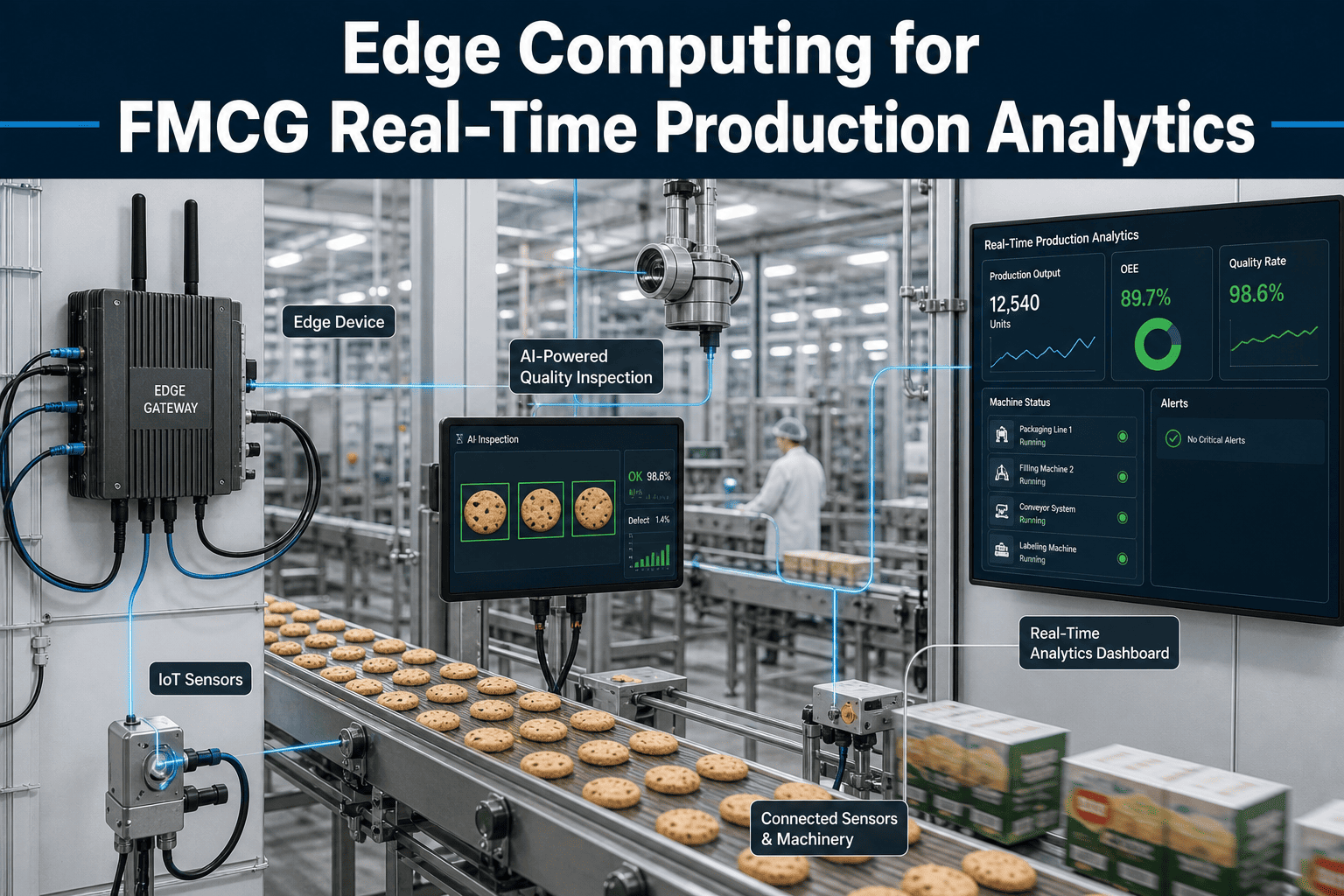
Predictive maintenance in FMCG manufacturing uses IoT sensors, machine learning algorithms, and real-time data analysis to monitor equipment condition continuously—detecting degradation patterns that signal impending failures before they cause unplanned downtime. Unlike reactive maintenance (fix after failure) or preventive maintenance (fix on a schedule), predictive maintenance triggers interventions based on actual equipment health data. For high-speed FMCG production lines running 24/7 where a single hour of downtime costs $36,000, predictive maintenance transforms the economics of asset management by replacing emergency repairs with planned interventions scheduled during production lulls. The approach requires three components: continuous condition monitoring through sensors, analytics platforms that identify anomaly patterns, and integrated CMMS that converts health alerts into scheduled work orders. Start a free trial to configure predictive monitoring workflows in Oxmaint, or book a demo to see condition-based maintenance scheduling for FMCG lines.
Core Technologies
Four Essential Predictive Maintenance Technologies for FMCG Production Lines
Vibration Monitoring
Tri-axial accelerometers on motors, pumps, and conveyors detect bearing wear, misalignment, and imbalance 8-10 weeks before failure. Critical for rotating equipment in filling lines and packaging systems where bearing failures cause 35% of unplanned stops.
Thermal Imaging
Infrared cameras identify electrical hotspots, motor overheating, and seal degradation before catastrophic failure. Particularly effective for high-speed packaging robots and automated palletizers where thermal anomalies precede mechanical failures by 4-6 weeks.
Machine Learning Analytics
AI algorithms trained on historical failure data recognize degradation patterns across equipment classes. Systems learn normal operating signatures for each asset, flagging anomalies that indicate developing problems—reducing false alerts by 70% compared to threshold-only monitoring.
SCADA Integration
Real-time production data from existing control systems combined with condition monitoring creates predictive models that account for production intensity. A mixer running at 85% capacity shows different degradation rates than one at 60%—SCADA integration enables context-aware predictions.
Industry Pain Points
Six Critical Equipment Failure Modes Predictive Maintenance Prevents in FMCG Production
Problem 1
Bearing Failures in High-Speed Packaging Lines
Bearing degradation in filling machines and capping equipment causes 35% of unplanned packaging line stops. Traditional time-based replacement wastes serviceable bearings; reactive replacement causes 4-hour emergency shutdowns during peak production.
Impact: $144,000 average downtime cost per bearing failure event
Problem 2
Vision System Drift and Calibration Loss
Quality inspection cameras drift out of calibration gradually, creating escalating reject rates that operators don't recognize as sensor degradation until thousands of units are scrapped. Manual quarterly calibration checks miss drift occurring between inspection windows.
Impact: 12,000-30,000 units scrapped before sensor drift is identified
Problem 3
Conveyor Belt Wear and Tear Progression
Belt degradation progresses asymmetrically—one section wears faster due to product weight distribution or environmental factors. Scheduled replacement based on average belt life wastes serviceable sections or fails to catch accelerated wear in high-stress zones.
Impact: 2.5-hour average downtime for emergency belt replacement
Problem 4
Motor Winding Insulation Breakdown
Electrical insulation in mixer motors and pump motors degrades through thermal cycling and contamination exposure. Failures occur suddenly—no visible warning—resulting in complete motor replacement during unplanned downtime rather than controlled rewinding during scheduled maintenance.
Impact: 8-12 hour downtime plus $15,000-$40,000 emergency motor replacement
Problem 5
Seal and Gasket Degradation in Mixing Systems
Seals in mixing tanks and transfer pumps degrade gradually through chemical exposure and mechanical wear. Small leaks escalate to contamination events or batch losses before visual inspection detects the problem. Scheduled seal replacement during production runs wastes product; reactive replacement risks contamination.
Impact: $22,000-$85,000 per contaminated batch plus regulatory reporting
Problem 6
Gearbox Lubrication Breakdown
Lubrication in conveyor gearboxes and packaging robots degrades through contamination and thermal breakdown. Time-based oil changes waste serviceable lubricant; condition-based oil analysis requires manual sampling. Reactive approach waits for elevated vibration or noise—by then gear damage has begun.
Impact: $8,000-$18,000 gearbox rebuild vs. $400 oil change if caught early
Oxmaint Solution
How Oxmaint Enables Predictive Maintenance for FMCG Production Equipment
01
IoT Sensor Integration with Automated Alert Generation
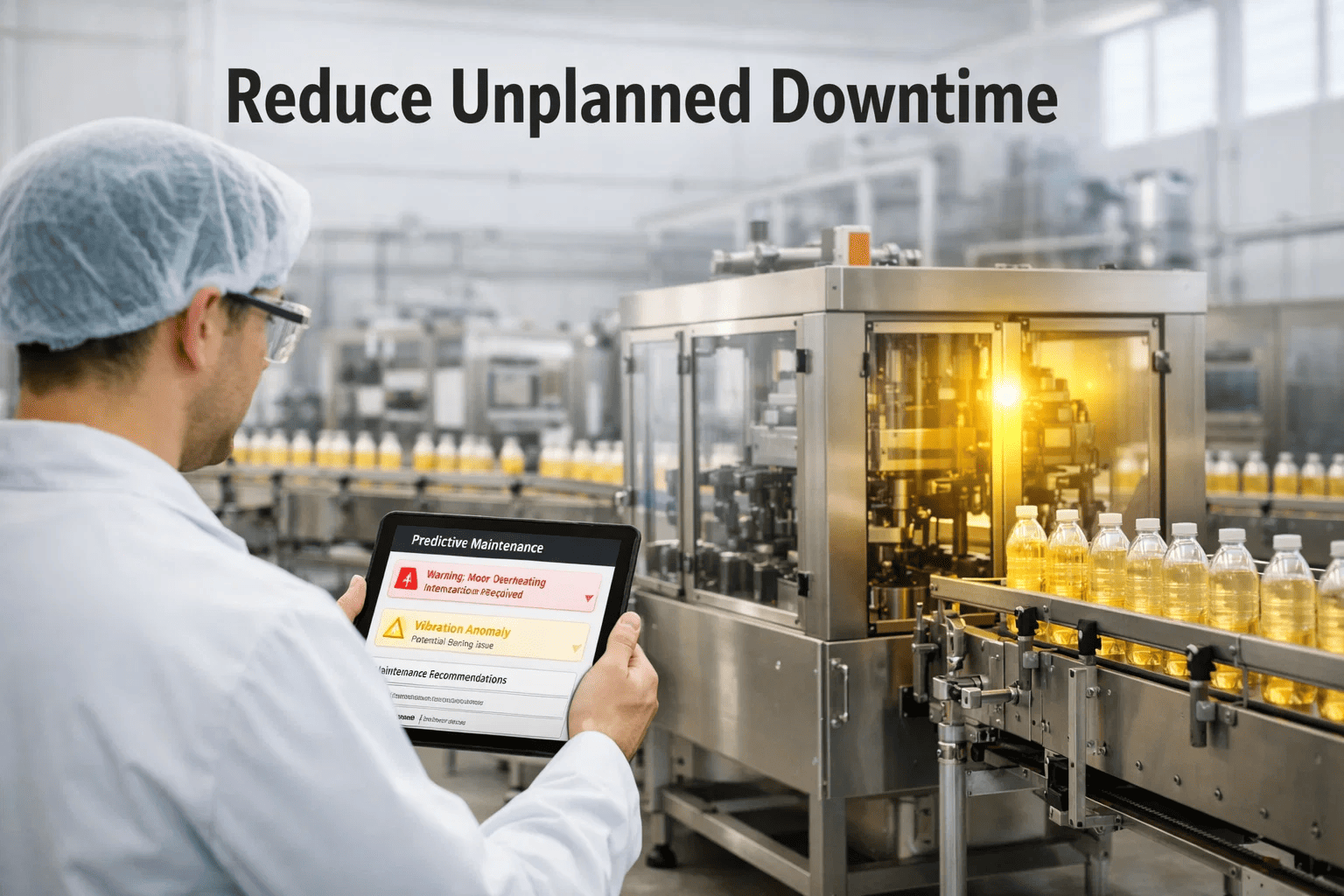
Oxmaint connects to vibration sensors, thermal cameras, and SCADA systems via API integration—pulling real-time equipment health data into the CMMS platform. When sensor readings exceed baseline thresholds or ML models detect anomaly patterns, the system auto-generates work orders with priority levels based on failure probability and production impact. No manual interpretation required—technicians receive actionable alerts with specific equipment location, detected issue, and recommended intervention. Start a free trial to configure sensor-triggered work order automation.
02
Condition-Based Scheduling with Production Calendar Awareness
Predictive alerts identify developing problems 4-12 weeks before failure—enough lead time to schedule interventions during planned downtime windows instead of interrupting production. Oxmaint's scheduler coordinates predictive work orders with production calendars, clustering multiple interventions during planned outages to maximize wrench time and minimize production impact. A bearing replacement flagged on Tuesday gets scheduled for Sunday's planned maintenance window, not Thursday's peak production shift.
03
Asset Health Scoring with Degradation Trending
Every monitored asset gets a health score (0-100) updated in real-time based on sensor data, maintenance history, and operating hours. Maintenance managers see entire equipment populations ranked by health status—prioritizing attention on assets approaching failure thresholds. Trend charts show degradation velocity over time, distinguishing between slow wear (schedule next quarterly outage) vs. accelerating deterioration (intervene within 2 weeks). Book a demo to see asset health dashboards for FMCG production lines.
04
Failure Mode Library with Equipment-Specific Signatures
Oxmaint's predictive maintenance module includes pre-configured failure signatures for common FMCG equipment—bearing wear patterns for conveyor motors, thermal signatures for packaging robots, vibration profiles for mixer gearboxes. When sensor data matches a known degradation pattern, the system identifies the specific failure mode and recommends the exact corrective action. Custom signatures can be added for facility-specific equipment, building institutional knowledge into the platform.
05
Root Cause Analysis with Failure Pattern Recognition
When failures do occur despite predictive monitoring, Oxmaint's RCA module links failure events to preceding sensor data—identifying what the monitoring system missed or what operational conditions accelerated degradation beyond predicted timelines. This feedback loop continuously improves prediction accuracy. A gearbox that failed 6 weeks earlier than predicted reveals that production line speed increases stress levels beyond the baseline model—the system adjusts future predictions for similar assets under similar conditions.
06
Mobile Access for Field Technicians with Offline Capability
Technicians receive predictive alerts on mobile devices with complete asset history, sensor trend charts, and recommended corrective procedures. Offline mode enables data collection during interventions in areas without WiFi coverage—photos, notes, parts used, completion sign-off—syncing to the CMMS when connectivity restores. Every predictive work order completion feeds back into the ML model, improving future predictions for that asset class. Start a free trial to test mobile predictive maintenance workflows.
Comparison
Reactive vs. Predictive Maintenance Economics in FMCG Production
Factor
Reactive Maintenance
Predictive Maintenance
Intervention Trigger
Equipment fails during production—technicians respond to emergency calls from operators reporting stopped lines or quality defects
Sensor data or ML algorithm detects degradation 4-12 weeks before failure—work order auto-generated for next planned downtime window
Production Impact
Unplanned downtime during peak production shifts—average 3.2 hours per failure event at $36,000/hour = $115,200 direct cost per event
Interventions scheduled during planned outages or low-production periods—zero unplanned downtime for 85% of predicted failures
Parts Procurement
Emergency orders at 40-60% premium pricing plus expedited shipping—parts arrive in 24-72 hours extending downtime duration
Standard lead time procurement at list pricing—parts ordered when failure is predicted, available in stock when intervention is scheduled
Labor Costs
Overtime labor for emergency repairs during off-shifts—technicians pulled from other work creating cascading delays across facility
Scheduled work during regular shifts—balanced workload distribution enables better workforce planning and eliminates most overtime
Secondary Damage
Failures propagate to connected equipment—a seized bearing damages the motor shaft, turning a $400 bearing replacement into a $12,000 motor rebuild
Early intervention before catastrophic failure—replace degraded component before it damages surrounding equipment, containing repair scope
Material Waste
Product in process at failure time must be scrapped—average 2,400-8,000 units depending on line configuration and product type
Controlled shutdowns complete current batch before stopping—minimal waste from planned interventions during product changeovers
Total Cost per Event
$145,000-$280,000 including downtime, expedited parts, overtime labor, scrap, and secondary damage
$8,000-$18,000 for planned intervention—parts at list price, no downtime cost, no emergency labor, no secondary damage
Predictive maintenance reduces cost per intervention by 85-94% compared to reactive emergency repairs—transforming FMCG maintenance from a cost center to a margin protection strategy. Book a demo to calculate predictive maintenance ROI for your FMCG facility.
See Predictive Maintenance for FMCG in Oxmaint—Book a 15-Minute Demo
Vibration monitoring integration · Thermal imaging alerts · ML-based anomaly detection · Condition-based scheduling · Asset health scoring · Mobile field access · Production calendar awareness · 40-60% downtime reduction in 18 months.
Predictive Maintenance Results: FMCG Production Performance Improvements
40-60%
Reduction in Unplanned Downtime
Achieved within 12-18 months of deploying integrated CMMS with condition monitoring—first 25-30% improvement from addressing top 5 failure modes identified through Pareto analysis
85-94%
Lower Cost per Intervention
Predictive interventions during planned outages cost $8,000-$18,000 vs. $145,000-$280,000 for reactive emergency repairs—eliminating expedited parts, overtime, and downtime costs
20-30%
Extension of Asset Useful Life
Components replaced at optimal degradation point rather than after failure or on arbitrary schedules—eliminating premature replacement waste and catastrophic failure damage
35-50%
Reduction in Maintenance Labor Costs
Scheduled interventions eliminate 75% of overtime labor and emergency callouts—balanced workload distribution improves technician productivity and reduces workforce stress
15-25%
Decrease in Spare Parts Inventory
Predictive lead times enable just-in-time parts procurement for planned interventions—reducing capital tied up in safety stock while maintaining service levels
70%
Reduction in False Alerts
Machine learning models trained on facility-specific equipment behavior eliminate threshold-only alert noise—technicians respond only to validated degradation patterns requiring intervention
Implementation Roadmap
Six-Phase Predictive Maintenance Deployment for FMCG Facilities
Phase 1
Asset Criticality Analysis and Pilot Equipment Selection
Identify 5-10 highest-impact assets where downtime creates disproportionate production losses—typically primary mixers, filling lines, packaging robots, and critical conveyors. Calculate true downtime cost per asset including production loss, material waste, and labor inefficiency. Pilot predictive monitoring on these assets first to demonstrate ROI before facility-wide deployment. Duration: 2-3 weeks.
Phase 2
Sensor Installation and Baseline Data Collection
Install vibration sensors on rotating equipment, thermal cameras on electrical panels and motors, and pressure/temperature sensors on fluid systems. Collect 4-6 weeks of baseline data during normal operations to establish equipment health signatures before implementing alerts. Integrate sensor data streams with Oxmaint CMMS via API. Duration: 4-6 weeks including sensor commissioning.
Phase 3
Alert Threshold Configuration and ML Model Training
Define alert thresholds based on baseline data and manufacturer specifications—vibration limits, temperature ranges, operating parameter boundaries. Train ML models on historical failure data to recognize degradation patterns specific to facility equipment. Configure work order auto-generation rules linking alert types to maintenance procedures. Duration: 3-4 weeks including testing and refinement.
Phase 4
Maintenance Workflow Integration and Technician Training
Connect predictive alerts to existing maintenance scheduling—ensuring predicted interventions coordinate with production calendars and planned outage windows. Train maintenance technicians on interpreting sensor data, validating alerts, and documenting intervention outcomes in CMMS. Establish feedback loops where completed work orders improve prediction accuracy. Duration: 2-3 weeks.
Phase 5
Performance Monitoring and Model Refinement
Track prediction accuracy (true positives vs. false alerts), intervention lead times, and downtime reduction over 12-week validation period. Refine alert thresholds and ML models based on actual equipment behavior—adjusting sensitivity to reduce false positives while maintaining early warning capability. Measure ROI based on prevented downtime events. Duration: 12 weeks ongoing.
Phase 6
Facility-Wide Expansion and Continuous Improvement
Expand predictive monitoring to secondary assets based on pilot success—prioritizing equipment with highest failure frequency or longest replacement lead times. Implement autonomous condition monitoring where AMRs conduct thermal and vibration scans on defined routes, uploading data to CMMS automatically. Establish quarterly model retraining cycles as equipment populations age and operating conditions evolve. Duration: Ongoing expansion over 6-12 months.
FAQ
Predictive Maintenance for FMCG Manufacturing—Common Questions
What FMCG equipment should be monitored first for maximum predictive maintenance ROI?
Prioritize single-point-of-failure assets where downtime stops entire production lines: primary mixing systems, filling and bottling equipment, high-speed packaging robots, and critical material handling conveyors. These assets deliver fastest ROI because their failure cascades through downstream operations—a stopped filler halts packaging, palletizing, and shipping. Secondary priorities include assets with highest repair costs, longest replacement lead times, or direct quality impact. Most FMCG facilities achieve 60% of total downtime reduction benefit by monitoring just 15-20% of equipment population—the critical assets that drive production throughput. Start a free trial to identify your critical asset population in Oxmaint.
How much advance warning do predictive systems provide before FMCG equipment failures?
Typical advance warning ranges from 4-12 weeks depending on failure mode and monitoring technology. Vibration analysis detects bearing wear 8-10 weeks before failure, thermal imaging identifies motor insulation breakdown 4-6 weeks early, and oil analysis flags lubrication contamination 6-8 weeks before gearbox damage begins. This lead time is sufficient to schedule repairs during planned production outages instead of interrupting operations—a 6-week warning lets you order parts at standard lead times, schedule interventions during weekend shutdowns, and avoid emergency overtime labor. The key is that predictive systems provide enough runway to convert unplanned emergency repairs into planned maintenance events.
What is the typical ROI timeline for predictive maintenance deployment in FMCG facilities?
Most FMCG facilities achieve positive ROI within 8-12 months of deployment, with break-even occurring when prevented downtime costs exceed total implementation investment. Initial 6-8 week setup includes sensor installation, baseline data collection, and CMMS integration. First measurable downtime reduction appears in months 3-4 as the system begins catching degradation before failure. Full performance benefit—40-60% downtime reduction—typically manifests in months 12-18 as ML models mature and maintenance teams optimize scheduling workflows. Facilities with higher baseline downtime or expensive production lines reach ROI faster—a plant losing $36,000/hour to 15 monthly unplanned stops justifies predictive investment more quickly than one with 5 stops. Book a demo to calculate ROI for your specific FMCG operation.
Can predictive maintenance integrate with existing SCADA and production control systems?
Yes—modern predictive platforms integrate with existing SCADA, DCS, and MES systems via standard industrial protocols including OPC UA, Modbus, and MQTT. This integration is critical because production intensity directly impacts equipment degradation rates—a mixer running at 85% capacity degrades faster than one at 60%, and predictive models must account for operational context to generate accurate failure predictions. Oxmaint's SCADA integration pulls production data alongside condition monitoring inputs, creating context-aware predictions that reduce false alerts and improve intervention timing. The platform doesn't require replacing existing control systems—it layers predictive intelligence on top of your current infrastructure through API connections.