A beverage bottling plant in Ohio lost $340,000 in a single weekend. A bearing in their rotary filler seized at 2 AM Saturday—destroying the spindle assembly, contaminating 14,000 bottles of product already in the line, and halting production for 38 hours while a replacement was sourced by emergency freight. The bearing had been vibrating outside normal parameters for 11 days. The plant's maintenance team had no way of knowing. Their program was calendar-based: bearings were replaced every 18 months regardless of condition. This one failed at 14 months. The $85 bearing that caused a third-of-a-million-dollar loss had been telling anyone who would listen that it was dying. Nobody was listening.
FMCG plants run equipment at relentless speeds—filling lines cycling hundreds of units per minute, conveyors running 20 hours a day, mixers handling viscous products that stress seals and gearboxes beyond catalog ratings. Calendar-based maintenance either replaces parts too early (wasting components with remaining useful life) or too late (after catastrophic failure has already occurred). AI-powered predictive maintenance closes that gap by continuously analyzing equipment behavior and forecasting failures days or weeks before they happen—turning emergency breakdowns into planned 30-minute part swaps. Plants ready to stop reacting to failures can sign up for Oxmaint to deploy predictive maintenance across their FMCG operations.
Predictive Maintenance Platform Architecture
Effective predictive maintenance for FMCG equipment requires a layered system that captures high-frequency machine data, processes it at the edge for real-time anomaly detection, and feeds cloud-based AI models that learn each asset's unique degradation signature over time.
01
IoT Sensor Deployment
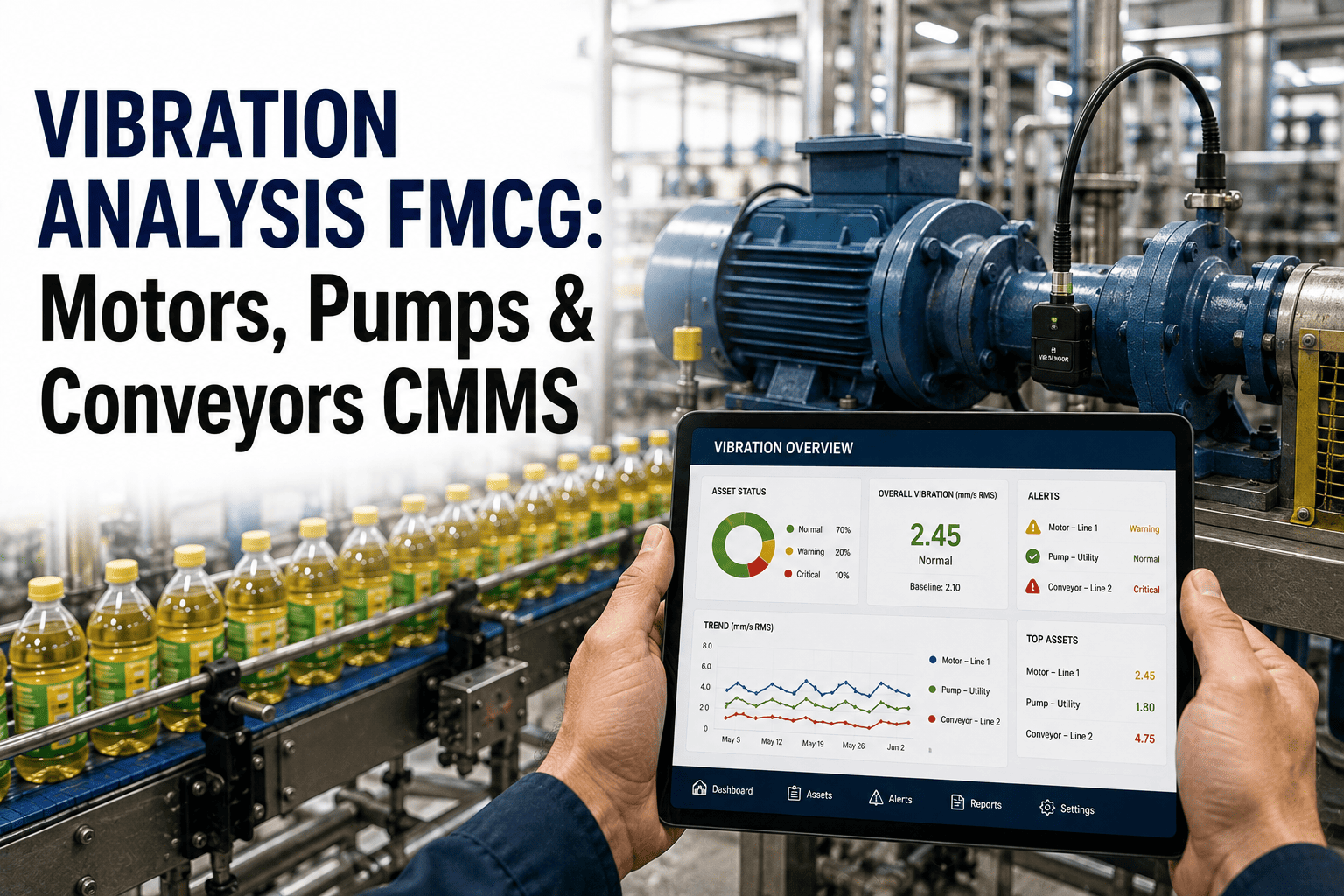
Wireless vibration sensors, temperature probes, current transformers, and acoustic emission monitors installed on critical FMCG assets—fillers, sealers, conveyors, mixers, and compressors. Sensors sample at 10-50 kHz to capture high-frequency fault signatures invisible to human senses.
02
Edge Processing & Feature Extraction
Industrial edge gateways perform Fast Fourier Transforms, envelope analysis, and statistical feature extraction locally—reducing raw vibration waveforms into meaningful health indicators in milliseconds. Edge processing ensures critical alerts trigger even during network outages.
03
AI Model Training & Learning
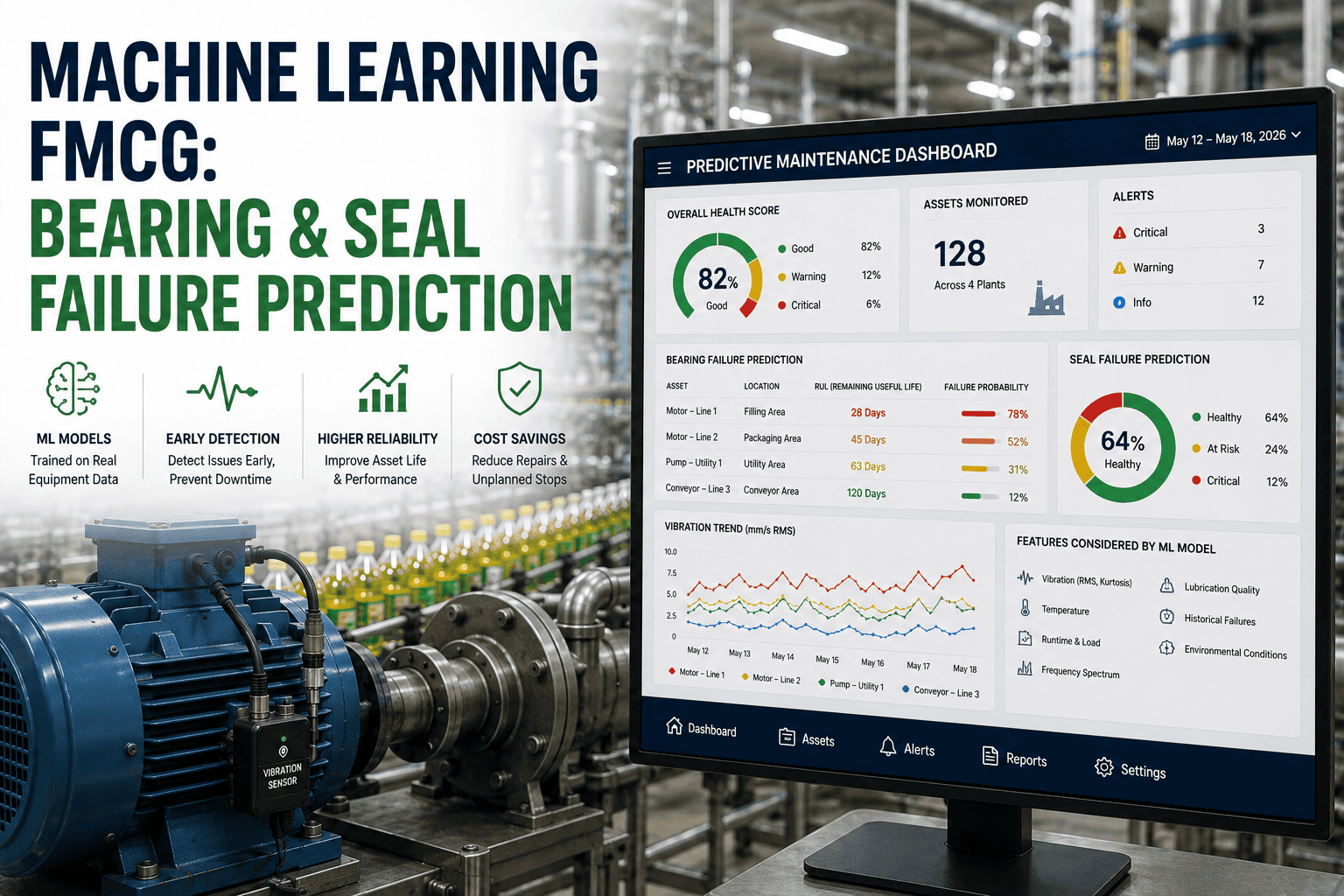
Machine learning models train on each asset's unique vibration spectrum, thermal profile, and current draw pattern during healthy operation. As the system accumulates failure history, supervised models learn the specific degradation signatures for each failure mode—bearing wear, belt misalignment, seal deterioration, gearbox tooth damage.
04
Remaining Useful Life Estimation
AI algorithms calculate remaining useful life (RUL) for monitored components, projecting when each asset will cross from acceptable degradation into failure risk. RUL estimates update continuously as new data arrives, narrowing prediction windows from weeks to days as failure approaches.
05
CMMS Work Order Generation
When AI detects impending failure, the system automatically generates a prioritized work order in the CMMS with the predicted failure mode, recommended parts, estimated repair time, and optimal maintenance window based on production schedule.
Book a demo to see how Oxmaint turns AI predictions into actionable maintenance workflows.
Critical FMCG Equipment for Predictive Monitoring
FMCG plants contain specific equipment categories where predictive maintenance delivers the highest return—assets that run continuously, fail expensively, and exhibit measurable degradation signatures before catastrophic failure.
Filling & Dosing Lines
Monitor servo drives, nozzle actuators, and rotary valve bearings. Detect fill accuracy drift from mechanical wear before it triggers overfill giveaway or underfill regulatory violations.
Sealing & Capping Machines
Track sealing bar temperature uniformity, jaw pressure consistency, and torque head wear patterns. Predict seal failures that cause product contamination, shelf-life reduction, and consumer complaints.
Conveyors & Material Handling
Vibration analysis on drive motors, belt tension monitoring, and bearing temperature tracking across conveyor networks. Predict chain stretch, belt tracking issues, and idler failures before line stops.
Mixers & Blenders
Monitor gearbox vibration spectra, seal leak detection, motor current analysis, and agitator shaft alignment. Critical for product consistency where mechanical degradation affects batch quality.
Compressors & Utilities
Track compressed air system health, refrigeration compressor vibration, and boiler combustion efficiency. Utility failures cascade across every production line simultaneously.
Labeling & Coding Equipment
Monitor print head degradation, label applicator timing drift, and servo positioning accuracy. Predict print quality failures and misapplication before they produce mislabeled product requiring recall.
Each equipment category exhibits distinct failure signatures that AI models learn to recognize. A filler bearing degradation follows a different vibration trajectory than a conveyor drive motor winding fault, and effective predictive systems distinguish between them—telling maintenance not just that something is wrong, but exactly what component is degrading and how long it has before failure. Plants managing diverse FMCG equipment can create a free Oxmaint account to see how the platform organizes predictive insights across all asset types.
Stop Reacting to FMCG Equipment Failures
Your calendar-based PM program cannot tell you that a filler bearing is 11 days from seizure or that a sealing bar heater is losing thermal uniformity. Oxmaint's AI predictive maintenance monitors every critical asset continuously, forecasts failures before they happen, and automatically generates the work orders to prevent them.
Calendar-Based vs. AI Predictive Maintenance
The fundamental limitation of time-based maintenance is that equipment doesn't fail on a calendar. Two identical fillers running different products, at different speeds, in different ambient conditions will wear at entirely different rates. AI predictive maintenance replaces fixed intervals with condition-based intelligence that adapts to actual equipment behavior.
Calendar-Based PM
- Fixed intervals regardless of actual condition
- Replaces healthy components prematurely
- Still experiences unexpected failures between PMs
- No visibility into real-time equipment health
- Maintenance scheduled around calendar, not production
30-40%
of PM tasks are unnecessary at time of execution
AI Predictive Maintenance
- Condition-based timing from continuous monitoring
- Replaces components at optimal remaining life
- Detects degradation weeks before failure
- Real-time health scores for every monitored asset
- Maintenance timed to minimize production impact
25-40%
reduction in total maintenance cost
AI Failure Detection Capabilities
Each FMCG equipment failure mode produces unique sensor signatures that AI models learn to recognize. The following table maps the primary failure modes, their detectable signatures, and the typical lead time between first AI detection and functional failure.
These lead times transform maintenance from emergency scrambles into planned interventions. A 14-day warning on a filler bearing means maintenance can order the part at standard shipping rates, schedule the repair during a planned changeover, and complete the swap in 30 minutes instead of 38 hours. Plants tracking diverse failure modes can schedule a consultation to discuss which assets in their operation offer the highest predictive maintenance ROI.
Measurable ROI of Predictive Maintenance
Predictive maintenance ROI in FMCG compounds across three dimensions: eliminated unplanned downtime, reduced spare parts inventory, and extended asset lifespan. The financial impact scales with production volume—the faster your lines run, the more expensive every minute of unplanned stoppage becomes.
Reduction in unplanned downtime events
Lower total maintenance spend
Reduction in emergency spare parts spending
Extension in average asset lifespan
Implementation Approach
Successful predictive maintenance deployment in FMCG requires starting with the assets that fail most expensively, proving value quickly, and then expanding systematically. Trying to instrument every asset on day one creates sensor fatigue and dilutes focus. A targeted approach delivers faster ROI and builds organizational confidence in AI-driven maintenance decisions.
Week 1-3
Criticality Assessment
Failure history & cost analysis
Asset criticality ranking
Sensor placement design
Week 4-6
Pilot Deployment
Sensor installation on top 5-10 assets
Edge gateway configuration
Baseline data collection
Week 7-12
AI Model Training
Normal behavior profiling
Anomaly threshold calibration
CMMS integration & workflow setup
Week 13+
Scale & Optimize
Expand to all critical assets
Supervised model refinement
RUL prediction activation
The pilot phase is critical. Starting with 5-10 assets that have documented failure history allows AI models to validate against known failure patterns. Once the system successfully predicts its first failure—and maintenance intervenes before breakdown—the organization understands the value viscerally, not theoretically. Plants ready to identify their highest-ROI pilot assets can sign up free for Oxmaint and begin the criticality assessment process immediately.
In FMCG, every unplanned stop is a cascade. The filler goes down, the upstream mixer has nowhere to send product, the downstream case packer starves, and within 15 minutes your entire line is idle. Predictive maintenance doesn't just prevent one repair—it prevents the production avalanche that follows. The first time AI gives you a two-week warning on a bearing that would have taken your line down for a full shift, the investment case is settled.
FMCG Plant Reliability Engineering Manager
Predict FMCG Equipment Failures Before They Happen
Your calendar-based maintenance program replaces parts that don't need replacing and misses the failures that actually shut down your lines. Oxmaint's AI predictive maintenance monitors every critical asset continuously, calculates remaining useful life in real time, and generates work orders with the right parts, right timing, and right priority—turning catastrophic breakdowns into planned 30-minute interventions.
Frequently Asked Questions
How many sensors does a typical FMCG plant need for predictive maintenance?
The number depends on asset criticality, not plant size. Most FMCG plants start with 20-50 wireless vibration sensors covering their 5-10 most failure-prone assets—typically the filling line, primary conveyor drives, mixer gearboxes, and critical utility equipment. Each asset usually requires 2-4 sensor points (drive end bearing, non-drive end bearing, gearbox, and motor). Plants can expand to 200+ sensors as they prove value and broaden coverage.
Book a demo to get a sensor plan designed for your specific equipment layout.
How long does AI take to learn our equipment's normal behavior?
Unsupervised anomaly detection models begin flagging abnormal behavior within 2-4 weeks of baseline data collection—enough time to capture normal operating variation across different products, speeds, and ambient conditions. Supervised failure prediction models require 3-6 months and ideally at least 2-3 documented failure events to develop accurate RUL estimates. However, transfer learning allows models trained on similar equipment at other facilities to accelerate this timeline significantly. Even in the baseline period, simple threshold-based alerts provide value immediately.
Does predictive maintenance work in washdown environments?
Yes. Modern industrial IoT sensors are designed for FMCG environments with IP67/IP69K ratings that withstand high-pressure washdown, caustic cleaning chemicals, and temperature extremes. Wireless sensors eliminate the cable routing challenges that make wired monitoring impractical in food plants where cables create harborage points. Battery-powered sensors with 3-5 year battery life mount directly to bearing housings, motor frames, and gearbox casings with industrial-grade adhesive or magnetic mounts that survive daily washdown cycles.
What happens when AI detects a potential failure?
The system follows a structured escalation workflow. First, the health score for the affected asset changes on the dashboard, alerting the reliability engineer. If degradation continues, the system generates a predictive work order in the CMMS specifying the predicted failure mode, recommended replacement parts, estimated time to failure, and suggested maintenance window that minimizes production impact. The maintenance planner can then schedule the intervention during a planned changeover or low-production period.
Sign up free to see the complete predictive workflow from detection to work order completion.
Can predictive maintenance integrate with our existing SCADA and CMMS?
Absolutely. Modern predictive platforms integrate with SCADA systems through OPC-UA, Modbus TCP, and MQTT protocols to leverage existing process data alongside dedicated sensor data. CMMS integration works through REST APIs, enabling automatic work order creation, parts requisition, and maintenance history documentation. The platform can also ingest historian data from PI, Wonderware, or similar systems to enrich AI models with process context—correlating equipment health with production parameters like speed, product type, and batch size.


.png)


