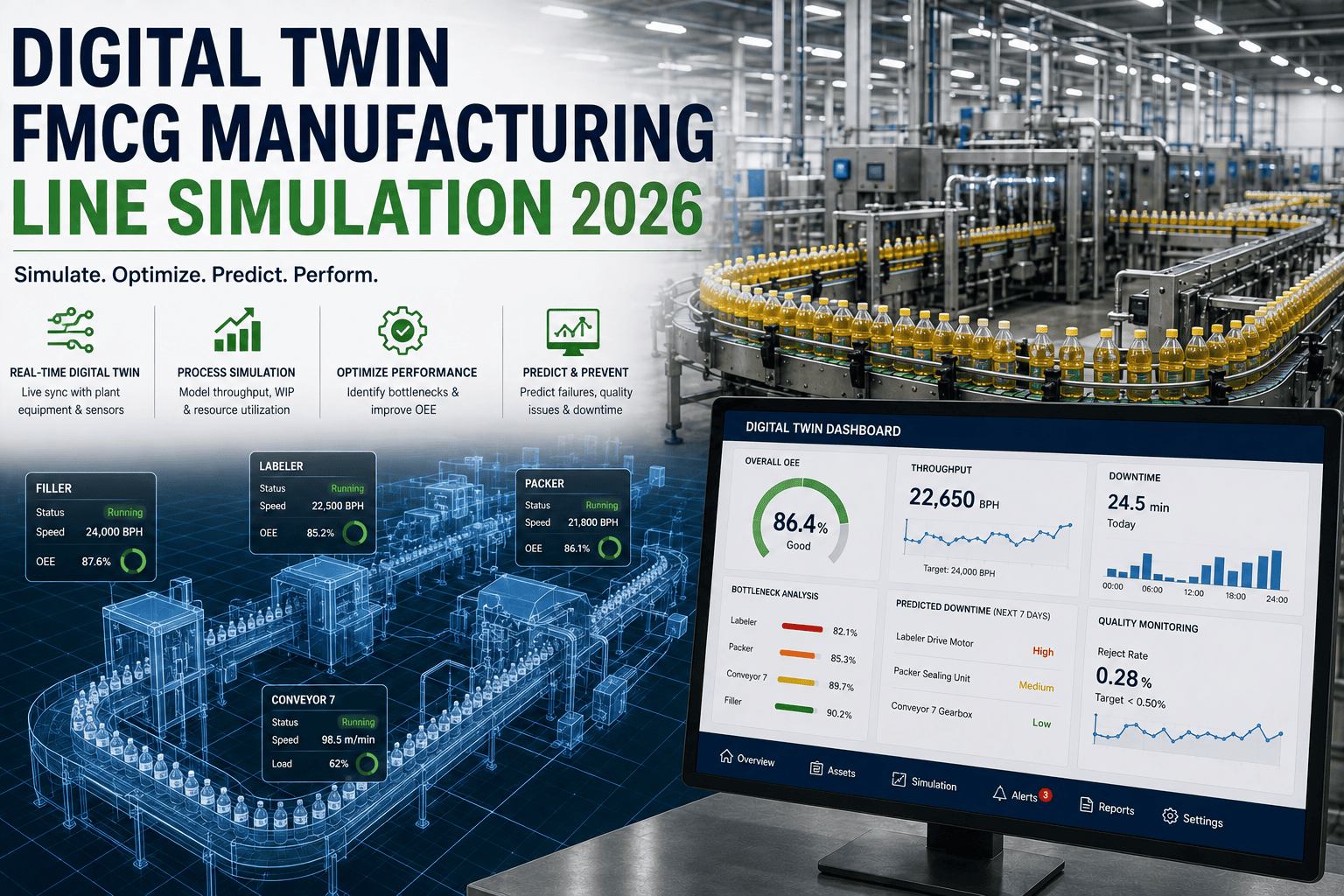
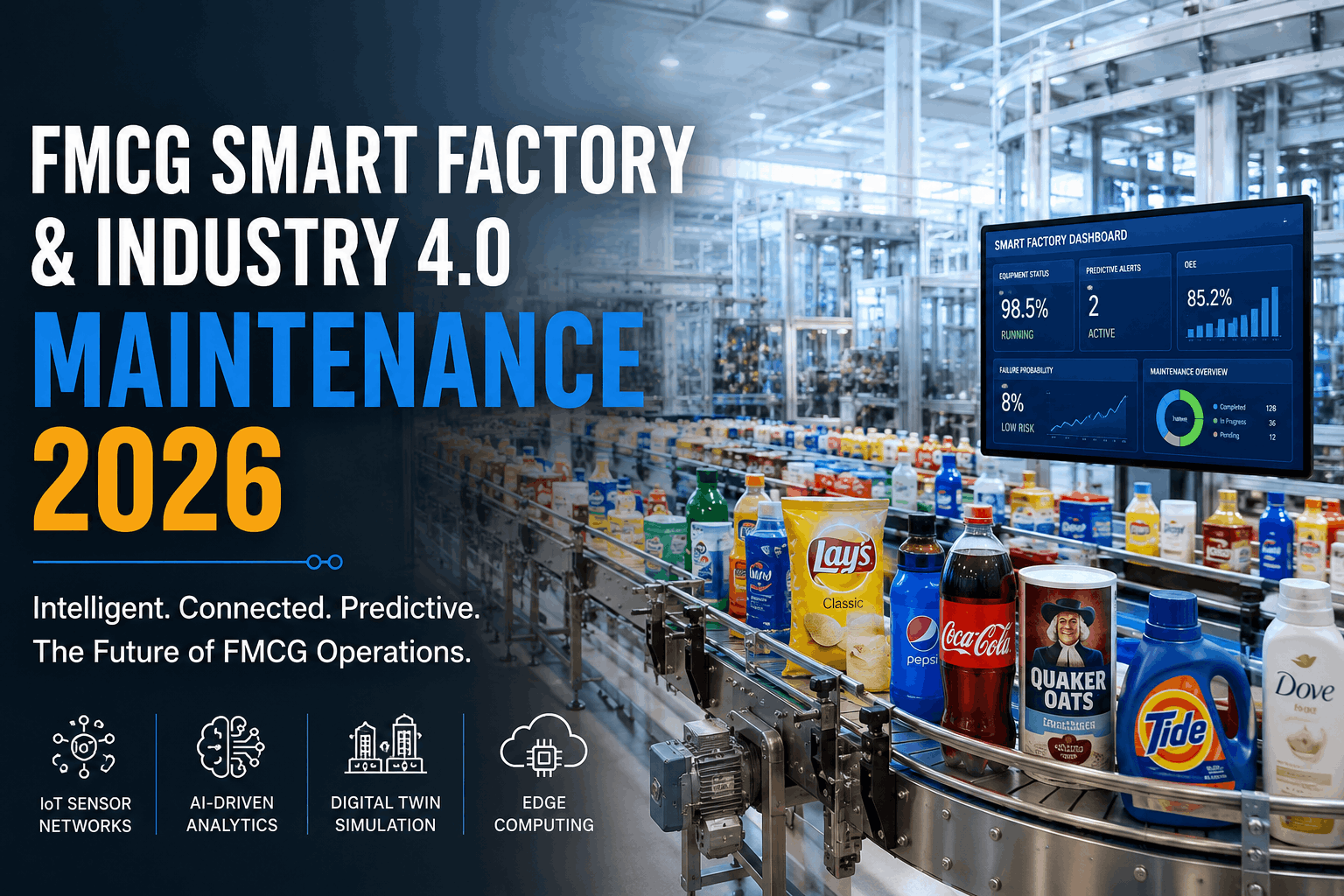
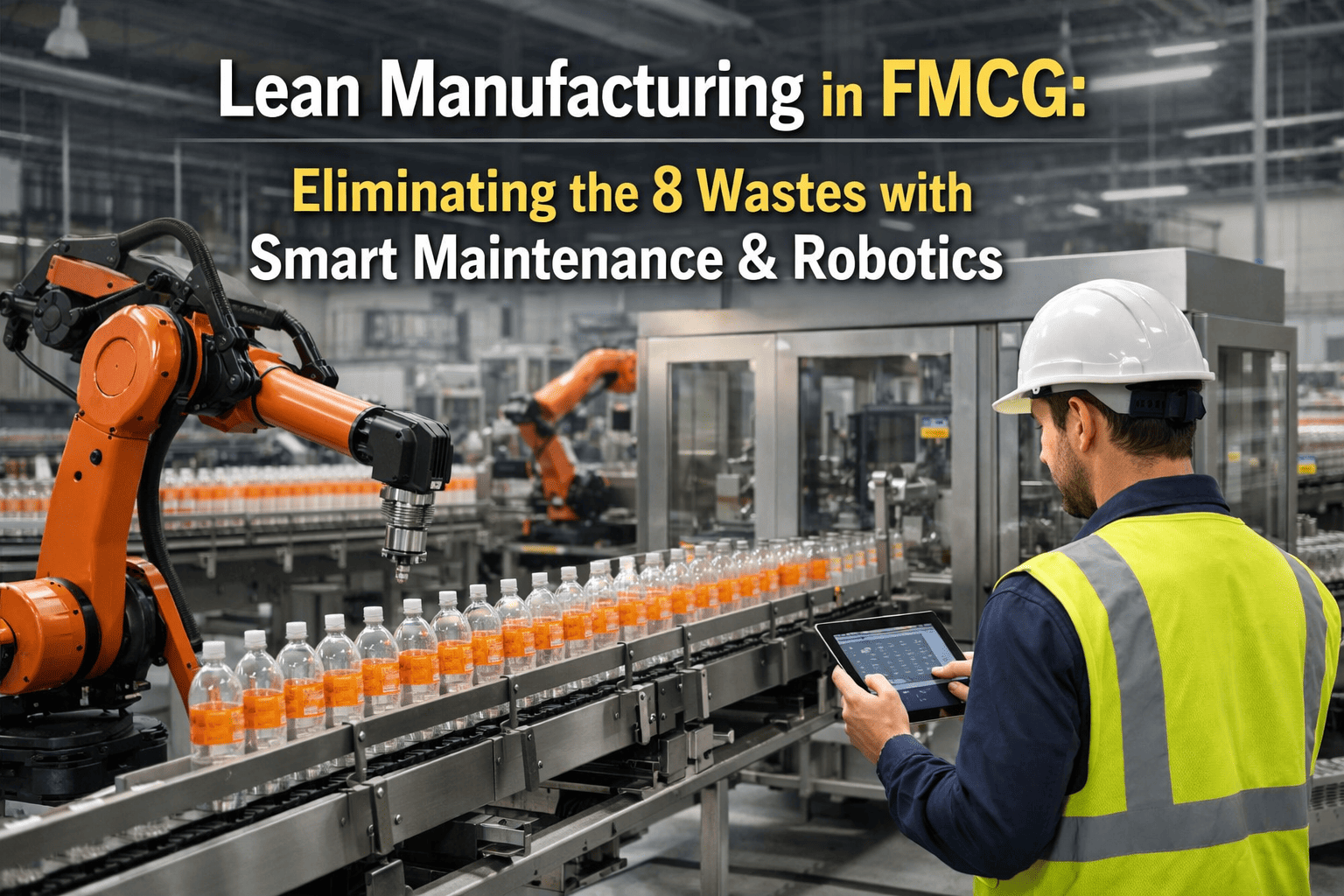
The average FMCG packaging line generates 4.2 terabytes of data per year from PLCs, sensors, drives, and HMIs — and throws away 97% of it. Temperature readings that could predict seal failures, vibration patterns that signal bearing degradation, current draw profiles that reveal motor wear — all streaming in real time, all ignored because the systems that generate data and the systems that act on data have never been connected. The smart factory is not a futuristic concept — it is the act of closing this loop: collecting equipment data with IoT sensors, analyzing it with AI, and automating responses through robotics and intelligent controls. FMCG plants deploying these technologies today are achieving 15–25% OEE improvement, 50–70% downtime reduction, and $1M–$3M annual savings on existing production lines — not by replacing equipment, but by making the equipment they already own dramatically smarter. Start your free trial to connect your first IoT sensors to AI-powered maintenance. Book a demo to see OxMaint's IoT Sensor Integration and Edge AI module on live FMCG data.
IoT Sensor Integration & Edge AI
Make Your Existing Equipment Smarter — Not Just Newer
OxMaint connects IoT sensors, AI analytics, and your CMMS into a single intelligence layer — turning raw machine data into predictive work orders, automated alerts, and self-optimizing maintenance schedules.
97%
of machine data generated on FMCG lines is never analyzed or acted upon
15–25%
OEE improvement from IoT + AI integration on existing equipment
$1M–$3M
annual savings at a typical 5-line FMCG smart factory deployment
What "Smart Factory" Actually Means for FMCG
Strip away the marketing buzzwords and a smart factory is built on three technology layers, each feeding the next. No single layer delivers transformative results alone — the value comes from the closed loop between sensing, thinking, and acting. Here is the architecture in practice:
Layer 1 — Sense
IoT Sensors & Edge Devices
Vibration
Tri-axial accelerometers on motors, gearboxes, pumps — 30-sec intervals
Temperature
Wireless sensors on bearings, motors, electrical panels, heat exchangers
Current / Power
CT clamps on motor feeds detecting load changes and winding degradation
Vision
AI cameras inspecting labels, seals, fill levels, and print quality at line speed
Layer 2 — Think
AI Analytics & Machine Learning
Anomaly Detection
ML models learn normal baselines and flag deviations invisible to human analysis
Failure Prediction
Remaining useful life estimates — 7–28 days of advance warning per asset
Root Cause Correlation
Links defect patterns to equipment degradation across multiple sensor streams
Optimization Engine
Recommends optimal run speeds, changeover sequences, and PM timing
Layer 3 — Act
Automated Response & Robotics
Auto Work Orders
CMMS generates predictive maintenance tasks with parts, timing, and priority
Self-Adjusting Lines
PLC parameters auto-tuned based on real-time quality and performance data
Cobot Deployment
Collaborative robots handling palletizing, pick-place, and changeovers
AMR Logistics
Autonomous mobile robots moving materials, parts, and finished goods
Most FMCG plants attempting smart factory initiatives fail because they start at Layer 3 (buying robots) or Layer 2 (buying AI software) without building Layer 1 (sensor infrastructure). AI cannot predict failures without continuous sensor data. Robots cannot self-optimize without AI feedback. The winning sequence is always Sense → Think → Act — and each layer delivers standalone ROI while enabling the next.
The Smart Factory ROI: Layer by Layer
Each technology layer delivers measurable returns independently — you do not need to deploy all three to start seeing value. Here is what each layer contributes to a typical 5-line FMCG plant:
Predictive failure detection$320K/yr saved
Energy waste identification$62K/yr saved
Equipment life extension$180K/yr saved
Optimized maintenance timing$210K/yr saved
Quality defect prevention$180K/yr saved
Speed optimization per SKU$145K/yr saved
Labor reallocation (cobots)$290K/yr saved
Changeover automation$185K/yr saved
24/7 consistent output$350K/yr saved
Combined Smart Factory Value: $1.9M/yr on a 5-Line FMCG Plant
The critical insight: Layer 1 has the highest ROI ratio because the investment is lowest and the data it produces feeds everything else. A $50K sensor deployment generating $562K in annual savings is the fastest path to proving smart factory value and funding the next layers. Plants that start with $250K robot purchases skip the data foundation and get expensive automation that cannot self-optimize.
Five Use Cases Running in FMCG Plants Today
These are not pilot projects or proof-of-concept demos. These are production-deployed smart factory use cases operating at scale in FMCG plants across snack, beverage, dairy, and personal care manufacturing.
01
Predictive Bearing Replacement
Vibration sensors on 40+ motors feed AI models that predict bearing failure 14–28 days ahead. CMMS auto-generates work orders with parts and timing.
72% fewer unplanned bearing failures — $274K saved per year
02
AI Vision Quality Gate
Cameras at 4 inspection points detect label, seal, fill, and print defects at 1,200 upm. Defect data feeds back to maintenance as equipment health alerts.
99.8% detection accuracy — 75% recall reduction — $180K system, $8M+ value
03
Self-Tuning Filler Speeds
AI analyzes real-time fill accuracy, reject rates, and nozzle performance to auto-adjust fill speeds per SKU. Operators approve — system executes.
8% throughput increase on variable-viscosity products — $340K recovered output
04
Cobot Palletizing Fleet
3 cobots handling end-of-line palletizing across 5 lines. Recipe-driven changeovers in under 60 seconds. Joint torque and cycle data tracked in CMMS.
Zero ergonomic injuries — 25% throughput gain on night shift — 4.2 month payback
05
Energy Optimization Loop
Power monitors on compressors, chillers, and HVAC correlate energy usage with production schedules. AI identifies waste patterns and recommends setpoint adjustments.
12% energy cost reduction — $95K/yr savings — 8 month payback on sensors
The common thread across all five use cases: they retrofit onto existing equipment. None required replacing a production line or installing a greenfield system. Smart factory is an overlay strategy — sensors bolted onto existing motors, cameras mounted beside existing conveyors, cobots placed at the end of existing lines. This is what makes the ROI so compelling: the denominator (investment) is small because you are upgrading the intelligence layer, not the mechanical layer.
IoT + AI + CMMS
Start With Sensors. Let AI Do the Thinking. Let Your Team Do the Winning.
OxMaint integrates IoT sensor data, AI failure predictions, and automated work orders in one platform — so your existing equipment becomes a smart factory without replacing a single machine.
The Maturity Roadmap: Where to Start and How to Scale
Smart factory transformation is a 12–18 month journey with value at every stage. Plants that try to leap to "fully autonomous" in 6 months fail. Plants that follow this staged approach build capability and ROI cumulatively.
Connected
Deploy 40–80 sensors on critical assets. Establish data pipelines to CMMS. Begin condition monitoring and basic alerting. First predictive catches within 4–8 weeks.
Expected ROI: $200K–$400K/yr
Predictive
AI models trained on your equipment data. Failure predictions with 85–92% accuracy. Automated work order generation. Quality-to-maintenance correlation enabled.
Expected ROI: $500K–$900K/yr
Optimized
AI recommends optimal speeds, schedules, and maintenance windows. Cobots deployed on highest-ROI stations. Digital twins model what-if scenarios before changes go live.
Expected ROI: $1M–$2M/yr
Self-Optimizing
Closed-loop automation: sensors detect → AI decides → systems adjust → results validate. Human oversight shifts from operating to governing. Continuous improvement is automated.
Expected ROI: $1.5M–$3M/yr
Phase 1 is the critical proof point. If your sensor deployment does not deliver measurable value within 8 weeks, something is wrong with the targeting — not the technology. The most common Phase 1 mistake is instrumenting too many assets at once. Start with your 15–20 worst-performing assets (highest downtime, highest repair cost). These are where the first predictive catches will occur and where the ROI is fastest and most visible.
Common Pitfalls and How to Avoid Them
80% of failed smart factory initiatives fail for organizational reasons, not technical ones. These are the five traps that derail FMCG smart factory programs — and the proven countermeasures.
1
Starting with robots, not sensors
Deploy sensors first — data enables everything else
2
Instrumenting every asset at once
Start with 15–20 worst assets — prove ROI, then expand
3
IT owns the project, not operations
Maintenance + operations lead — IT supports infrastructure
4
Collecting data without action workflows
Every sensor alert must trigger a CMMS work order or it is noise
The most damaging pitfall is the fourth one: collecting data without action workflows. Plants that install 200 sensors and build beautiful dashboards but do not connect those dashboards to work order generation end up with expensive monitoring systems that nobody acts on. The rule is simple: if a sensor alert does not trigger a specific maintenance action within the CMMS, it should not exist. Dashboards are outputs. Work orders are outcomes.
Frequently Asked Questions
IoT Sensor Integration & Edge AI
Your Equipment Already Generates the Data. Now Make It Work.
$1.9M
annual smart factory value
90 Days
to first predictive catch
Trusted by FMCG teams deploying smart factory technology across snack, beverage, dairy, and personal care manufacturing. No credit card required.