AI-Optimized Maintenance Scheduling in Food Manufacturing

By Fur Jaden on March 2, 2026

ai-optimized-maintenance-scheduling-food-manufacturing

A snack food manufacturer in Georgia was running 47 scheduled PM tasks every week across two production lines — all assigned by calendar, all treated with equal urgency, and all consuming the same fixed maintenance crew regardless of what the equipment actually needed. In any given week, 12 of those tasks were performed on assets running perfectly, 8 were overdue because priority conflicts had pushed them back, and 3 genuinely critical interventions were buried in the queue behind lower-risk paperwork tasks. Nobody knew which was which until something broke. After deploying AI-optimized maintenance scheduling through Oxmaint, the same crew handled the same assets — but now every task was ranked by actual failure probability, weighted by production impact, and timed to minimize line disruption. Emergency work orders dropped 61% in the first quarter. PM compliance hit 94%. And the maintenance manager stopped fielding 11 PM calls. Sign up for Oxmaint to put AI-driven scheduling intelligence to work in your food plant today.

AI Optimization  ·  AI Scheduling Systems

AI-Optimized Maintenance Scheduling in Food Manufacturing

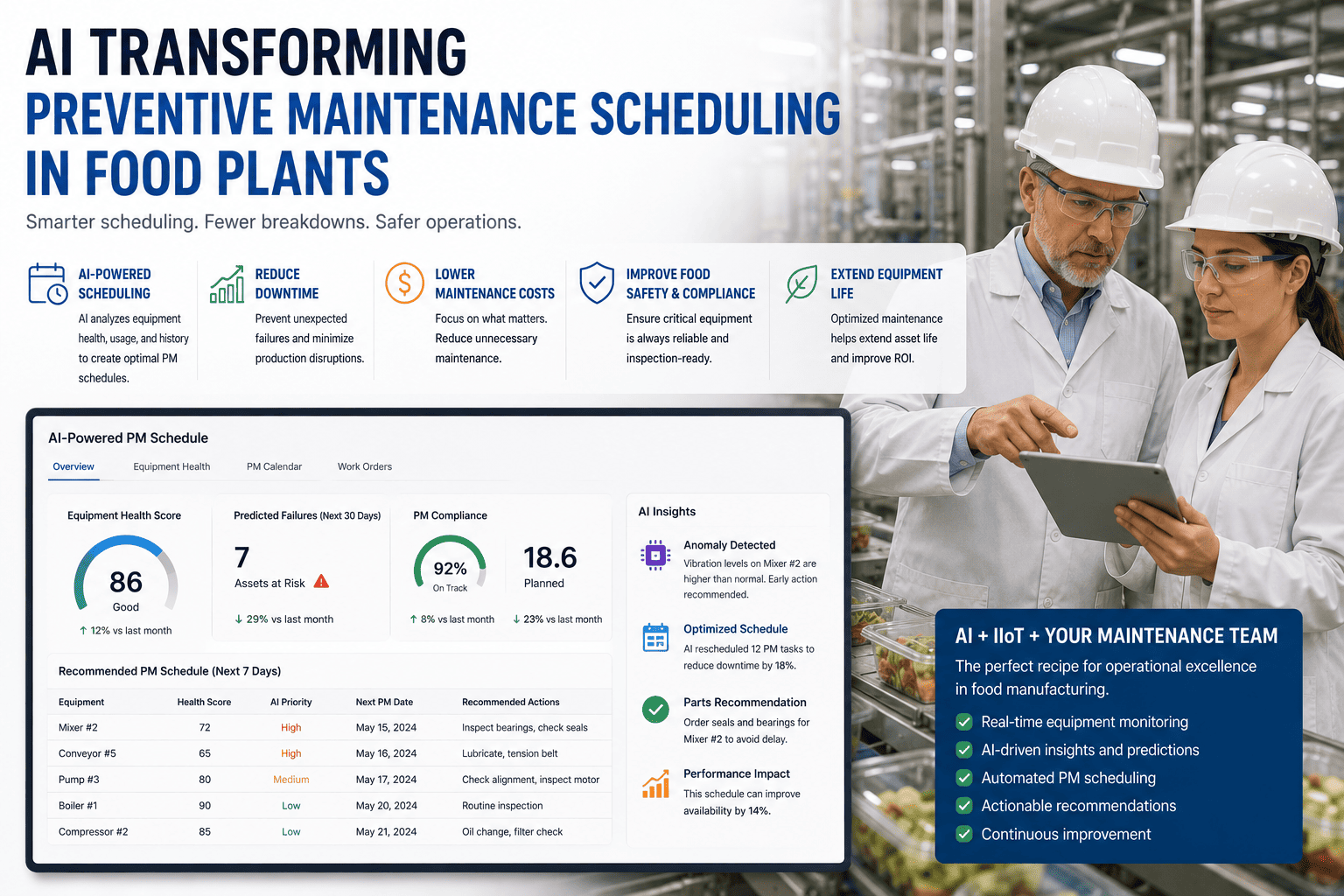
Calendar-based maintenance schedules treat every task with equal importance regardless of actual equipment condition, production risk, or available resources. AI-optimized scheduling replaces this static approach with a dynamic intelligence engine that continuously re-prioritizes every maintenance task based on real-time failure probability, production impact, crew availability, and parts readiness — ensuring the right work happens at exactly the right time.

61%
Reduction in emergency work orders within 90 days of AI scheduling deployment

94%
PM compliance rate achieved vs. industry average of 68% with calendar-based programs

38%
Reduction in total maintenance labor hours through elimination of unnecessary PM tasks

2.4x
ROI improvement when maintenance resources are directed by AI priority scoring
The Problem With Calendar PM

Why Fixed-Schedule Maintenance Fails Food Manufacturing Operations

Calendar-based preventive maintenance is the dominant approach in food manufacturing — and it is systematically wrong in ways that compound over time. Understanding exactly where calendar scheduling fails helps food plant managers see why AI-optimized scheduling produces such dramatically different operational outcomes.

01
Over-Maintenance of Healthy Assets

When every PM task fires on schedule regardless of equipment condition, a significant percentage of maintenance labor is spent on assets that need nothing. Industry analysis consistently shows that 25–35% of scheduled PM tasks in food plants are performed on equipment that is operating within optimal parameters and would not benefit from intervention for another 4–8 weeks. This over-maintenance consumes crew time that should be directed at genuinely at-risk assets, wastes consumables, and introduces the risk of maintenance-induced failures from unnecessary disassembly and reassembly.

Wasted labor: 25–35% of all scheduled PM hours on healthy assets
02
Under-Maintenance of Degrading Assets

The same calendar schedule that over-maintains healthy assets simultaneously under-maintains degrading ones. A conveyor bearing that is developing a fault 3 weeks before its scheduled PM will continue degrading until the calendar date arrives — or until it fails catastrophically first. Calendar schedules are set based on average failure intervals, not the actual condition of specific equipment. An asset running under heavy production load, in a harsh thermal environment, or with a maintenance-induced vulnerability may need attention at half its standard PM interval — but calendar scheduling has no mechanism to recognize or respond to this.

Failure risk: Assets degrade through scheduled intervals without condition-based adjustment
03
No Production-Aware Timing

Calendar PM schedules are typically set during commissioning and rarely updated to reflect actual production patterns. A monthly PM task assigned to the 15th of each month will fire regardless of whether the 15th falls during peak production, a scheduled changeover window, a sanitation cycle, or a planned shutdown. In food manufacturing, where production schedules change weekly and sanitation windows are the natural maintenance opportunity, calendar-anchored scheduling consistently fires tasks at the worst possible times and misses the best available windows entirely.

Timing waste: PM tasks scheduled at wrong production phases 40–60% of the time
04
Static Priority — No Risk Weighting

When resource constraints force trade-offs — when 12 PM tasks compete for 6 available maintenance hours — calendar systems provide no rational basis for prioritization. The task that gets bumped is typically the one that is easiest to defer, not the one with the lowest consequence of deferral. Without failure probability data and production impact scoring, maintenance managers are forced to make priority decisions by gut feel. The result is a systematic tendency to defer exactly the tasks that carry the highest risk, because high-risk tasks are often the most disruptive and complex to execute.

Decision quality: Priority trade-offs made by intuition, not failure probability data
How AI Scheduling Works

The Four Engines Inside AI-Optimized Maintenance Scheduling

AI-optimized maintenance scheduling is not a smarter calendar — it is a fundamentally different decision architecture that replaces fixed intervals with continuously calculated risk scores, production-aware timing, and resource-matched work packages. Here is how each analytical engine operates.

Engine 1
Dynamic Risk Scoring
Every asset in your food plant receives a continuously updated failure risk score that combines current condition data (inspection readings, sensor values, and operator observations) with historical failure patterns for that asset class and equipment age data. The risk score changes in real time as new inspection data arrives, as sensor readings shift, and as operating conditions change. An asset that scored "low risk" on Monday morning may score "medium risk" by Wednesday afternoon if inspection readings show a developing trend — and the AI scheduling engine immediately elevates its priority in the maintenance queue without waiting for human review.
Engine 2
Production Impact Weighting
Risk scores alone don't determine scheduling priority — production impact weighting modifies risk scores based on what each asset's failure would actually cost. A sealing machine on your highest-volume line has a higher impact weight than the same sealing machine on a secondary line, even with identical risk scores. The AI incorporates downtime cost per hour, product criticality, line interdependencies, and inventory buffer levels to calculate a weighted priority score that reflects both the probability of failure and the consequence of failure — the combination that rational maintenance investment decisions require.
Engine 3
Production-Aware Window Optimization
The AI scheduling engine integrates with your production schedule to identify optimal maintenance windows for every task. Sanitation cycles, planned changeovers, scheduled line pauses, and shift transitions are all recognized as natural maintenance opportunities. The engine matches task duration, crew skill requirements, and parts availability against available windows — scheduling each task in the window where it creates the least production disruption. A 45-minute bearing replacement that would cost 45 minutes of production downtime if done reactively might fit perfectly into a scheduled 60-minute changeover that was happening anyway.
Engine 4
Resource & Parts Matching
Scheduling a high-priority maintenance task that cannot be executed because the required technician skill is unavailable or the necessary parts are not in stock does not prevent failures — it just creates false confidence. The AI resource matching engine checks every scheduled task against crew availability, skill certification requirements, and parts inventory before confirming a maintenance appointment. Tasks that cannot be properly resourced are either rescheduled to the next available window with appropriate resources or trigger automatic parts procurement requests to ensure readiness before the optimized window arrives.
Stop scheduling by the calendar. Start scheduling by risk.
Oxmaint's AI scheduling engine continuously re-prioritizes every maintenance task in your food plant based on real failure probability, production impact, and crew availability — not the date it was set up during commissioning.
Scheduling in Practice

A Week in the Life: Calendar PM vs. AI-Optimized Scheduling

The practical difference between calendar-based and AI-optimized maintenance scheduling becomes clear when you compare how the same maintenance crew handles the same week with each approach. Both scenarios involve the same 6-person maintenance team, the same 3 production lines, and the same equipment portfolio.

Calendar-Based Week
Monday
Conveyor lubrication on Line 1 — asset health score: 94/100 (unnecessary)
Metal detector calibration verification — passed last 3 checks, no trend concern
Packaging line drive bearing inspection — asset health score: 58/100 (deferred to Thursday)
Wednesday
Monthly gearbox oil change — 3 weeks early based on oil sample analysis
Packaging line bearing fails at 2 PM — 6-hour emergency repair, $31K production loss
Thursday
Packaging line bearing inspection (scheduled) — now irrelevant, bearing already replaced
Refrigeration unit filter check — no performance degradation indicators present
Result: 1 emergency failure · $31K production loss · 3 unnecessary PM tasks completed
AI-Optimized Week
Monday
Packaging line drive bearing inspection — AI risk score: 72/100, ranked #1 priority for week
CIP pump seal check — AI flagged 0.8°C/week temperature rise, scheduled for 60-min sanitation window
Wednesday
Bearing replacement during planned 45-min changeover — $420 in parts, 0 production impact
Metal detector sensitivity trend review — AI cleared as low-priority, freed time for higher-risk assets
Thursday
Refrigeration compressor inspection — AI detected 6% runtime extension trend, addressed proactively
Conveyor lubrication deferred to next week — AI confirmed health score 94/100, no risk in deferral
Result: 0 emergency failures · $0 unplanned production loss · Every task ranked by actual risk
Scheduling by Asset Type

How AI Scheduling Criteria Vary Across Food Manufacturing Equipment

AI scheduling optimization applies different weighting factors and window logic to different equipment categories. The risk signals that matter for a refrigeration unit are fundamentally different from those that matter for a metal detector — and the optimal maintenance windows differ just as much.

Conveyors & Drive Systems
AI scheduling factors:
Belt tension readings, motor amperage trend, bearing vibration signature, lubrication interval vs. actual cycle count
Optimal maintenance window:
Sanitation cycle (2–4 hrs), changeover between product runs, or scheduled production pause. Belt adjustments and bearing inspections can occur during 15–30 min micro-stops.
Production impact if unplanned:
High — typically halts entire production line
Metal Detectors & X-Ray Systems
AI scheduling factors:
Sensitivity drift rate, reject mechanism timing trend, false reject rate trend, post-sanitation temperature deviation pattern
Optimal maintenance window:
Pre-production startup window (30 min before first run), or during scheduled sanitation. Calibration and mechanical checks require line stoppage but can often be batched with adjacent PM tasks.
Production impact if unplanned:
Critical — food safety CCP, regulatory line stop required
Industrial Mixers & Blenders
AI scheduling factors:
Gearbox oil temperature trend, vibration frequency shift, motor amperage post-service baseline comparison, batch mix time extension rate
Optimal maintenance window:
Between batch cycles (15–45 min), scheduled recipe changeover windows, or end-of-shift CIP period. Gearbox oil changes require 45–90 min and are best scheduled during overnight sanitation.
Production impact if unplanned:
High — batch loss plus formula consistency risk
Refrigeration & Cold Chain
AI scheduling factors:
Compressor runtime per cycle extension, suction pressure trend, condenser delta-T, cold room recovery time at standard load
Optimal maintenance window:
Low production load periods, scheduled defrost cycles, or facility maintenance windows. Refrigeration PM must avoid disruption to cold chain — AI schedules non-invasive checks during operation and major service during planned downtime.
Production impact if unplanned:
Critical — cold chain compliance and product safety at risk
Packaging Lines
AI scheduling factors:
Seal jaw temperature variance, fill weight standard deviation trend, reject rate by SKU, label placement drift rate
Optimal maintenance window:
SKU changeover windows (20–60 min), film roll changes (5–10 min micro-stops), or overnight sanitation. Seal jaw replacements require line cooldown and are best scheduled during extended sanitation windows.
Production impact if unplanned:
High — product integrity and throughput directly affected
CIP Systems
AI scheduling factors:
Chemical concentration variance, cycle time extension trend, flow rate progressive decline, temperature recovery rate deterioration
Optimal maintenance window:
Between CIP cycles when the system is accessible but lines are clean. Pump and valve maintenance scheduled during production periods when CIP system is on standby. Chemical system checks performed during pre-sanitation prep.
Production impact if unplanned:
Critical — sanitation compliance and food safety directly at risk
Every asset type gets the right PM at the right time — automatically.
Oxmaint's AI scheduling engine knows the difference between a bearing that needs attention today and one that can wait three weeks — and it schedules both into the exact production windows where maintenance creates the least disruption and the most protection.
Results Benchmark

What Food Plants Actually Achieve with AI-Optimized Scheduling

These performance outcomes reflect documented operational improvements from food manufacturing facilities that transitioned from calendar-based PM to AI-optimized maintenance scheduling. Results vary by facility size, starting maintenance maturity, and equipment complexity.

Performance Metric
Calendar PM Baseline
AI-Optimized Result
Improvement
Emergency work order rate
22–35% of all work orders
6–12% of all work orders
60–65% reduction
PM compliance rate
62–71%
90–96%
+28–34 points
Unplanned downtime hours/month
14–28 hrs
3–8 hrs
55–70% reduction
Maintenance labor hours wasted on healthy assets
25–35% of PM hours
8–12% of PM hours
65% reduction in waste
Mean time between failures (MTBF)
Baseline
+40–60% improvement
Significant extension
Maintenance cost per production unit
Baseline
22–31% lower
Material cost reduction
Time to first AI-optimized schedule
14–21 days post-deployment
Fast implementation
Frequently Asked Questions

AI Maintenance Scheduling for Food Plants — Questions Answered

These are the questions maintenance managers, plant engineers, and operations directors ask most frequently when evaluating AI-optimized maintenance scheduling for their food manufacturing facilities.

Does AI scheduling require us to abandon our existing PM program and start over?
No. Oxmaint's AI scheduling engine enhances your existing PM program rather than replacing it. Your current PM tasks, intervals, and procedures are imported into the system and become the foundation that the AI optimizes. The AI begins by learning your equipment's actual performance patterns, then progressively adjusts when tasks are triggered based on condition data rather than calendar date. You keep all the institutional knowledge embedded in your existing PM program while gaining the ability to move from fixed-interval to condition-based execution. Most facilities see the first AI-adjusted schedule within 14–21 days of deployment.
How does AI scheduling handle regulatory and compliance-mandated PM tasks that cannot be condition-deferred?
Food safety compliance PM tasks — including metal detector verification frequencies, HACCP-required equipment checks, and FSMA preventive control documentation requirements — are classified as non-deferrable in Oxmaint's scheduling engine. These tasks are always executed at their required compliance intervals regardless of asset condition. The AI optimizes window timing within those intervals (scheduling the task at the optimal point within the required frequency window) but never suggests deferring a compliance-mandatory task beyond its regulatory deadline. The system maintains a clear distinction between condition-deferrable PM and compliance-anchored PM, and generates separate compliance documentation for each category.
What data does the AI need to start generating scheduling recommendations?
The AI can generate initial scheduling priority recommendations with as little as 30 days of structured digital inspection data — no sensor infrastructure is required as a starting point. Digitizing your existing paper PM checklists with Oxmaint's mobile inspection forms creates the data stream the scheduling engine needs. Historical work order data from your existing CMMS (typically importable in 1–3 days) provides the failure pattern foundation that immediately improves scheduling accuracy. As more data accumulates — particularly sensor data and production context from SCADA integration — scheduling precision improves continuously. The system is purposefully designed to start delivering value before the data infrastructure is complete, improving as your data architecture matures.
How does the AI handle equipment that has never failed — where there is no failure history to learn from?
For new equipment or equipment with no documented failure history, Oxmaint's scheduling engine uses its pre-trained food manufacturing failure mode library — built from aggregate failure data across the broader food manufacturing equipment population. This library provides sensible default risk models for conveyors, mixers, metal detectors, refrigeration systems, packaging lines, and CIP systems that are appropriate for equipment at commissioning. As your specific equipment accumulates operational history, the model progressively shifts from the library baseline to a facility-specific model tailored to your equipment configuration, operating conditions, and production patterns. The transition is automatic and transparent — the scheduling engine simply becomes more precise as your data foundation grows.
Can the maintenance manager override AI scheduling recommendations?
Yes, always. AI scheduling recommendations in Oxmaint are presented as prioritized suggestions that the maintenance manager reviews and approves — not automatic dispatches that bypass human judgment. Every AI-recommended schedule shows the reasoning behind each prioritization decision: the specific risk signals detected, the production impact weighting applied, and the window timing rationale. Managers can accept, modify, or override any recommendation with a documented reason. Override patterns are tracked and fed back into the AI model — if certain AI recommendations are consistently overridden in specific circumstances, the model learns from those human judgments and adjusts future recommendations accordingly. The system is designed to improve human decision-making, not replace it.
How does AI scheduling integrate with our production schedule to find maintenance windows?
Oxmaint integrates with production scheduling systems — including ERP systems, MES platforms, and shared scheduling spreadsheets — to receive upcoming production plans. The AI scheduling engine reads planned production runs, changeover times, sanitation windows, and scheduled line pauses, then matches maintenance task duration and crew requirements against available windows. Integration methods include direct API connection, scheduled data file exchange, or manual schedule upload. For facilities without digital production scheduling, maintenance windows can be defined manually in Oxmaint (for example, "Monday 2–4 AM: sanitation window on Line 2") and the AI will match tasks to these windows in its scheduling recommendations. Even without full integration, window-aware scheduling consistently outperforms calendar scheduling by reducing production-maintenance conflicts.
What happens when the AI flags a high-priority task and the required parts are not in stock?
When Oxmaint's scheduling engine elevates a task to high priority based on condition data, it simultaneously checks parts inventory against the required components for that task. If required parts are not available, the system takes two parallel actions: it generates an automatic procurement alert to your parts management team or ERP system with the specific parts needed and the urgency level based on failure probability timeline, and it schedules a monitoring-only inspection for the near term while the full corrective action is pending parts arrival. The failure prediction window — typically 2–6 weeks for AI-detected developing conditions — usually provides sufficient lead time for standard procurement, avoiding emergency sourcing in most cases. For assets with very short predicted failure windows where standard procurement cannot deliver in time, the system escalates the alert to management for expedited sourcing decisions.
How long does it take to see measurable results after deploying AI-optimized scheduling?
The first measurable results typically appear within 30–60 days of deployment. Early wins often come from two sources: the identification of over-maintained assets where PM frequency can be safely reduced (freeing crew time immediately), and the identification of genuinely at-risk assets that were buried in the standard PM queue and can now be prioritized before they fail. The most significant outcome improvements — emergency work order reduction, MTBF extension, and maintenance cost reduction — typically become statistically significant at the 90-day mark when the AI has accumulated sufficient operational data to reliably distinguish developing conditions from normal variation. Most Oxmaint food manufacturing customers achieve positive ROI within their first 6 months of deployment, with the first prevented emergency failure event often covering a significant portion of the annual platform cost. Sign up for Oxmaint to start your deployment today.
Start Scheduling Smarter

Your Maintenance Crew Is Working Hard. AI Makes Sure They're Working on the Right Things.

AI-optimized maintenance scheduling doesn't replace your team — it gives every technician a prioritized work list that reflects actual equipment risk, production window opportunities, and resource availability. The result is a maintenance program that prevents more failures with the same crew, at the same cost, starting within weeks of deployment.

Share This Story, Choose Your Platform!