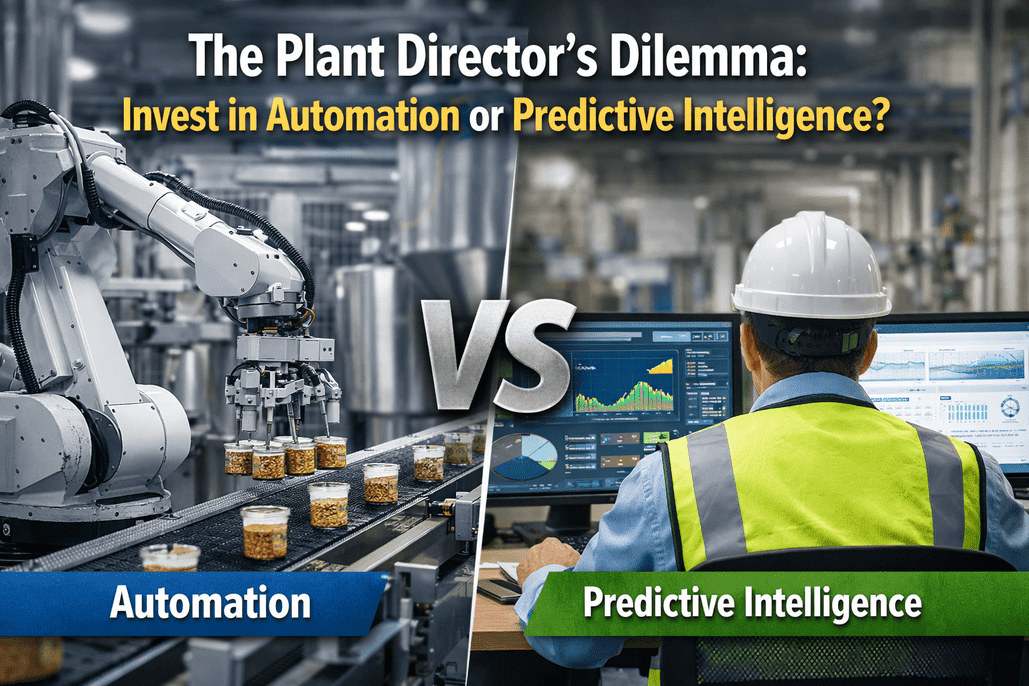
A mid-sized frozen meals facility was spending $340,000 annually on time-based preventive maintenance—replacing parts on schedule whether they needed it or not. Despite this investment, unplanned breakdowns still accounted for 28% of all production stoppages, costing an additional $180,000 per incident in spoiled product, overtime labor, and emergency parts. After transitioning to predictive maintenance management powered by CMMS condition monitoring, the same plant cut unplanned downtime by 40% in the first year and redirected $95,000 in unnecessary PM spending toward high-impact predictive tasks. The shift wasn't about abandoning preventive maintenance—it was about evolving it. Sign up for Oxmaint to start your transition from calendar-based maintenance to condition-based intelligence.
From Preventive to Predictive: The Evolution of Maintenance Management in Food Manufacturing
The food industry is undergoing a quiet revolution. Plants that once relied on fixed schedules and clipboard inspections are embracing sensor data, machine learning, and CMMS platforms to predict failures before they happen—saving millions and strengthening food safety compliance.
The Three Eras of Food Plant Maintenance
Maintenance in food manufacturing didn't leap from reactive to predictive overnight. It evolved through distinct phases—each building on the lessons and limitations of the last. Understanding where your plant sits on this spectrum is the first step toward modernization.
Reactive Maintenance
"Run it until it breaks"
Preventive Maintenance
"Fix it on a schedule"
Predictive Maintenance
"Fix it when data says it's needed"
Where Does Your Plant Sit on This Spectrum?
Most food facilities are somewhere between preventive and predictive. Oxmaint helps you bridge the gap with CMMS-powered condition tracking that turns scheduled maintenance into data-driven decisions.
Why Food Manufacturing Can't Afford to Stay Preventive-Only
Unlike general manufacturing, food plants face a unique combination of regulatory pressure, environmental stress, and zero tolerance for contamination. These factors make the case for predictive maintenance especially compelling.
Harsh Operating Conditions
Temperature swings, moisture, and caustic cleaning chemicals create variable stress that makes fixed-interval PM unreliable. A bearing in a cold room degrades differently than one in a dry warehouse—data captures what calendars cannot.
Regulatory Compliance at Stake
FSMA and HACCP require documented preventive controls. Maintenance logs aren't just internal records—they're legal documents. Predictive systems with CMMS integration create automatic, audit-ready maintenance trails that strengthen compliance posture.
Contamination Risk from Failures
A worn seal or overheated motor isn't just a maintenance problem in food—it's a potential contamination event. Predictive monitoring catches microscopic vibration changes and pressure shifts that indicate deterioration before product safety is compromised.
Thin Margins, High Stakes
With unplanned downtime costing up to $30,000 per hour and product spoilage adding to losses, food manufacturers need every advantage. Predictive maintenance lets teams schedule repairs during planned sanitation windows instead of scrambling during production.
The Transition: What Changes When You Go Predictive
Moving from preventive to predictive doesn't mean scrapping your existing program. It means layering intelligence on top of it. Here's how the day-to-day shifts across key operational areas. Sign up for Oxmaint to start making this transition.
Your 4-Phase Transition Roadmap
Shifting to predictive maintenance is a journey, not a switch you flip overnight. The most successful food manufacturers follow a phased approach that builds on existing preventive programs. Book a demo to discuss your plant's specific roadmap.
Digitize Your PM Program
Move from paper logs and spreadsheets to a CMMS platform. Capture every work order, inspection, and shift handoff digitally. This creates the data foundation that predictive analytics will later rely on.
Weeks 1-4Identify Critical Assets
Audit your equipment to determine which assets have the highest failure impact—pasteurizers, packaging lines, refrigeration compressors, and conveyors typically top the list. Focus predictive efforts where downtime hurts most.
Weeks 4-8Deploy Condition Monitoring
Install vibration, temperature, and current sensors on critical equipment. Start with 20-30 motors for a proof of concept. Feed sensor data into your CMMS to establish baselines and spot anomalies.
Weeks 8-16Activate Predictive Intelligence
Use CMMS analytics and machine learning to convert condition data into failure predictions. Set automated threshold alerts that trigger work orders before breakdowns occur. Scale across the facility based on proven results.
Weeks 16-24Real-World Results from the Transition
Food manufacturers who have made this shift are seeing measurable outcomes across downtime, cost, and compliance metrics.
Ready to Evolve Your Maintenance Strategy?
Oxmaint gives food manufacturers the CMMS foundation and predictive tools to transition from calendar-based maintenance to condition-based intelligence—without disrupting production.
How Oxmaint Powers the Preventive-to-Predictive Shift
Oxmaint isn't just a CMMS—it's the bridge between where your maintenance program is today and where it needs to be. Schedule a demo to see these capabilities in action.
Condition-Based Work Orders
Automatically generate work orders when sensor readings or manual inspections exceed defined thresholds. Maintenance happens when data demands it—not when the calendar says so.
Trend Analytics Dashboard
Track vibration, temperature, current draw, and cycle times across shifts and weeks. Spot the gradual degradation patterns that fixed-interval PM programs miss entirely.
Smart Threshold Alerts
Set custom alert thresholds for each asset based on baseline performance. When readings drift, on-shift technicians get instant notifications to investigate before failure occurs.
Audit-Ready Documentation
Every inspection, work order, and sensor reading is automatically logged with timestamps and technician IDs. FSMA and HACCP auditors get instant access to complete maintenance history.
Shift Logbook Integration
Capture observations and developing trends across shift handoffs. Predictive insights are only valuable if every shift sees them—Oxmaint ensures zero information loss between teams.
Controller Data Integration
Receive data from equipment controllers including cycle counts, error logs, and performance metrics. This data automatically populates maintenance records and feeds predictive models.
Frequently Asked Questions
The Future of Food Plant Maintenance Is Predictive
Every day you rely solely on calendar-based maintenance, you're over-spending on healthy equipment and under-protecting critical assets. Oxmaint gives you the tools to evolve—at your own pace, on your own terms.

.png)