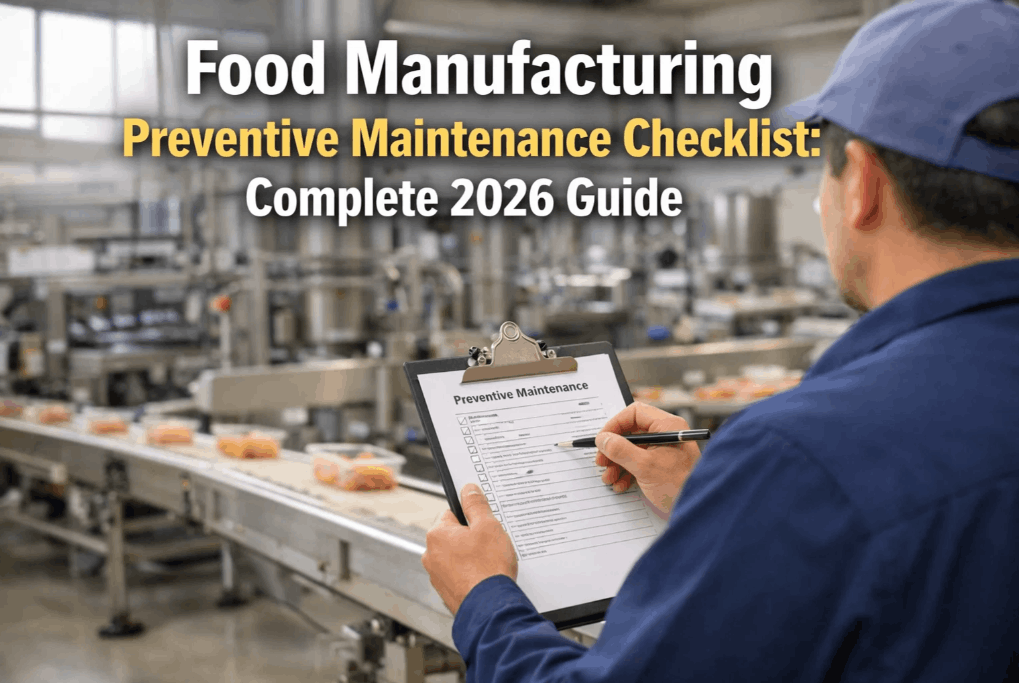
Food processing facilities operate under a dual mandate that few other industries face: maximize uptime while meeting the strictest hygiene standards in manufacturing. Preventive maintenance scheduling for food processing equipment is the operational backbone that keeps production lines running, regulatory audits clean, and product quality consistent. Yet most food plants still manage PM programs reactively — responding to failures rather than preventing them — costing the average mid-sized facility hundreds of thousands in unplanned downtime annually. Start free today and build a PM program that keeps your food processing equipment running at peak performance.
Automate Your Food Equipment PM Program
Schedule, track, and optimize preventive maintenance across every line — integrated with sanitation and production planning.
Why Preventive Maintenance Is Non-Negotiable in Food Manufacturing
In food processing, equipment failure is never just a production problem. A seized bearing on a conveyor line, a worn seal on a filling head, or a miscalibrated temperature controller on a retort system can trigger a cascade that reaches food safety, quality, and regulatory compliance simultaneously. The cost of corrective maintenance in a food plant is not simply the repair — it is the batch loss, the potential recall exposure, the sanitation teardown required before restart, and the production schedule disruption that ripples downstream.
Preventive maintenance programs in food processing environments must account for variables that don't exist in other manufacturing sectors: USDA and FDA oversight, HACCP critical control points tied to equipment performance, allergen cross-contamination risk from degraded seals, and the mandatory integration of PM activities with sanitation standard operating procedures. A PM program that ignores these interdependencies is not merely incomplete — it is operationally dangerous. Start your journey toward a fully compliant, audit-ready PM program today.
Building a Complete Preventive Maintenance Program for Food Processing Equipment
A high-performing PM program in food manufacturing is not a maintenance checklist — it is a structured system that connects equipment criticality, regulatory requirements, sanitation schedules, and production calendars into a coordinated operational framework. The following components are essential to any PM program that delivers measurable results in a food plant environment.
1. Equipment Criticality Assessment and Prioritization
Not all food processing equipment carries the same risk profile. The first step in building an effective PM program is conducting a criticality assessment that scores each asset on three dimensions: impact on production continuity, food safety consequence of failure, and cost and time to repair or replace. This assessment determines PM frequency, resource allocation, and escalation thresholds for each asset class.
Critical path equipment — fillers, pasteurizers, retort systems, CIP stations, and high-care zone conveyors — typically warrants daily or shift-level inspection tasks in addition to weekly and monthly PM intervals. Secondary equipment that does not directly contact product or affect a CCP can carry longer intervals, freeing maintenance bandwidth for high-risk assets.
2. PM Frequency Determination for Food Plant Equipment
PM frequency in food processing is driven by a combination of manufacturer specifications, regulatory requirements, historical failure data, and operational intensity. A filling machine running three shifts at full capacity needs more frequent PM than the same model running a single shift. Establishing correct intervals requires analysis of mean time between failures (MTBF), lubrication and wear cycles, sanitation frequency impact on components, and any applicable regulatory inspection requirements.
| Equipment Category | Typical PM Interval | Key PM Tasks | Regulatory Driver |
|---|---|---|---|
| Pasteurizers / Retorts | Daily + Monthly + Annual | Temperature calibration, seal inspection, valve function | FSMA, 21 CFR Part 113 |
| Filling and Dosing Systems | Weekly + Monthly | Nozzle wear, valve seating, fill weight accuracy | HACCP CCP verification |
| CIP / Sanitation Systems | Weekly + Quarterly | Flow rate, chemical dosing, spray coverage, temperature | SSOPs, audit readiness |
| Conveyors (product contact) | Daily inspection + Monthly PM | Belt integrity, bearing lubrication, frame sanitation gaps | GMP, SQF/BRC audit |
| Refrigeration / Cold Storage | Monthly + Semi-annual | Coil cleaning, refrigerant charge, temperature logging | Cold chain compliance |
| Metal Detectors / X-Ray | Per shift + Monthly calibration | Sensitivity testing, reject mechanism function, log verification | HACCP CCP, retailer codes |
| Packaging Equipment | Weekly + Quarterly | Seal integrity, date coding accuracy, film tracking | Labeling compliance |
Integrating PM Scheduling with Sanitation Programs
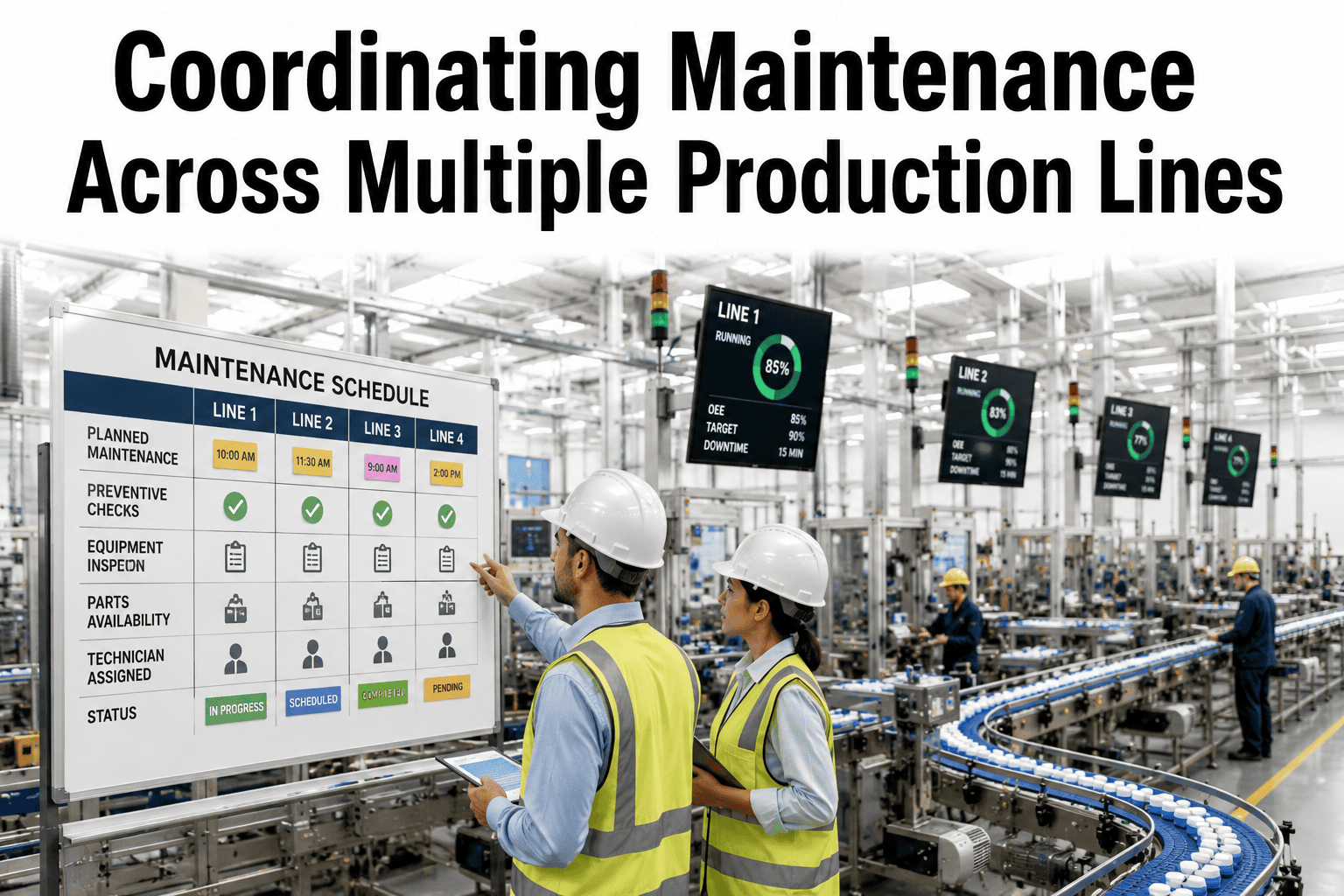
In food processing facilities, maintenance and sanitation are inseparable — yet in most plants, they are managed as entirely separate functions with separate schedules, separate ownership, and frequent conflicts over equipment access. This structural disconnect is one of the most common sources of PM non-compliance in food manufacturing: maintenance teams arrive to perform scheduled PM tasks on equipment that is either mid-sanitation, locked out for cleaning, or already back in production after sanitation ran early.
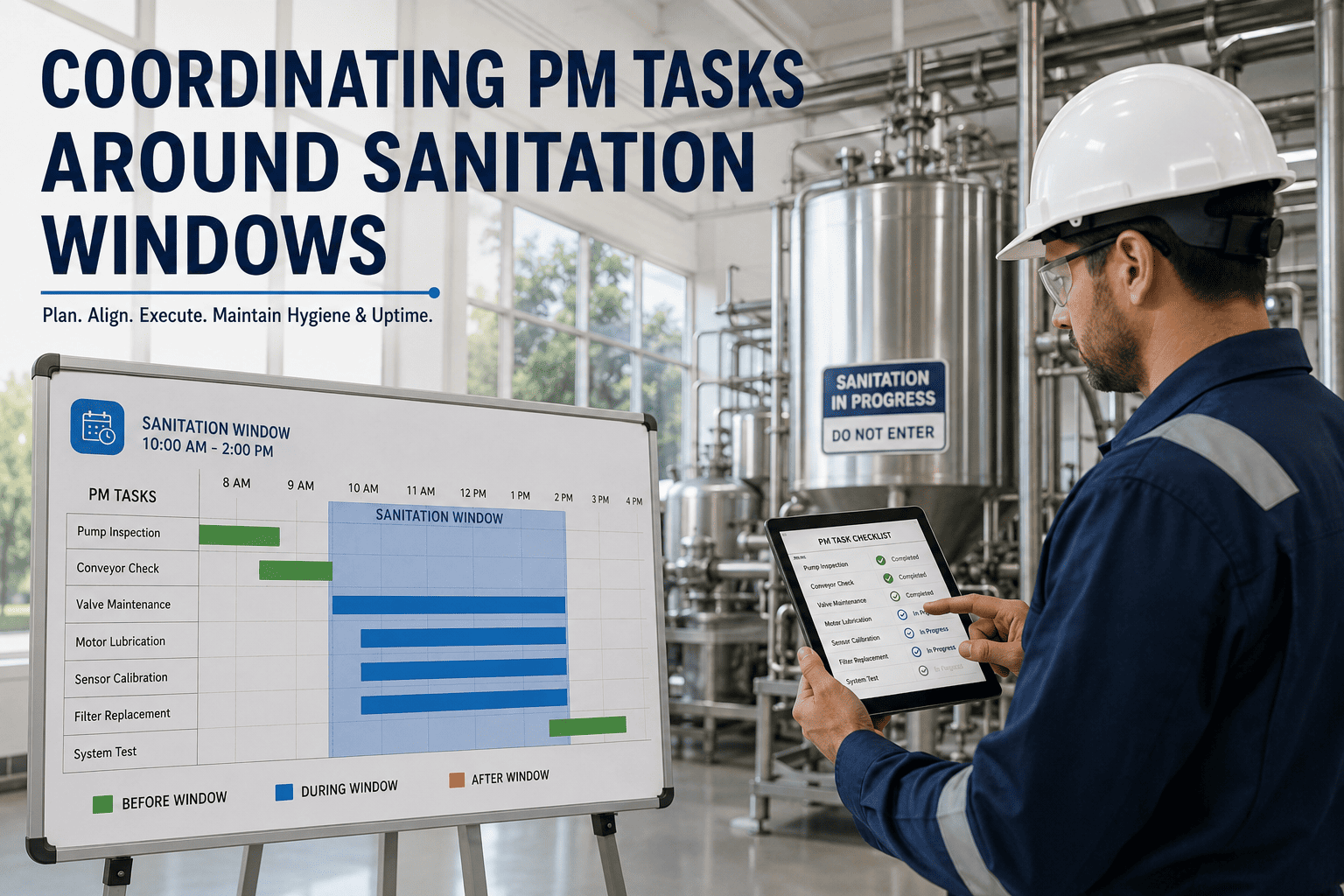
Effective PM programs in food plants require formal integration with the master sanitation schedule. PM tasks that require equipment disassembly — bearing replacements, seal changes, belt re-tensioning — are most efficiently performed either immediately before or immediately after a scheduled sanitation event, minimizing the number of separate production line shutdowns. Coordination with the sanitation supervisor should be a standing element of weekly PM planning meetings, not an ad hoc conversation when conflicts arise. Book a demo to see how integrated PM-sanitation scheduling works in practice.
Pre-Sanitation PM Window
Schedule lubrication, adjustment, and external inspection tasks in the hour before scheduled sanitation. Equipment is already offline; maintenance access requires no additional production interruption.
During-Sanitation Inspection Tasks
Perform disassembly-dependent inspections — bearing condition, seal integrity, spray nozzle condition — while sanitation has equipment opened for cleaning. Zero additional downtime added.
Post-Sanitation Verification
After sanitation sign-off and before production restart, maintenance completes functional verification — torque checks, operational run, sensor calibration — confirming the equipment is food-safe and mechanically sound simultaneously.
Coordinated Shutdown Planning
Major PM tasks requiring extended access are planned with production and sanitation leads during weekly scheduling. A shared maintenance calendar prevents conflicts and maximizes the productive use of planned downtime windows.
Production Schedule Coordination: Minimizing PM Impact on Throughput
Production pressure is the #1 reason PM tasks get skipped. When maintenance competes with output targets, output usually wins — and deferred PM quietly builds into breakdown risk.
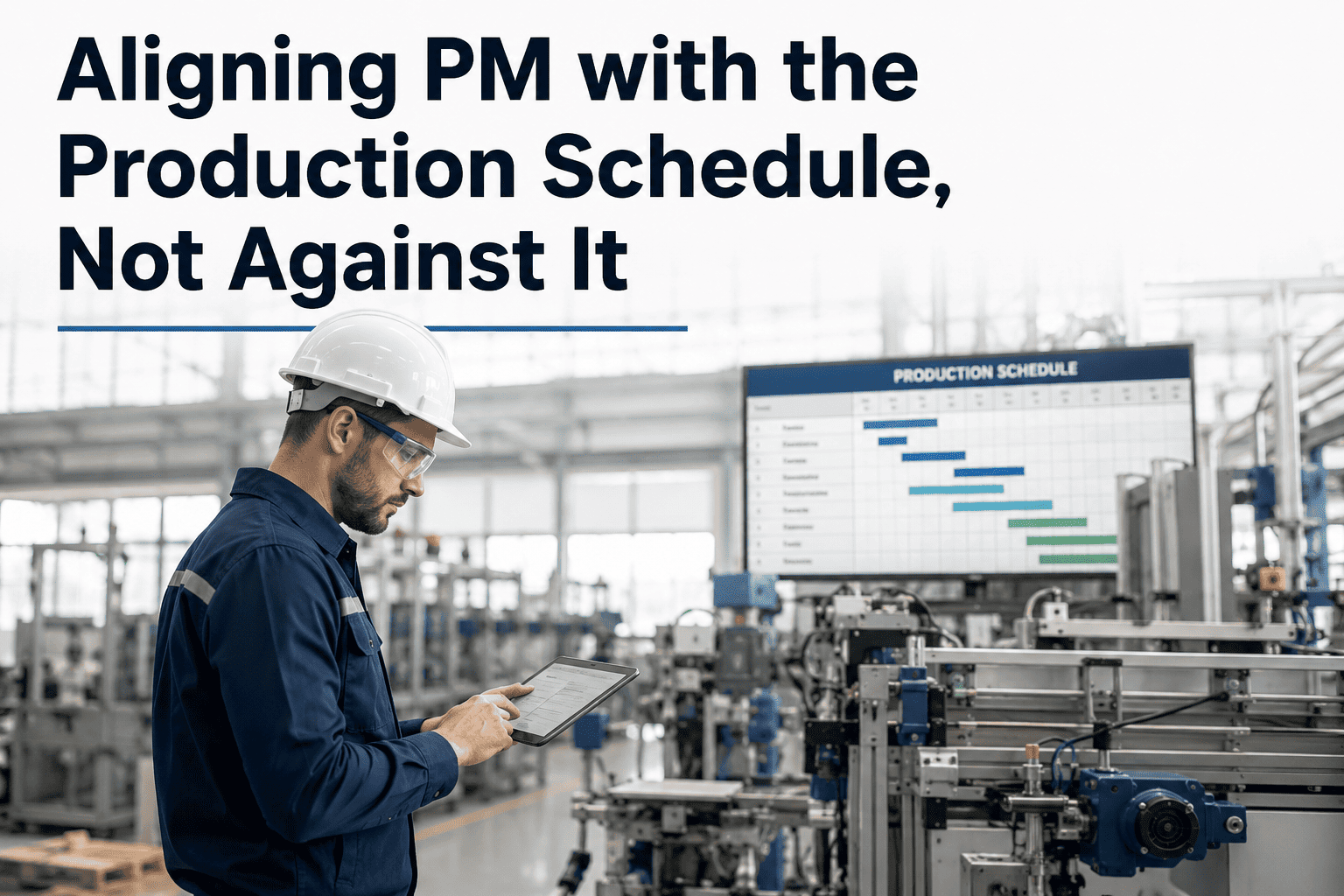
The fix is simple: anchor PM tasks to production transitions already in the schedule — changeovers, CIP runs, shift changes. No extra downtime. No conflict. PM gets done.
Changeover-Linked PM
Assign PM tasks to product or line changeover windows already in the production schedule. The equipment is offline anyway — maintenance access requires no additional downtime.
PM Compliance Tracking
Track PM completion rates by asset, line, and technician. Compliance dashboards surface deferred tasks before they accumulate into backlog that creates breakdown risk.
Shutdown Maintenance Optimization
Batch major PM tasks — motor replacements, gearbox overhauls, conveyor re-belting — into planned weekly or monthly shutdown windows, maximizing the ROI of each production halt.
Cross-Functional PM Calendar
A shared maintenance calendar visible to production, sanitation, and quality teams prevents scheduling conflicts and ensures PM tasks are never overridden by competing priorities.
Regulatory Documentation
Automated PM completion records, calibration logs, and work order histories are generated as auditable documentation — ready for USDA, FDA, SQF, or BRC inspector review at any time.
Failure Pattern Analysis
PM history data reveals recurring failure modes and optimal interval adjustments. Over time, PM schedules are refined from manufacturer defaults to plant-specific data-driven intervals.
CMMS Automation for Food Plant PM Scheduling
A Computerized Maintenance Management System (CMMS) is the operational infrastructure that makes food equipment PM programs sustainable at scale. Manual PM tracking — spreadsheets, paper checklists, whiteboard schedules — consistently fails as plant complexity grows, because it depends on individual follow-through rather than systematic workflow triggers. CMMS platforms automate PM schedule generation, work order dispatch, parts requisition, and completion documentation, removing the human memory dependency that causes most PM programs to degrade over time.
For food processing facilities specifically, a CMMS configured for food industry requirements delivers several capabilities that generic maintenance tracking tools cannot provide. These include sanitation-integrated scheduling logic, food safety documentation templates, allergen risk flagging on work orders for cross-contamination control, and regulatory audit trail generation that maps PM completion records directly to HACCP plan verification requirements. Start your journey with a CMMS built for food manufacturing operations.
Key CMMS Capabilities for Food Equipment PM
| CMMS Function | Manual PM Approach | CMMS-Automated Approach | Food Industry Impact |
|---|---|---|---|
| PM Schedule Generation | Manually updated calendar or spreadsheet | Auto-triggered by date, runtime hours, or production cycles | Eliminates missed PM due to schedule oversight |
| Work Order Dispatch | Verbal or email assignment to technicians | Automatic mobile dispatch with task instructions and parts list | Faster PM execution, complete task documentation |
| Sanitation Coordination | Separate schedules, verbal coordination | Linked PM-sanitation windows in unified calendar | Maximizes equipment access, reduces line conflicts |
| Regulatory Documentation | Paper records, manual filing, audit preparation | Automated log generation, searchable digital audit trail | Audit-ready records available instantly for inspectors |
| PM Interval Optimization | Static manufacturer defaults, rarely updated | Data-driven interval refinement from failure history | Right-sized PM frequency reduces cost and downtime |
| Parts Inventory Management | Manual reorder, frequent stockouts | PM-triggered parts reservation and auto-reorder | PM never delayed by missing parts |
Food Safety Compliance and Preventive Maintenance: The Regulatory Framework
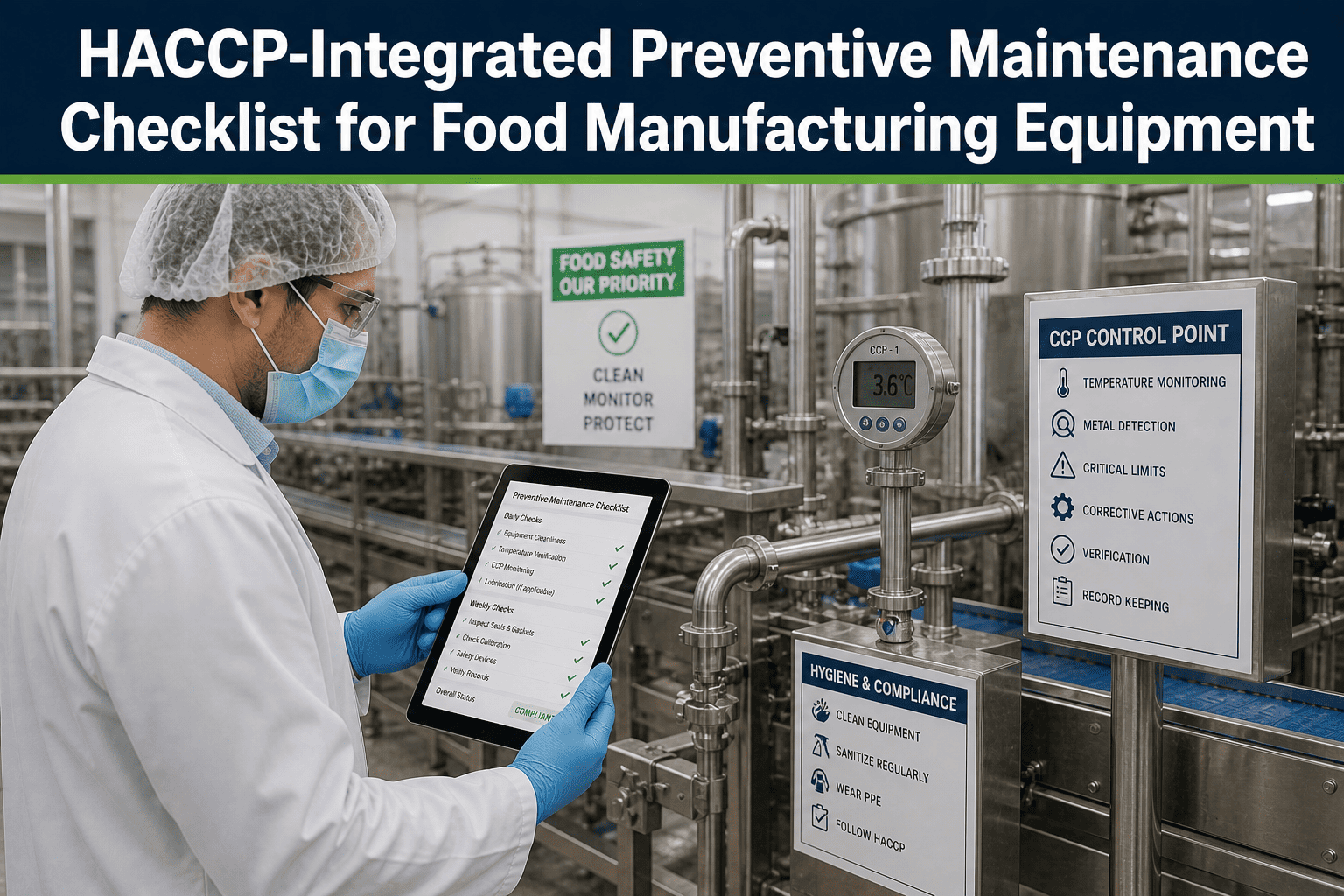
PM in food manufacturing is not optional — it is a regulatory requirement. FSMA's Preventive Controls rule explicitly lists equipment maintenance as a preventive control that must be documented, monitored, and verified.
SQF, BRC, FSSC 22000, and IFS Food all require a documented PM program as a condition of certification. Auditors check PM schedules, work order records, and calibration logs. No documentation = compliance liability, no matter how well the physical work is done. Book a demo to see how automated PM documentation keeps your facility audit-ready at all times.
Requires documented equipment maintenance as a preventive control with defined monitoring procedures, corrective actions, and verification activities for food contact equipment and CCPs.
Equipment performance at critical control points must be maintained and verified through PM programs. Calibration records and maintenance logs serve as CCP monitoring documentation.
Both schemes require a documented PM program covering all food safety-relevant equipment, with completion records available for audit review and non-conformance histories maintained.
21 CFR Part 110 and Part 117 mandate that equipment be maintained in a sanitary condition and operating condition that prevents product adulteration from maintenance-related failures.
Implementation Roadmap: Deploying a Preventive Maintenance Program in Your Food Plant
Building a sustainable PM program in a food processing facility is a phased process that requires cross-functional buy-in from maintenance, production, quality, and food safety leadership. Organizations that attempt to implement PM programs as a purely technical exercise — without addressing scheduling integration and organizational ownership — consistently see compliance rates fall below 60% within six months. The following roadmap addresses both the technical and organizational dimensions of a durable PM program. Schedule a demo to see how our platform accelerates every phase of this implementation.
Asset Registry and Criticality Scoring
Document every piece of production equipment with nameplate data, manufacturer PM specifications, and a criticality score based on food safety impact, production dependency, and repair complexity. This registry is the foundation of every downstream PM decision.
PM Task Library Development
Build a task library that defines, for each asset, the specific PM activities required at each interval: inspection criteria, adjustment tolerances, lubrication specifications, calibration procedures, and accept/reject criteria. Task standardization enables consistent execution regardless of which technician performs the work.
Sanitation and Production Schedule Integration
Map PM windows to the existing sanitation and production schedule. Identify recurring opportunities — changeovers, CIP runs, shift breaks — where PM tasks can be executed without additional production impact. Build this mapping into the CMMS scheduling logic.
CMMS Configuration and Rollout
Configure your CMMS with the asset registry, task library, and PM schedules. Set up automated work order generation, mobile dispatch to technicians, parts inventory links, and completion documentation templates. Pilot on highest-criticality assets before full plant rollout.
KPI Baseline and Continuous Improvement
Establish pre-implementation baselines for PM compliance rate, mean time between failures, unplanned downtime hours, and maintenance cost per production unit. Track these monthly post-launch, using deviation analysis to refine PM intervals and task content as plant-specific failure pattern data accumulates.
Build Your Food Plant PM Program on a Platform Built for It
Connect equipment assets, PM schedules, sanitation coordination, and compliance documentation in a single maintenance operations platform designed for food manufacturing environments.
Frequently Asked Questions: Preventive Maintenance in Food Processing
What is preventive maintenance in food processing?
Preventive maintenance in food processing is a structured program of scheduled inspections, adjustments, lubrications, calibrations, and component replacements performed on production equipment at defined intervals — before failures occur. Unlike reactive maintenance that responds to breakdowns, PM programs reduce unplanned downtime, protect food safety, and extend equipment service life through systematic, calendar- or condition-driven maintenance activities.
How often should food processing equipment be maintained?
PM frequency for food processing equipment depends on equipment criticality, production intensity, regulatory requirements, and manufacturer specifications. High-criticality assets at HACCP critical control points — pasteurizers, metal detectors, filling systems — typically require daily or shift-level inspection plus weekly and monthly PM intervals. Secondary equipment may be maintained monthly or quarterly. Intervals should be validated against actual failure history data and adjusted as operational experience accumulates.
How do you coordinate PM scheduling with food plant sanitation?
The most effective approach is to schedule PM tasks in alignment with existing sanitation windows — immediately before, during, or after scheduled CIP and SSOP cleanings. This maximizes equipment access without adding production downtime. A shared maintenance-sanitation calendar, managed through a CMMS, provides the visibility both teams need to prevent conflicts and coordinate access efficiently.
What documentation is required for food equipment PM compliance?
Food safety regulations and certification schemes require PM programs to maintain work order completion records, calibration logs for measurement and monitoring equipment, corrective action records for PM findings, and a master PM schedule showing planned vs. completed activities. Under FSMA Preventive Controls and schemes like SQF and BRC, these records must be readily available for regulatory and third-party audit review.
How does a CMMS improve preventive maintenance in food manufacturing?
A CMMS automates PM schedule generation, work order dispatch, parts management, and documentation — removing the manual coordination burden that causes most food plant PM programs to fall behind compliance targets. For food manufacturers specifically, a CMMS with food safety functionality generates audit-ready documentation automatically, integrates with sanitation scheduling, and tracks PM compliance rates that are required for regulatory and certification audits.