A single skipped step in an allergen changeover — one bolt left off a disassembly checklist, one swab point never re-tested — is the difference between a routine production run and a Class I recall that shuts a line down for weeks. Undeclared allergens remain one of the leading causes of food recalls worldwide, and most of those failures trace back not to a cleaning method that failed, but to a verification system that let production restart before every required check was actually closed out. Regulators under FDA FSMA, BRCGS, and SQFI now expect allergen changeover records — teardown documentation, swab results, photo evidence, and QA sign-off — to be generated in real time and kept retrievable for the shelf life of the product, sometimes up to two years. Paper checklists and shared spreadsheets make that retention nearly impossible to guarantee, because a missing signature or a lost swab report at audit time reads exactly the same as a changeover that was never verified at all. Plants that want that record locked down before the next allergen-to-allergen transition can start a free trial on a single line first.
Allergen Changeover Guide
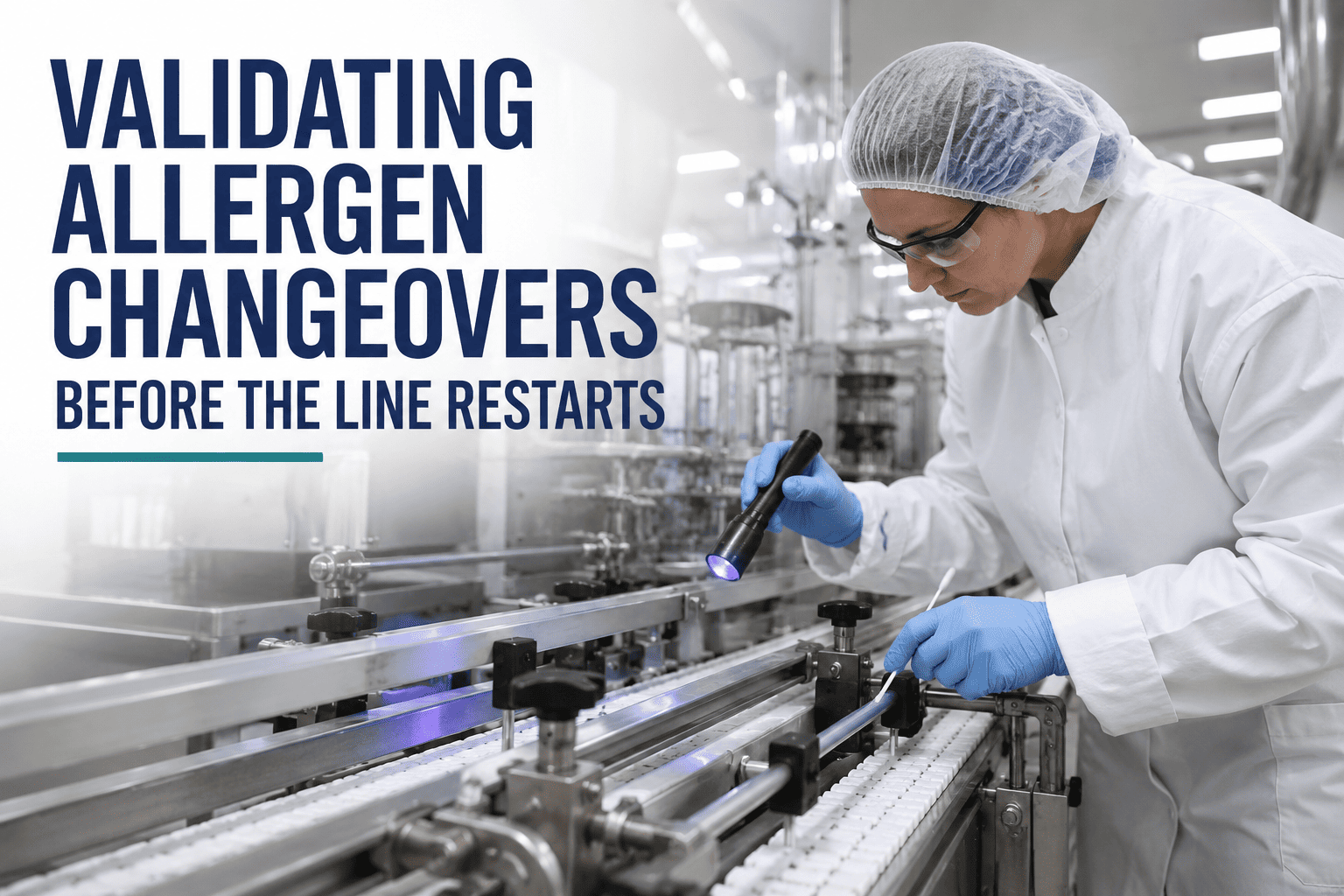
Validating Allergen Changeovers Before the Line Restarts
Non-skippable digital teardown checklists, dedicated belt and hose swap verification, and photo-documented sign-off — built so a changeover can't be marked complete until it actually is.
34-Point
Typical teardown-to-release checklist spanning disassembly, cleaning, swabbing, and reassembly
2 Years
Allergen changeover records must stay retrievable for the shelf life of the product
Big 9
Major labeled allergens that drive most changeover risk and sequencing decisions
5-10 Min
Lateral flow swab result time used to gate line release ahead of lab ELISA confirmation
The Allergen Changeover Chain: From Teardown to Release
An allergen changeover is not one cleaning task — it is a chain of dependent steps, and the chain is only as strong as its weakest sign-off. It starts with an authorized work order that names the outgoing and incoming allergens, moves through equipment disassembly and inspection, cleaning execution with tracked chemical concentration and contact time, a visual and ATP screen, an allergen-specific swab using lateral flow or ELISA, and finally reassembly with a first-run product check before the line is released back to production.
Skip the order, or let one step get a rubber-stamp sign-off instead of a real verification, and the whole chain fails silently — the line looks clean and runs anyway. Teams that want that chain enforced step by step, with no way to jump ahead, can book a demo on their own line layout.
A changeover signed off without a re-swab isn't verified — it's a guess with a signature on it.
Six Stages Every Allergen Changeover Has to Clear
Each stage below has its own failure mode. Miss one and the record — not just the equipment — is what fails the audit.
Stage 1
Pre-Changeover Authorization
Work order names the outgoing and incoming allergen, the line, and the recipe before any teardown starts.
Stage 2
Disassembly & Inspection
Product-contact parts, dedicated belts, and hoses come off and get inspected before cleaning begins.
Stage 3
Cleaning Execution
Chemical concentration, contact time, and manual scrub steps are logged against the validated SOP.
Stage 4
Visual & ATP Screening
Surfaces are visually cleared, then ATP swabs confirm general residue is below the site action limit.
Stage 5
Allergen Swab Testing
Lateral flow or ELISA swabs at pre-mapped critical points confirm the specific allergen is below limit.
Stage 6
Reassembly & Release
First-run product is checked, QA signs release, and the line restarts on a documented, gated record.
Where Allergen Changeovers Actually Break Down
The cleaning protocol is rarely the root cause. The verification and documentation system around it usually is — and these four gaps show up across plants of every size.
Non-Skippable Steps Get Skipped Anyway
A paper checklist can be signed top to bottom without every box being physically true, especially under changeover time pressure between two scheduled runs.
Dedicated Belts and Hoses Get Cross-Used
Belts and hoses assigned to one allergen profile get grabbed from the wrong rack when the labeled one isn't within reach on the floor.
Swab Points Drift From the Validated Plan
Sampling locations change with the operator instead of staying fixed to the mapped critical points, which breaks trend analysis across changeovers.
Photo Evidence Is Missing at Audit Time
A visual clearance step without a timestamped photo is a claim, not evidence, and auditors treat the two very differently.
Repeat swab failures at the same point are not bad luck — they are a cleaning protocol that was never actually validated for that allergen pair.
How OxMaint Locks Down the Allergen Changeover Record
OxMaint builds the changeover as a gated digital workflow on the line asset, so the next stage cannot open until the current one is checked, swabbed, and signed.
01
Non-Skippable Digital Teardown
Each checklist step must be marked complete in sequence before the next unlocks, so the record can't outrun the actual work.
02
Dedicated Belt & Hose Verification
Belts and hoses are scanned and matched against the allergen profile assigned to them before reassembly is allowed to proceed.
03
Photo Documentation at Every Checkpoint
Visual clearance steps require an attached photo timestamped to the checklist item, closing the evidence gap auditors flag most.
04
ATP and Allergen Swab Gate
Line release stays locked until ATP and allergen-specific swab results are logged and within the site-validated limit.
05
Allergen Matrix & Sequencing
Products are mapped to allergen profiles so runs are sequenced to reduce high-to-low allergen transitions before they're even scheduled.
06
Two-Year Retrievable Records
Every checklist, swab result, and sign-off stays attached to the line asset and pulls up instantly for the full retention window.
Plants ready to replace a paper changeover binder with a gated digital record can start a free trial on one line and compare the next audit pull side by side.
Paper Changeover Logs vs OxMaint-Gated Records
The gap is not effort — plants running paper logs work hard at this. The gap is recoverability the moment an auditor or investigator asks for the record.
| Changeover Dimension |
Paper / Spreadsheet Log |
OxMaint Gated Workflow |
Audit Impact |
| Teardown checklist completion |
Can be signed without verifying every step |
Locked sequence, no step can be bypassed |
Skipped steps eliminated |
| Belt and hose assignment |
Relies on operator memory and labeling |
Scanned match against allergen profile |
Cross-use prevented |
| Visual clearance evidence |
Written note, no photo attached |
Timestamped photo on the checklist item |
Evidence gap closed |
| Swab sampling locations |
Drifts with the operator on shift |
Fixed to the mapped validation points |
Trend analysis possible |
| Line release authorization |
Production supervisor can override |
Locked until swab results are logged in limit |
No premature restart |
| Record retrieval at audit |
Filed across binders, sometimes lost |
Pulled by line and date in minutes |
Two-year retention held |
Every row resolves the same way: the step still has to happen, but the system no longer lets it be marked done without proof, which is the posture teams install when they book a demo against their own allergen matrix.
Outcomes Plants Report After Gating the Changeover Record
Results vary by product mix and line count, but the shape of the improvement is consistent across mid-size and large food manufacturing sites.
100%
Checklist completion proof
Every step carries a timestamp and, where required, a photo — no more signed-but-unverified changeovers.
Under 1 Day
Audit pull turnaround
Down from digging through binders, since every record lives on the line asset by date.
0
Missing swab records
Results log directly to the checklist item, so a completed changeover can't exist without them.
Frequently Asked Questions
What is the difference between ATP and allergen-specific swabbing
ATP swabs detect general organic residue fast, but they can't confirm which protein is present. Allergen-specific lateral flow or ELISA swabs confirm the actual allergen is below the validated limit, which is why release should require both.
How long do allergen changeover records need to be kept
Most food safety programs expect records retrievable for the shelf life of the product, which can run up to two years. Teams centralizing that record can
start a free trial to see retention handled automatically.
What happens if an allergen swab fails after cleaning
Production should not be authorized. The failure gets escalated to quality, the cleaning protocol is reviewed for that allergen pair, and the location is retested after corrective action before release proceeds.
Why do swab locations need to stay fixed between changeovers
Consistent sampling points are what make trend analysis possible. If locations shift with the operator, a repeat failure at a critical surface can go unnoticed instead of triggering a protocol review.
Can a changeover workflow like this be reviewed before rollout
Yes. Teams can
book a demo against their own line layout and allergen matrix before deciding how many lines to gate first.
Stop Signing Off Changeovers You Can't Actually Prove
Turn every teardown, swab, and reassembly step into a gated, photo-backed, two-year-retrievable record on one platform.
Non-skippable digital checklists
Photo-documented sign-off
Swab-gated line release
Dedicated belt and hose match verification
ATP and allergen swab results on record
Audit pulls by line and date in minutes