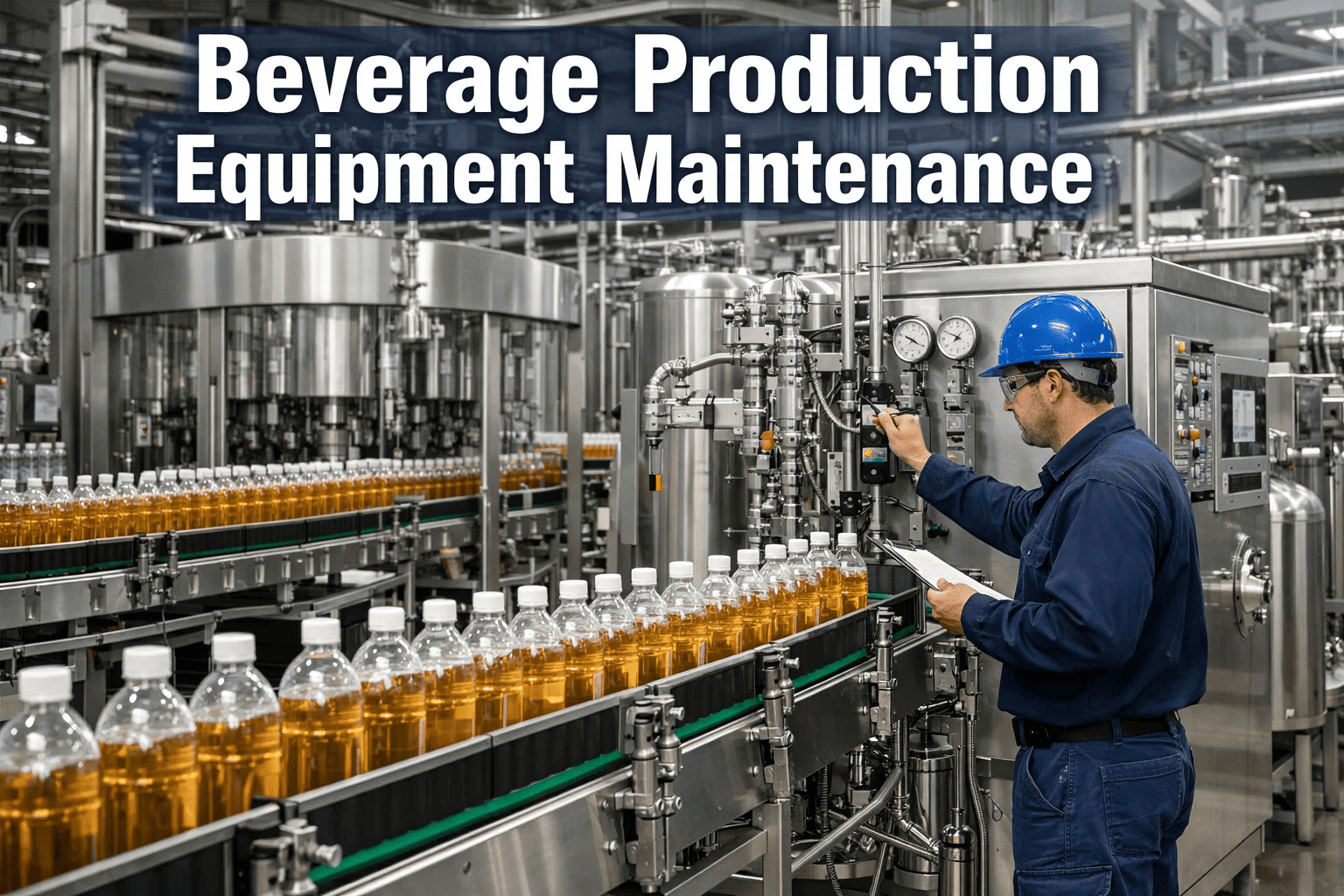
Beverage production facilities operate some of the most mechanically demanding environments in the food and manufacturing sector. From high-speed filling lines running thousands of containers per hour to precision carbonation systems maintaining exact CO₂ ratios, every piece of equipment must perform flawlessly — shift after shift, day after day. A single unplanned stoppage on a bottling line doesn't just mean lost output; it means spoiled batches, missed delivery windows, and compliance exposure that can cost far more than the downtime itself. Structured beverage production equipment maintenance is not a cost center — it is a core production strategy.
Take control of your beverage plant's maintenance operations with software built for production line reliability.
OxMaint helps beverage facilities automate PM scheduling, track CIP compliance, and eliminate unplanned downtime across every line.
Why Beverage Equipment Maintenance Demands a Dedicated Strategy
The beverage production environment is uniquely punishing on mechanical systems. Equipment runs continuously in humid, high-temperature, and chemically active conditions — cleaning agents, carbonated liquids, sugar solutions, and acidic flavors all accelerate wear on seals, valves, sensors, and mechanical components. Unlike discrete manufacturing, beverage lines are designed for continuous throughput, which means maintenance windows are narrow, changeovers are complex, and the cost of misjudged wear is immediate and visible.
What differentiates high-performing beverage plants from consistently underperforming ones is rarely capital investment — it is maintenance discipline. Facilities that implement structured preventive maintenance programs for their filling machines, carbonation systems, pasteurizers, cappers, and labelers achieve measurably higher OEE scores, longer asset useful lives, and more consistent product quality than those relying on reactive repair. The challenge is building a maintenance program sophisticated enough to manage the sheer diversity of equipment types, regulatory requirements, and CIP protocols that define beverage production. Explore OxMaint to see how purpose-built maintenance software addresses exactly this challenge.
Filling Machine Maintenance: Precision Under Pressure
The filling machine is the operational heart of any bottling or canning line. Whether the plant runs isobaric pressure fillers for carbonated beverages, gravity fillers for still water and juice, or hot-fill systems for shelf-stable products, the maintenance requirements are intensive and unforgiving. Fill head valves, flow meters, level sensors, and sealing surfaces must all operate within tight tolerances — drift in any one component translates directly into overfills, underfills, or contamination events that trigger quality holds and regulatory review.
Inspect and replace elastomer seals, O-rings, and valve seats on a defined interval schedule. Worn seals are the leading cause of product leakage and microbial ingress in filling systems.
Verify electromagnetic and Coriolis flow meter accuracy against certified reference standards at each maintenance interval to ensure fill volume compliance.
Inspect filler bowl surfaces, float mechanisms, and level sensors for buildup, corrosion, and dimensional wear that compromise fill consistency and sanitary compliance.
Check container-handling components including starwheels, infeed screws, and timing belts for wear and alignment; misalignment causes container jams and high-speed line damage.
Inspect all product-contact surfaces for pitting, crevices, and surface roughness that can harbor biofilm and compromise CIP effectiveness during scheduled sanitation cycles.
Monitor servo motor performance, encoder feedback, and drive system torque parameters; trending deviation from baseline indicates bearing or mechanical wear requiring intervention.
Carbonation System Maintenance: Where Chemistry Meets Mechanics
Carbonation systems — whether inline venturi injectors, static mixers, or pressurized saturation vessels — introduce CO₂ into the product stream at precise ratios that define the finished beverage's taste profile and shelf stability. The maintenance complexity of carbonation equipment goes beyond mechanical wear: it involves the interaction of pressure, temperature, CO₂ chemistry, and product composition in ways that create unique failure modes not found in other process equipment categories.
Carbonation ratio drift is one of the most commercially damaging quality issues in carbonated beverage production. It is rarely caused by a single failure event — more often it is the cumulative result of deferred maintenance across multiple system components. CO₂ flow control valves that have not been recalibrated, chiller systems operating above specified temperature ranges, carbonation vessels with worn pressure relief assemblies, and inline sensors with calibration drift all contribute incrementally to carbonation inconsistency that may go undetected until consumer complaints or QA rejections surface the problem.
Critical Carbonation System Maintenance Points
Calibrate and inspect CO₂ flow control valves at scheduled intervals; verify actuator response, seat integrity, and flow coefficient against original equipment specifications
Maintain product chilling systems at specified temperature setpoints; inspect refrigerant levels, compressor performance, heat exchanger surfaces, and temperature sensor accuracy
Conduct statutory pressure vessel inspections per applicable regulations; inspect safety relief valves, pressure gauges, vessel walls, and nozzle integrity on the defined certification schedule
Calibrate inline carbonation measurement sensors against certified reference standards; sensor drift of even 0.1 vol/vol can produce product outside specification before trend alarms trigger
Inspect and service deaerator vacuum systems, spray nozzles, and vacuum pump assemblies; oxygen ingress from poorly maintained deaerators accelerates product degradation and carbonation loss
Bottling Line Maintenance: Capping, Labeling, and Packaging Systems
Beyond filling and carbonation, a complete bottling or canning line comprises a dense chain of interdependent subsystems — each with its own maintenance requirements, wear patterns, and failure modes. Capping machines, labeling equipment, pasteurizers, date coders, and end-of-line packaging systems must all perform reliably for the line to achieve its rated throughput. A single underperforming subsystem creates a bottleneck that cascades backward through the entire production sequence.
Capping Machine Maintenance
Capping equipment — whether rotary cappers, chuck cappers, or roll-on pilfer-proof systems — applies closure torque that directly affects product seal integrity and consumer safety. Under-torqued closures leak and allow oxygen ingress; over-torqued closures crack or cause consumer difficulty and generate customer complaints. Maintaining capping machine performance requires regular torque head inspection and calibration, chuck replacement on wear-based intervals, cam and chuck tooling inspection for wear grooves, and magnetic clutch calibration for torque-controlled systems. Torque verification should be performed at every shift start and logged for quality traceability.
Labeling Machine Maintenance
High-speed labeling equipment runs at rates that make even small misalignments operationally significant. A labeling machine applying 60,000 labels per hour with a 0.5% misapplication rate generates 300 non-conforming packages per hour — enough to trigger a quality hold and rework event that erases several hours of production efficiency. Effective labeling machine maintenance encompasses vacuum drum and belt inspection, glue system temperature and viscosity management, label feed tension calibration, applicator roller and wipe-down assembly inspection, and vision system verification for placement accuracy monitoring.
Tunnel Pasteurizer Maintenance
For facilities producing beer, juice, and other products requiring in-package pasteurization, the tunnel pasteurizer is a critical compliance and quality asset. Pasteurizer maintenance must ensure that product achieves the specified pasteurization unit (PU) accumulation across every zone of the tunnel — a requirement that demands consistent spray header performance, accurate temperature measurement across all zones, and verified conveyor speed. Deferred maintenance on pasteurizer spray nozzles is a particularly common source of PU shortfall: blocked or worn nozzles create cold spots in the product zone that allow under-pasteurized product to reach the market. Nozzle inspection and replacement schedules must be strictly enforced and documented.
Bottling Line Equipment: Maintenance Intervals and Key Parameters
| Equipment | Primary Failure Mode | Key PM Interval | Critical Parameter |
|---|---|---|---|
| Filling Machine | Seal and O-ring wear | Weekly inspection / quarterly overhaul | Fill volume accuracy ±1% |
| Carbonation System | Sensor drift, valve wear | Monthly calibration | CO₂ vol/vol ±0.1 |
| Capping Machine | Chuck and cam wear | Shift torque check / weekly inspection | Closure torque within spec range |
| Tunnel Pasteurizer | Nozzle blockage, sensor drift | Weekly nozzle check / monthly calibration | PU accumulation per zone |
| Labeling Machine | Glue system and roller wear | Daily inspection / monthly overhaul | Label placement accuracy |
| Deaerator | Vacuum pump wear, nozzle wear | Monthly inspection | Dissolved oxygen ≤0.1 ppm |
| Conveyors and Transfers | Belt and guide wear | Weekly lubrication / monthly inspection | Belt tension and guide alignment |
CIP System Maintenance: Sanitation as a Maintenance Discipline
Clean-In-Place (CIP) systems are among the most maintenance-intensive assets in a beverage plant — and among the most consequential when they underperform. A CIP system that delivers sub-specification chemical concentrations, inadequate temperature, or insufficient flow velocity does not clean effectively, and the consequences range from microbial contamination events to product taste defects and regulatory action. Yet CIP systems are frequently treated as utilities rather than production assets, receiving less structured maintenance attention than the filling and packaging equipment they support.
Effective CIP system maintenance addresses the full system — not just the supply skid. CIP supply pump performance must be verified against flow and pressure specifications. Chemical dosing systems require calibration to ensure concentration accuracy across the full range of cleaning cycles. Spray devices, return piping, and heat exchanger surfaces must be inspected for scale buildup and fouling that reduces both cleaning effectiveness and thermal efficiency. Conductivity and temperature sensors require calibration on a defined schedule, since CIP control systems rely on these readings to verify cycle completion. Documenting CIP cycle performance — including conductivity profiles, temperature logs, and cycle timing — creates the traceability record required by FSMA, BRC, and SQF food safety standards. Talk to our experts to learn how OxMaint structures CIP compliance documentation for audit-ready beverage facilities.
Preventive Maintenance Scheduling for Beverage Production Lines
The complexity of managing maintenance across a full beverage production line — with dozens of equipment types, multiple shift patterns, narrow maintenance windows, and interdependent sanitation cycles — makes manual scheduling systems structurally inadequate. Spreadsheet-based PM programs consistently fail to account for condition-based maintenance triggers, equipment utilization variability, and the compounding effect of deferred maintenance across interdependent line components. A dedicated beverage plant maintenance software platform transforms PM scheduling from a reactive administrative task into an intelligent, risk-stratified program.
Modern CMMS platforms built for process manufacturing enable beverage plants to structure preventive maintenance programs around multiple scheduling triggers simultaneously. Calendar-based intervals drive compliance-required inspections and statutory certifications. Runtime-based triggers schedule high-wear component replacement based on actual production hours rather than elapsed time — a critical distinction for plants running variable production volumes across different SKUs. Condition-based triggers, enabled by integration with process control systems and IoT sensors, allow maintenance teams to act on real equipment condition data rather than conservative fixed intervals. The result is a PM program that is both more responsive and more cost-efficient than either pure calendar-based or purely reactive approaches.
Build a complete digital asset register covering every piece of production, utility, and sanitation equipment with manufacturer specs, criticality ratings, and regulatory classifications
Develop standardized PM task templates for each equipment category including required tools, consumable parts, safety procedures, and completion documentation requirements
Configure PM schedules with calendar, runtime, and condition-based triggers appropriate to each asset's wear patterns, regulatory requirements, and operational criticality
Equip maintenance technicians with mobile work orders that include task checklists, equipment history, parts information, and digital documentation capture at the point of work
Generate food safety audit documentation, PM completion records, and corrective action histories automatically from completed work order data for FSMA, BRC, SQF, and customer audits
Monitor OEE, MTBF, PM compliance rates, and reactive-to-preventive maintenance ratios across all line equipment to drive continuous improvement in maintenance program performance
Spare Parts Management for Beverage Production Lines
High-speed beverage production lines are highly intolerant of parts shortages. A single unavailable seal kit or replacement fill head valve can extend a line stoppage from a two-hour planned maintenance event into a day-long production loss while parts are expedited from distributors at premium cost. Effective spare parts management is an integral component of beverage plant maintenance strategy — not a separate logistics function. The parts inventory must be aligned with the maintenance program: PM task templates should specify required consumables, and the inventory management system should be configured to trigger replenishment when critical spares fall below minimum stock levels.
Beverage plants should stratify their spare parts inventory by criticality classification. Critical spares — components whose absence would cause an unplanned line stoppage and cannot be sourced same-day — should be maintained in stock with clearly defined minimum quantities based on consumption rates and supplier lead times. High-wear consumables including seals, O-rings, gaskets, and filter elements should be managed on automatic replenishment schedules linked to PM task completion. Long-lead capital components such as servo drives, specialized pump assemblies, and custom machine tooling require strategic stocking decisions based on equipment age, failure history, and procurement lead time analysis. Explore OxMaint's spare parts management to see how inventory control integrates directly with your PM program.
Predictive Maintenance and Digital Transformation in Beverage Plants
The most advanced beverage production facilities are moving beyond preventive maintenance programs into condition-based and predictive maintenance models enabled by IoT sensors, process data integration, and machine learning analytics. Vibration sensors on high-speed filling machine drives, temperature monitoring on motor windings, pressure trending on CIP supply systems, and inline quality sensors on carbonation equipment all generate continuous streams of condition data that, properly analyzed, can predict component failures days or weeks before they occur.
The return on investment case for predictive maintenance in beverage production is compelling. A bearing failure on a high-speed labeling machine that develops over two weeks of increasing vibration signature — detected and resolved during a planned maintenance window — costs a fraction of the same failure occurring during production, including the cost of machine damage, product loss, and line downtime. As sensor costs continue to fall and cloud-connected CMMS beverage industry platforms develop more accessible predictive analytics modules, the threshold for economically viable predictive maintenance implementation is dropping rapidly for mid-size beverage plants. Schedule a demo to see how OxMaint's predictive maintenance capabilities are built for beverage production environments.
Structured PM programs targeting filling, carbonation, and packaging equipment consistently deliver measurable OEE gains by reducing unplanned downtime and improving first-pass quality rates
Digital maintenance documentation systems generate the calibration records, PM completion logs, and corrective action evidence required for FSMA, BRC, SQF, and customer audit compliance
Beverage plants transitioning from reactive to preventive maintenance programs report significant reductions in emergency repair costs, parts expediting fees, and overtime maintenance labor
Consistently maintained filling and packaging equipment achieves design service life and beyond; deferred maintenance programs accelerate mechanical degradation and trigger premature capital replacement
Ready to build a world-class maintenance program for your beverage production line?
OxMaint delivers automated PM scheduling, CIP compliance tracking, and mobile work order management purpose-built for beverage and food processing facilities.
Frequently Asked Questions
What are the most critical maintenance tasks for a carbonated beverage filling line?
The highest-priority maintenance tasks for carbonated beverage filling lines include fill valve seal replacement on defined wear intervals, CO₂ flow control valve calibration, filler bowl level sensor verification, capper torque head inspection, and inline carbonation sensor calibration. Collectively these tasks govern fill accuracy, carbonation consistency, and closure integrity — the three parameters most directly linked to product quality and consumer safety compliance.
How often should CIP systems be maintained in a beverage plant?
CIP system maintenance should follow a tiered schedule: daily inspection of chemical dosing performance and conductivity sensor readings, weekly inspection of spray devices and return piping, monthly calibration of temperature and conductivity sensors, and quarterly inspection of pump performance, heat exchanger surfaces, and chemical tank integrity. CIP cycle performance data should be trended continuously to detect drift before it produces a non-conforming cleaning event.
What causes carbonation ratio inconsistency in high-speed beverage lines?
Carbonation ratio inconsistency is typically a multi-cause problem. The most common contributing factors are CO₂ flow control valve wear or miscalibration, product temperature variation caused by chiller system issues, deaerator performance degradation allowing oxygen ingress, inline sensor calibration drift, and product tank level fluctuations that affect carbonation contact time. Diagnosing carbonation drift requires systematic inspection and calibration of each system component rather than replacement of the most accessible part.
How does beverage plant maintenance software improve food safety audit performance?
Purpose-built beverage maintenance software automatically generates the calibration records, PM completion documentation, corrective action logs, and equipment history reports that food safety auditors require. Rather than assembling audit evidence from paper records and spreadsheets in the days before an audit, facilities with digital CMMS platforms can produce complete, timestamped maintenance documentation on demand — dramatically reducing audit preparation time and virtually eliminating the risk of documentation gaps that produce audit findings.
What is the ROI of implementing a preventive maintenance program on a bottling line?
The return on investment from preventive maintenance programs on bottling and filling lines is well-documented across the beverage industry. Reactive repair costs for high-speed production equipment typically run three to five times higher than planned maintenance costs for the same work. Beyond direct repair cost, unplanned downtime events generate product loss, overtime labor, expedited parts costs, and potentially batch rejection costs that dwarf the investment in structured PM. Facilities that achieve PM compliance rates above 90% consistently report significant improvements in overall equipment effectiveness, reduced emergency maintenance spend, and more predictable capital planning cycles.