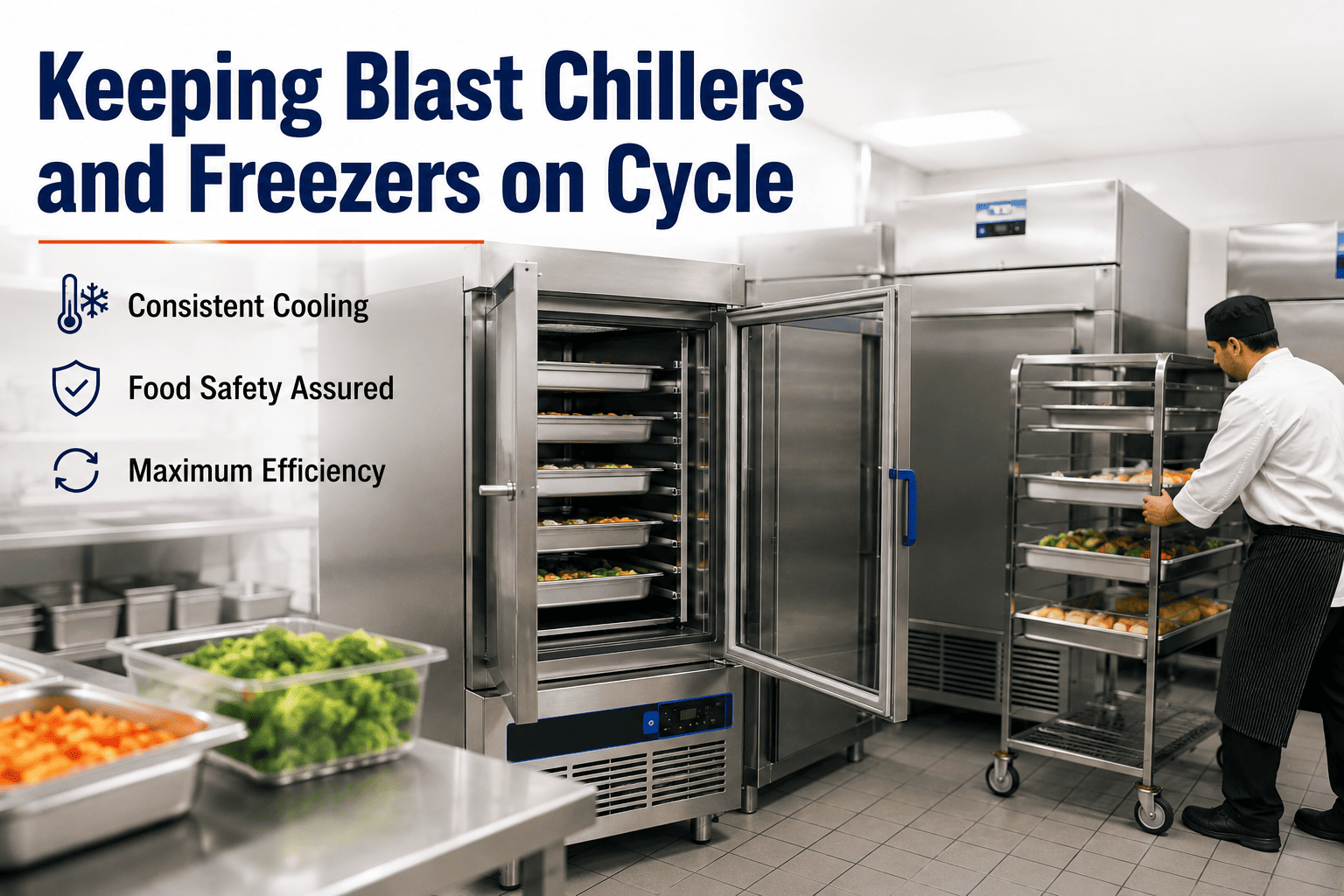
Blast chillers and freezers carry the heaviest thermal duty in any food plant — pulling product core temperature from 70°C down to 3°C in under 90 minutes is non-negotiable for HACCP compliance, and even a single missed cycle can compromise an entire batch. The reliability of these units hinges on disciplined preventive maintenance: compressor health, evaporator coil integrity, refrigerant charge stability, defrost timing, and the CMMS-driven scheduling that keeps every asset on cycle. This guide breaks down the PM practices that protect product safety and throughput, with a focus on building a CMMS-backed reliability program you can Start Free Trial today.
BLAST CHILLER & FREEZER RELIABILITY GUIDE 2026
Can your blast chiller survive 1,800 pull-down cycles this year without drift?
A single defrost fault can extend a cooling cycle by 35 minutes, pushing product past the 4°C danger zone and stalling the next production batch. CMMS-driven PM scheduling keeps compressors, evaporators, and defrost cycles verified — every shift, every quarter.
CRITICAL PATH
The real cost of a missed blast chill cycle
When a blast chiller drifts off cycle, the financial and safety impact compounds across the entire production line — not just the asset itself.
WORKED EXAMPLE — MIDWEST PROTEIN PLANT
A 180-asset protein processing facility running four blast chillers on a continuous 2-shift schedule was losing roughly $42,000 annually to unplanned cycle extensions and two condemned batches per quarter. After implementing CMMS-scheduled compressor oil analysis, evaporator coil inspections, and defrost timer verification on 30/60/90-day intervals, the plant reduced off-cycle events by 71% in the first six months — recovering over $30,000 in prevented product loss and cutting emergency refrigerant top-ups by 80%.
PREVENTIVE MAINTENANCE BREAKDOWN
Five PM pillars that keep blast chillers on cycle
Each pillar maps to a specific failure mode that derails thermal cycles — together they form the backbone of a defensible reliability program.
Compressor PM
Oil sampling every 90 days catches bearing wear before it escalates. Monitor superheat and discharge temperature weekly — a 10°C rise in discharge temp signals valve or charge issues. Replace contactors and check motor amperage draw on a 6-month cycle.
Evaporator Service
Frost accumulation reduces heat-transfer efficiency by up to 40%. Inspect coil fins, fan blades, and defrost heaters weekly. Verify drain pan flow — a blocked drain causes ice bridging that extends cycle time by 25–40 minutes.
Refrigerant Management
A 15% refrigerant charge loss can extend pull-down time by 50% and trigger compressor overheating. Log suction and discharge pressures every shift. Use leak detection quarterly — infrared sniffers catch leaks refrigerant-costing $2K–$6K annually per unit.
Defrost Optimization
Defrost cycles that run 2 minutes too long waste energy; cycles that end 2 minutes too short leave ice on coils. Verify termination thermostat accuracy quarterly and log defrost duration trends in the CMMS to detect heater degradation early.
CMMS Scheduling
A CMMS automates work-order generation, tracks cycle-time trends, and flags assets drifting from baseline. Without one, PM compliance typically sits at 55–60%; with structured CMMS scheduling, plants consistently hit 92%+ PM adherence.
Cycle Verification & Logging
Verify each blast cycle against HACCP time-temperature targets using data-logger probes. Log core temp pull-down curves in the CMMS — this creates the audit trail regulators and QA teams require, and surfaces cycle drift before it becomes a safety event.
DEFROST CYCLE TIMING
The formula for optimal defrost interval
Defrost timing is the single most adjusted parameter on a blast chiller — getting it wrong costs energy, cycle time, and product integrity simultaneously.
Frost Accumulation Rate
Measured in grams per hour per m² of coil surface. High-humidity environments and frequent door openings accelerate accumulation. Baseline: 80–150 g/h·m².
Defrost Duration
Electric defrost: 20–40 minutes. Hot-gas defrost: 15–25 minutes. Over-running by even 5 minutes per cycle wastes 3–5% of total unit energy consumption.
Termination Setpoint
Defrost should terminate when coil temp reaches 10–15°C. A faulty termination thermostat is the #1 cause of energy waste — verify accuracy every 90 days.
PM SCHEDULE TIMELINE
CMMS-driven maintenance calendar for blast chillers
A structured cadence ensures no PM task slips — and gives auditors a defensible maintenance history for every asset.
Shift-level checks
Log suction/discharge pressures, verify cycle completion time against HACCP target, visually inspect evaporator for frost buildup, confirm drain pan flow, record product core temp at cycle end.
Coil and fan inspection
Inspect evaporator coil fins for damage, verify fan blade rotation and motor amperage, clean condenser coils, check door seal integrity, review CMMS cycle-time trend report for drift.
Defrost system verification
Test defrost heater continuity, verify termination thermostat accuracy, inspect defrost drain line for blockages, calibrate temperature probes against NIST-traceable reference, generate monthly PM compliance report.
Refrigerant and oil analysis
Perform refrigerant leak detection sweep, pull compressor oil sample for lab analysis, check superheat and subcooling against manufacturer specs, inspect electrical connections for thermal damage, verify expansion valve operation.
Deep service and recertification
Replace contactors and capacitors, perform full refrigerant charge recovery and recharge to spec, inspect compressor valves, replace door gaskets, recalibrate all instrumentation, update CMMS asset criticality ranking.
TAKE ACTION
Stop guessing at blast chiller cycle reliability
Deploy a CMMS that auto-generates PM work orders, tracks cycle-time trends, and gives you the audit trail HACCP and FDA inspectors expect.
CYCLE PERFORMANCE BENCHMARKS
Blast chiller vs. blast freezer — PM comparison
The two assets share refrigeration fundamentals but diverge sharply in thermal duty, cycle length, and PM intensity. Treating them identically is a common reliability mistake.
| Parameter | Blast Chiller | Blast Freezer | PM Implication |
|---|---|---|---|
| Target core temp | 3°C (chill) | -18°C (freeze) | Freezer probes need lower-range calibration |
| Typical cycle time | 90 min | 240 min | Freezer PM window is tighter per batch |
| Evaporator temp | -5°C to -10°C | -30°C to -40°C | Freezer coils frost faster — more defrost cycles |
| Defrost frequency | Every 6–8 hours | Every 4–6 hours | Freezer defrost heaters under higher stress |
| Compressor duty | High (continuous) | Very high (sustained low-temp) | Freezer oil changes 2× more frequent |
| Refrigerant charge loss tolerance | 10% before cycle drift | 8% before cycle drift | Freezer leak detection cadence tighter |
| Annual PM labor hours | ~42 hours/unit | ~68 hours/unit | Budget freezer PM at 1.6× chiller cost |
FREQUENTLY ASKED
Blast chiller and freezer maintenance — answered
How often should defrost cycle timing be verified on a blast chiller?
Defrost termination thermostat accuracy should be checked every 90 days using a calibrated reference thermometer. Defrost duration trends should be logged in the CMMS weekly — if duration increases by more than 15% from baseline, it signals heater degradation, ice bridging, or a failing termination sensor. Most blast chiller defrost faults develop slowly over 4–8 weeks, making trend-based detection far more reliable than calendar-only scheduling.
What refrigerant charge loss level triggers cycle performance drift?
For blast chillers, cycle time typically begins to extend at 10% charge loss; blast freezers are more sensitive, showing drift at around 8%. Suction pressure drops, superheat rises, and compressor discharge temperature climbs — all of which a CMMS can flag automatically if shift-level pressure logs are entered. Quarterly leak detection sweeps catch slow leaks long before they reach these thresholds. You can Start Free Trial to automate these pressure-trend alerts.
How does a CMMS specifically improve blast chiller reliability?
A CMMS auto-generates PM work orders on the correct cadence (daily, weekly, monthly, quarterly, annual), tracks cycle-time trends per asset, and creates an audit-ready maintenance history for HACCP and regulatory inspections. Plants using CMMS scheduling typically achieve 92%+ PM compliance versus 55–60% with manual scheduling, and they identify cycle drift 3–4 weeks earlier — before a batch is compromised.
What is the HACCP requirement for blast chilling core temperature pull-down?
HACCP guidelines require reducing product core temperature from 70°C to 3°C within 90 minutes for most cooked foods, and from 60°C to 5°C within 4 hours for chilled distribution. Blast freezers must reach -18°C core within 240 minutes for most protein products. Every cycle must be logged with a calibrated probe — this is where CMMS cycle verification and data-logger integration becomes essential for audit defense. To see the logging workflow, Book a Demo.
How much can a plant save by implementing CMMS-driven blast chiller PM?
A mid-size plant running 4–6 blast chillers typically saves $25,000–$45,000 annually through reduced product loss, fewer emergency refrigerant top-ups, lower energy waste from defrost over-run, and extended compressor life. The CMMS subscription cost is usually recovered within 2–3 months, and the prevented cost of a single condemned batch often exceeds a full year of software licensing.
START YOUR RELIABILITY PROGRAM
Get every blast chiller and freezer on cycle — and keep it there
Join the food processing plants using CMMS-driven PM to protect product safety, hit HACCP targets, and eliminate unplanned cycle extensions.
Free 14-day trial · No credit card